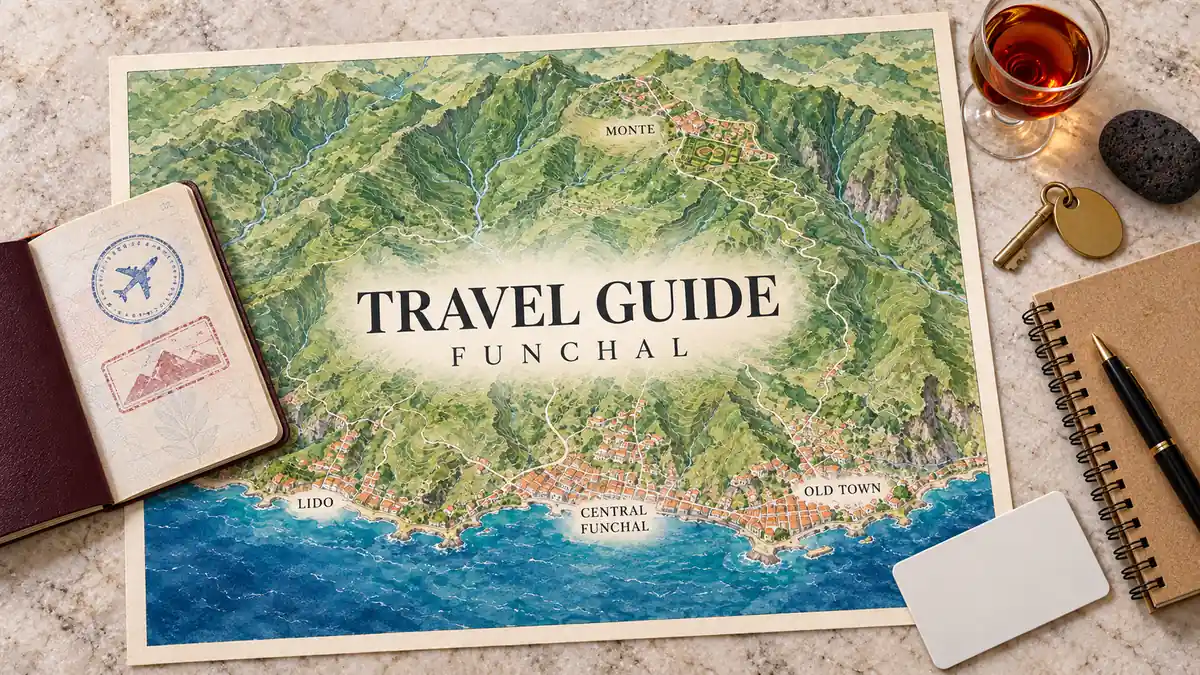
Funchal is Madeira’s capital and the default base for a first trip to the island, which is exactly why the interesting questions are practical ones: does the city fit you, how many nights does it earn, and how do the days actually work? Funchal is built into a steep amphitheatre bay — flat and easy along the seafront and through the Old Town, hard work the moment you turn uphill. That shape drives half the decisions on this page: where you sleep, whether you walk or ride, and how far a day trip really is.
This guide resolves the base verdict first, then trip length, season, stay style, getting around, what the trip costs in relative terms, and which day trips are genuinely close. Island-level questions — one base or two, car or no car, which coast — belong to the Madeira guide one level up.
Quick Answer
Funchal is worth visiting and is the right base for a first Madeira trip: Old Town, Monte, levada access. The city itself is a two- to three-night place; give it five to seven as your island base. It suits first-timers and travelers without a car; sleep on the seafront or in the Old Town.
Trust Layer
Tripstou city guide for travelers planning a city trip. Covers trip length, stay style, season, cost, and mobility tradeoffs.
Produced with AI assistance and reviewed by Alex Perrut, working in tourism since 2015, for the Tripstou editorial team. See our editorial process for details.
Last factual review: September 9, 2026.
Official sources consulted: Visit Portugal, Turismo de Portugal, Teleférico do Funchal.
Key Takeaways
- Funchal earns two to three nights as a city, but five to seven if it is your island base.
- Sleep low and travel up: seafront or Old Town beds keep every evening flat and every climb optional.
- Funchal is the strongest base for travelers without a car, since buses, tours and the cable car all start here.
- Spring buys the Flower Festival, autumn buys the warmest sea, and winter buys space everywhere except New Year’s Eve.
- Monte, Câmara de Lobos and Cabo Girão are half-days; the north coast and far west consume a whole day.
- Add a second base only when full-day drives, not the city, dominate the week you have planned.
Table of Contents
Is Funchal Worth Visiting?
Funchal is worth visiting: it is Madeira’s only real city and the best base for a first trip. A historic Old Town, a covered market, a working harbour and a mountain reachable by cable car sit inside one compact bay. The honest limit is the coastline — no sandy beach, and steep streets behind the seafront.
What Funchal is best for is variety inside a short radius. You can spend a morning among painted doors and fish stalls, ride a cable car into gardens at altitude by lunchtime, and be back on a flat promenade for sunset without ever starting a car. That density is unusual for a city of this size, and it is why Funchal absorbs bad weather better than most island bases: when the mountains are clouded in, the city still works.
Within Portugal, Funchal sits in a category of its own. The mainland stars in every shortlist of the best places in Portugal are cities and coastlines you connect by road or rail; Madeira is a separate flight and a separate trip, closer in feel to a subtropical mountain than to the Algarve. Compared with the Azores — the other half of Portugal’s island story — Madeira is warmer, drier on the south coast, and far easier without a car, because Funchal concentrates the transport, the tours and the beds in one place. For how the island fits into the country as a whole, the Portugal travel guide sets the wider frame.
Who should think twice: travelers whose holiday is defined by lying on sand, and anyone who dislikes gradients. Funchal will not fix either.
What Funchal Is Known For: Old Town, Monte and the Seafront
Funchal is known for its painted-door Old Town, the Monte cable car and toboggan, and a long seafront promenade. Mercado dos Lavradores and the Sé anchor the centre, while Santa Catarina Park and Forte de São Tiago frame the two ends of the waterfront. Everything sits inside one bay.
The Zona Velha is the eastern end of the centre, a grid of narrow lanes where Rua de Santa Maria’s painted doors turned an ordinary street into the city’s most photographed one. A few minutes west, Mercado dos Lavradores is the working produce and fish market, and the Sé — Funchal’s cathedral, with its dark cedar ceiling — sits just beyond it. The seafront runs the whole length below: Forte de São Tiago at the eastern edge, Santa Catarina Park on the rise above the marina, and the Lido promenade continuing west past the hotel strip.
Everything else that defines Funchal is uphill. Monte is the village on the slope above the city, reached by cable car, and it holds Monte Palace with its terraced gardens; the Madeira Botanical Garden occupies a separate hillside on the same side of town. Monte is also where the carreiros do Monte run the wicker toboggans — a two-kilometre descent on a sledge steered by two men in white. It is a set piece, not transport.
Food and swimming are the two things visitors most often misread. Funchal is where you meet espada with banana, poncha, bolo do caco and Madeira wine at the Blandy’s lodges in the centre, and the Portugal food guide covers what each of those actually is. For swimming, be clear-eyed: Funchal offers lidos, sea-water pools and pebble, and if soft sand is the point of your holiday, Portugal’s best beaches are on the mainland. Sight-by-sight planning, opening times and what is worth queueing for belong in the guide to things to do in Funchal.
How Many Days You Need in Funchal
Funchal itself takes two to three nights; as your Madeira base it earns five to seven. The city is compact enough to cover on foot in a couple of days, and the extra nights buy day trips to the mountains, the north coast and the west. City days and base nights are two different counts.
| Trip length | What it realistically buys | Who it fits |
|---|---|---|
| 2 nights in the city | Old Town, market, seafront and one Monte morning | Stopovers and travelers adding Madeira to a longer trip |
| 3 nights in the city | The same, unhurried, plus one nearby half-day | Anyone who wants the city without feeling rushed |
| 5 nights as island base | City days plus two or three real excursions out | First-time Madeira visitors staying in one place |
| 7+ nights as island base | Adds full-day west and north coast trips, with slack for weather | Walkers, drivers and anyone travelling in winter |
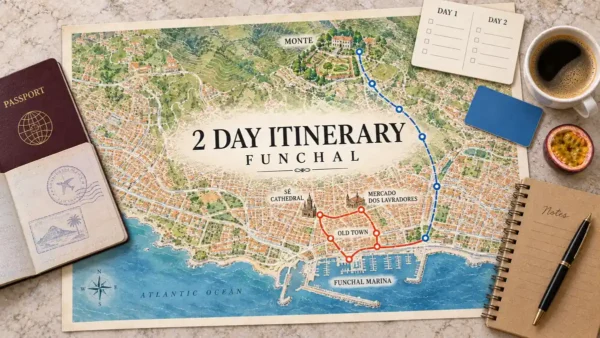
The two- and three-night tiers are city trips, and both are covered day by day in the 2-day Funchal itinerary and the 3-day Funchal itinerary. Past three nights you stop paying for Funchal and start paying for position: a bed that shortens every drive to the mountains, and a spare day to reschedule when the north coast is under cloud.
Fitting Madeira into a wider Portugal trip works differently from adding another mainland city. It is a flight, not a leg, so it sits alongside rather than inside the mainland route — see how the pieces combine in the Portugal itinerary planner, or in the ready-made 7 days in Portugal, 10 days in Portugal and 14 days in Portugal routes. On a two-week trip, Madeira is comfortable. On a week, it usually costs you the mainland.
Is Funchal the Right Base for Madeira?
Funchal is the right base for a first Madeira trip and for anyone travelling without a car. The airport road, the island bus network, the tour operators and the cable car all converge on the city. It stops being enough when your trip is built around long hikes or the north and west coasts.
How the base decision falls by traveler type:
- First-time visitors: Funchal is the safe default. Everything is bookable from one place and you never have to move hotels. The tradeoff is a longer approach to the far west on the days you go there.
- Travelers without a car: this is the strongest case of all. Buses, taxis, the cable car and every organised excursion start in the city. The tradeoff is that you travel on someone else’s timetable.
- Cruise stopovers: the port sits inside the city, so a day on foot plus a cable car ride works with no transfer at all. The tradeoff is that a stopover only ever sees Funchal, never Madeira.
- Serious hikers: Funchal works as a launch pad but not as a trailhead. Early starts to the north and the high ridges eat into the day. The tradeoff is real driving time before breakfast.
- Older travelers: a seafront base is the flattest, easiest ground on the island, and the cable car removes the worst climb. The tradeoff is that the Old Town’s lanes are cobbled and uneven.
- Families: pools, the promenade, the market and the cable car fill days without long transfers. The tradeoff is the absence of a sandy beach to fall back on.
Levadas deserve one clear sentence: Funchal is where you sleep before a levada walk, and the walks themselves are spread across the island’s interior and north, as set out in the guide to Madeira’s levada hikes. The moment two or three of those walks are the reason for your trip, the driving in and out of the city stops being a detail and starts shaping every morning.
Everything above is the city-level decision. Whether to split into two bases, whether to rent a car, and how the island’s sides differ in weather and character are island-level calls, resolved in the Madeira travel guide.
When to Visit Funchal
Spring and autumn are the best times to visit Funchal; winter is mild and quiet outside New Year’s Eve. Spring brings the Flower Festival and the gardens at their peak, while autumn brings the warmest sea and thinner streets. Summer is the busiest season, with the Atlantic Festival lighting the bay on Saturday nights.
| Season | How the city feels | What is on | Crowds and price pressure |
|---|---|---|---|
| Spring (Flower Festival) | Warm and green, gardens at their best | Flower Festival takes over the centre | Busy in festival week, moderate either side |
| Summer (Atlantic Festival) | Hot on the seafront, cooler up at Monte | Atlantic Festival fireworks on Saturday nights | Peak crowds and the highest hotel pressure |
| Autumn (shoulder season) | Warm sea, softer light, comfortable walking | Harvest and wine events around the centre | Thinner streets and easier availability |
| Winter (low season) | Mild by European standards, occasional rain | Christmas lights and New Year’s Eve fireworks | Quiet except the New Year’s Eve spike |
The trade is straightforward once you know what you are optimising for. Spring buys spectacle at the cost of crowds in the centre; autumn buys the easiest version of the same city; winter buys space, low prices and a climate most of Europe simply does not have in midwinter, with one loud exception. New Year’s Eve is the single most expensive night to sleep in the bay, and it books out far ahead of the rest of the season.
Pack for two altitudes. The seafront can be shirtsleeve weather while Monte is ten minutes away and noticeably cooler and wetter, so layers and a light waterproof earn their space in any season — the Portugal packing list covers the rest. For how Madeira’s calendar compares with the mainland’s, see the best time to visit Portugal.
Where to Stay in Funchal: Seafront, Old Town or the Hills
First-timers should stay on the seafront or in the Old Town; hill hotels trade convenience for views. The seafront and Lido strip give pools and flat walking, while Zona Velha puts the evening restaurants and bars at your door. Anything above the centre means a bus or taxi every time you go down.
- Seafront and Lido strip. Best for: travelers who want a pool, sea access and level ground all day. This is the resort side of the city, west of the centre, with the promenade running past the door and the flattest walking in Funchal. The tradeoff is distance from the Old Town’s evening life, which becomes a bus ride or a short taxi after dinner.
- Old Town and the historic centre. Best for: travelers who want to walk out to dinner and back without transport. Zona Velha, Rua de Santa Maria and the streets around the market put restaurants, bars and the cathedral within a few minutes on foot. The tradeoff is noise on the busiest lanes and smaller rooms in older buildings.
- Hill hotels above the city. Best for: travelers with a car who value the bay view over the walk. The slopes towards Monte deliver the panorama Funchal is photographed for, along with quieter nights and cooler air. The tradeoff is that every meal, every errand and every departure begins with a descent and ends with a climb.
Altitude is the Funchal booking variable most people fail to price in: a hill room that looks like good value adds a fare to every dinner and every early start, and the totals catch up faster than the nightly difference suggests. Solo travelers, and solo women in particular, tend to be happiest in the Old Town or on the near seafront, where the walk back is short, lit and busy — the guide to solo female travel safety in Portugal covers the general ground rules.
Choosing between specific streets, hotel types and price levels is a resolution deeper than this page goes. Take that to the guide on where to stay in Funchal, or, if the trip is built around the property itself, to the shortlist of luxury hotels in Funchal.
Hotels and places to stay
Compare hotels, apartments and stays for your dates in one search.
Search hotels and stays on hotels.com →
Tripstou may earn a commission if you book through this link, at no extra cost to you.
How to Get Around Funchal
Funchal is walkable along the seafront and Old Town; the hills are for buses, the cable car and taxis. The city sits in a steep amphitheatre bay, so a short distance on the map can be a long climb on foot. A rental car is unnecessary inside Funchal and awkward to park.
Think in altitude bands. Everything from Forte de São Tiago through the Old Town, the market and the cathedral to the marina and along the Lido promenade is essentially flat, and that band holds most of what visitors came for. Above it, the gradient turns serious quickly, and streets that look walkable on a map are stepped, cobbled and steep enough to change your plans by mid-afternoon.
Urban buses run by Horários do Funchal cover the climbs, and a rechargeable GIRO card keeps single rides down to a couple of euros. The Funchal–Monte cable car climbs from the seafront to Monte for €16 one-way or €22 return for an adult, and runs daily except Christmas Day. Taxis and Bolt are the third option and the one most people underuse — a short hill ride costs little and saves a great deal of effort. Basic taxi hygiene still applies, and the guide to common scams in Portugal covers what to watch for.
Plan your Funchal days downhill: ride up on the bus or the cable car, walk back down, and the city stops feeling steep. More city-level practicalities are collected in the Funchal travel tips.
Getting From Funchal Airport Into the City
Cristiano Ronaldo Madeira Airport (FNC) sits roughly 20 km east of Funchal on the coast road. Three options cover almost everyone: SIGA network buses under the CAM brand, a taxi or Bolt, and a pre-booked private transfer. Routes, stops, fares and journey times are set out in the guide to Funchal airport to city transport.
How Much a Funchal Trip Costs
Funchal is a mid-priced city, and your hotel choice decides the budget more than food or transport does. Eating and getting around cost less here than in Lisbon or Porto, while seafront hotels in peak weeks cost more. Stay altitude, tours versus buses, and where you eat move the bill most.
- Budget: a guesthouse or small hotel in the centre, eating where the market traders eat, and using urban buses for the climbs. Funchal is kind to this style because the flat band is free to walk and the food culture is genuinely inexpensive once you step off the tourist lanes.
- Mid-range: a comfortable seafront or Old Town hotel, a mix of tascas and one or two bigger dinners, buses supplemented by taxis for the hills, and two or three organised excursions. This is where most visitors land and where the city gives the best value for money.
- High-end: a pool hotel with a bay view or a hill property, private drivers for island days, and restaurant dining most nights. Funchal is punishing here in peak weeks — the supply of genuinely premium seafront rooms is limited, and demand concentrates on the same handful of dates.
Two levers do most of the work whatever your style: booking outside the festival weeks and New Year, and resisting the instinct to book every island day as a private tour. Actual daily bands, category by category, belong in the Funchal trip cost breakdown, and the national picture — how Madeira compares with mainland prices — sits in the Portugal trip cost guide.
Day Trips From Funchal: What Is Close and What Is a Full Day
Câmara de Lobos, Cabo Girão and Monte are easy half-days from Funchal; the north and west are full days. Monte is barely a trip at all, since the cable car climbs to it straight from the seafront. Once your list is dominated by full-day drives, a second base starts to earn its place.
Ranked by how much of your day they consume:
- Near — an afternoon at most: Monte, its gardens and the toboggan descent. You leave from the seafront and you are back for dinner without planning anything.
- Half-day: Câmara de Lobos, the fishing town just west of the city, and Cabo Girão with its glass skywalk above the sea. Both are close enough to pair with a slow morning in Funchal.
- Full day: the north coast around Porto Moniz and São Vicente, the far west at Ponta do Pargo, and the high interior around Pico do Arieiro. These are genuine expeditions; treat each as its own day and keep the weather in view, because the north often does the opposite of the south.
The full-day group is where the base question resurfaces. Two or three of them in one week is comfortable from Funchal; five is a week spent mostly in a car, and that is the signal to split the trip and sleep somewhere else for part of it.
One honest note on the mainland. Madeira is reached by air, so the Portugal road trip and the Portugal by train itinerary are separate mainland journeys you fly to Funchal from — neither of them reaches the island, and no passenger ferry links Madeira to Lisbon or Porto.
Tours and activities
Book skip-the-line tickets, day trips and local tours with free cancellation on most activities.
You can also browse everything on getyourguide.com.
Tripstou may earn a commission if you book through this link, at no extra cost to you.
Frequently Asked Questions
What food is Funchal known for?
Funchal is known for espada with banana, poncha, bolo do caco and Madeira wine. Espada is black scabbardfish, sold at the fish counters of Mercado dos Lavradores; poncha is a rum, honey and citrus drink; bolo do caco is a flat garlic-buttered bread. Madeira wine is tasted at the Blandy’s lodges in the centre.
Is Funchal safe for tourists?
Funchal is a safe city for tourists, including solo travelers, with ordinary city precautions the main requirement. Watch your belongings in the market, on the seafront promenade and in busy Old Town lanes at night. Streets are well lit and busy in the centre, and taxis are straightforward to use.
Is Funchal walkable or too hilly?
Funchal is walkable in one flat band and steep everywhere else. The strip from Forte de São Tiago through the Old Town and market to the marina and the Lido promenade is level. Behind it, streets turn stepped and cobbled, so anyone with limited mobility or a pushchair should plan around that band.
Do you need to book the Monte toboggan in advance?
Plan the Monte toboggan around the queue, not around booking. It is a short paid descent from Monte, usually paired with the cable car ride up, and the wicker sledges are steered by two carreiros. Arrive earlier in the day if you want to spend less of it queueing.
Does Funchal have beaches?
Funchal has no sandy beach. Swimming happens at lidos, sea-water pools cut into the rock and pebble shores along the coast west of the centre, reached by ladders and steps. If soft sand is the point of the holiday, the mainland coast, not Madeira, is where you find it.
Related Guides
- Madeira travel guide — the island-level decisions: one base or two, car or no car, which coast.
- Things to do in Funchal — sight-by-sight detail, including what is worth queueing for.
- Where to stay in Funchal — areas and hotel types resolved street by street.
- 3-day Funchal itinerary — the city trip planned day by day.
- Funchal trip cost — daily budget bands by spend style.
- Funchal airport to city transport — buses, taxis and transfers, with fares and journey times.
Did this guide save you time or money? Tripstou is independent and reader-funded — if you'd like to give something back, you can support the site with a crypto contribution of any size.