The Azores are already Portugal’s off-the-beaten-path answer, which makes the phrase hidden gems slippery here. Search it and you get Sete Cidades, Furnas and Lagoa do Fogo — the three most photographed places on the busiest island, none of them remotely hidden. Hidden in the Azores has to mean hidden relative to São Miguel and the Triangle, not relative to Europe. That is a second-order test, and most lists never apply it.
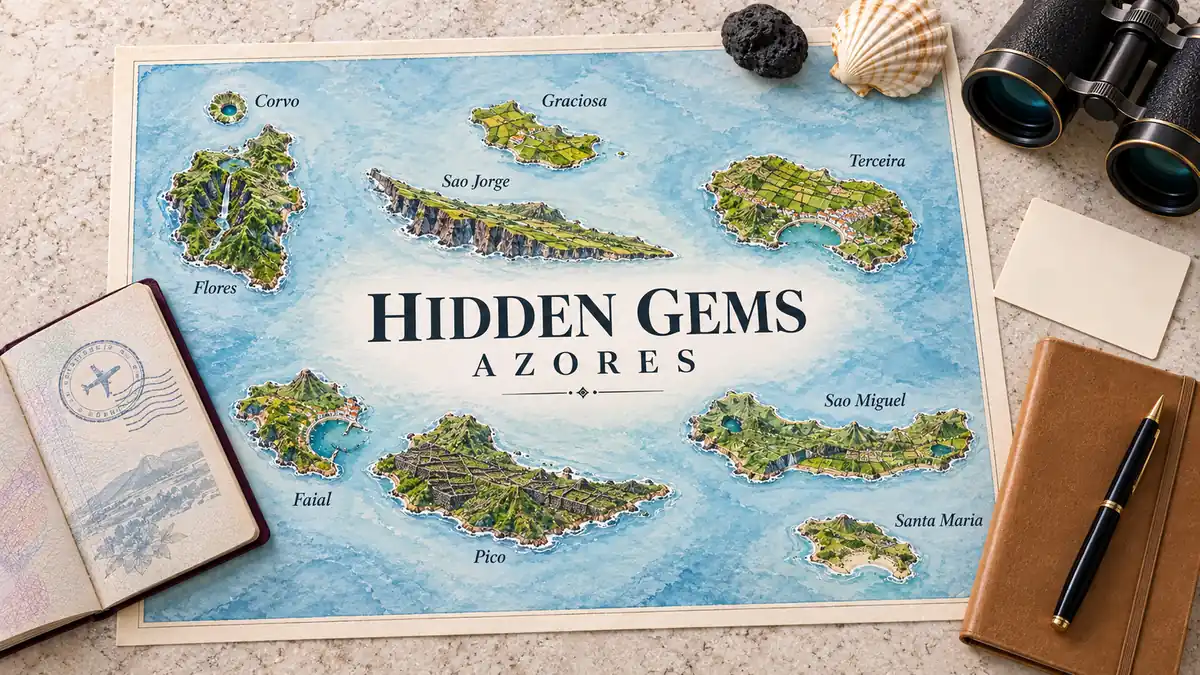
This page names eight places that pass it: four outer islands most São Miguel trips never reach, one quiet island inside the Triangle, and three overlooked corners of the famous islands themselves. Each pick comes with the mechanism that keeps it overlooked, what it costs in effort to reach, and who it actually suits. And each one resolves the same decision: whether to leave the São Miguel default for one quiet island, or build the whole trip around the quiet ones.
Quick Answer
The genuinely overlooked Azorean islands are Corvo, Graciosa, Santa Maria and Flores — the four most São Miguel trips never reach. Each costs an extra flight leg or a summer-weighted ferry, so the trade is effort for quiet. São Jorge’s fajãs stay reachable year-round and suit first-timers adding one island.
Trust Layer
Tripstou selection guide for travelers choosing between multiple places. Covers selection criteria, traveler fit, and trip value.
Produced with AI assistance and reviewed by Alex Perrut, working in tourism since 2015, for the Tripstou editorial team. See our editorial process for details.
Last factual review: September 12, 2026.
Official sources consulted: Visit Portugal, Turismo de Portugal.
Key Takeaways
- Corvo is the quietest pick in the archipelago, but reaching it means a second westward hop and two spare days.
- São Jorge is the only quiet island reachable year-round by ferry, which makes it the safest addition to a locked trip.
- Every outer island costs one extra leg from a specific hub, and the western legs need a buffer day built in.
- Choose by ground, not by effort: sand on Santa Maria, waterfalls on Flores, pasture and thermal water on Graciosa.
- If a second flight is impossible, São Miguel’s east, Terceira beyond Angra and Pico’s coast deliver most of the contrast.
- Sete Cidades, Furnas, Lagoa do Fogo, the Pico summit and Angra are mainstream stops, not hidden gems.
Table of Contents
Sete Cidades, Furnas and Lagoa do Fogo are not hidden gems
The most-listed Azores hidden gems are São Miguel’s busiest sights, and none of them appears on this list. Sete Cidades, Furnas, Lagoa do Fogo, the Pico summit and Angra do Heroísmo are mainstream stops. Hidden here is measured against São Miguel and the Triangle, not against Europe.
Commodity lists fail this query because they rank Azorean places by fame inside São Miguel, which is the one island almost every visitor already books. Sete Cidades and Lagoa do Fogo sit on the busiest island’s most-driven circuit, with coach parking at the viewpoints and a queue for the photograph. Calling them hidden only works for a reader who has never heard of the Azores at all.
Every pick below had to pass a second-order test. It costs an extra flight leg, it has no ordinary road, it depends on a summer-weighted ferry link, or it simply never built a reputation the way its famous neighbour did. A place that fails all four belongs on the famous side of the axis, however beautiful it is. That is why the calibration comes first: without it, the word hidden means nothing here.
The signature experiences attached to those famous names — whale watching, the Sete Cidades walk, the Pico climb, the Furnas thermal circuit — are resolved in our guide to things to do in the Azores, because this page ranks places and never activities. And if you are weighing the Azores against the famous end of the Portuguese axis, Lisbon and Porto through the Algarve and the Douro, that shortlist lives in our guide to the best places to visit in Portugal.
Corvo is the least touristy island in the Azores
Corvo is the smallest and least-visited Azorean island: one village, one crater, reached only from Flores. A few hundred people live in Vila do Corvo, and the Caldeirão crater fills most of what is left. Nothing else in the archipelago is this small or this far west.
What makes Corvo distinct is that the island itself is the sight. You walk the rim of the Caldeirão, look down into a crater floor scattered with small lakes and islets, and that is the whole itinerary. Every other pick on this page is a corner of somewhere bigger — a quiet coast, a second half, an overlooked municipality. Corvo is the entire place.
Corvo stays quiet for a reason that is pure arithmetic. It sits behind Flores, and Flores itself sits behind a flight from the Central Group, so reaching it means one more hop on a westward chain that weather can break at any link. Beds number in the handful, so book far ahead and treat a buffer day on either side as basic planning on this route.
Skip Corvo if you want a choice of restaurants, a beach day, or anything you can book in advance. There is one settlement, and beyond the crater the island offers walking, birdwatching and the North Atlantic. Corvo is the one pick where arriving with nothing planned is the plan — travelers who fill days with reservations tend to run out of island by lunchtime.
Pick this if: you want the smallest inhabited island in the archipelago and you can give the weather two spare days.
Graciosa, Santa Maria and Flores are worth the second flight
Three outer islands justify a second flight leg, each for a different traveler. Graciosa suits slow travelers who want a caldera and thermal water without a headline sight. Santa Maria is the beach island. Flores is the landscape island, and the one hikers fly west for.
Graciosa — the quietest island of the Central Group
Graciosa is the Central Group island nobody routes through, and that is exactly its value. A UNESCO Biosphere Reserve of low green pasture, windmills and whitewashed villages, it holds one genuinely rare sight: the Furna do Enxofre, a vast volcanic cave inside the caldera with a sulphurous lake on its floor. It is a managed site, so confirm current access before you build a day around it.
What separates Graciosa from the other picks is that nothing here is dramatic. The landscape is gentle where Flores is vertical and Pico is black, and the day ends at the Termas do Carapacho, thermal water at the edge of the sea, after an afternoon of lanes with no traffic on them. Its direct link is Terceira, and because it never had a postcard sight, no itinerary has ever been designed to include it.
Pick this if: you are on a second or third Azores trip and want an island with nothing to tick off.
Santa Maria — the beach island the Azores are not known for
Santa Maria has the white sand the rest of the archipelago does not. Praia Formosa is a genuine sweep of pale beach, and the island’s position as the southeasternmost and driest of the nine gives it the warmest, sunniest weather in the Azores. Barreiro da Faneca adds something stranger: a red clay badland of bare ochre hills that looks imported from another latitude, with the small Anjos chapel down on the coast.
Routing is what buries it. Santa Maria connects chiefly through São Miguel, so on a map it reads as a detour from the island everyone is already on, and it is the first line itineraries delete. That also makes it the cheapest quiet island to add in effort terms — one short hop, no westward chain, no exposed weather leg to manage.
Pick this if: you want swimming weather and sand, and you will not trade them for volcanoes.
Flores — Poço da Ribeira do Ferreiro, Fajã Grande and Fajãzinha
Flores is the most spectacular island in the Azores and the hardest one to schedule. Poço da Ribeira do Ferreiro is why people fly west: a green amphitheatre of cliffs with dozens of waterfall threads dropping into a still pool. On the west coast, Fajã Grande and Fajãzinha sit as hamlets on a narrow shelf between the ocean and a wall of falling water, with the island’s ravines behind them — the reason canyoning exists here, covered on our Azores experiences guide.
Its distinction is vertical scale. Other Azorean islands have waterfalls; Flores has a landscape built entirely out of them, at a density no other island approaches. It stays overlooked because it is the westernmost point of the archipelago, the leg is the most weather-exposed in the network, and the bed stock on the west side is thin enough that a late booking simply fails.
Pick this if: landscape is the whole point of your trip and you can absorb a cancelled flight without losing the trip.
The three share one tradeoff, and it is logistical. Book accommodation far ahead on all three, arrange a car before you arrive because supply on the smaller islands is limited, and keep slack in the schedule on the western leg. The second flight costs about the same whichever of the three you choose, so let the ground decide: pasture and thermal water, sand and sun, or waterfalls and cliffs.
São Jorge is worth visiting for its fajãs alone
São Jorge is the one quiet island reachable year-round without a second flight. Its fajãs are the reason to go. A fajã is a flat coastal platform formed by landslide debris at the foot of a cliff. São Jorge has roughly 75 of them.
Those platforms are where the island lives. Fajã da Caldeira de Santo Cristo is the famous one, a settlement beside a lagoon with no ordinary road down to it — how you reach it changes, so confirm access locally before you commit a day to it. Fajã dos Cubres is the other named one, a thin green tongue of land between two lagoons, visible from the ridge road above. A surf break sits at Santo Cristo, unusual enough in the Azores to draw people who come for nothing else.
Shape is what sets São Jorge apart. It is long, narrow and cliff-edged, a ridge dropping to the sea on both sides, and no other Azorean island is built like that — which is why its walking is lateral, along and down the cliffs, instead of around a crater. The island stays quiet because the Triangle’s attention goes to Pico’s summit and Faial’s harbour, and São Jorge reads on a map as the third one.
Skip it if you want beaches or a town to base in; the settlements are small, the coast is rock and the best of the island is at the bottom of a descent. Its real advantage is risk: São Jorge is the only quiet pick you can add without booking a second flight, which makes it the safe choice when the rest of a trip is already locked.
Pick this if: you want one quiet island reachable by ferry, and you are willing to walk down a cliff to earn it.
Hidden gems on São Miguel, Terceira and Pico beyond the famous stops
You do not need a second flight to leave the crowds. São Miguel, Terceira and Pico each hide a quiet side: the Nordeste and Povoação coast, Terceira beyond Angra, and Pico away from the mountain. Each sits on the far side of its island from the headline sight.
Nordeste and Povoação — São Miguel’s quiet east
São Miguel’s east is the part of the island the day-trip circuit runs out of time for. Nordeste and Povoação are municipalities of steep green valleys, laurel forest and small coastal villages, at the opposite end of the island from both Sete Cidades and the airport. Roads are slower here, there is usually space at the viewpoints, and the pace drops the moment you pass Ribeira Grande.
What keeps this corner overlooked is simple geometry. Almost every São Miguel base sits in or near Ponta Delgada, and the east is the one direction that needs a full day to do properly, so it loses to the west every time a trip is short. Give it that day and it works as its own quiet island, with no extra ticket, no ferry and no weather risk attached.
Pick this if: you are staying on São Miguel and want one slow day with no queue at the viewpoint.
Biscoitos, Algar do Carvão and the Serreta side — Terceira beyond Angra
Angra do Heroísmo is Terceira’s famous half, and everything else on the island is the pick. Biscoitos is a north-coast stretch of black lava pools filled and emptied by the Atlantic, with vineyards growing in the volcanic ground behind them. Algar do Carvão is a volcanic chimney you descend into, and a managed site — confirm current access before planning around it. The Serreta side, west and green, is where the island’s traffic disappears entirely.
Terceira’s quiet half stays quiet because Angra absorbs the attention a UNESCO old town attracts, and most visitors treat the island as a day or two of city and then leave. The north and west coasts ask for a car and an unstructured afternoon, which is exactly what a short stopover does not have. They reward anyone already on the island for another reason.
Pick this if: you are basing on Terceira for the Graciosa link and want the island’s other half.
Criação Velha, Lajes do Pico and São Roque do Pico — Pico beyond the mountain
Pico’s mountain is the famous half; the coast is the overlooked one. Criação Velha and Santa Luzia hold the UNESCO vineyard landscape, a lattice of dry-stone currais — low black walls built to shelter vines from the wind — running from the lava fields down to the sea. Lajes do Pico and São Roque do Pico are the main coastal towns: low, working, unhurried, and both former whaling ports.
The summit itself is what hides the rest. People book Pico for the climb, sleep near the trailhead and leave the day after, so a landscape unlike anywhere else in Portugal gets used as a car park. Walking the vineyard paths at Criação Velha takes an afternoon and needs no permit, no guide and no weather window. Whale watching also departs from Lajes, which is what most day visitors come for.
Pick this if: you want the wine landscape and the coast, and you have no intention of climbing anything.
How hard is it to reach the smaller Azores islands?
Every quiet island costs one extra leg from a specific hub, and the western ones need a weather buffer. Santa Maria connects chiefly through São Miguel, Graciosa through Terceira, Corvo from Flores. São Jorge is the exception: a year-round ferry inside the Triangle, no second flight required.
| Island | Reached from | Flight or ferry | Seasonal or year-round | Who it suits |
|---|---|---|---|---|
| Corvo | Flores, the neighbouring western island | Short ferry hop on the western link | Runs through the year, weather permitting | Travelers who want the archipelago’s quietest island |
| Graciosa | Terceira, its Central Group hub | Flight, with summer-weighted ferry options | Flights through the year, ferries in summer | Slow travelers and returning Azores visitors |
| Santa Maria | São Miguel, the Eastern Group hub | Flight, plus a summer-weighted ferry link | Flights through the year, ferry in summer | Beach-seekers pairing it with São Miguel |
| Flores | A Central Group hub, then the western leg | Flight, plus the ferry link to Corvo | Through the year, with the highest weather risk | Hikers and landscape-first travelers |
| São Jorge | Pico, Faial or Terceira in the Triangle | Year-round Triangle ferry, flights also serve it | Year-round, the steadiest link of the five | Walkers wanting quiet without a second flight |
The pattern matters more than any timetable. Flights inside the archipelago are short and cover the main routes through the year, while the wider ferry network beyond Flores–Corvo and the Triangle is summer-weighted, so a plan built on boats works in the warm months and stops working outside them. Build the buffer day into the western islands specifically: a cancelled Flores or Corvo leg eats the day you meant to spend there and the day you meant to spend somewhere else.
Two habits cover the rest. Book accommodation on Corvo, Graciosa, Flores and Santa Maria far ahead, because bed stock is small and fills in the summer window, and arrange a car before you land, since the smallest islands have little to rent and no walk-up supply. For the general questions — getting to the Azores, moving between islands, how long a trip needs — our Azores travel guide is where they are resolved.
Train and bus tickets
Compare routes, schedules and prices across rail and bus operators in one search, with mobile tickets on your phone.
New to Omio? Code NEW10 takes 10% off your first booking — or APPNEW10 if you book inside the Omio app. Both apply to bookings up to €80.
Search routes and compare prices on Omio →
Tripstou may earn a commission if you book through this link, at no extra cost to you.
Should you add one quiet island or build the whole trip around them?
First-timers add one quiet island to São Miguel; returners build the trip around the quiet ones. One quiet island gives you the contrast without turning a holiday into a sequence of airports. Building around them works once you already know what Azorean weather does to a plan.
A first trip should spend its effort budget once. São Miguel earns its place — the flights land there and it holds the sights that made the archipelago famous — and a single extra leg buys the contrast the trip needs. Which island depends entirely on what you want: Santa Maria for sand, Flores for landscape, São Jorge for walking and the only option that needs no second flight, Graciosa for slowness, Corvo for the extreme.
Building the trip around the quiet islands is a returner’s move. It pays when you can hold a week or more, when the pace is the point instead of the checklist, and when a lost day reads as part of the experience. Give the small islands more days than their size suggests: on Corvo or Graciosa, a two-day visit usually delivers one usable day once weather and the local rhythm take their cut.
Some travelers should stay on São Miguel entirely, and that is a legitimate answer. If the trip runs under a week, if it is your first time and the famous sights are why you came, or if a missed connection would break the journey home, use the quiet corners in the section above and skip the second leg altogether. Trip length, first-trip island choice and inter-island transport are resolved in our Azores travel guide. If you want quiet somewhere else in the country, the mainland’s overlooked regions sit in our guide to hidden gems in Portugal.
- First Azores trip, about a week: São Miguel plus one quiet island — Santa Maria for the beach, São Jorge for the walking.
- Returning traveler: skip São Miguel, base in the Triangle and add Graciosa from Terceira.
- Landscape-first traveler: Flores and Corvo as the whole trip, with slack built in for the western weather.
- No second flight possible: the quiet corners of São Miguel, Terceira and Pico deliver most of the contrast for none of the risk.
Frequently Asked Questions
What is the most beautiful village in the Azores?
Fajã Grande on Flores is the strongest candidate: a handful of houses on a narrow shelf between the ocean and a cliff wall of waterfalls. Vila do Corvo and the São Jorge fajã settlements are the other contenders — small, low-built, and hemmed in by the landscape around them.
What is Furna do Enxofre?
Furna do Enxofre is a large volcanic cave inside the caldera on Graciosa, with a sulphurous lake on its floor. It is the island’s rarest sight and the one thing on Graciosa that draws visitors deliberately. It is a managed site, so confirm current access before building a day around it.
Is Lagoa do Fogo still a hidden gem?
No. Lagoa do Fogo is one of São Miguel’s most visited sights, on the standard day-trip circuit with coach parking at the viewpoints. It belongs on the famous side of the axis. For a genuinely quiet São Miguel day, the east around Nordeste and Povoação is the substitute.
Can you visit Corvo as a day trip from Flores?
Yes — Corvo is reached from Flores on a short crossing that runs through the year, and a day visit is the normal way to see it. The link is weather-exposed, though, so treat any Corvo day as provisional and keep a spare day behind it in the plan.
Is Terceira less touristy than São Miguel?
Overall yes, though the difference is uneven. Angra do Heroísmo draws the crowds a UNESCO old town attracts, so the city half feels busy. The north and west coasts — Biscoitos, the Serreta side — are markedly quieter than anywhere comparable on São Miguel, and most short stays never reach them.
Are the fajãs on Flores the same as the ones on São Jorge?
They share the name and the geology — flat coastal shelves at the foot of a cliff. The difference is scale: São Jorge has roughly 75 of them and builds its whole settlement pattern on them, while on Flores the fajã coast is a short western strip at Fajã Grande and Fajãzinha.
Related Guides
Next steps for planning around these picks:
- Azores travel guide — island choice, trip length, seasons, getting around and where to base.
- Things to do in the Azores — the signature experiences, from whale watching to the Pico climb.
- Hidden gems in Portugal — the quiet regions on the mainland, away from Lisbon and the Algarve.
- Best places to visit in Portugal — the famous end of the axis, for a first trip to the country.
Did this guide save you time or money? Tripstou is independent and reader-funded — if you'd like to give something back, you can support the site with a crypto contribution of any size.