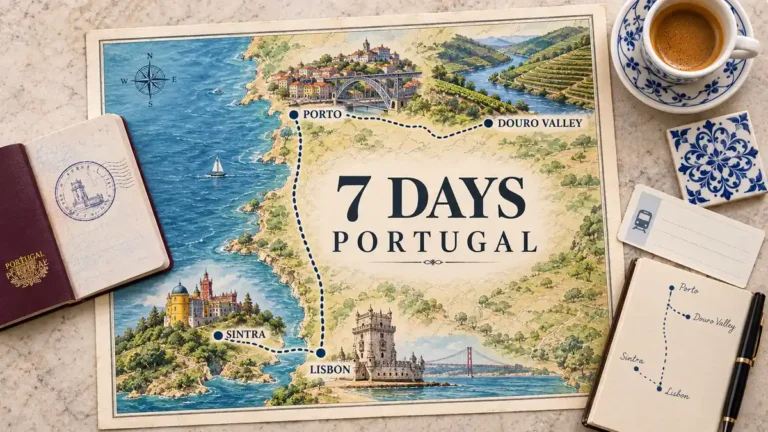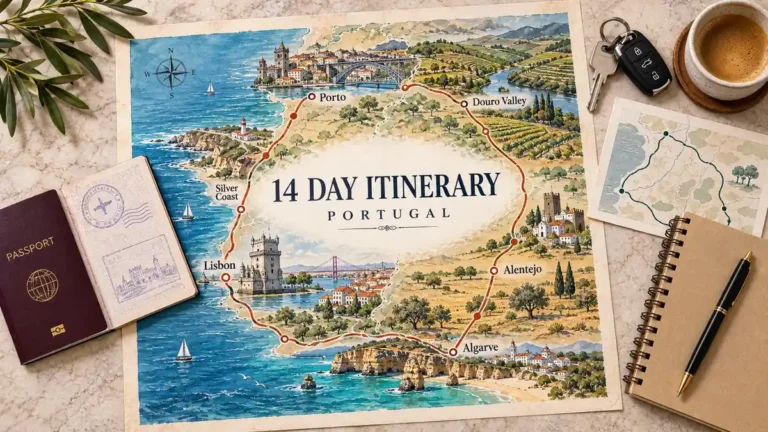
Ten days in Portugal is not a shorter trip taken slower. It is a different shape. The extra days do not buy longer mornings in the same two cities — they buy a third anchor, and they only buy it if the route is reordered to make room.
The reordering rule is one sentence: Lisbon goes in the middle. A week-long trip has two endpoints. Ten days has a hinge, and Lisbon is the only Portuguese city that can hold it, because it is the only one with frequent trunk services running north and south. Build the trip around that and both long legs become morning trains out of the best-connected station in the country. The country’s weakest long link never appears on your schedule at all.
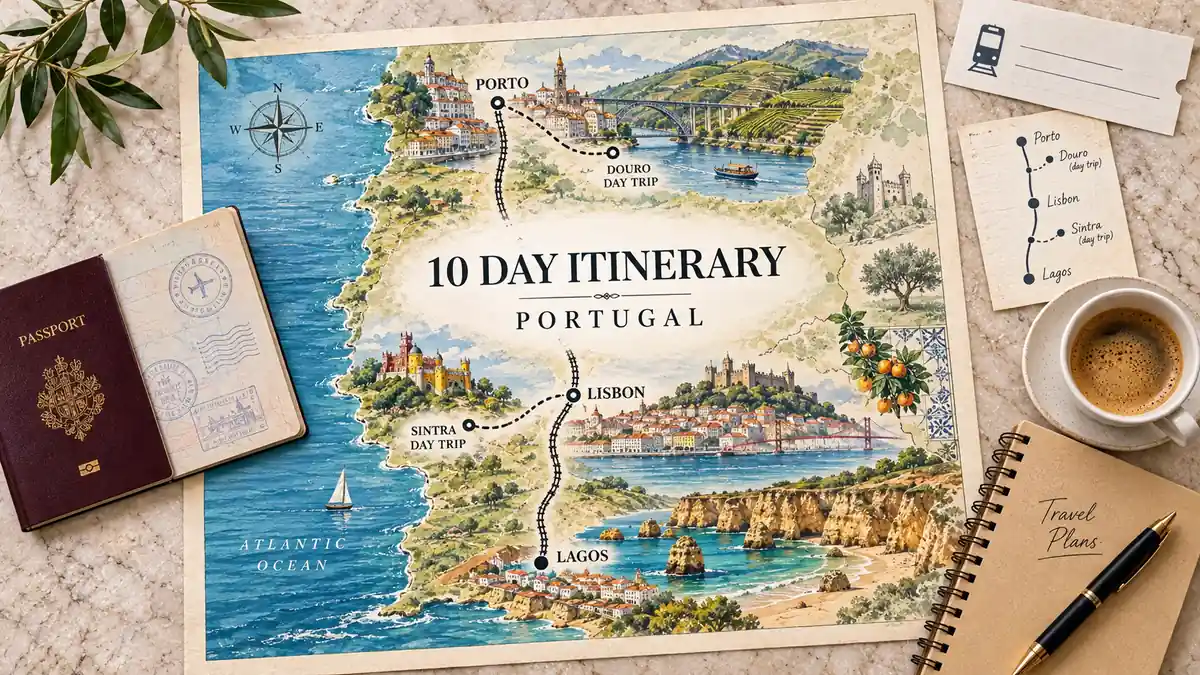
What follows is one committed route, days 1 to 10, with three days in Porto, four in Lisbon and three on the Algarve coast. There is exactly one swap available, and it is not a change of order.
Quick Answer
Ten days fits Lisbon, Porto and the Algarve if Lisbon sits in the middle. Spend three days in Porto, four in Lisbon and three on the Algarve coast, with both long legs run as morning trunk trains. Fly into Porto and out of Faro, or reverse it — Lisbon stays central either way.
Trust Layer
Tripstou itinerary guide for travelers planning a route. Covers pacing, stop count, stop order, base logic, and trip length.
Produced with AI assistance and reviewed by Alex Perrut, working in tourism since 2015, for the Tripstou editorial team. See our editorial process for details.
Last factual review: September 10, 2026.
Official sources consulted: Visit Portugal, Turismo de Portugal.
Key Takeaways
- Ten days buys a third anchor by changing the trip’s shape, not its speed — a week has endpoints, ten days has a hinge.
- Lisbon in the middle is the invariant: every other element of this route can be adjusted, that one cannot.
- Commit to three days in Porto, four in Lisbon and three on the Algarve coast, flying out of Faro.
- Both long legs run as morning trunk trains out of Lisbon, so the route spends no full travel day.
- Porto to the Algarve has two direct trains a day and one nonstop airline — this route is built never to use it.
- The only swap on offer is direction: reverse the route if flights are better, but never reorder the three bases.
Table of Contents
Ten days fits three anchors only if Lisbon sits in the middle
Ten days holds Lisbon, Porto and the Algarve, but only if Lisbon sits between them. The extra days buy a third anchor by changing the trip’s shape, not its speed. Lisbon is the only Portuguese city with frequent trunk services running both north and south, which makes it the hinge the whole route turns on.
A week has two endpoints. Ten days has a hinge. That structural difference is the entire reason this page exists, and it is worth more to the finished trip than any amount of extra sightseeing time bolted onto the same two bases.
Lisbon earns the middle position on frequency alone. CP, the national operator, runs roughly 15 to 19 trains a day between Lisbon and Porto, split between the Alfa Pendular, which is the fast service with fewer stops, and the Intercidades, which stops more often and takes longer. Southbound, a frequent Intercidades service links Lisbon to the Algarve, with a timed cross-platform connection at Tunes for trains continuing to Lagos. Both directions run through the day. Neither leg has to be planned around one departure.
Put Lisbon at either end and the trip inherits the country’s weakest long link. Porto to the Algarve has only two direct CP services a day, and it is the longest rail leg in this route set. In the air, Ryanair is the sole nonstop operator between Porto and Faro. Neither option is broken. Both are thin.
Frequency matters more than distance when a trip has only three moves in it. A long leg that runs through the day barely constrains you; a shorter one that runs twice a day dictates the whole week around it. That is why Porto–Algarve, and not Porto–Lisbon, is the leg this itinerary is designed around — by never using it.
So the route runs in one direction, north to south, with no backtracking and no base visited twice. Every move radiates from Lisbon. If you are working with a materially different amount of time, start instead from the Portugal itinerary hub, which routes readers to the right trip length before the route logic begins.
The 10-day route: Porto, Lisbon, the Algarve, in that order
The route runs Porto for three days, Lisbon for four, and the Algarve for three, flying out of Faro. North to south is the natural direction because it ends at the coast and at an airport that suits most European travelers. Lisbon takes the extra night because it absorbs both travel half-days.
- Days 1–3: Porto — the northern anchor, Douro on Day 3
- Day 4: Porto to Lisbon — morning trunk train, half a day
- Days 4–7: Lisbon — the hinge, Sintra on Day 6
- Day 8: Lisbon to Lagos — Intercidades via Tunes
- Days 8–10: The Algarve — based in Lagos, out of Faro
Days 1–3: Porto, the Douro, and why the route starts north
Porto gets three nights and the trip’s opening position. Land at Porto airport, base yourself centrally, and give the first two days to the old city, the river frontage at Ribeira and the lodges across the water in Vila Nova de Gaia. Two full days is enough to know the city without racing it, which is the standard this route holds to everywhere. Our Porto guide goes deeper on what fills those days.
Day 3 belongs to the Douro. It survives the cut because it is the only part of this itinerary that is not a city, and a ten-day trip made entirely of urban centres reads flatter than it should. Planning that day well is its own subject, and the Douro Valley guide covers the options.
The onward move is a morning train from Porto Campanhã to Lisbon. Take the Alfa Pendular if the timing works — it is the fast service, and a morning departure puts you in Lisbon with the afternoon still ahead of you. The Intercidades covers the same route with more stops and a longer run.
Days 4–7: Lisbon, the hinge that absorbs both travel days
Lisbon takes four nights because it is the only base that pays for two half-days of travel. You arrive on Day 4 with the afternoon intact and you leave on Day 8 having had a genuine three full days in between. Put the extra night anywhere else and one of those halves belongs to a train instead of a city. The Lisbon guide handles what to do with them.
Day 6 goes to Sintra, reached by suburban train from Lisboa Rossio. It is a day trip, not a stopover — you sleep in Lisbon either side of it, which is exactly why the hinge structure works. See the Sintra day trip guide for how to shape the day.
The onward move on Day 8 is a CP Intercidades from Entrecampos or Oriente, changing at Tunes onto the timed cross-platform regional service for Lagos. Book the Intercidades, not the Alfa Pendular, which runs only as far as Faro.
Days 8–10: the Algarve from Lagos, flying out of Faro
Lagos is the base for the final three days and Faro is the exit. Lagos sits at the western end of the Algarve line, so the train delivers you into a walkable town rather than a resort strip, and the coastline immediately west and east of it is the most dramatic in the region. The Lagos guide covers the town itself.
Three coastal days realistically hold two beach days and one day given to the cliffs and coves around the headland, with an afternoon left over for doing nothing. That last part is deliberate. A trip with three anchors needs one segment that does not have a schedule attached to it, and the Algarve is where it belongs.
Faro is the flight out. It is heavily served by low-cost carriers, weighted towards the UK and Ireland, which makes it a realistic end point for most European readers. Long-haul nonstop options from Faro are thin, so travelers flying beyond Europe usually do better routing their final connection through Lisbon.
Tours and activities
Book skip-the-line tickets, day trips and local tours with free cancellation on most activities.
You can also browse everything on getyourguide.com.
Tripstou may earn a commission if you book through this link, at no extra cost to you.
How you move between the three bases without losing a day
Both long legs are morning trunk trains, so this route spends no full travel day. Every move touches Lisbon, and Lisbon is the best-connected station in the country in both directions. You arrive in the new city with the afternoon intact, which is what keeps a three-anchor trip from feeling like a transfer schedule.
Porto to Lisbon is the easiest long leg in Portugal. CP runs it between Porto Campanhã and Lisboa Santa Apolónia or Oriente, roughly 15 to 19 departures a day. The choice is between two services. The Alfa Pendular stops rarely and is the only one of the two that stays under three hours; the Intercidades stops more often and takes longer over the same line. Either is a morning, not a day.
Lisbon to Lagos is a connection, not a through service, and that is worth knowing before you book. The Intercidades leaves Entrecampos or Oriente and runs to Tunes, where a timed regional service waits across the platform for Lagos. The transfer is designed to be walked, not run. The Alfa Pendular on this corridor terminates at Faro, so it is not the clean option if Lagos is your base.
Évora is the stop most readers try to insert here, and it does not fit. Évora sits at the end of its own line, so continuing south to the Algarve means backtracking towards Lisbon, taking a sparse change at Pinhal Novo, or accepting a long bus. It is an excellent Lisbon day trip and a poor stopover, which is how the Alentejo and Évora guide frames it too.
Rail routing beyond this itinerary — passes, class differences, booking windows — belongs to the Portugal train itinerary guide. Fares are not quoted anywhere on this page; the Portugal trip cost guide carries the budget side.
Do you need a car for this route?
No. This itinerary is built to run without one, and a car is a liability in all three city centres, where parking is expensive, scarce and unnecessary given that every base here is walkable. Hiring for ten days to leave the car parked for seven is a poor trade.
What a car would buy is the space between the anchors: the Alentejo on the way south, the Silver Coast towns, and easy hopping between Algarve beaches that the train and the regional buses reach awkwardly. Tolls apply on the main motorway corridors and are handled electronically. If driving genuinely appeals, treat it as a different trip shape and read the adaptation rules further down, where the car variant is set out properly.
Train and bus tickets
Compare routes, schedules and prices across rail and bus operators in one search, with mobile tickets on your phone.
New to Omio? Code NEW10 takes 10% off your first booking — or APPNEW10 if you book inside the Omio app. Both apply to bookings up to €80.
Search routes and compare prices on Omio →
Tripstou may earn a commission if you book through this link, at no extra cost to you.
Should you fly into Porto or into Faro?
Book into Porto and out of Faro, or reverse it if the flights are better that way. The route is symmetric, so running it south to north changes nothing structural. Lisbon stays in the middle either way, and that is the one element of this itinerary that never moves.
Reversing the direction is the only swap this page offers, and it is a direction swap, not a route swap. Run it south to north and the sequence becomes Algarve, Lisbon, Porto, with both long legs still radiating from Lisbon as trunk services. Nothing about the pacing, the base count or the day split changes. What must never change is Lisbon in the middle.
Faro’s connectivity usually decides it. The airport is extensively served by low-cost carriers weighted towards the UK and Ireland, which for many European readers makes it the cheaper of the two ends to book, and cheaper on the outbound as often as on the return. Travelers coming from outside Europe generally find Porto or Lisbon the workable end and should let the long-haul leg pick the direction.
One variant is not on the table: entering and leaving through the same end, with Porto and the Algarve joined directly. The evidence on that leg makes it the one to design around, not to build on. If the Algarve is the part of the trip you care most about, the Algarve guide is where to decide how much of it you want.
Where to base yourself in each of the three segments
One base per segment: central Porto, central Lisbon, and Lagos in the Algarve. This route moves three times in ten days, so every base has to be walkable from its station. Anything that adds a taxi at each end turns a half-day transfer into a full one.
- Central Porto. Best for: travelers who want the old city and the river on foot from the door. The tradeoff is noise and stairs — the historic core is steep and lively, and a quiet night is not what you are buying.
- Central Lisbon. Best for: travelers using the city as a hinge, with easy reach of Rossio for Sintra and Entrecampos or Oriente for the southbound train. The tradeoff is that the most central districts are also the most touristed, so value drops as convenience rises.
- Lagos over Albufeira. Best for: travelers who want the west-coast beaches and the rail terminus in the same place, which is what this route is optimised for. Albufeira is the alternative if nightlife and a broader stay market matter more; the Albufeira guide covers that side, and the best beaches in Portugal guide covers what each base reaches.
What ten days in Portugal still gives up
This route skips the Alentejo, the Minho, the Silver Coast and the islands entirely. That is the price of the third anchor: ten days buys breadth across the country’s three signature regions, and it pays for it with everything in between. The trade is deliberate, and it is the right one for most first trips.
Ten days buys a third anchor or real depth in two. It does not buy both. Travelers who already know they prefer depth — repeat visitors, slow travelers, anyone who resents changing hotels — should drop the Algarve and split the time between Porto and Lisbon with proper day trips from each. Everyone on a first trip who wants the north, the capital and the coast in one visit is better served by the committed route above.
If your must-see list is longer than three anchors, the honest answer is that ten days is not the constraint to solve — the list is. Start from the Portugal itinerary hub to find the trip length that matches it, or from the best places to visit in Portugal to work out which items on the list actually earn their travel time.
The mainland regions this route drives past
The Minho, north of Porto, is what a longer trip adds first. It is close enough to Porto that reaching it costs almost nothing in transit, and it holds Braga, Guimarães and the Peneda-Gerês uplands — the strongest single addition available to this route, covered in the Minho guide.
The Silver Coast sits between Porto and Lisbon and is the region this itinerary most literally passes through, since the trunk train runs straight by it. Óbidos, Nazaré and the surf coast make a natural extra base for anyone who can afford to break the northern leg, as set out in the Silver Coast guide. The Alentejo is missed for the reason already given further up: Évora is a day trip from Lisbon, and the region does not sit on a workable line between Lisbon and the Algarve.
Madeira and the Azores need their own trip
Madeira and the Azores are flights, not detours. Adding either to a mainland ten days costs two of those days to airports and transfers before you have seen anything, and it would have to come out of an anchor, since there is no slack in this route to absorb it. The islands reward a dedicated trip and punish a bolted-on one.
If they are pulling at you, plan them separately. The Portugal islands guide compares the two archipelagos, the Madeira guide and the Azores guide cover each in full, and the Funchal guide handles Madeira’s base city, which is where most island trips actually start.
How to adapt this route for a car or a shorter trip
Keep Lisbon in the middle and everything else on this route is negotiable. The cut principle is simple: shorten a segment before you add a base. Adding a fourth stop costs a travel half-day and buys a rushed afternoon, while trimming nights from one anchor costs almost nothing structural.
- At nine days: shorten the Algarve to two nights. It is the segment with the least fixed content, so it loses the least when compressed.
- At eight days: drop the Douro day, not an anchor. The route survives intact and the pacing keeps its shape; cutting a city instead would break the hinge that holds the whole thing together.
- With a car: the route works driven, but it becomes a different trip. Parking is a liability in all three city centres, and the southbound leg turns into a full driving day where the train gives you a morning. If that trade appeals, the Portugal road trip guide is built for it.
- With more days: add depth in the segment you liked most, or add the first region north of Porto. Do not add a fourth anchor — the day it costs comes out of the three you already committed to.
- On timing: season changes what the Algarve segment is worth more than it changes the two cities, so the shoulder months shift the day split as much as the weather. The best time to visit Portugal guide sets out when.
- On shorter trips: readers with materially less time should not compress this route further. Go to the Portugal itinerary hub and pick the shape that fits the time you actually have.
Frequently Asked Questions
Can you run this route if you fly in and out of Lisbon?
Yes, but the shape changes and you pay for it. A return into Lisbon forces the city to the start and the end, which pushes one anchor to an endpoint and puts the thin Porto–Algarve leg back on your schedule. Drop to two anchors before you accept that.
Is the Douro Valley worth a day of a 10-day trip?
Yes, on this route. The Douro is the only non-urban day in a trip otherwise built from three cities, and it costs nothing structural because it sits inside the Porto block instead of adding a fourth base. Drop it only if the trip shortens to eight days.
Can you stop in Évora between Lisbon and the Algarve?
Not on this route. Évora sits at the end of its own line, so continuing south by rail means backtracking towards Lisbon or taking a sparse change at Pinhal Novo, and the bus is a long haul. Évora works beautifully as a Lisbon day trip instead.
Where should you stay in the Algarve, Lagos or Albufeira?
Lagos, if you are running this route by rail. It sits at the western terminus of the Algarve line, so the train drops you inside a walkable town beside the region’s most dramatic coastline. Choose Albufeira instead when nightlife and a wider choice of stays matter more than the walk.
Do you need a car for the Algarve days of this itinerary?
No, though it buys the most here of anywhere on the route. Lagos puts beaches and clifftop walking on your doorstep, which fills three days comfortably. A car mainly widens the choice of coves and makes the regional buses unnecessary, so hire one only if beach-hopping is the point of your trip.
Can you add Madeira or the Azores to a 10-day Portugal trip?
Not without surrendering an anchor. Reaching either archipelago costs a flight out and a flight back, which consumes two of your ten days before the islands begin, and this route holds no slack to absorb that. Give the islands their own trip and keep the mainland three intact.
Related Guides
- Portugal travel guide — the full country planner, start to finish
- Portugal itinerary hub — routes for other trip lengths
- Portugal trip cost — what a Portugal trip actually costs
- Best time to visit Portugal — when to go, region by region
- Porto guide — the northern anchor in detail
- Lisbon guide — the hinge city in detail
- Algarve guide — the coast, region by region
Did this guide save you time or money? Tripstou is independent and reader-funded — if you'd like to give something back, you can support the site with a crypto contribution of any size.