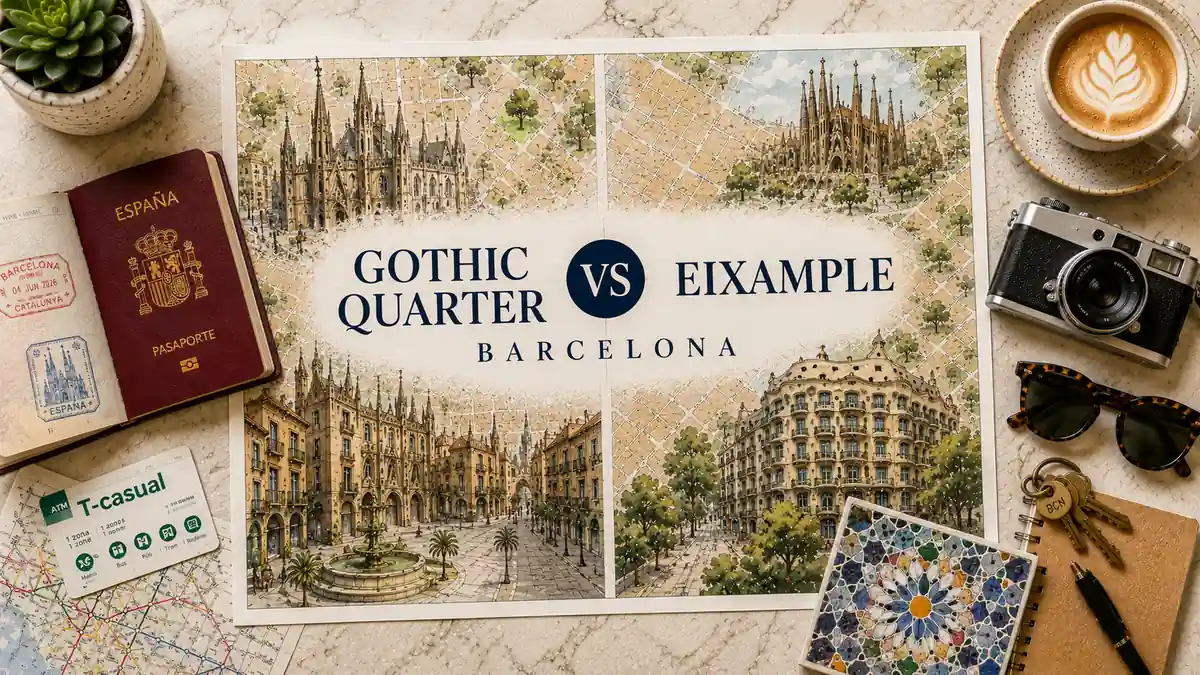
The Gothic Quarter and Eixample are two of Barcelona’s most-booked bases, and they feel almost nothing alike. One is a medieval old town of narrow, cobbled lanes; the other is a 19th-century grid of wide boulevards and modernist facades. That single contrast shapes everything that matters for a stay: atmosphere, room size, noise, and how easily you move around. This guide settles the choice head-to-head, comparing the two areas on the axes that actually decide a base, then closing with a clear pick by traveler type so you can book the area that fits how you travel.
Quick Answer
Stay in the Gothic Quarter for medieval charm, energy, and being in the thick of the action; choose Eixample for space, calm, and modernist elegance. First-timers and atmosphere-seekers lean Gothic, while families and travelers wanting quiet and larger rooms lean Eixample. Pick by what you value most: character or comfort.
Trust Layer
Tripstou comparison guide for travelers choosing between options. Covers tradeoffs, traveler fit, and decision logic.
Produced with AI assistance and reviewed by Alex Perrut, working in tourism since 2015, for the Tripstou editorial team. See our editorial process for details.
Last factual review: June 4, 2026.
Official sources consulted: travel-europe.europa.eu, european-union.europa.eu.
Key Takeaways
- Choose the Gothic Quarter for medieval charm, central energy, and old-town immersion right outside your door.
- Choose Eixample for wider streets, larger rooms, easier orientation, and a calmer, modernist setting.
- The core tradeoff is atmosphere and density versus space and quiet — character against comfort.
- Eixample is the easier base for luggage, strollers, kids, and taxi access thanks to its grid.
- First-timers and couples lean Gothic; families and longer stays lean Eixample, with both holding budget and luxury options.
- The common mistake is booking on charm alone and underestimating how narrow streets complicate daily logistics.
Table of Contents
How Gothic Quarter and Eixample differ at a glance
The core difference is simple: the Gothic Quarter is a medieval old town of narrow, winding streets, while Eixample is a wide, orderly grid. The Gothic Quarter delivers history and density; Eixample delivers space and air. That contrast in street pattern drives almost every other tradeoff between the two bases.
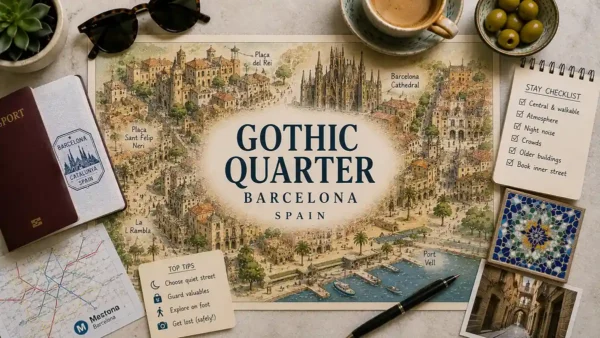
The Gothic Quarter, or Barri Gòtic, is Barcelona’s medieval core. Its cobbled, irregular lanes wrap around the cathedral and a tangle of small squares, so a stay here puts you inside centuries of old-town texture, steps from much of the historic center. The flip side is that the streets are tight and atmospheric rather than spacious.
Eixample is the product of the 19th-century Cerdà plan: long, straight boulevards and chamfered right-angle blocks that make the neighborhood feel open and easy to read. It also holds Barcelona’s headline modernist architecture, with Casa Batlló and La Pedrera along its avenues and the Sagrada Família in or bordering the district. The feel is elegant and residential rather than medieval.
| Axis | Gothic Quarter | Eixample |
|---|---|---|
| Character | Medieval old town, dense and historic | Elegant 19th-century grid, residential feel |
| Streets | Narrow, cobbled, irregular lanes | Wide, straight, easy to navigate |
| Atmosphere | Lively, immersive, central energy | Calmer, more spacious and orderly |
| Architecture | Cathedral and medieval landmarks | Modernist icons like Casa Batlló |
| Best suited to | Charm and atmosphere seekers | Travelers wanting space and comfort |
For the full single-area picture beyond this head-to-head, the dedicated Gothic Quarter guide and Eixample guide go deeper, while the wider where to stay in Barcelona overview covers every other area.
Gothic Quarter wins on atmosphere, history, and being in the thick of it
The Gothic Quarter wins decisively on atmosphere and immersion. Staying inside the medieval core means stepping straight into cobbled lanes, hidden squares, and the cathedral district the moment you leave your door. For travelers who want Barcelona’s history and energy at street level, no other central base feels as alive.
The advantage is location and texture. The Gothic Quarter sits in the historic center, so much of old Barcelona is walkable, and the old-town setting gives evenings a distinct, time-worn character. This makes it a natural fit for first-time visitors who want to feel embedded in the city and for travelers who rank atmosphere above comfort.
The tradeoff is that the same density that creates the charm also limits space and quiet. Streets are narrow, some carry foot traffic and noise into the evening in the busier pockets, and rooms tend to be smaller than in newer parts of the city. If your priority is a calm, roomy base, the charm comes at a cost. For a deeper look at the area on its own terms, see the full Gothic Quarter guide.
Eixample wins on space, calm, and modernist elegance
Eixample wins on space, comfort, and a calmer overall feel. The wide grid streets, generally larger rooms, and easy orientation make it the more relaxed base, surrounded by Barcelona’s celebrated modernist architecture. For travelers who want room to breathe without leaving the center, Eixample is the stronger pick.
The advantages stack up for comfort-led stays. Buildings here often have larger floor plans than the medieval core, the boulevards feel open and unhurried, and the grid is simple to navigate on foot. You are also surrounded by landmark architecture, with Casa Batlló, La Pedrera, and the Sagrada Família within the district or close by.
The tradeoff is that Eixample trades some old-town atmosphere for that comfort. It feels more residential and less immediately “historic” than the Gothic Quarter, and the busiest action of the old center is a short walk or transit ride away, not on your doorstep. For travelers who value calm and space over medieval texture, that is a fair exchange. The full Eixample guide covers the area in more detail, and the Barcelona travel guide sets the wider city context.
Which area is more practical for luggage, kids, and getting around?
Eixample is the more practical base for luggage, kids, and getting around. Its wide, even grid makes wheeling suitcases and pushing strollers easy, orientation is straightforward, and taxis can pull up close to most doors. The Gothic Quarter is more atmospheric but harder to manage with bags or young children.
The grid layout is the deciding factor. In Eixample, broad pavements and right-angle blocks mean you rarely get lost, strollers and rolling luggage move smoothly, and vehicle access to your accommodation is rarely an issue. That makes it the lower-friction choice for families, longer stays, and anyone arriving with heavy bags.
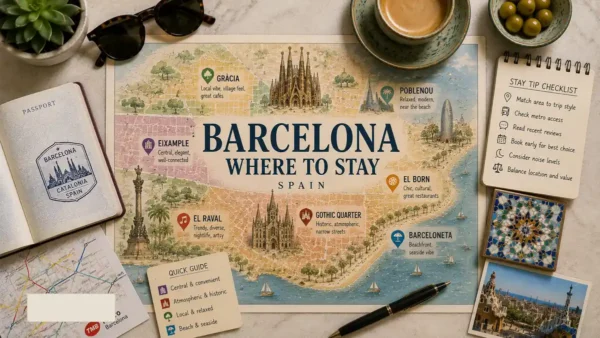
The Gothic Quarter asks more of you logistically. Many lanes are narrow, uneven, and partly pedestrianized, so suitcases can be awkward over cobbles and taxis often cannot reach the exact address, leaving a short walk with your bags. None of this rules it out, but practicality-first travelers should weigh it carefully. The wider where to stay in Barcelona overview helps if you want to compare these tradeoffs against other areas too.
Which is better for nightlife, noise, and quiet?
The Gothic Quarter is livelier and louder, while Eixample is generally calmer with quieter residential pockets. Choose the Gothic Quarter if you want energy and an old-town buzz on your doorstep; choose Eixample if a quieter night and a more settled atmosphere matter more to your stay.
The Gothic Quarter’s appeal is its energy. Its central lanes and squares stay active into the evening in the busier zones, which suits travelers who want to be where things are happening. The same liveliness can mean more sound carrying up to rooms, so light sleepers should favor a quieter street or a higher floor.
Eixample skews calmer overall. Its scale and residential character give it more peaceful blocks, especially away from the main boulevards, making it the easier place to wind down at the end of a day. Both areas have busier and quieter corners, so the area choice sets the baseline and the specific street fine-tunes it.
Which Barcelona area should you choose? Verdict by traveler type
Choose by what you value: pick the Gothic Quarter for atmosphere and central energy, and Eixample for space, calm, and comfort. First-timers, couples, and nightlife-seekers lean Gothic; families, longer stays, and quiet-seekers lean Eixample. Budget and luxury options exist in both, with the deciding factor being feel.
Best for first-time visitors and couples
First-time visitors and couples usually win in the Gothic Quarter. The medieval setting delivers the atmospheric, walkable Barcelona most newcomers picture, and its old-town romance suits couples looking for character over space. The tradeoff is smaller rooms and more evening buzz. Compare persona-specific picks for first-time visitors and couples.
Best for families and longer stays
Families and longer stays usually win in Eixample. Larger rooms, easy stroller and luggage movement, simple orientation, and a calmer residential feel make daily logistics far smoother, which matters more the longer you stay. The tradeoff is being a short hop from the old-town action, not inside it. See the dedicated picks for families.
Best for nightlife, budget, and luxury
Nightlife-seekers lean Gothic for its central energy, while budget and luxury travelers can find a fit in either area depending on feel. The Gothic Quarter keeps you closest to the buzz; Eixample offers calmer, more spacious stays across price points. Compare options for a nightlife base, budget stays, and luxury stays.
Hotels and places to stay
Compare hotels, apartments and stays for your dates in one search.
Search hotels and stays on hotels.com →
Tripstou may earn a commission if you book through this link, at no extra cost to you.
Frequently Asked Questions
Is the Gothic Quarter too noisy to sleep in?
The Gothic Quarter can be noisy in its busier central pockets, where lanes and squares stay active into the evening. Light sleepers are usually fine on a quieter side street or a higher floor. If a calm night is a priority, Eixample’s residential blocks are the safer baseline choice.
Is Eixample boring or too far from the action?
Eixample is not boring; it is calmer and more residential, surrounded by landmark modernist architecture. The old-town buzz sits a short walk or transit ride away, not on your doorstep. For travelers who want space and a settled feel between outings, that small distance is usually a worthwhile trade.
Which area is better value for money?
Neither area is reliably cheaper, since both span budget to luxury and prices shift by season, street, and property. Eixample often offers more room for the rate, while the Gothic Quarter buys location and atmosphere. Decide by the feel you want first, then compare specific properties within that area.
Is the Gothic Quarter walkable with a suitcase?
It is walkable but harder with a suitcase, as many Gothic Quarter lanes are narrow, uneven, and partly pedestrianized. Taxis often cannot reach the exact address, leaving a short cobbled walk with your bags. Eixample’s wide, level grid is far smoother for rolling luggage and stroller access.
Which area is better for first-time visitors to Barcelona?
First-time visitors usually prefer the Gothic Quarter, since the medieval core delivers the atmospheric, walkable Barcelona most newcomers picture. You step straight into history and central energy. Travelers who value space, quiet, and easy logistics over old-town texture may find Eixample the more comfortable first base instead.
What if neither area fits — where else should I look?
If neither the Gothic Quarter nor Eixample fits, consider a calmer, village-feel alternative with its own dining and atmosphere. The neighborhood of Gràcia suits travelers wanting a relaxed, local base slightly away from the busiest center while staying well connected to the city’s main sights.
Related Guides
- Where to stay in Barcelona — the full area-by-area overview.
- Gothic Quarter guide — the medieval old town in depth.
- Eixample guide — the modernist grid in depth.
- Gràcia — a calmer, village-feel alternative if neither fits.
- Barcelona travel guide — wider city context for your trip.
- Best Barcelona areas for families — persona-specific stay picks.
Did this guide save you time or money? Tripstou is independent and reader-funded — if you'd like to give something back, you can support the site with a crypto contribution of any size.