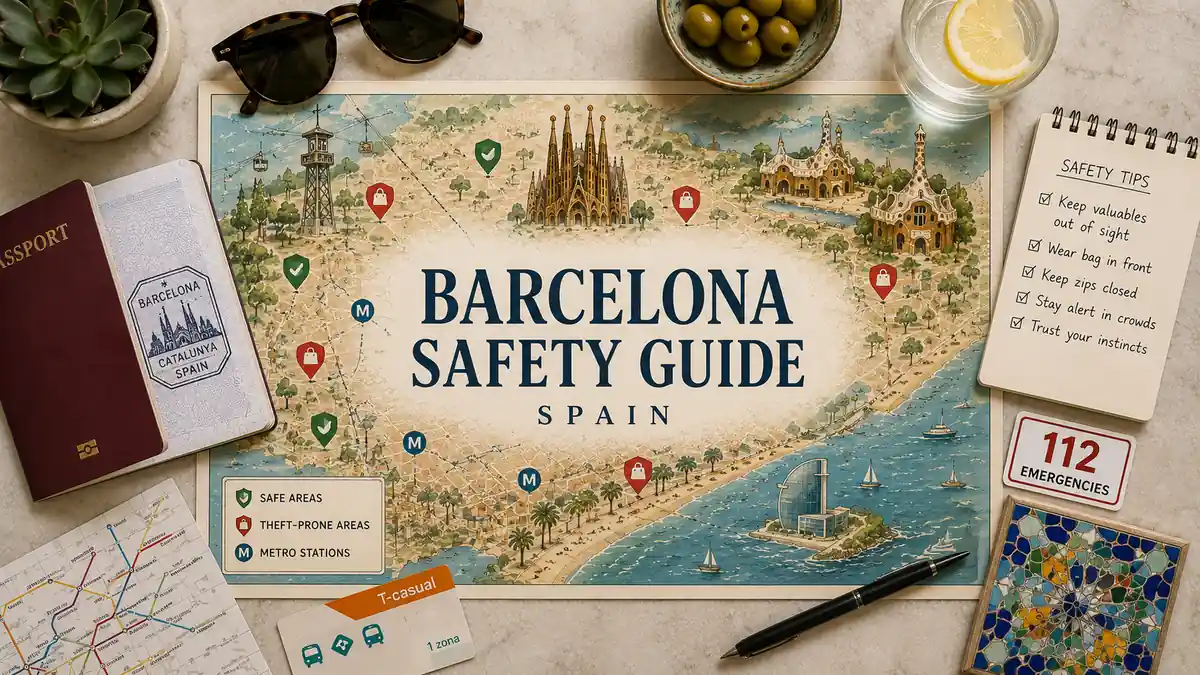
Yes, Barcelona is broadly safe for visitors, and violent crime against tourists is rare. The real risk is pickpocketing and distraction theft, concentrated in crowded tourist hotspots and on the metro. Stay alert in crowds, keep valuables secured and out of sight, and most visitors have no problems at all.
What you actually need to manage is theft, not danger. Barcelona has a well-earned reputation for pickpocketing and distraction scams that target tourists in crowded places, yet violent crime against travelers is rare. The difference between a smooth trip and a stolen phone is almost entirely behavioral. The sections below name where theft concentrates, lay out the concrete habits that keep your valuables where they belong, and cover what to do if something goes missing anyway. Read this guide once before you go, and you will move through the city the way confident locals do.
Is Barcelona safe for tourists?
Yes, Barcelona is one of Europe’s safer major cities for visitors, and violent crime against tourists is rare. The genuine risk you face is theft, not personal harm. Millions of travelers visit every year and the overwhelming majority leave without any incident more serious than a near-miss with a pickpocket.
The reassurance is real, but it should not become complacency. Barcelona feels safe because it largely is: streets stay busy late, public spaces are well used, and serious crime against tourists makes headlines precisely because it is uncommon. The friction most visitors meet is opportunistic theft, which is preventable instead of threatening. If you are weighing the city against wider national concerns, the picture is consistent with safety across Spain, where the same pattern holds: low violent risk, real petty-theft risk in tourist-dense zones. Treat Barcelona as a place to relax and enjoy, while keeping the simple guard-up habits this guide covers. That combination (confidence plus a few deliberate routines) is exactly how residents and seasoned travelers move through the city.
Is Barcelona safe for solo female travelers?
Yes, Barcelona is considered a safe destination for solo female travelers, with the same theft-focused caveat as for everyone. Violent crime against tourists is rare, and many women travel the city comfortably. Use normal city sense: stay in busy areas at night, keep valuables secured, and trust your instincts about people who linger.
What is the real safety risk in Barcelona?
The real risk is theft — pickpockets and distraction teams — not violence. Barcelona’s theft problem is organized and opportunistic, aimed at unattended bags, loose phones, and distracted tourists. Knowing this reframes safety entirely: you are not defending against attack, you are defending against a moment of inattention in a crowd.
It helps to hold the contrast clearly in mind:
- The common risk: pickpocketing, bag-snatching, and staged distractions (a spilled drink, a fake petition, a sudden crowd) that pull your attention while a partner lifts your valuables.
- The rare risk: violent crime, mugging, or assault against tourists, which is statistically uncommon and not the threat that defines the city.
Distraction theft is the signature method here, and it works because it is social rather than aggressive. Teams operate in pairs or groups, often around landmarks, transport hubs, and busy terraces. The financial sting can also outlast the trip: a stolen phone, replacement documents, and blocked cards add real expense, which is worth factoring into your Barcelona trip cost. The good news is that the same awareness that protects your wallet protects everything else, so prevention is a single habit, not a long checklist of fears.
Where do pickpockets target tourists in Barcelona?
Theft clusters where crowds gather: Las Ramblas, the Gothic Quarter, and the busiest metro lines. Pickpockets follow density, so the riskiest spots are simply the most visited ones. Anywhere tourists pause, photograph, queue, or pack together is where attention drops and hands move.
The recurring hotspots are well known and worth memorizing before you arrive:
- Las Ramblas — the single most notorious pickpocketing stretch, dense with distracted foot traffic.
- The Gothic Quarter — narrow, crowded lanes where it is easy to lose track of your bag.
- Plaça de Catalunya — a major transit and gathering point with constant movement.
- La Boqueria market — tight aisles and slow-moving crowds are ideal cover for theft.
- Park Güell — busy viewpoints and queues where attention goes to the camera, not the pocket.
- Barceloneta beach — unattended belongings on the sand are a frequent target.
- The busiest metro lines — crowded carriages and platform crushes, especially on the main lines linking the airport and central sights.
The metro deserves particular care because boarding and exiting create natural pinch points where a hand can reach a bag unnoticed. Keep your phone away from doorways and stay aware as crowds surge on and off; for the wider picture on routes and tickets, see getting around Barcelona. The pattern across all of these is the same: it is not the place that is dangerous, it is the density of distraction.
Are taxis and rideshares safe in Barcelona?
Yes, licensed taxis and app-based rideshares in Barcelona are safe and reliable. Official taxis are black and yellow with visible meters and licence numbers. Use the meter or app fare instead of agreeing a price, keep your bag with you, and avoid unmarked cars that approach you outside stations or the airport.
How to avoid getting pickpocketed in Barcelona
Keep valuables secured and out of sight, and stay alert in crowds and on public transport. Prevention in Barcelona is almost entirely about habit, not gear. A handful of consistent behaviors removes the easy opportunities thieves rely on and makes you a far less attractive target than the next distracted tourist.
Adopt these core rules and apply them every day, not just at the famous sights:
- Wear a crossbody bag at the front — keep it in front of your body in crowds, not slung behind you.
- Keep zips closed and hands aware — a closed, hard-to-reach compartment defeats most opportunistic lifts.
- No phone on café tables — a phone left on an outdoor terrace table is one of the easiest grabs in the city.
- No wallet in your back pocket — move it to a front pocket or an inside zipped pocket.
- Carry day-cash only — bring what you need for the day and leave spare cards and cash secured at your accommodation.
- Ignore unsolicited approaches — petitions, “free” bracelets, spilled drinks, and sudden helpfulness are common distraction setups; keep walking and keep a hand on your bag.
None of this requires looking nervous or anti-social; it simply means defaulting to closed bags and front pockets. These habits dovetail with broader general Barcelona travel tips on moving through the city smoothly. Build them in on day one and they become automatic, which is exactly when they work best.
Is Barceloneta beach safe for your belongings?
Barceloneta beach is safe to visit, but unattended belongings on the sand are a frequent theft target. Never leave bags, phones, or wallets unwatched while you swim. Bring only what you need, take turns minding your group’s things, and keep valuables in a zipped, water-resistant pouch you can carry into the water.
Which areas of Barcelona are safer?
Most visitor areas are safe; risk tracks crowd density and time of day, not dangerous districts. Barcelona does not really split into “good” and “bad” neighborhoods for tourists in the way some cities do. Your exposure rises with how crowded a place is, not which postcode you are standing in.
Central, residential, and quieter areas tend to feel calm, while the tourist-magnet zones carry the most pickpocketing simply because that is where the crowds and distractions concentrate. The practical takeaway is to scale your vigilance to the situation: relaxed in a quiet local street, more alert on a packed terrace or a crowded landmark. For choosing where to base yourself, this is an area-selection question, not a safety one, so see which areas to stay in Barcelona for the neighborhood breakdown. The safety logic stays simple: it is the density of the moment, not the district, that decides how careful to be.
Is Barcelona safe at night?
Yes, Barcelona is generally safe to walk at night, especially in central, well-lit, and busy areas. The main risk stays the same as by day: opportunistic theft rather than violence. Stick to populated streets, keep your bag closed and in front, and stay aware around late-night bar crowds and quiet side lanes.
What should you do if you get robbed in Barcelona?
Stay calm, get to a safe spot, report to police, and call 112 in an emergency. If something is stolen, your priority is to limit the damage quickly and methodically, not to chase the thief. Most theft here is non-violent, so there is rarely any danger once the moment has passed.
Work through these steps in order:
- Get to a safe, calm spot — step out of the crowd and take a moment before acting.
- Call 112 in an emergency — this is the single emergency number for police, medical, and fire across the city and the wider EU, and operators can assist in several languages, including English.
- Report the theft to the local police — file a report so you have official documentation; you will usually need it for insurance and to replace documents.
- Block cards and contact your bank — cancel any stolen cards immediately to stop further loss.
- Contact your embassy if documents are gone — for a stolen passport, your embassy or consulate handles emergency replacement.
Keep digital copies of your passport and a record of your card-cancellation numbers somewhere separate, so you are not scrambling if your phone goes with your wallet. The financial fallout (replacements, document fees, and lost cash) is worth keeping in view when you plan your Barcelona trip cost. Handled calmly, even a theft becomes an inconvenience, not a trip-ender.
Travel medical insurance
SafetyWing Nomad Insurance provides travel medical coverage designed for travelers and digital nomads, with flexible Monthly and Annual plans.
Check Nomad Insurance coverage and current pricing →
New Nomad Insurance Essential members can get 8 weeks of electronic theft coverage free with reward code TRIPSTOU8.
Apply the reward before creating your SafetyWing account by looking for the pink camera icon on the Nomad Insurance page.
Tripstou may earn a commission if you purchase through this link, at no extra cost to you.
About This Guide
This page answers one planning question for Barcelona: how a visitor avoids theft and what to do after it. It is not a full city guide, an itinerary, an area-by-area stay ranking or a catalogue of every scam.
Checked for the Tripstou editorial team by Alex Perrut, working in tourism since 2015. Produced with AI assistance; the editorial process page sets out how.
Last factual review: June 3, 2026.
Official sources consulted: travel-europe.europa.eu, european-union.europa.eu.
Where to Go Next in Barcelona
Three pages pick up where this one stops:
- Barcelona travel guide — the full city planner and starting point for everything else.
- 2 days in Barcelona itinerary — a tight, well-paced short-stay route.
- 3 days in Barcelona itinerary — a fuller plan with room to slow down.
Did this guide save you time or money? Tripstou is independent and reader-funded — if you'd like to give something back, you can support the site with a crypto contribution of any size.