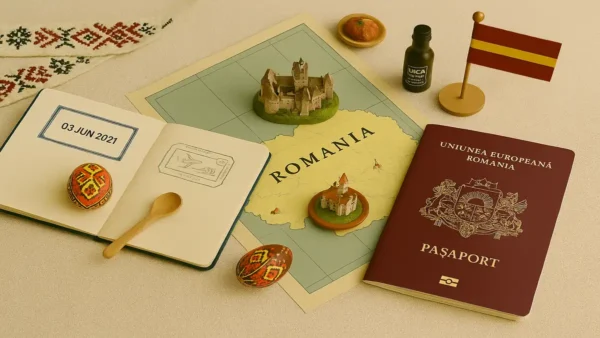
Most visitors do not need a visa for a short trip to Romania. EU, EEA and Swiss citizens enter with a valid ID card or passport. Holders of visa-exempt passports such as those of the UK, the US, Canada and Australia enter without a visa for up to 90 days in any 180, counted across the whole Schengen area with Romania included. Every other nationality needs a Schengen short-stay visa, applied for through Romania’s official visa portal before travel. Romania is a full Schengen member, so a day in Romania uses the same 90-day allowance as a day in Hungary, Italy or Germany.
How We Checked These Rules
This page answers, passport by passport, whether you need a visa for Romania, how Schengen counts your Romanian days and what the border checks; it is not a trip planner, a guide to entering Moldova, Ukraine or Serbia, or a visa service.
Alex Perrut, working in tourism since 2015, went over these entry rules for the Tripstou editorial team; the page was written with AI assistance, and our editorial process sets out how.
Official sources consulted: Romanian Ministry of Foreign Affairs, European Commission, EUR-Lex, UK Foreign Office, European Union – Travel to Europe.
Do you need a visa for Romania? Your passport decides
Your passport puts you on one of three routes. EU, EEA and Swiss citizens need no visa and travel on an ID card or passport. UK, US, Canadian and Australian passport holders, and other visa-exempt nationals, need no visa for a short stay within the 90/180 rule. Everyone else needs a Schengen short-stay visa before departure. For any passport not named here, the “Do you need a visa?” checker on eviza.mae.ro, run by the Romanian Ministry of Foreign Affairs, is the test that counts.
A short stay means tourism, business meetings or visiting family and friends. Work and study fall outside it. The EU’s common visa list decides which passports need a visa, and the Romanian checker applies that list to your nationality.
| Passport | Document needed | Stay rule | Where to check |
|---|---|---|---|
| EU, EEA, Swiss | Valid ID card or passport | Free movement, no 90/180 limit | Your own national ID rules |
| Visa-exempt (e.g. US, UK, Canada, Australia) | Passport meeting the Schengen validity rule | Up to 90 days in any 180, Schengen-wide | eviza.mae.ro checker |
| Visa-required nationals | Passport plus Schengen short-stay (type C) visa | Dates and entries printed on the visa | eviza.mae.ro application |
Romania issues Schengen visas; there is no separate Romanian tourist visa to apply for on top.
Romania is in Schengen, so Romanian days count toward your 90 in 180
Romania is a full member of the Schengen area, and every day you spend there comes out of the same allowance as your days in the other member states. Visa-exempt visitors may stay up to 90 days in any rolling 180-day period across the Schengen area as a whole, not per country. The separate Romanian allowance that older guides describe no longer exists.
Status: Romania has applied the full Schengen rules since 1 January 2025, when checks at its land borders with other Schengen countries ended, so days spent in Romania count toward the 90/180 limit.
The count looks back. On any day of your trip, border guards add up the days you spent anywhere in Schengen during the previous 180 days. Three weeks in Italy followed by five weeks in Romania uses 56 of your 90 days.
The days most often forgotten are the ones spent before Romania. A long summer in Greece or Croatia can leave little room for a Transylvania autumn trip if both fall inside the same 180-day window.
Ninety days covers almost any holiday. How long to spend in the country is a planning question that the Romania travel guide works through. Staying beyond the limit can lead to a fine or an entry ban, so count your days before a multi-country trip.
Can you use a Schengen visa from another country to visit Romania?
Yes. A valid Schengen short-stay visa issued by any member state is valid for Romania, within its validity dates, its number of entries and the 90/180 total. Holders of such a visa do not apply for anything extra to enter Romania.
It works the other way too: a Schengen visa issued by Romania covers travel to the other member states. Where you apply still matters, because the consulate that issues the visa should belong to the country where you will spend the longest (the application section below explains the rule). National long-stay visas and residence permits follow different rules, covered in the section on staying longer than 90 days.
What the Romanian border checks: EES, ETIAS and your passport
For a non-EU visitor, the Romanian border does two things today: it registers you in the Entry/Exit System and checks that your passport is recent enough and valid long enough. A third check, the ETIAS travel authorisation, is not part of it yet.
Does the Entry/Exit System register you when you enter Romania?
Yes. The Entry/Exit System registers non-EU travelers biometrically at the border and is fully operational across the Schengen area. You do not apply in advance. On your first entry the officer takes your fingerprints and a photo; later crossings are quicker because the record already exists. Registration happens at Romanian airports and at the external land borders with Moldova, Ukraine and Serbia.
Do you need ETIAS for Romania?
Not yet. ETIAS is a pre-travel authorisation for visa-exempt nationals that is not yet in operation; the European Union will announce the start date several months before launch. Once it runs, it will apply to visa-exempt nationals of 59 countries visiting 30 European countries, Romania among them. Each authorisation will be valid for up to three years or until the passport expires, whichever comes first. Websites selling an ETIAS today are not official.
How long must your passport be valid to enter Romania?
Your passport must have been issued less than 10 years before the day you arrive and stay valid for at least 3 months after the day you plan to leave the Schengen area. This is the Schengen rule, not a Romanian one. The “6 months” figure on many visa-agency sites is not the rule. EU, EEA and Swiss citizens travelling on an ID card simply need that card to be valid.
How to apply for a Romanian Schengen visa through eviza.mae.ro
Apply on eviza.mae.ro, the visa portal of the Romanian Ministry of Foreign Affairs. Run the “Do you need a visa?” checker, fill in the online application, then lodge it with your documents and fingerprints at the Romanian mission the portal names. The window opens six months before travel and closes 15 days before it.
A standard application rests on six elements:
- a passport that meets the issue and validity rule above;
- the completed application form;
- a recent photo;
- medical travel insurance covering emergency care, hospitalisation and repatriation;
- supporting documents for the purpose of the trip, your accommodation and your means of support;
- fingerprints, taken when you lodge the application.
The standard Schengen visa fee applies, and the portal’s fees section lists it. Processing normally takes 15 days and can be extended in individual cases.
Which country’s consulate do you apply to when Romania is one stop of several?
You apply to the consulate of your main destination, the country where you will spend the longest. When the stays are equal, you apply to the first Schengen country you enter. A Romania-only trip goes through a Romanian mission. A Vienna–Budapest–Bucharest route with most nights in Romania also goes through Romania, and the visa then covers the Austrian and Hungarian stops.
Crossing to Moldova, Ukraine or Serbia takes you out of Schengen
Romania’s borders with Hungary and Bulgaria are internal Schengen borders with no systematic passport check. Its borders with the Republic of Moldova, Ukraine and Serbia are external Schengen borders. There you pass passport control, the Entry/Exit System records your exit and your return, and your 90/180 clock pauses while you are outside and resumes when you come back.
What each crossing does to your trip:
- Hungary or Bulgaria: no routine check and no effect on the day count, though a member state may reintroduce temporary internal checks, so keep your passport or ID card on you.
- Moldova, Ukraine or Serbia: a full exit and entry check on each side, an EES record, and days outside Schengen that do not count toward the 90.
- Flying out of a Romanian airport to a non-Schengen country: an exit check and EES record at the airport, the same as at a land border. The Bucharest guide covers arriving at and leaving from the capital’s airport.
On a Bucharest–Chișinău side trip or a Timișoara–Belgrade crossing, the days spent in Moldova or Serbia are not Schengen days, so they do not come out of your 90. Check the other country’s own entry rules before you go, because this page does not cover them.
External borders are also where EU customs applies, and large sums of cash must be declared when you cross. Leaving the EU is where a non-EU shopper’s tax-free purchases are validated, which the guide to the VAT refund in Romania explains.
Staying in Romania longer than 90 days means a national visa, not a Schengen one
The 90/180 limit cannot be extended for tourism. A longer stay needs a long-stay national visa (type D) from a Romanian mission before you travel, followed by a residence permit from the General Inspectorate for Immigration once you are in Romania.
The type D visa is tied to a purpose such as work, study or family reunification. Remote workers have a digital-nomad route, applied for the same way. For a short-stay trip, the next decisions are about the country itself: where to go, when and for how long.
What to Remember at the Romanian Border
- Your passport sets the route: EU, EEA and Swiss citizens travel on an ID card, visa-exempt passports such as the US and UK need no visa for a short stay, and every other nationality needs a Schengen short-stay visa.
- Days in Romania come out of the same Schengen-wide allowance as days in Italy, Greece or Hungary, so add up your earlier Schengen days before a long trip.
- The Romanian border registers non-EU travelers in the Entry/Exit System with fingerprints and a photo, while ETIAS is not yet in operation and no site selling it today is official.
- A visa applicant goes through eviza.mae.ro only when Romania is the main destination; otherwise the consulate of the country with the longest stay issues the visa.
- Crossing into Moldova, Ukraine or Serbia means a full passport check and an EES record, and the days spent there are not Schengen days.
Romania Entry Questions, Answered Briefly
What do US citizens need to enter Romania besides a passport?
No visa, but be ready to show why and how you are travelling. US citizens enter Romania visa-free for a short stay, and Romanian border guards can ask for proof of a return or onward ticket, your accommodation and enough money for the stay, so keep those documents to hand on arrival.
Can you take a day trip to Moldova on a single-entry Schengen visa?
Not if you want to come back into Romania on the same visa. A single-entry visa allows one entry into the Schengen area, and leaving for Moldova, Ukraine or Serbia uses it up. A side trip outside Schengen needs a visa issued for two or multiple entries.
Can a child leave Romania without both parents?
A Romanian child aged 17 or under who leaves Romania without both parents may need notarised consent from the parent who is not travelling. Check the requirement with the Romanian authorities before the trip, since the consent is checked when the child leaves the country.
Plan the Rest of the Romania Trip
- Romania travel guide: how long to stay, when to go and which regions to choose.
- Bucharest guide: arriving in the capital and planning the first days.
- VAT refund in Romania: claiming back tax on purchases when a non-EU visitor leaves the EU.
Did this guide save you time or money? Tripstou is independent and reader-funded — if you'd like to give something back, you can support the site with a crypto contribution of any size.