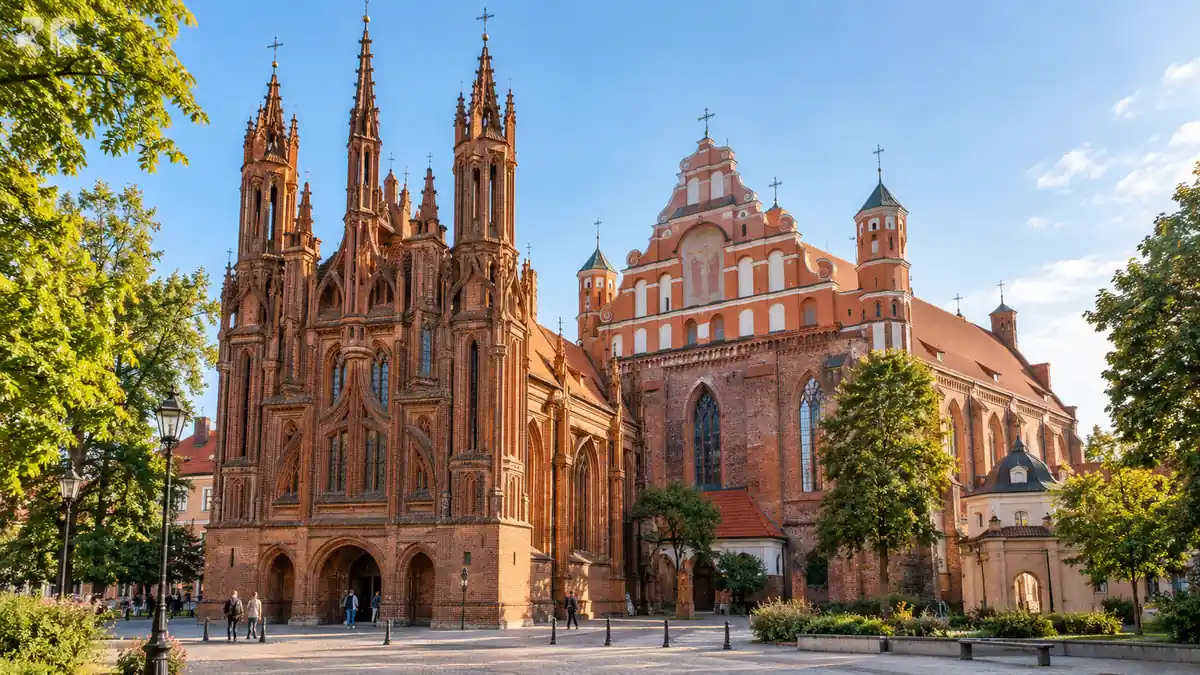
The Vilnius picks that earn your time are the Old Town core, the Gediminas Tower view and Užupis. The core (Gate of Dawn, St Anne’s, Cathedral Square) is free to walk on a one- or two-day stay; only the tower, museums and bell towers charge. History-minded travelers should give the KGB museum (the Museum of Occupations) its own hour.
Vilnius packs more into its Old Town than a short stay can hold. Baroque and Gothic churches stand a few minutes apart, courtyards open off almost every street, and three different viewpoints compete for the same hour. The real question is not what there is to see. It is what earns your time.
This page answers that question with a stance. The picks are grouped by theme: the Old Town core, the viewpoints, the Soviet history and the neighbourhoods beyond the churches. Each pick says what makes it different from the stop next door and who it suits best. Free sights are marked apart from the ones that charge entry. The page also names what to downgrade when time runs short, which is the part most lists leave out. Read it before you draw a route, and the route gets shorter.
The Old Town Churches and Courtyards Are the Core
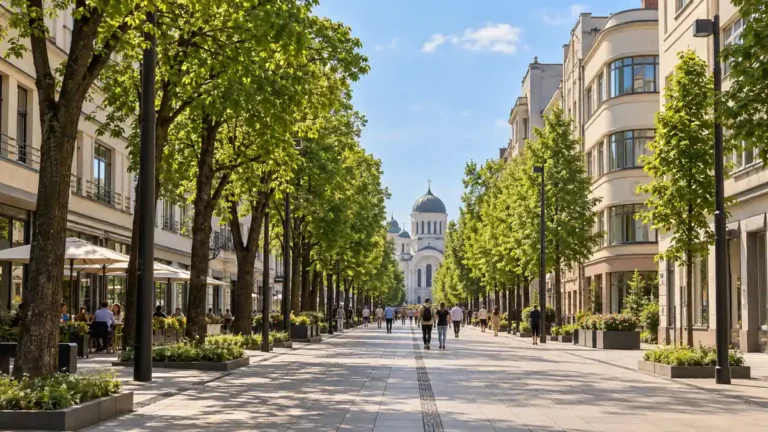
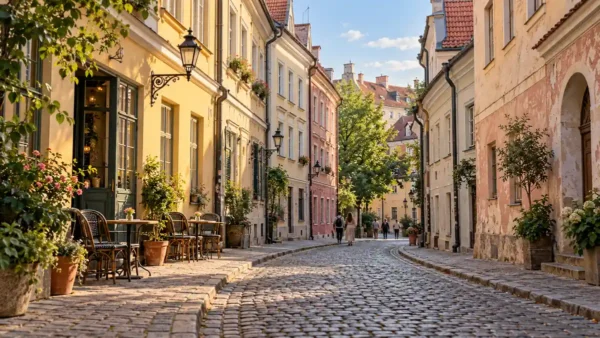
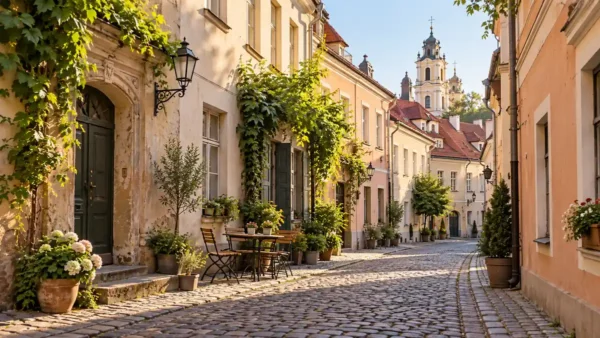
The Old Town is the best thing to do in Vilnius, and four stops deserve more than a glance. The Gate of Dawn, St Anne’s with the Bernardine complex, Cathedral Square and the university courtyards carry the city’s story. All four sit within a short walk of each other along the centre’s main axis.
Everything between them is worth walking slowly, but these are the places to stop. Each one shows a different side of the city. The core fits into one day because the centre is compact and walkable, with room left for one viewpoint and, on an early start, the KGB museum.
Gate of Dawn: the last city gate and its chapel
The Gate of Dawn (Aušros Vartai) is the only surviving gate of the old city walls. Above the arch sits a chapel holding a revered icon of the Virgin Mary, visible through a window from the street below.
What makes it distinct is that it is still in use. Worshippers stop, pray and sometimes kneel on the pavement while traffic and tourists pass underneath. It is a working pilgrimage site above a street, not a monument to look at. A visit takes a few minutes. Go in quietly, and keep photography discreet inside the chapel. It also makes a natural starting point for the walk north into the Old Town. Choose it for the one place where local devotion is visible, not just preserved.
St Anne’s and the Bernardine complex
St Anne’s Church is the most photographed building in Vilnius, a Flamboyant Gothic facade in red brick that is free to view from outside. Its intricate brickwork reads almost like lace from across the street. With time for only one church exterior, this is the one to see.
The pairing makes it distinct. St Anne’s stands beside the larger, plainer Bernardine church and monastery, so the delicate Gothic front and the heavier monastic mass appear in the same frame. See them together. Church-minded readers with extra time can add Sts Peter and Paul in the Antakalnis district, where the baroque interior is the whole reason to go. It sits outside the core, so it suits a second round of churches.
Cathedral Square: Cathedral, Bell Tower and the Palace of the Grand Dukes
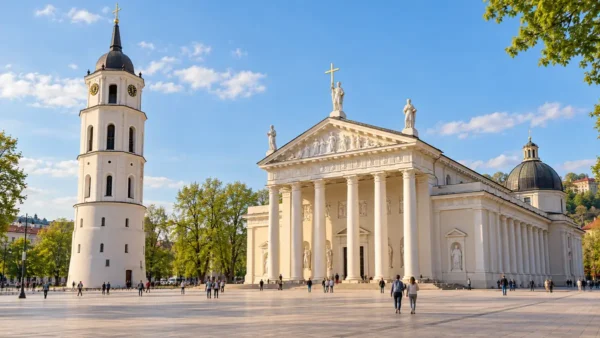
Cathedral Square is the civic and royal centre of Vilnius in one open space, at the foot of Castle Hill. The white neoclassical Cathedral, its free-standing Bell Tower and the rebuilt Palace of the Grand Dukes all face the same square.
Few places in the city hold this much state history in one space. The Cathedral is free to enter. The Palace is a paid museum covering the grand dukes who ruled one of the largest states in medieval Europe. From the middle of the square, the Cathedral, the Bell Tower and Castle Hill fit into a single frame. The square is also the base for the climb up Castle Hill, and readers after Lithuanian state history get it here in one stop before they start up.
Vilnius University courtyards
Vilnius University is one of the oldest universities in Central and Eastern Europe, and its linked courtyards are among the best architecture in the Old Town. Arcades, frescoed walls and St John’s Church open off one another behind the street front.
This is a working university, not a museum. Students cross the courtyards between classes while visitors wander the arcades. The ensemble rewards slow walking. St John’s bell tower rises above the main courtyard and doubles as a viewpoint, covered in the viewpoint section below. Allow time to look up: the courtyards are quiet, compact and easy to miss from the street. For anyone who likes architecture they can wander without a ticket queue, this is the stop. If you want to sleep inside this part of the city, see where to stay in Vilnius.
Which Vilnius Viewpoint Is Worth the Climb?
Gediminas Tower is the viewpoint to pick if you take one; the Hill of Three Crosses is the free alternative. The tower adds a short history exhibition to the classic skyline view. Three Crosses gives a wider panorama from a park hill. St John’s bell tower is the third option, worth it only in season.
The three options split cleanly by what you want from the view:
- Gediminas Tower: for first-timers who want the classic view and a history stop; it charges entry.
- Hill of Three Crosses: for travelers who want the widest view for free; it takes a longer park walk.
- St John’s bell tower: for warm-season visitors who want the view from inside the Old Town; it is seasonal and paid.
Choose one. Two viewpoints show the same roofs from slightly different angles. From the top of Gediminas Tower you cannot photograph Gediminas Tower, and the free hill puts it in the foreground of the skyline, so photographers often get the better picture without buying a ticket.
Gediminas Tower: the classic view up a steep path
Gediminas Tower is the surviving tower of the Upper Castle on Castle Hill and the city’s best-known landmark. It holds a small exhibition run by the National Museum of Lithuania, with the viewing platform on top.
Access is on foot, up a steep path that climbs the hill from near Cathedral Square. The walk is short but steep. Most visitors manage it without trouble, while travelers with limited mobility or small children should weigh the climb before planning around the view. Take it slowly. The tower is open daily, into the evening, which makes a late visit easy to fit around the rest of the core walk. One climb buys both the classic skyline shot and a short history stop.
Hill of Three Crosses
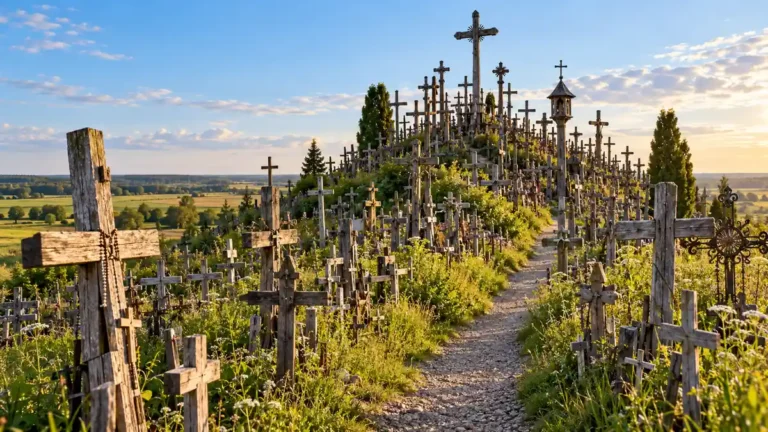
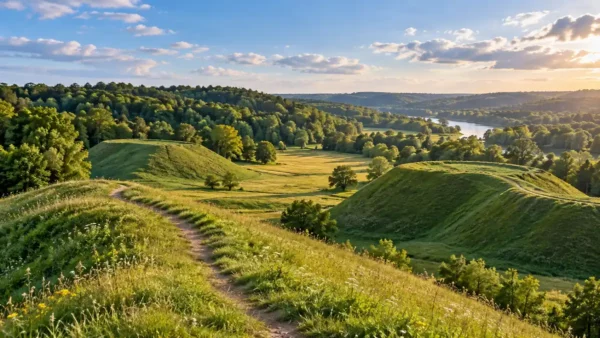
The Hill of Three Crosses is the best free viewpoint in Vilnius. It sits in Kalnai Park, just east of Castle Hill, and the white crosses on its summit are visible from much of the Old Town.
The angle is the point. From the top you look back at Castle Hill, Gediminas Tower and the Old Town roofs in one sweep. It is a park walk, not a ticketed site. No desk, no queue. Come here for the view for nothing and a quieter walk. The crosses you see today replaced an earlier monument destroyed during the Soviet period, so the hill carries its own piece of the city’s history. The path is steeper than it looks, and sturdy shoes help after rain.
St John’s bell tower (Vilnius University)
St John’s bell tower is the only one of the three viewpoints inside the Old Town grid. It stands in the Vilnius University ensemble above the main courtyard, and access is seasonal and paid.
Here the view comes from the middle. Instead of looking at the Old Town from a hill, you look down into it: the university courtyards, the church roofs and the streets you have just walked. The climb is part of the university visit. It rewards readers who already walked the courtyards below, as a warm-season way to look down on them. Outside the warmer months, treat it as closed and pick one of the two hills. If you only do one viewpoint on the whole trip, this is rarely the one.
The KGB Museum Is the Heaviest Hour in Vilnius, and Worth It
The Museum of Occupations and Freedom Fights, the former KGB headquarters, is worth its hour for almost every visitor. Its basement holds the former prison cells and an execution chamber, so visitors stand where the events took place. No other stop explains Soviet-era Vilnius as directly.
Locals still call it the KGB museum. The building is the exhibit. Most history museums tell you about events; this one puts you inside the rooms where they happened. The upper floors cover the Soviet occupation, the deportations and the armed resistance that gives the museum the “Freedom Fights” part of its name. The basement is the part visitors remember: narrow cells, an isolation room and the execution chamber at the end.
Some readers should downgrade it. Families with young children and travelers who want a light trip may find it too heavy, and nothing on this page requires it. Plan around its schedule. The museum is closed Mondays and Tuesdays; check the museum site for other days.
A visit changes how the rest of the city reads. After the basement, the Old Town’s restored facades and the state history on Cathedral Square stop looking like decoration, which is why it works best early in a stay. For history-minded readers, it is the Soviet layer of the city explained on the spot where it happened.
Užupis, Street Art and Local Life Beyond the Churches
Užupis, the self-declared republic across the river, is worth an hour, and two nearby stops show the everyday city. Literatų Street adds a free literary detour, and Halės Market turns lunch into a sight. Together they balance a trip full of churches with the Vilnius that locals actually use.
None of these stops needs a ticket. They work best at a slower pace, between the paid sights.
Užupis: the Angel, the Constitution and the mood
Užupis is an artists’ district just east of the Old Town that declared itself a “republic” on April Fools’ Day. The name means “beyond the river”, and the joke has held ever since.
It is a neighbourhood with its own joke, not a sight. The Angel of Užupis stands on a column in the main square. On Paupio gatvė, the district’s Constitution hangs on a wall of multilingual plaques. Its articles mix whimsy and principle, and reading a few in your own language is half the fun. Beyond the plaques, the appeal is in the galleries, riverside cafés and crooked courtyards. Come for the walk, not for a checklist: readers who enjoy a district that is more mood than monument get the most from it.
Literatų Street and street art
Literatų Street is a short Old Town lane lined with small artworks honouring writers connected to Lithuania. Each plaque is a different piece, in a different material, by a different artist.
Its appeal is the small scale. Nothing here is grand. The wall rewards close reading, and many visitors walk past without noticing it. It takes about ten minutes and costs nothing. For something to photograph that is not a church, this is the pick. Further out, murals and painted courtyards extend the theme beyond the Old Town, and they suit anyone who wants a looser walk after the churches. Street art changes as walls get repainted, so treat any one mural as a bonus. The Literatų Street plaques are the dependable part of this pick.
Halės Market and where to eat Lithuanian food
Halės Market is the city’s covered market hall, where the stalls serve locals, not visitors. That makes it the easiest place to see what Vilnius actually eats, and a better lunch stop than anything aimed at the tour groups on the main streets. Anyone who judges a city by its market should make this the lunch stop.
Lunch here is the sight. Two dishes deserve a try on any short stay. Cepelinai are large potato dumplings, usually filled with meat. Šaltibarščiai is a cold, bright pink beetroot soup, best on a warm day. In the warmer months, the seasonal weekend street-food market adds another place to graze.
What to Pay For and What to Skip on a Short Vilnius Stay
Vilnius rewards a walk-first plan: the Old Town core is free, so pay for one view and one museum. On a short stay, downgrade the second viewpoint, a third church interior and the Palace of the Grand Dukes, because each repeats something you have already seen or costs time the core deserves.
The compact centre packs churches, courtyards and squares within walking distance of each other. Add Užupis for mood, and treat everything else as optional once those anchors are covered.
Money splits the picks cleanly. Walking the core, looking at churches and crossing into Užupis are free. The tower, the museums and the bell towers charge entry. Pick one paid view and one paid museum, and the budget question mostly answers itself.
| Pick | What you pay | Who should prioritise it |
|---|---|---|
| Old Town core walk | Free to walk; the Palace museum charges | Every first-time visitor, whatever the length of stay |
| Gediminas Tower | Paid entry at the top of a steep path | Travelers who want the classic view plus history |
| Hill of Three Crosses | Free park walk up the hill | Budget travelers and anyone avoiding ticket desks |
| Museum of Occupations | Paid entry; closed Mondays and Tuesdays | Readers who want the Soviet layer explained on site |
| Užupis and Literatų Street | Free to wander at your own pace | Travelers who prefer mood over monuments |
Downgrading is part of the plan, not a failure of it. The Old Town has more church interiors than any visitor needs, and the second or third one adds little to the first. Cut early. For days, season and getting around, plan the trip in the Vilnius guide. To put these picks in walking order, follow the 2-day Vilnius itinerary.
A paid Old Town tour also drops down the list, because the centre is compact enough to guide yourself. Downgrade does not mean never. Each item below moves back up under a clear condition:
- The second viewpoint: Gediminas Tower and the Hill of Three Crosses frame the same roofs. It moves back up if you have spare time or want both the view and the photo of the tower.
- A third church interior: after St Anne’s and the Cathedral, the next interiors blur together. It moves back up if churches are your reason for coming; start with Sts Peter and Paul.
- The Palace of the Grand Dukes museum: a paid, detailed museum that fills more time than a one-day visit can spare. It moves back up on a rainy day or a second visit.
- A paid guided Old Town tour: the core is walkable and well signed. It moves back up if you want context on the Jewish and Soviet history of the streets. Tip-based free walking tours from several operators cover the basics for less.
The core stops are never on this list. Cut the extras first, and a short visit still covers the city’s best.
What most visitors cut last should go first: the Palace fills hours with context that the square outside and the free Cathedral already deliver in minutes.
In Vilnius the free half of the city is also the better half: the paid sights sharpen a visit, while the streets between them make it.
Tours and activities
Book skip-the-line tickets, day trips and local tours with free cancellation on most activities.
You can also browse everything on getyourguide.com.
Tripstou may earn a commission if you book through this link, at no extra cost to you.
Trakai and Day Trips from Vilnius: The Summary, Not the Plan
Trakai, with its island castle on a lake, is the classic day trip from Vilnius. It suits a half-day out and is the one trip out of the city that almost every Vilnius shortlist includes. Everything beyond it is a separate decision, with its own tradeoffs of time and interest.
Pick one trip, not two. The Vilnius day trips guide compares Trakai with the other options, including Kaunas (the second city). For the rest of the country, see things to do in Lithuania.
Behind This Shortlist
This page is a curated shortlist of sights and experiences inside Vilnius city, chosen for what earns time on a short stay, who each pick suits and what is free; it is not a full Vilnius city guide, a day-by-day itinerary or a plan for trips beyond the city.
This Vilnius shortlist was read through for the Tripstou editorial team by Alex Perrut, working in tourism since 2015. Produced with AI assistance, it follows the editorial process our About page sets out.
Official sources consulted: Lithuania Travel, Lithuanian Ministry of the Economy and Innovation.
Rainy Days and the MO Museum
Is the MO Museum in Vilnius worth visiting?
The MO Museum is worth it for art-minded travelers and for a rainy afternoon. It shows modern and contemporary Lithuanian art, which makes it a counterweight to a trip built on churches and Soviet history. On a short stay without a strong interest in art, the core walk and one viewpoint come first.
What is the best thing to do in Vilnius when it rains?
The KGB museum is the best rainy-day pick in Vilnius, since the whole visit is indoors. Pair it with the MO Museum for art or the Palace of the Grand Dukes, the paid museum a dry short stay can skip. Church interiors, from the Cathedral to Sts Peter and Paul, fill the gaps between them.
Did this guide save you time or money? Tripstou is independent and reader-funded — if you'd like to give something back, you can support the site with a crypto contribution of any size.