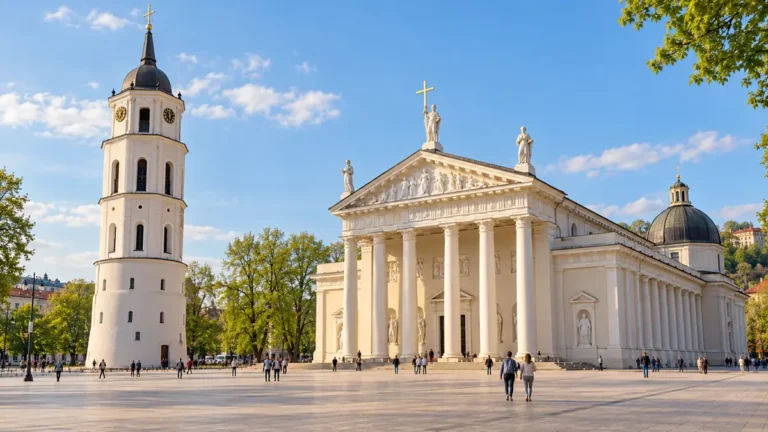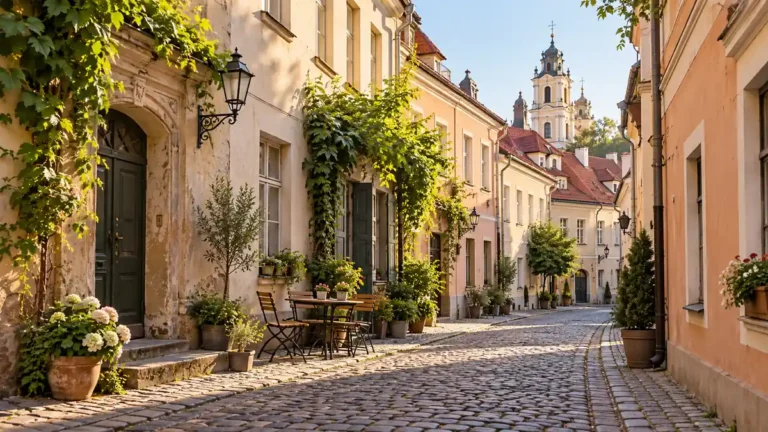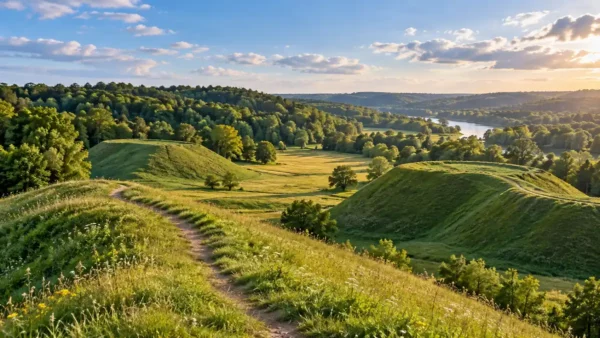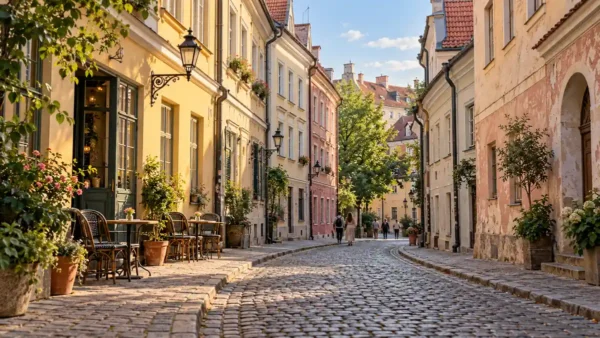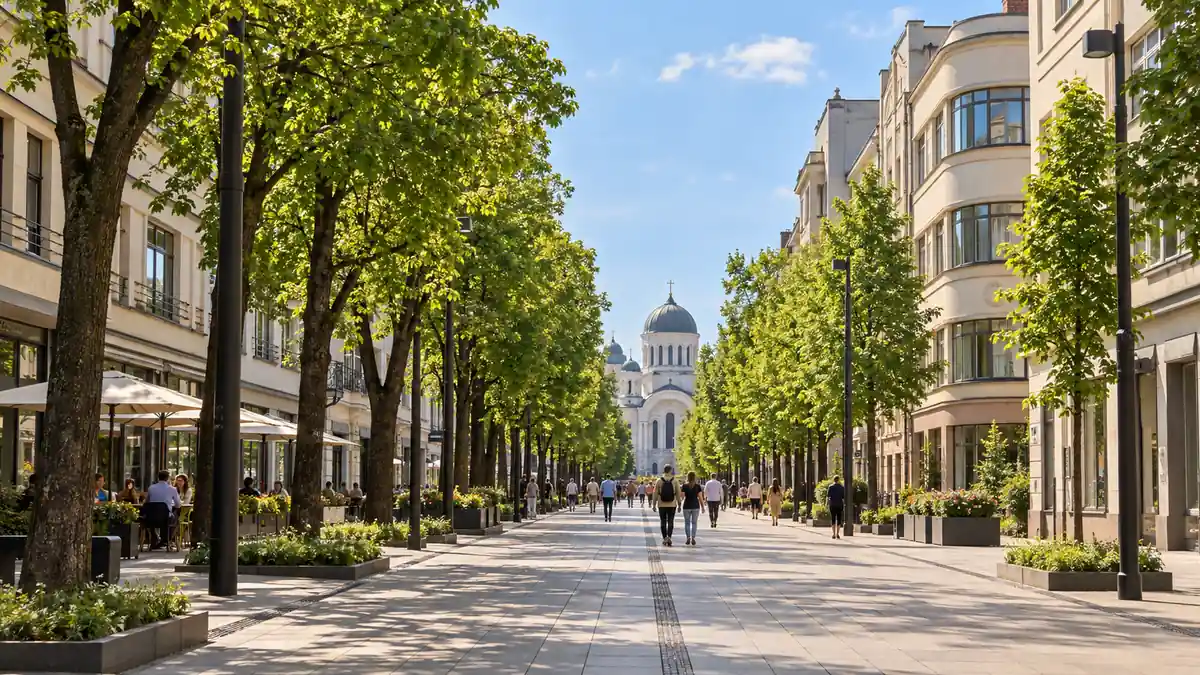
The best things to do in Kaunas are the UNESCO-listed interwar modernist centre, the Old Town where two rivers meet and the Ninth Fort. The modernist streets are the pick for most visitors and above all for architecture lovers; history-focused travelers should plan around the fort, and street-art fans around the murals and the Yard Gallery. A day trip covers the centre; stay one night to add the Ninth Fort and Pažaislis on a longer Lithuania trip.
Most travelers meet Kaunas as an add-on to Vilnius. The real questions are which sights earn your limited hours and whether the city earns a night of its own. This page answers both.
Kaunas splits cleanly into two halves, and the picks follow that split. The Old Town sits where two rivers meet, with the castle, the Town Hall and the best viewpoint over the water. The interwar New Town runs along Laisvės alėja, and its modernist buildings are the reason Kaunas stands apart from every other city in the Baltics. Beyond both halves sit two outlying picks, the Ninth Fort and Pažaislis Monastery, and they decide how long you should stay.
Interwar Modernist Kaunas Is the Reason to Come
Kaunas’s interwar modernist centre is UNESCO-listed and is what makes the city distinct in the Baltics. Built when Kaunas served as Lithuania’s temporary capital between the wars, the New Town (Naujamiestis) is lined with functionalist and Art Deco buildings on a grid of straight streets. Architecture travelers should give it at least an afternoon.
The temporary-capital years explain the look. A small provincial city suddenly had to house ministries, banks, a central post office, cinemas and apartments for a new professional class. It built them fast, in the modern style of the day, and it mixed that style with Lithuanian motifs.
On the street, interwar modernism in Kaunas means flat roofs and clean white or cream facades. It means rounded corners, ribbon windows, porthole details and tall stair towers. Some buildings add folk-inspired ornament or national symbols to otherwise plain fronts. The result feels calm, not flashy.
Walk it slowly. Laisvės alėja is the spine, the named buildings sit on or near it, and the church on the hill gives the overview.
Look up at corners and doorways here. The best modernist detail in Kaunas sits in curved balconies, lettering and entrance halls, and most of it is missed at a sightseeing pace.
Laisvės alėja, the Spine of the New Town
Laisvės alėja is the long pedestrian avenue that runs east through the New Town. It links the edge of the Old Town to the far side of the New Town, with shops, cafés and modernist facades along the way.
The avenue does the navigating for you. The other modernist picks need a route; this one is the route. It also carries the evening life of Kaunas, which is why an overnight stay feels different from a day visit. With one afternoon, it gives you the modernist centre without a map.
A Modernist Walking Route: Post Office, Pienocentras and the Officers’ Club
The named buildings on the UNESCO listing make an easy self-guided loop around Laisvės alėja. Read each one by the job it was built to do for the new capital:
- Former Central Post Office — the temporary capital’s main post office and one of the listing’s landmark public buildings.
- Pienocentras — the headquarters of the dairy cooperative, commercial modernism on a prominent corner of the centre.
- Romuva Cinema — an interwar picture house with a clean, modern street front.
- Officers’ Club — a stately building put up for the new army’s officers.
- Municipality building — civic modernism at its most restrained.
The loop is for travelers who come for architecture and want to read the buildings, not just pass them.
Christ’s Resurrection Church and Its Roof Terrace
Christ’s Resurrection Church is the tall white interwar basilica on Žaliakalnis hill, north of the New Town. Its flat roof works as a terrace, with a wide view over the modernist grid, Laisvės alėja and the rivers beyond. The climb up the hill on foot is steep but short.
Scale is the difference. Every other modernist pick is a street-level building; this church is the landmark you keep seeing from below, and its roof turns the whole New Town into one readable plan. Come up here for the modernist skyline from above instead of from the pavement.
Old Town and the Rivers: Where Kaunas Starts
Kaunas Old Town sits at the confluence of two rivers and takes half a day on foot. Its picks — the castle and Town Hall Square, Santaka Park at the river point and the Aleksotas viewpoint across the Nemunas — lie close together, so first-time visitors can cover all of them in one unhurried morning.
The Old Town is where the city’s story begins: the Nemunas and the Neris meet here, and the medieval street plan still funnels you towards the water. Start at the square, drift to the point, then cross the river for the view back.
Kaunas Castle and Town Hall Square
Kaunas Castle and Town Hall Square form the medieval core and the natural first stop. The castle stands on a bend near the confluence, and much of what you see today is a partial reconstruction on the old foundations. A short walk away, the white Town Hall anchors a broad square lined with old houses and cafés.
It works as the social centre of the Old Town. The other river picks are about space and views; this one is about street life, and it gives the city its bearings. On a first visit with a single morning, start here.
Santaka Park at the Confluence
Santaka Park is the green point where the Nemunas and the Neris meet, just beyond the castle. Paths run to the tip of the land, with water on both sides and the Old Town rooftops behind you. It is free to wander and never needs a plan.
Pace is what it offers. The square is busy and the viewpoint needs a crossing; Santaka is the open-air pause between them. Locals use it for walks and benches, and it shows how the rivers shaped the city better than any map. Slow travelers get the most from it: an easy riverside walk with nothing to queue for.
The Aleksotas Viewpoint
The Aleksotas viewpoint sits on the hill across the Nemunas from the Old Town. Cross the river on foot and climb the slope, and the classic panorama of Kaunas opens up: the Old Town roofs, the castle and both rivers meeting below. It is the postcard view of the city.
What sets it apart is the angle. Every other Old Town pick puts you inside the scene; this one lets you see it whole. The walk over the water is part of the payoff, and the view rewards late-afternoon light over the rooftops. It is the stop for anyone photographing the city, or with an hour to fill before the train back.
Street Art and Museums for the Quirky Side of Kaunas
Kaunas’s best street art sits within a short walk of the Old Town and Laisvės alėja. The murals are concentrated enough to see in an hour or two, while the museums reward specific interests more than general sightseeing. Street-art fans and rainy-day visitors get the most from this group.
Kaunas treats walls as part of its public culture, and large murals appear on buildings across the centre. They mix with the modernist walk without a detour. For collectors of the odd, the Devil’s Museum is the quirky alternative indoors.
The Wise Old Man Mural
The Wise Old Man is a large mural of an old man’s face painted across a building wall a short walk from the Old Town. It is the piece to start with: one wall, one face, and no searching once you are on the right street.
Its strength is recognition. The other street-art pick needs time and context; this one lands in a single glance. It works well as a stop between the Old Town and Laisvės alėja, with no ticket and no queue. For one photo that says Kaunas, this is the wall.
Yard Gallery (Kiemo galerija)
The Yard Gallery is a residential courtyard turned into an open-air gallery, with art covering the walls around the yard. Most street art is made to be seen from the pavement; this one asks you to step into a shared space and look closely.
The appeal is intimacy. The Wise Old Man is a landmark; the Yard Gallery is a neighbourhood. Because it is a residential courtyard, it rewards a quiet, respectful visit and some time to read the details on each wall. It suits travelers who prefer small, human-scale finds to headline landmarks.
M. K. Čiurlionis National Museum of Art
The M. K. Čiurlionis National Museum of Art is the country’s main collection of work by Mikalojus Konstantinas Čiurlionis, the painter and composer at the heart of Lithuanian culture. His dreamlike, musical paintings hang alongside wider collections of Lithuanian art.
Its reach goes further. The other picks in this group explain Kaunas; this museum explains Lithuania. It is the strongest indoor stop in the city and a natural move when the weather turns on a walking day. Go when rain moves you indoors, or when you want to understand Lithuanian art.
Is the Devil’s Museum in Kaunas worth visiting?
The Devil’s Museum is worth an hour for travelers who enjoy odd, single-theme collections. It is built around a large collection of devil figures, which makes it the city’s quirkiest indoor stop. It suits a rainy spell or a street-art day, but architecture and history travelers can skip it without losing much.
The Ninth Fort Is the Site History-Focused Travelers Should Not Skip
The Ninth Fort is a 19th-century fort turned memorial museum on the city’s edge. Built for the Kaunas Fortress ring, it became a site of mass murder during the Nazi occupation, and most of the people killed there were Jews murdered in the Holocaust. It is the one Kaunas pick that changes how the rest of the city reads.
The site has three parts that work together. The fort itself keeps its thick walls and underground casemates, the vaulted spaces that now hold the museum. Outside, a large memorial monument stands over the ground where the killings took place. Give each part time; the monument makes most sense after the museum.
What sets it apart is contrast. The modernist centre shows the confident city of the interwar years; the Ninth Fort shows what happened to many of its people next. Seen together, the two make Kaunas legible in a way neither manages alone.
Fit it carefully. The fort needs its own half-day, including the transfer out of the centre, and it is not a place to rush before a train. That is why it tips the verdict towards a night. It is also heavy going, so plan something gentle afterwards.
It belongs on any trip built around history, and on any route that follows the Second World War memory thread across the Baltics.
What is the Sugihara House in Kaunas?
Sugihara House is the former consulate where Japanese diplomat Chiune Sugihara issued transit visas to Jewish refugees during the Second World War. Today it is a museum that tells that story. It pairs naturally with the Ninth Fort for history-focused travelers, giving the wartime thread a story of rescue alongside one of loss.
Tours and activities
Book skip-the-line tickets, day trips and local tours with free cancellation on most activities.
You can also browse everything on getyourguide.com.
Tripstou may earn a commission if you book through this link, at no extra cost to you.
Pažaislis Monastery and the Kaunas Lagoon, Beyond the Centre
Pažaislis is a Baroque monastery on the Kaunas Lagoon, the one pick that needs an overnight stay. The church and monastery complex sits on the city’s eastern edge by the water, and its dome and Baroque interior stand apart from everything else in Kaunas. Slow travelers and architecture lovers get the most from it.
The complex is a full Baroque ensemble. A domed church rises between monastery wings, with an ornate interior that feels a world away from the flat roofs of the modernist centre. It sits beside the Kaunas Lagoon, a wide stretch of water with walks along the shore.
Here the draw is setting. Every other architecture pick on this page is urban; Pažaislis pairs grand interiors with water and open sky. In summer, the Pažaislis Music Festival brings concerts to the complex and the area around it, which adds an evening reason to be here.
Fit it as a half-day. Visit the church and monastery, then walk along the lagoon, or swim in summer. With the transfer from the centre, that fills a morning or an afternoon, which is exactly the time a day trip cannot spare. A night in Kaunas makes it easy.
Stay the night and it gives you architecture paired with water.
Is Kaunas worth visiting, and for whom?
Kaunas is worth visiting for its UNESCO-listed interwar centre and compact riverside Old Town. It rewards architecture lovers, history-focused travelers and anyone who prefers street art to big-ticket sights. The limit is scale: Kaunas is smaller and quieter than Vilnius, with fewer headline landmarks, so it suits a day or a night more than a long stay.
The shortlist was built on three tests. Each pick had to be distinct to Kaunas, reachable on foot or with one short transfer, and clearly matched to a type of traveler. Generic stops that any Baltic city offers were left out.
Four traveler profiles get the most from the city:
- Architecture lovers — the modernist New Town, Christ’s Resurrection Church and the Baroque of Pažaislis.
- History-focused travelers — the Ninth Fort and the story of the temporary capital.
- Street-art and quirky-find hunters — the murals, the Yard Gallery and the odder museums.
- Slow travelers — the rivers, Santaka Park and the lagoon.
The city works as two halves joined by a walk. The Old Town sits at the river point with the castle and the Town Hall. The interwar New Town, Naujamiestis, runs east along Laisvės alėja. Give each half its own block of time.
Kaunas pays off most for travelers who have already seen a Baroque old town or two in the region: the modernist grid is the part no other Baltic city repeats at this scale. Architecture and history travelers gain the most; anyone chasing more Baroque churches can skip the city. Kaunas is also known for the Old Town at the meeting of two rivers, a lively street-art scene and its spell as a European Capital of Culture.
| Pick | Best for | Time to allow |
|---|---|---|
| Modernist New Town and Laisvės alėja | Architecture lovers and first-time visitors alike | An afternoon on foot, longer with interiors |
| Old Town, castle and Town Hall Square | First-time visitors with a single morning | Half a day including cafés and side streets |
| Aleksotas hill viewpoint | Photographers and travelers short on time | About an hour on foot, river crossing included |
| Street art and the Yard Gallery | Travelers who like small, human-scale finds | An hour or two woven into walks |
| Ninth Fort memorial museum | History-focused travelers tracing wartime memory | Half a day including the transfer out |
| Pažaislis Monastery and the lagoon | Slow travelers staying at least one night | Half a day, more with a lagoon walk |
Day trip or overnight: how many days Kaunas needs
One full day covers central Kaunas; stay a night if you want the Ninth Fort and Pažaislis too. Both sit outside the walkable core and need their own transport and time. A night also buys the evening on Laisvės alėja. Two nights only make sense for slow travelers set on the museums and the lagoon.
- Day trip — buys the Old Town, the modernist walk along Laisvės alėja and one viewpoint. It fits travelers based in Vilnius who want the architecture and can live without the outlying picks.
- One night — adds the Ninth Fort or Pažaislis (both, with an early start) plus an unhurried evening in the New Town. It fits history and architecture travelers on a Lithuania trip of a week or more.
- Two nights — adds the museums, the street-art detours and a slow lagoon afternoon. It fits slow travelers who prefer settling in to ticking off sights.
Kaunas is about an hour by train from Vilnius. Tickets, timing and the other options from the capital are covered in our guide to day trips from Vilnius.
Staying over changes the Ninth Fort from a rushed late-afternoon detour into a calm morning visit. That shift is what unlocks the second half of this shortlist. On a longer Lithuania trip, a night here usually gives more than a second day trip out of Vilnius would.
Should you stay in the Old Town or near Laisvės alėja in Kaunas?
Stay in the Old Town for atmosphere and the rivers; stay near Laisvės alėja for the modernist centre and the city’s evening life. The two areas are joined by a walk, so neither choice cuts you off. Pick the New Town if your trip is mostly architecture, and the Old Town if the castle and river views come first.
What can you skip if you only have one day?
With one day, skip Pažaislis and the Ninth Fort and keep the Old Town, Laisvės alėja and the Aleksotas view. Both outlying picks need transport and a half-day each, which a day trip cannot absorb. Drop the indoor museums next, unless it rains, and keep the modernist walk as the non-negotiable core.
- Keep: the Old Town and Town Hall Square, the modernist walk along Laisvės alėja, one viewpoint (Aleksotas or the church roof) and the Wise Old Man mural on the way.
- Drop: Pažaislis, the Ninth Fort, the indoor museums and any second viewpoint.
Some travelers should reverse part of that cut. History-focused travelers can drop the museums and the viewpoint and keep the Ninth Fort, accepting a faster modernist walk. Architecture lovers can swap Aleksotas for the church roof, which sits closer to the New Town. On a wet day, the Čiurlionis museum earns back its place.
On a single day, the Aleksotas view gives the best return on time in Kaunas: one hour buys the whole Old Town and both rivers in one frame.
Travelers with more days in the country can build out from here with our shortlist of things to do in Lithuania, which covers Trakai, the Curonian Spit and the other national picks. For planning the wider trip, from entry rules to budget, start with the Lithuania travel guide.
Train and bus tickets
Compare routes, schedules and prices across rail and bus operators in one search, with mobile tickets on your phone.
New to Omio? Code NEW10 takes 10% off your first booking — or APPNEW10 if you book inside the Omio app. Both apply to bookings up to €80.
Search routes and compare prices on Omio →
Tripstou may earn a commission if you book through this link, at no extra cost to you.
About This Kaunas Shortlist
This is a curated shortlist of things to do in Kaunas, picked for how distinct each one is to the city and which traveler it suits. It is not a full Kaunas city guide, a day-by-day itinerary or a roundup of sights elsewhere in Lithuania, and it leaves fares, opening hours and hotel names out.
Written with AI assistance, this Kaunas shortlist was signed off by Alex Perrut, working in tourism since 2015, for the Tripstou editorial team; the editorial process page sets out how.
Official sources consulted: Lithuania Travel, Lithuanian Ministry of the Economy and Innovation.
Did this guide save you time or money? Tripstou is independent and reader-funded — if you'd like to give something back, you can support the site with a crypto contribution of any size.