Madeira is the Atlantic’s hiking island: levadas cut into cliff faces, laurel forest on a high plateau, mountain ridges above the cloud line, and a subtropical capital that works in any month. It belongs to Portugal but sits far out in the Atlantic, and it is the more accessible of the country’s two island regions.
Four decisions shape a first trip, and they come in order: whether the island suits you at all, how many days to give it, where to base, and whether to rent a car. Everything else follows from those answers.
One orientation fact does most of the planning work. Madeira is a single island with two characters — a sheltered, sunny south and a wet, dramatic north — and almost every practical choice, from base town to hiking day, traces back to that split.
Quick Answer
Madeira is worth visiting for hikers and landscape travelers: a subtropical Atlantic island, not a beach destination. Two variables shape the trip — how many days you have, and whether you rent a car. Most first-timers base in or near Funchal and drive; five to six days covers the island comfortably.
Trust Layer
Tripstou region guide for travelers planning a regional trip. Covers sub-areas, trip shape, base strategy, timing, and mobility tradeoffs.
Produced with AI assistance and reviewed by Alex Perrut, working in tourism since 2015, for the Tripstou editorial team. See our editorial process for details.
Last factual review: August 29, 2026.
Official sources consulted: Visit Portugal, Turismo de Portugal.
Key Takeaways
- Madeira suits hikers and landscape travelers; anyone planning a sandy beach holiday should look at Porto Santo or the mainland instead.
- Five to six days covers the whole island comfortably; three days only works as an add-on to a mainland trip.
- Base in or near Funchal for a first trip; a second base earns its place only on longer, north-heavy stays.
- A rental car unlocks the north coast, mountain viewpoints and levada trailheads that bus routes and city walking never reach.
- Without a car, Madeira still works from a Funchal base using buses and day tours, but early light disappears.
- The island’s sunny south and cloudy north differ daily, so keep one spare day and route each morning by the sky.
Table of Contents
Is Madeira Worth Visiting?
Madeira is worth visiting if you want dramatic landscape and daily walking more than sand. The island delivers cliff coastline, laurel forest, mountain viewpoints and a mild subtropical capital that functions all year. It disappoints travelers whose core plan is a sandy beach holiday.
The levadas are the defining draw. These irrigation channels, threaded in a dense network across the whole island, double as walking routes that reach forests, waterfalls and ridgelines a road never touches — the reason most repeat visitors come back, and the subject of our guide to hiking in Madeira.
The landscape works even without a hiking plan. Roads climb from sea level into cloud in a matter of minutes, viewpoints hang over vertical coastline, and the interior looks nothing like the coast you drove in from. Add a capital that stays mild through winter, and Madeira becomes one of Europe’s few genuinely year-round destinations.
The beach reality is the honest caveat: Madeira’s shoreline is rock, pebble and black sand, with swimming mostly in natural pools and lidos. Sandy beaches mean a trip to Porto Santo, the separate island offshore — a distinction worth reading before you plan around our roundup of Portugal’s best beaches. Of Portugal’s two island regions, Madeira is the more accessible, with the Azores demanding more connections and more time.
Who it does not suit: travelers who want long flat sunbathing days, a nightlife-led city break, or a first taste of Portugal. If you are still weighing the island against the mainland, our overview of the best places to visit in Portugal puts Madeira in context.
How Many Days You Need in Madeira
Five to six days is the right length for a first Madeira trip. That covers the south coast, the north, the mountain interior and one full hiking day without rushing between them. Three days works only as an add-on to a mainland Portugal trip. Longer stays buy weather insurance.
The tiers break down cleanly:
- Three to four days (add-on): Funchal plus one side of the island, one hiking day, one viewpoint drive. Fits travelers slotting Madeira into a wider Portugal trip and accepting they will see half the island. Works best appended to a ten-day Portugal itinerary, where the mainland already has its own momentum.
- Five to six days (full island): south coast, north coast, western plateau and eastern headland, with two walking days and room for one weather write-off. This is the tier that makes the flight worth it, and the one most first-timers should book.
- Eight days or more (deep): the whole island unhurried, several long levadas, and an optional two nights on Porto Santo for beach days. Fits repeat visitors, walkers, and anyone travelling in the wetter months who wants spare days in hand.
If Madeira is one leg of a bigger trip, the length pages do the arithmetic for you: a seven-day Portugal itinerary has little room for an island flight, while a fourteen-day Portugal itinerary absorbs a full Madeira block without gutting the mainland. Our general Portugal itinerary planner shows where the island fits in each shape.
Build one spare day into the plan for cloud. Madeira’s mountain viewpoints can sit inside a cloud layer for two days straight, then clear completely on the third — and the itinerary that has nowhere to move its hiking day is the one that loses it.
How to Get to Madeira
Madeira is reached only by air — there is no passenger ferry from mainland Portugal. That single constraint shapes planning: your arrival and departure days are flight days, and the island becomes a separate leg of any Portugal trip, not a detour you drive to.
Flights arrive from Lisbon and Porto year-round, alongside direct routes from a range of European cities, which is why the island is reachable without a mainland stop at all. If you are combining both, our Portugal travel guide covers the mainland leg you fly from. The airport sits on an exposed coastal shelf and has a reputation for windy approaches; go-arounds happen, and pilots flying it are specifically trained for the airport.
Porto Santo is a separate hop. The smaller island is reached from Madeira by ferry or by a short flight, and it is planned as its own overnight block, not a half-day excursion.
Madeira’s Sides and Sub-Areas — and Which Fits Your Trip
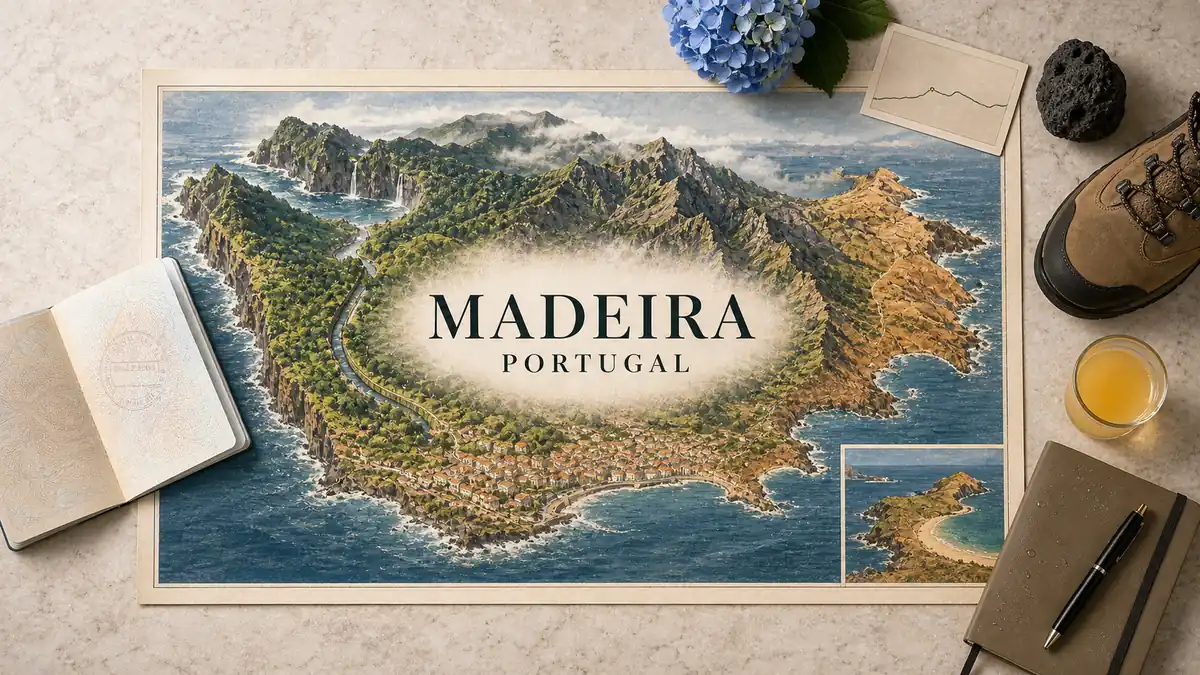
Madeira is one island with two climates: a sunny sheltered south and a wet, dramatic north. The west adds high plateau and laurel forest; the east narrows into bare volcanic headland. Understanding those four characters is what turns a Madeira map into a trip plan.
The south coast around Funchal is the island’s sheltered, developed face — the capital, the hotel belt, the botanical gardens and the cable cars, plus the sunniest weather on the island. It is where almost every first trip begins, and where the widest range of things to do sits within a short drive. Best for: first-time visitors who want a comfortable base with reliable sun.
The north coast, based around São Vicente or Porto Moniz, is the theatrical side: cliffs, waterfalls hitting the old coast road, volcanic sea pools, and cloud that arrives without warning. It is wetter and quieter, with fewer hotels and more atmosphere. Best for: travelers who came for landscape drama and do not mind rain.
The west, reached through Calheta and up onto the Paúl da Serra plateau, is the island’s high, empty interior — moorland, wind turbines, and the laurel forest that gives Madeira its most photographed woodland. Weather changes fastest here. Best for: walkers and photographers chasing forest and plateau light.
The east, around Machico and Caniçal, ends at the Ponta de São Lourenço peninsula, where the greenery stops and the island turns into bare ochre rock above the sea. It is the driest corner and the easiest hiking terrain. Best for: visitors wanting a short, spectacular coastal walk near the airport.
Porto Santo, offshore and reached separately, is the sand: a long golden beach and a slow, low-rise resort island with almost none of Madeira’s terrain. Best for: longer trips that want two or three genuine beach days.
| Area | Character | Base town | Best for |
|---|---|---|---|
| South coast around Funchal | Sheltered, sunniest, most developed side | Funchal or nearby Caniço | First-timers wanting comfort and reliable sun |
| North coast | Cliffs, waterfalls, wet and theatrical | São Vicente or Porto Moniz | Landscape travelers who accept the rain |
| Western plateau and forest | High moorland, laurel forest, fast weather | Calheta on the southwest coast | Walkers and photographers chasing forest light |
| Eastern peninsula | Dry, bare ochre rock above sea | Machico near the airport | Short spectacular coastal walking on arrival days |
| Porto Santo island | Long sandy beach, slow resort pace | Vila Baleira, the island’s only town | Longer trips that want real beach days |
Anchor experiences sit in each area, and they are covered at depth elsewhere: our list of things to do in Madeira handles the signature viewpoints, gardens and sea pools by area. If your instinct is to route around the tour-bus stops entirely, the off-radar corners of Madeira are mapped separately.
Pick your areas by weather tolerance, not by photograph. The north and the plateau produce Madeira’s best images precisely because they are the wettest parts of the island, and a trip that schedules them on fixed days is gambling with its two best days.
Where to Stay: One Base or Two?
Funchal or the nearby south coast is the right single base for a first Madeira trip. It holds the island’s accommodation and transport concentration, and the island is compact enough to day-trip from one place. Two bases make sense only on longer, north-heavy trips.
Funchal wins on logistics before it wins on anything else. It is the capital, the transport centre and where the island’s accommodation is concentrated, which means the widest choice, the easiest arrivals and the shortest reach to the airport. Its own attractions are a bonus covered in our Funchal city guide; as a planning decision, it is simply the most efficient place to sleep.
The one-base model works because Madeira is small. From the south coast you can reach the north, the east and the plateau on separate days and be back for dinner, which keeps luggage in one room for the whole trip. The tradeoff is time in the car and the fact that you never see the north in early light.
Two bases earn their place on trips of a week or more, typically Funchal plus two or three nights on the north coast or in the west. That split costs you a packing-and-transfer half-day, so it only pays when you actively want to be on the wet side at dawn and dusk — for photography, for early starts on northern levadas, or for the quiet that leaves with the day-trippers.
Hotels and places to stay
Compare hotels, apartments and stays for your dates in one search.
Search hotels and stays on hotels.com →
Tripstou may earn a commission if you book through this link, at no extra cost to you.
Do You Need a Car in Madeira?
A rental car is the strongest upgrade you can make to a Madeira trip. It unlocks the north coast, the mountain viewpoints and the trailheads, all of which sit far from bus routes. Without one, your Madeira shrinks to Funchal plus organised excursions.
The case for driving is about access and timing together. Levada trailheads and high viewpoints are reachable early, before the tour groups and often before the cloud; the north coast becomes a morning decision instead of a booking; and a bad-weather day can be redirected to whichever side of the island is clear. That flexibility is worth more on Madeira than on most islands, because the weather genuinely differs by coast.
The case against is narrow but real. If you are staying only in Funchal, walking the city and taking two or three organised day tours, a car sits parked and costs you paid parking in a dense capital. Nervous drivers, and travelers who dislike steep gradients or narrow lanes, are also better served by tours.
On cost, Madeira sits at the affordable end of European island travel, and the car is usually the main add-on to an otherwise moderate trip; our Portugal trip cost breakdown sets the wider baseline. The car earns that money on the days you did not plan — the pullout you stop at, the trailhead you reach at eight, the coast you switch to because the other side is under cloud.
What Is Driving in Madeira Actually Like?
Driving in Madeira is demanding but manageable, and short. Distances are small, the motorway network along the south coast is modern and fast, and the difficulty is concentrated on the older mountain and north-coast roads. Expect these conditions:
- Steep gradients. Some village roads climb sharply enough that first gear and engine braking are normal, not a sign of trouble.
- Narrow lanes with passing etiquette. On single-track mountain roads, the driver with the safer pullout gives way; expect to reverse occasionally.
- Tunnels everywhere. The main routes run through long tunnels that cut journey times dramatically and make the island feel smaller than the map suggests.
- Fast weather changes. You can leave sunshine at sea level and be in thick cloud with headlights on within a few kilometres of climbing.
- Parking pressure in Funchal. Street parking in the capital is tight; paid garages are the practical default for anyone based there.
Getting Around Madeira Without a Car
Madeira without a car works from a Funchal base and gets limiting everywhere else. Regional buses run, but they are built around Funchal and thin out on the north coast and in the mountains. Day tours and taxis fill the gaps at a cost.
The workable no-car trip looks like this: stay in Funchal, use the city on foot, take buses to nearer coastal towns, and book organised day trips for the north, the plateau and the levada walks that need a trailhead drop-off. Many walking companies include transfers, which solves the hardest problem — getting to a trailhead and being collected from a different endpoint.
The limitation is not access, it is timing. Bus frequency outside the Funchal corridor is low enough that a missed connection can cost an afternoon, and tours run on their own clock, which means you see the famous viewpoints when everyone else does. Travelers who want early light or empty trails will feel the constraint quickly.
Tours and activities
Book skip-the-line tickets, day trips and local tours with free cancellation on most activities.
You can also browse everything on getyourguide.com.
Tripstou may earn a commission if you book through this link, at no extra cost to you.
When to Visit Madeira
Madeira works year-round, and spring and autumn are the best months for hiking. Summer is the driest and busiest stretch; winter stays mild at sea level but wetter in the mountains. The island has no bad season, only seasons that suit different plans.
The north–south split matters more than the calendar. The southern coast can sit in full sun while the mountains and the north coast are closed in cloud, and the reverse happens too, so plan each morning around the sky and keep the fixed bookings light. Visitors who treat the day’s weather as a routing decision lose far fewer days than those who lock a hiking day to a date.
Seasonally, the summer months bring the highest visitor numbers and the tightest accommodation, while the quieter shoulder and winter months trade some of that pressure for more changeable mountain conditions. Our guide to the best time to visit Portugal covers the national picture, and Madeira’s mild winters make it a genuine outlier within it.
Pack for two climates in one suitcase. Sea level can be short-sleeve warm while a ridge walk is cold, windy and wet within the same afternoon, so a waterproof layer and proper footwear travel every month of the year — our Portugal packing list covers the base kit to build on.
Frequently Asked Questions
Does Madeira have sandy beaches?
Barely. Madeira’s coastline is mostly rock, pebble and dark volcanic sand, and the usual swimming spots are natural sea pools and seafront lidos, not open beaches. For a genuine golden-sand day, travelers take the ferry or short flight to Porto Santo, the smaller island offshore.
Is Madeira expensive to visit?
Madeira sits at the affordable end of European island travel, broadly in line with mainland Portugal. Food, transport and everyday costs stay moderate; the rental car is usually the main addition to the budget. Peak summer months push accommodation higher, and shoulder-season trips generally cost less.
Is landing at Madeira Airport dangerous?
No — it is demanding, not dangerous. The runway sits on an exposed coastal shelf where crosswinds and turbulence are common, so pilots flying the route hold specific training for the airport. Go-arounds and occasional diversions are a normal part of operating there, and passengers should expect a bumpy final approach.
Is Porto Santo worth visiting from Madeira?
Yes, on trips of a week or more that want real beach days. Porto Santo is reached by ferry or a short flight and delivers the long golden sand Madeira lacks, at a slow, low-rise pace. On shorter trips it costs too much of your island time.
Do you need to speak Portuguese in Madeira?
No. Portuguese is the official language, but English is widely spoken across Funchal, the hotels, restaurants and tour operators that visitors use most. A few polite Portuguese phrases go a long way in smaller north-coast and mountain villages, where English is less consistent, though gestures usually close the gap.
Related Guides
Madeira is one leg of a Portugal trip, and the mainland is planned separately. These guides cover the other half:
- Portugal by train on the mainland — the rail-based route between mainland cities, for the part of your trip that happens off the island.
- A mainland Portugal road trip — how the driving legs connect once you are back on the continent.
- The Silver Coast, north of Lisbon — a mainland coastal region that pairs well with a short island block.
- What to eat across Portugal — the national food guide, including how island cooking differs from the mainland.
- Common tourist scams in Portugal — the mainland city situations worth recognising before you arrive.
- Solo female travel safety in Portugal — practical mainland guidance for travelers going alone.
Did this guide save you time or money? Tripstou is independent and reader-funded — if you'd like to give something back, you can support the site with a crypto contribution of any size.