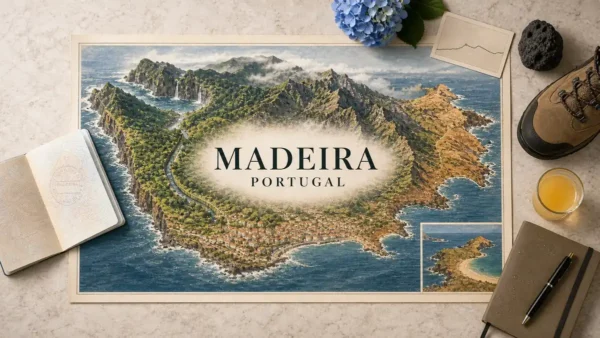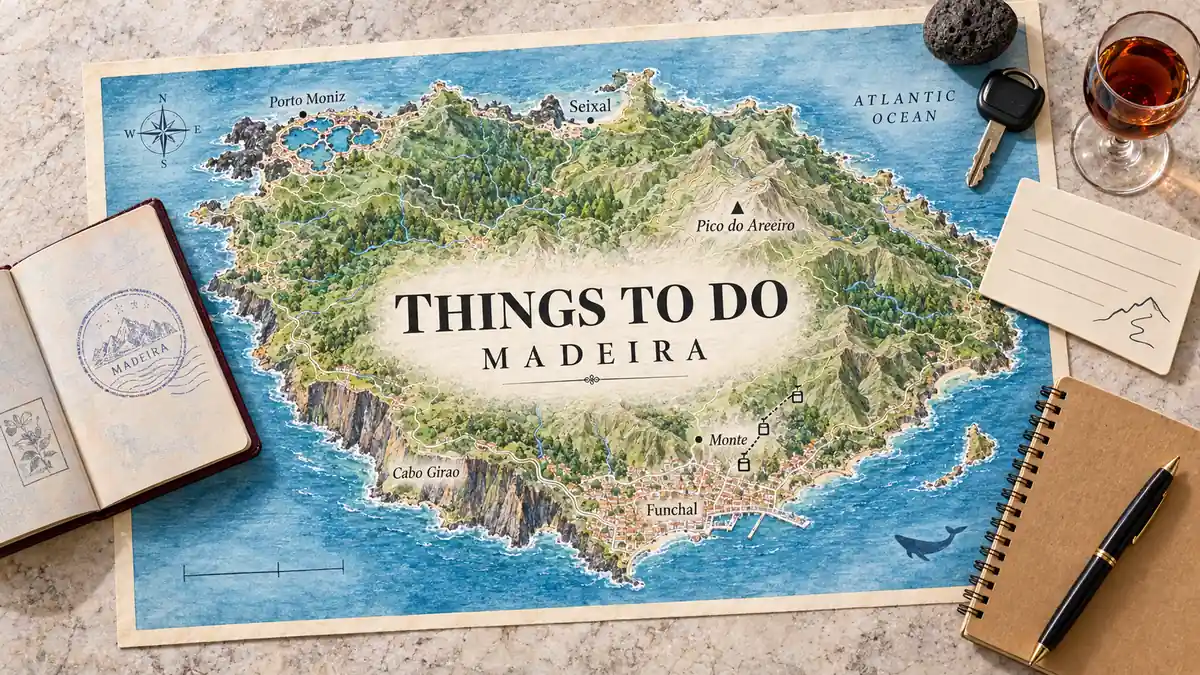
You have a few days on Madeira and more ideas than mornings. This page decides which experiences earn those days. Madeira is an outdoor island: nearly everything worth doing happens outside, depends on what the sky is doing that morning, and sits at the end of a drive. That makes the choosing harder than it looks, because the forecast keeps rewriting the order.
Nine experiences are judged here — a sunrise above the cloud, a walk beside a levada, the sea pools and the boats, the Monte pairing, an afternoon of fortified wine — each with a verdict, the traveler it suits, and the catch that decides it. The page does not rank towns, plan your days or walk you through named trails.
Quick Answer
Madeira’s best experiences are a Pico do Areeiro sunrise, one levada walk, the Monte pairing and a sea day. Weather decides the order: cloud kills the mountain, swell closes the pools and cancels the boats. Book the classified levada ahead; non-hikers get the coast, Monte and the boats, and wine tasting is the rainy-day swap.
Trust Layer
Tripstou attraction guide for travelers deciding whether an experience is worth doing and how to do it well. Covers value, booking versions, timing, access, and traveler fit.
Produced with AI assistance and reviewed by Alex Perrut, working in tourism since 2015, for the Tripstou editorial team. See our editorial process for details.
Last factual review: September 11, 2026.
Official sources consulted: Visit Portugal, Turismo de Portugal.
Key Takeaways
- Four experiences carry a first visit: the Pico do Areeiro sunrise, one levada walk, the Monte pairing and a sea day.
- Pick each day by forecast: cloud kills the summit and the cable-car view, while swell closes the pools and cancels the boats.
- Book the classified levada ahead, book a tasting slot and book the boat early; the pools and the toboggan are walk-up.
- Cable car up and toboggan down is the Monte default, but check before you go: the sledge does not run daily.
- Non-hikers lose nothing: the coast, the boats, the Monte pairing, the lava tubes and a wine tasting fill a full week.
- Cabo Girão, Santana’s houses and Câmara de Lobos are twenty-minute stops, so fold them into a driving day instead.
Table of Contents
Madeira’s best experiences are outdoor, weather-led and drive-led
Madeira is famous for outdoor experiences that depend on the weather and, mostly, on a car. The signature set is small: a sunrise above the cloud, levada walks through laurel forest, volcanic sea pools, a cable car and a wicker toboggan, and fortified wine. Almost none of it happens indoors, and almost none of it happens without driving.
That combination decides how you plan. You pick the day by forecast, not by list. The island’s two sides also rarely fail together — a clouded summit often sits above a bright coast — which is why a cancelled plan here usually becomes a swap instead of a wasted day.
This page profiles five groups of experiences:
- Mountain viewpoints — the high summits and cliff platforms you drive to for something the road itself cannot give you.
- Forest and water — walks beside the levada channels through laurel forest, and the ravines the same water carved.
- Coast and sea — volcanic rock pools, black-sand swims and boat trips out from the south coast.
- The Monte pairing — the cable car up from Funchal and the wicker toboggan that runs back down.
- Food and wine — a tasting of the island’s fortified wine and a glass of poncha in a harbour bar.
Two decisions sit outside this page. Whether you need a car, where to base yourself and how long the island deserves belong to our Madeira travel guide; nearly every experience below assumes you can drive to it or join something that drives for you. And if you are still weighing an island week against the mainland, our guide to the best places to visit in Portugal puts Madeira in national context.
Which Madeira viewpoints are worth the drive?
Two viewpoints earn a dedicated drive on Madeira: Pico do Areeiro at sunrise and the Cabo Girão skywalk. Areeiro gives you the island’s one true spectacle, the sea of cloud below the summit; Cabo Girão gives you a glass floor over one of Europe’s highest sea cliffs. Every other miradouro is a stop you take because you are passing.
A viewpoint earns a dedicated drive when it delivers something the road does not — the cloud sea, the drop, the light. The caveat is cloud: if the summit is buried, neither the drive nor the dawn alarm pays, so hold the mountain morning for a forecast that promises clear air above the hills.
Areeiro is the one experience you commit to blind: you set out in the dark and only learn at the top whether the cloud is below you or around you.
Pico do Areeiro at sunrise
Pico do Areeiro is an activity at sunrise and a stop at any other hour. Arrive before first light, watch the cloud layer turn and stay while the light moves across the ridges, and it becomes the experience people remember from the trip. By day it is a twenty-minute stop.
Worth it for: early risers who want the island’s one true spectacle, above the cloud.
The tradeoffs are real: a pre-dawn drive up a winding mountain road, cold at the top even when the coast is warm, and the chance that the summit sits inside the cloud instead of above it. The ridge route that starts here is the island’s headline walk, and its access rules change and must be checked before the day; our guide to Madeira levada walks and hikes covers the walking side.
The Cabo Girão skywalk
Cabo Girão is worth twenty minutes and no more, which is exactly the right amount. The platform is one of Europe’s highest sea cliffs with a glass floor set over the drop, and standing on it is a jolt — you see terraced fields and surf beneath your shoes. Then you have seen it.
Worth it for: non-hikers who want cliff drama in a twenty-minute stop.
This is a stop, and treating it as one is the honest call. Fold it into a day already heading along the south coast and it costs you nothing; drive out for it alone and the return journey is longer than the experience. Anyone uneasy with heights should know the glass floor is the whole point of the platform, and the cliff edge reads just as dramatic from a few steps back.
A levada walk is essential, and canyoning is the upgrade for the fit
One levada walk belongs on every first visit to Madeira, whatever your fitness. Flat stretches exist, and the laurel forest they run through is the point. The catch is booking: classified routes must be reserved ahead, and some close after storms. Canyoning is the same landscape at full effort, guided only.
A levada is an irrigation channel cut along the contour of the hillside, with a narrow maintenance path running beside it. Follow one into the Laurissilva — the ancient laurel forest that covers the island’s wet interior — and you get moss, water and tree ferns with barely a gradient.
A levada walk in the Laurissilva
A levada walk is the experience that defines Madeira for most travelers, and it does not require a hiker’s legs. The channels follow the contour, so the gradient stays gentle for long stretches, and the reward is the laurel forest itself: wet, green, quiet and unlike anything on the Portuguese mainland.
Worth it for: every first visit, including non-hikers who pick a flat stretch.
The planning rule matters more than the route. Classified walking routes on Madeira require a booking made in advance, and trails can close after storms or landslides, so choose your walk and secure it before the morning you want to go. Which walk suits your fitness, how the booking works and what the conditions are on the day belong to our guide to Madeira levada walks and hikes.
Canyoning in the ravines
Canyoning is the upgrade for travelers who want the forest at full effort. A guide takes you down a stream bed in a wooded ravine, abseiling past waterfalls, jumping into pools and sliding polished rock chutes. It is the same landscape as the levada walk, seen from inside the water instead of the path beside it.
Worth it for: adrenaline seekers with a guide and a dry forecast.
It is guided only, and that is not a formality. The routes need ropes, local knowledge and an honest read of the water. Heavy rain cancels the day outright, because the same streams that make the descent fun turn dangerous when the interior is saturated. Plan a half-day and a reasonable level of fitness.
Tours and activities
Book skip-the-line tickets, day trips and local tours with free cancellation on most activities.
You can also browse everything on getyourguide.com.
Tripstou may earn a commission if you book through this link, at no extra cost to you.
Coast and sea: Porto Moniz pools, whale watching and where you can swim
The sea side of Madeira is rock pools and boat trips, and swell decides both. The volcanic pools at Porto Moniz and a whale-and-dolphin trip are the two sea days worth planning, and because swell rules them, they are the natural swap when the mountains are shut. Swimming here is rock pools and black sand.
A rough sea closes the pools and cancels the boats on the same morning, so the sea day needs a calm forecast. That is the mirror image of the mountain rule: keep the summit for clear air and the coast for flat water, and read both before you commit.
Porto Moniz natural pools, and where else you can swim
The Porto Moniz pools are worth the drive to the north-west corner on a calm day. Lava flows left a set of natural basins in the rock that the Atlantic refills, and swimming in clear water with surf breaking a few steps away beats any hotel pool. The complex closes when the sea is rough.
Worth it for: swimmers and families on a calm-sea day who accept rock pools over sand.
There are ticketed and free sections at Porto Moniz, and the ticketed side is the more managed swim. Elsewhere on the island, swimming means Seixal’s black sand, the sheltered strand at Calheta and a scattering of other sea-pool complexes along both coasts. None of it is a long golden beach, and expecting one is the quickest way to be disappointed by an otherwise spectacular coast.
Whale and dolphin watching
A whale-and-dolphin trip is worth a half-day for travelers who accept a chance instead of a promise. Dolphins are the common sighting off the south coast; whales pass through by season and by luck. What you are buying is a morning on deep water with people who know where to look.
Worth it for: wildlife-first travelers who accept a chance, not a guarantee.
Boats here work under licence, approaches are time-limited, and swimming with cetaceans is not part of a standard trip. Those rules exist to keep the animals undisturbed, and they are also why a good skipper keeps a distance you might not expect. Swell cancels sailings outright. On marginal days, bring sea-sickness tablets. Book a morning early in your stay, so a cancelled trip still has a second chance.
Is the Monte cable car and toboggan pairing worth it?
The Monte pairing is worth it once, for the view going up and the story coming down. The cable car climbs from downtown Funchal to Monte and hands you the harbour and the hills on the way; the wicker toboggan is a few minutes you will describe to people for years. The real choice is which version you buy.
Three versions of the Monte trip exist, and they suit different travelers:
- Cable car return only — view-first travelers and anyone who will not sledge. You get the harbour-to-hills view twice, going and coming, and you miss the story everyone asks about.
- Cable car up, toboggan down — first-timers and families with older children. This is the classic pairing, but the sledge finishes part-way down toward Livramento, so plan how you are getting back before you slide, and know it does not run every day of the week.
- Drive up and skip both — car-based travelers short on time who want the hilltop without the queue. You lose the ascent view entirely, and Monte’s hilltop without the ride is a stop, not an activity.
Monte is the island-level entry here: the cable car, the hilltop and the sledge. Funchal’s own sights are a separate decision and are not covered on this page.
The Funchal–Monte cable car
The cable car is the best ascent to Monte for anyone who would prefer not to drive the hill. It lifts you out of downtown Funchal and over rooftops and gardens, and the view back across the harbour and the amphitheatre of the city is the reason to buy it. The ride up is the product.
Worth it for: first-timers who want the harbour-to-hills view without driving.
It runs daily, and you can buy the return or the cable-car-and-toboggan combo at the terminal or online. Decide which before you queue, because changing your mind at the top is the part people get wrong. One tradeoff outranks everything: cloud sitting on the hill erases the view you paid for, so look up at Monte from the seafront before you buy a ticket.
The Monte wicker toboggan
The toboggan is worth doing once, and it is a story more than a thrill. Two carreiros push and steer a wicker-and-wood sledge down the road from Monte toward Livramento, braking with the soles of their boots. It is charming, slightly absurd and over quickly.
Worth it for: anyone who would trade the view for a story to take home.
Treat it as a few minutes of fun and it delivers exactly that. Treat it as a ride and it will underwhelm you. Two things to know before you commit: it does not run every day of the week, so check before you go up, and there is usually a queue at the top. If the queue is long and the idea does not appeal, skipping costs you nothing but a photograph.
Madeira wine and poncha are the best weather-proof afternoon
Wine tasting is the experience on Madeira that no weather can cancel. A guided flight of the island’s fortified wine works in cloud, rain or swell, and a glass of poncha in a fishing-village bar is the cheap, sociable version of the same afternoon. Both are indoor, both are short.
Worth it for: couples and non-hikers who want the island’s flavour with zero weather risk.
Madeira wine is a fortified wine matured with heat, which is why it travels as well as it does and why the styles run from bone dry to properly sweet. That range is the argument for a flight over a single glass: one style tells you nothing, four tell you which one you actually like. Tastings happen at wine lodges and out at producers in the vineyards.
Poncha is the island’s other drink and the easier afternoon: cane spirit with citrus juice and honey, mixed by hand and drunk standing up. Câmara de Lobos, the fishing village along the coast from Funchal, is where people go for it. It is a stop on a driving day, not a destination in itself.
- Book the tasting, skip the walk-in — lodges and producers run tastings to a schedule, and a booked slot gets you the guided flight instead of a glass at a counter.
- Ask for a flight across the styles — dry through sweet in one sitting is the only reliable way to find the Madeira you like.
- Settle the driver first — every road back from a tasting is a mountain road, and this is the one afternoon on the island where that changes the plan.
Madeira Without Hiking, and When the Weather Turns
You do not need to hike on Madeira, and a rainy day is a swap, not a loss. Non-hikers fill every day from the coast, the Monte pairing, the boats and the wine, and bad weather moves you to the other side of the island, underground or indoors.
What to do in Madeira without hiking
A non-hiking week on Madeira is full without compromise, and one flat levada stretch stays available if you want the forest without the effort. Build the rest from these:
- The Monte pairing — the cable car does the climbing and the toboggan does the descending, so the island’s most photographed sequence needs no walking.
- A whale-and-dolphin trip — a half-day where you sit down the whole time and still end up somewhere no road reaches.
- The Porto Moniz pools on a calm day — a swim, a drive along the north coast and lunch, with the effort entirely optional.
- The Cabo Girão skywalk — cliff drama measured in steps from the car park, glass floor included.
- A Madeira wine tasting — the island’s flavour delivered sitting down, indoors, in any weather.
- The Grutas de São Vicente — volcanic lava tubes you walk through on a flat, lit path, which is the gentlest way to see what built this island.
What to do in Madeira when it rains
Rain and cloud remove specific experiences, not the day. Here is what dies and what replaces it:
- Cloud on the summit kills the Areeiro sunrise and flattens the cable-car view — swap in a wine tasting or the Grutas de São Vicente, which ignore the sky entirely.
- Swell on the coast closes the Porto Moniz pools and cancels the boats — take the Monte pairing instead if the hill is clear, or drive toward the drier side.
- Heavy rain in the interior cancels canyoning and can close levada routes — the lava tubes and a tasting flight fill the same hours without a forecast check.
- Grey but dry is the underrated day — Santana’s triangular houses and a slow coastal drive work fine under cloud, and the light is kinder for photographs.
- A full washout is the day to stop driving — pick one indoor experience, eat a long lunch, and push the mountain to the next clear forecast.
How to Choose: First-Timers, Families and What to Skip
First-timers do the sunrise, one levada, the Monte pairing and a sea day; the rest is bonus. Families swap the booked levada for the pools and the caves, and everyone treats Santana’s triangular houses, Câmara de Lobos and the roadside miradouros as stops folded into a driving day, not as activities that deserve one.
| Experience group | Best for | Weather risk | Book ahead? |
|---|---|---|---|
| Mountain viewpoints (Areeiro sunrise, Cabo Girão) | Early risers and non-hikers wanting big views | Cloud closes the summit view | No, but check the sky first |
| Forest and water (levada walk, canyoning) | Walkers, and the fit who want full effort | Storms close trails; rain cancels canyoning | Classified trails — yes, in advance |
| Coast and sea (Porto Moniz, whale watching) | Swimmers, families and wildlife-first travelers | Swell shuts the pools and the boats | Boats yes; the pools are walk-up |
| The Monte pairing (cable car, toboggan) | First-timers and families with older children | Cloud on the hill erases the view | Walk-up; sledge not daily |
| Food and wine (tasting, poncha) | Couples and non-hikers wanting zero weather risk | None; the reliable wet-day choice | Book the tasting; poncha walk-up |
Families get more from the coast than the mountain. Porto Moniz on a calm day is the standout — natural pools, shallow edges, a proper swim — and the whale-and-dolphin trip, the cable car and the lava tubes all work across mixed ages. Santana’s triangular houses are a photo stop that children tend to like more than adults expect. The toboggan suits older children who will sit still and hold on, and the levada belongs in a family week only as a flat, fenced stretch.
Three famous names — Santana’s triangular houses, Câmara de Lobos and Cabo Girão — are twenty-minute stops that work best folded into a driving day already passing. The trap on this island is not missing an experience; it is spending a whole day driving to one that a passing hour would have covered. Two honest skips: the toboggan when the queue is long and the story does not appeal, and the whale trip in a swell — waiting for a calm morning beats paying to be sick.
Tour or self-drive is decided by the experience, not by preference. Boats and canyoning are tours by nature; what you are paying for is someone else’s licence and rope. Viewpoints, levadas and the pools reward a car, because you leave when the forecast says leave, which is the whole game here. A guided island day is the right call for non-drivers and very short stays, at one real cost: group departures rarely leave early enough for the sunrise.
Once you know which experiences you want, the sequencing is a separate decision. To slot the island into a wider route around the country, use our Portugal itinerary. And if you are weighing an island week against the mainland’s set — palaces, river valleys, surf coast — our guide to things to do in Portugal makes the comparison.
Frequently Asked Questions
Do you need to book Madeira trails in advance?
Yes — classified walking routes must be booked before the day, and some close after storms. The rule follows the route’s classification, not its length, so a short flat walk can still need one. Our Madeira levada walks and hikes guide covers which route to pick.
Is Madeira worth visiting if you don’t hike?
Yes. Most of the island’s signature experiences involve no walking at all: the cable car and toboggan, a whale-and-dolphin trip, the Porto Moniz pools, the Cabo Girão skywalk, the lava tubes and a wine tasting. The only real loss is the laurel forest, which one flat levada stretch still gives you.
Can you visit the Porto Moniz pools all year?
Sea state decides, not the calendar. Rough water closes the complex on any day it arrives, and it can arrive in any month, so there is no season that guarantees a swim. Check conditions the morning you plan to go and treat the pools as a calm-forecast swap, not a fixed date.
Is the Monte toboggan ride safe, and what actually happens?
It is a controlled descent on a public road, not a fairground ride. Two carreiros walk and steer behind a wicker-and-wood sledge, braking with the soles of their boots, and it runs only a few minutes before stopping part-way down toward Livramento. Expect charm and a queue, not speed.
How many things can you realistically fit in one day in Madeira?
One headline experience plus one or two roadside stops. The roads are slow and winding, weather can move the plan mid-morning, and everything sits at the end of a drive, so a day built around three big commitments usually loses one. Pair one experience with stops already on the route.
Are organised tours worth it in Madeira, or should you drive yourself?
Book single-experience tours and drive everything else. The boat trip is licensed and canyoning needs ropes, so both are tours regardless. A full-day island tour is a fallback for non-drivers and very short stays; it trades away the freedom to change plans when the forecast does.
Related Guides
- Madeira Travel Guide — whether you need a car, where to base yourself and how long the island deserves.
- Madeira Levada Walks and Hikes — which walk suits your fitness, how the booking works and what the conditions are on the day.
- Best Places to Visit in Portugal — where Madeira sits among the country’s regions and cities.
- Portugal Itinerary — how to fit an island week into a wider route.
- Things to Do in Portugal — the national set of experiences, from palaces to the Atlantic coast.
Did this guide save you time or money? Tripstou is independent and reader-funded — if you'd like to give something back, you can support the site with a crypto contribution of any size.