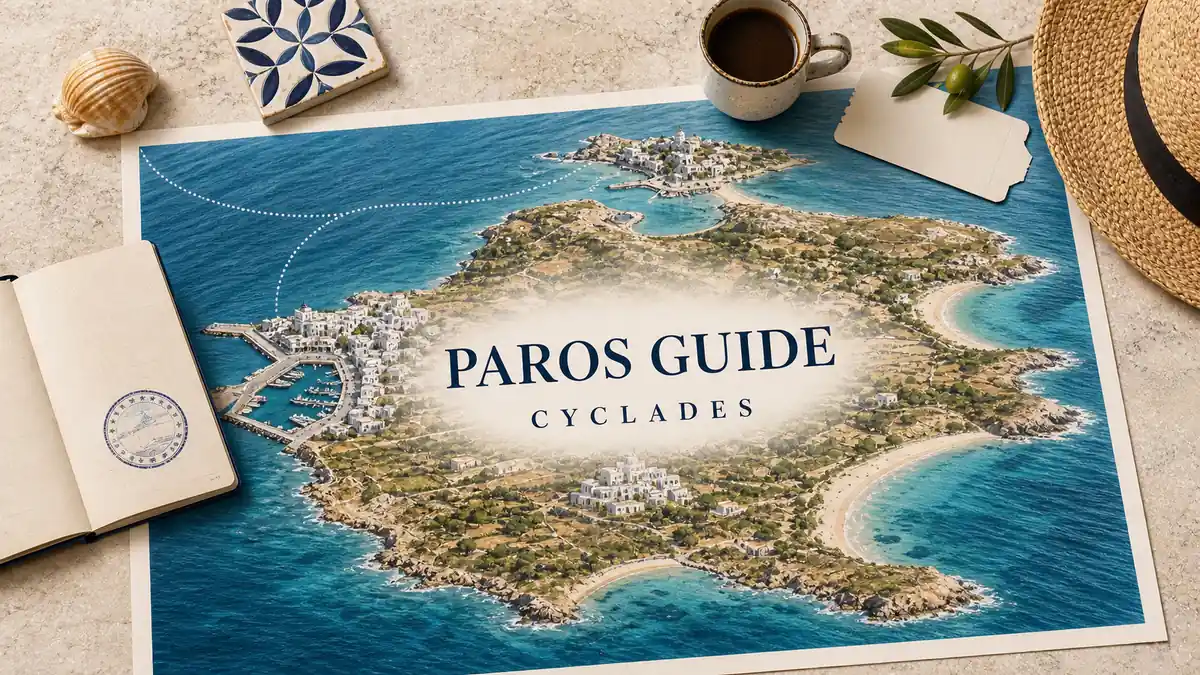
You have Paros on the shortlist, or you have already said yes to it, and now you want to know what committing actually looks like. Paros is the balanced Cyclade: a walkable harbour town with genuine local life, a real spread of beaches, whitewashed villages inland, and nothing pushed to an extreme. Travelers often describe it as a lighter Mykonos with fuller everyday texture and softer prices. It is also the best-connected node in the central Cyclades and the natural first leg of the classic Athens → Paros → Naxos → Santorini chain. Parikia is the port; Naoussa is the old town. Peak weeks are genuinely busy.
This guide resolves the planning layer: whether Paros is worth it and who it suits, how you get there, when to go, how long to stay, how the island is laid out, and how it compares with the islands you are weighing it against. The depth topics — stays, costs, transport, itineraries, beaches — each live on their own page.
Quick Answer
Paros is worth the trip: the balanced Cyclade, with real harbour-town life, beach variety and nothing extreme. Four nights is the comfortable answer, three the working minimum. Arrive by ferry from Athens. It suits first-timers and island-hoppers who want Mykonos’s look with softer prices and easier onward connections.
Trust Layer
Tripstou city guide for travelers planning a city trip. Covers trip length, stay style, season, cost, and mobility tradeoffs.
Produced with AI assistance and reviewed by Alex Perrut, working in tourism since 2015, for the Tripstou editorial team. See our editorial process for details.
Last factual review: August 29, 2026.
Official sources consulted: Visit Greece, Greek Ministry of Tourism.
Key Takeaways
- Paros is the balanced Cyclade: harbour-town life, beach variety and whitewashed villages, with nothing pushed to an extreme.
- Arrive by ferry from Piraeus, Rafina or Lavrio; the small domestic airport is the exception, not the plan.
- Book three nights as the working minimum and four for comfort, with Antiparos the honest reason for the fourth.
- June and September deliver the sweet spot; July and August bring the fullest island alongside the heaviest heat and crowds.
- Picture four zones: Parikia in the west, Naoussa in the north, the beach coast east, quiet villages inland.
- Paros is the best-connected node in the central Cyclades, which is what makes onward island-hopping easy to rearrange.
Table of Contents
Is Paros Worth Visiting — and Who Is It For?
Yes — Paros is worth visiting, and it is the easiest Cyclades island to say yes to. It is the balanced one: a walkable harbour town, genuine local life, beach variety, whitewashed villages, nothing extreme in any direction. It suits first-timers who want a bit of everything from one comfortable base.
Paros fits three traveler types especially well. First-timers in Greece, because the island covers the whole Cycladic promise without asking you to specialise. Island-hoppers, because it sits on every useful ferry line. And anyone who wants to unpack once and still have a varied week — beach days, town evenings, an inland village, a day on the water — without moving base. If you are still deciding where in the country to go at all, the wider selection of places to visit in Greece frames the choice.
It is a poor fit in two cases. Anyone chasing something extreme — the loudest nightlife, the most dramatic landscape, the most remote silence — will find another island does that one thing harder. And anyone who needs quiet in the peak weeks should know that Paros fills up: Naoussa’s lanes, the main beaches and the ferry port all get crowded at the height of summer.
On value, Paros is softer on the budget than Mykonos or Santorini without feeling like a compromise island. That gap shows up most in accommodation and in what an ordinary dinner costs. The numbers belong on the Paros trip cost breakdown, with country-level context on how much a Greece trip costs.
The travelers who come away disappointed with Paros are almost always the ones who arrived wanting one defining thing — a caldera view, a club scene, a mountain to climb. Paros trades peaks for range.
How to Get to Paros from Athens
Ferries are the way to Paros: crossings run from Piraeus, Rafina and Lavrio. Reckon on roughly 2h40m on a high-speed vessel, up to around four or five hours on a conventional ship. The island has a small domestic airport but no international one, so the boat is the plan.
Your arrival options, in the order most travelers use them:
- Ferry from Piraeus — the main port for Athens, with both high-speed and conventional services into Parikia.
- Ferry from Rafina or Lavrio — the alternative Attica ports, useful depending on where you are staying and which vessel you want.
- Island-to-island ferry — direct connections from Naxos, Mykonos, Santorini and other Cyclades, which is how most people arrive mid-trip.
- Domestic flight — limited and seasonal, from Athens only, into the small airport near Parikia.
Ferry-first arrival shapes day one more than people expect. You land in Parikia, at the working port in the middle of town, which means your first hours are walkable and your bags never travel far. It also means the crossing time is the day: an afternoon sailing turns arrival day into an evening, not a beach day. Frequency follows the season — several daily crossings in high summer, materially thinner in the shoulder months, and a skeleton service in winter.
Connectivity is the quiet reason Paros keeps winning trips. It is one of the best-connected nodes in the central Cyclades, which is why the classic chain starts here: you can reach Naxos, Mykonos or Santorini onward without designing your route around a single weekly boat. That flexibility is worth planning around if you intend to move at all — see how the routes fit together in the guide to island hopping in Greece.
If you do fly, the airport is small and close to Parikia, and the transfer is a short, simple job covered in the Paros airport transfer guide.
Train and bus tickets
Compare routes, schedules and prices across rail and bus operators in one search, with mobile tickets on your phone.
New to Omio? Code NEW10 takes 10% off your first booking — or APPNEW10 if you book inside the Omio app. Both apply to bookings up to €80.
Search routes and compare prices on Omio →
Tripstou may earn a commission if you book through this link, at no extra cost to you.
When to Visit Paros
June and September are the sweet spot in a season that runs roughly April to October. High summer delivers the fullest island — every beach club open, every ferry running — and also the hottest, busiest and windiest weeks. The shoulder months keep the warmth and drop the crowds.
The month-level trade-off is straightforward. April and May are quiet, green and cool enough that swimming is a decision rather than a default; some seasonal businesses are still opening up. June is the first month where everything works and nothing is yet overwhelming. July and August are peak in every sense — the fullest island, the highest heat, the strongest meltemi and the tightest availability. September holds summer water temperatures with visibly thinner crowds, and early October still functions before the season starts folding.
| Period | Crowds | Heat and wind | What is open | Ferry links |
|---|---|---|---|---|
| April to May | Quiet, easy to move around | Mild, sea still cool | Season opening up gradually | Building, still limited |
| June | Busy but comfortable | Warm, wind mostly pleasant | Effectively everything | Frequent and reliable |
| July to August | Peak, crowded in both towns | Hottest weeks, strongest meltemi | Everything, booked far ahead | Several crossings daily |
| September to early October | Thinning noticeably each week | Warm sea, calmer air | Most places still trading | Good, tapering late |
| Winter | Local life only | Cool, wet and windy | Much of the scene winds down | Skeleton service |
The off-season is worth understanding before you get creative with dates. Outside roughly April to October the island reverts to its residents: ferries thin out, seasonal beach businesses shut for the year, and much of Naoussa’s eating and drinking scene winds down over winter. Parikia keeps functioning as a working town with shops and tavernas, so a winter visit is possible — it is simply a different island, quiet and weather-led.
Pack for the shoulder with one extra layer than the forecast suggests. Evenings on an exposed Cycladic harbour are cooler than the daytime numbers imply, and the wind does the rest; the Greece packing list covers the full kit. For how Paros fits the national picture, see the best time to visit Greece.
The wind, not the heat, is what actually reshapes a Paros day in August. It decides which coast you swim on, and locals pick beaches by wind direction long before they pick by looks.
How Many Days You Need in Paros
Three nights is the working minimum on Paros; four is comfortable. Three lets you see both towns and reach the beach coast without rushing. The fourth night exists for a reason: Antiparos, the small neighbouring island that most Paros trips end up wanting a day for.
The arithmetic is the island’s own geography. Paros holds two towns with genuinely different characters, a beach coast strung along the east and southeast, and a quiet inland belt of villages. Three full days covers those without turning any of them into a drive-by. Add the arrival day, which the ferry usually eats, and you can see why three nights reads as a minimum instead of a plan.
Five nights or more starts to reward slowing down: repeat beaches, a second inland village, days with nothing scheduled. Below three, you are visiting Parikia and one beach and calling it Paros.
How you spend those days is a separate job from how many you book. Short trips are mapped out in the 2-day Paros itinerary and the standard 3-day Paros itinerary. If Paros is one leg of a longer route — and it is the natural first leg after Athens — start from the Greece itinerary planner, then the 7-day, 10-day or 14-day Greece routes.
The fourth night is not really about Paros. It buys Antiparos without forcing you to trade away a beach day for a rushed round trip.
Is Antiparos worth a day trip?
Yes — Antiparos is the standard day trip from Paros and the working argument for that fourth night. It is a short crossing to a small, low-key neighbouring island, frequent through the season, with a compact main village and its own beaches. Half a day is enough; a full one is more pleasant.
How Paros Is Laid Out: Parikia, Naoussa and the Beach Coast
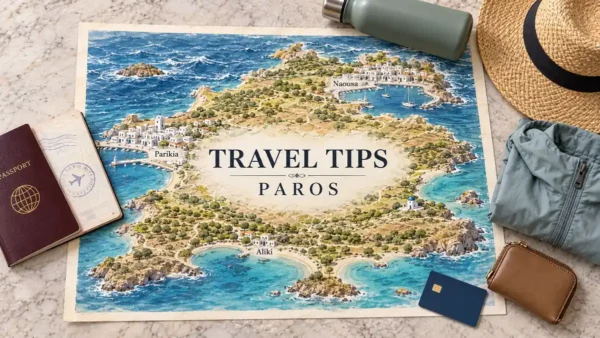
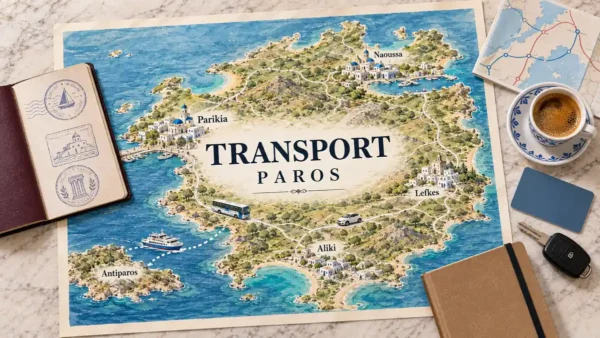
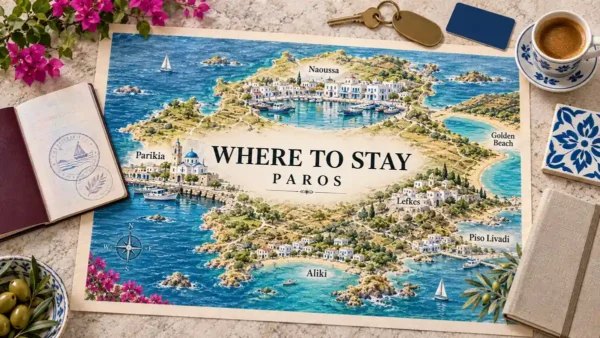
Paros divides into four zones: Parikia in the west, Naoussa in the north, the beach coast east, the interior between. Parikia is the capital and main ferry port. Naoussa is an old fishing harbour and the island’s evening-life centre. The beaches spread down the east and southeast.
- Parikia (west) — the capital and ferry port, with a whitewashed old town of lanes behind the waterfront and the island’s practical centre for shops and bus links.
- Naoussa (north) — an old fishing harbour that grew into the island’s evening-life centre, with small boats still tied up beside the restaurant tables.
- The beach coast (east and southeast) — Kolymbithres near Naoussa, then Santa Maria, Golden Beach and New Golden Beach, Piso Livadi and Logaras further down, with Aliki in the south and Parasporos just outside Parikia.
- The interior (middle) — Lefkes and the marble-quarry country, a belt of hill villages, terraces and quiet.
The two towns differ in feel more than in facilities, and the honest way to think about it is what you want your evenings to be. Both put you within reach of everything on an island this size. That choice, with the actual areas and stay styles laid out, belongs to the guide to where to stay in Paros.
The beach coast is geography, not a ranking. Kolymbithres is the sculpted-rock bay in the north; Golden Beach and New Golden Beach are the long open stretches on the southeast where the wind arrives; Piso Livadi and Logaras sit as small resort bays further along; Aliki is the quiet south; Parasporos is the closest swim to the port. For how they compare within the country, see the best beaches in Greece.
The headline draws — the Byzantine church in Parikia, Naoussa’s harbour, the marble villages, the boat trips — are covered in depth in things to do in Paros, and the corners most visitors miss in hidden gems in Paros.
Whether you need wheels comes down to one question: how far beyond your base you plan to go. Staying put in either town, buses and your feet cover it; roaming the east coast and the interior on your own schedule is where a car or ATV starts to matter. The options are set out in the Paros transport guide, and driving in Greece more broadly in the Greece road trip guide.
Windsurfing and Kitesurfing in Paros: Which Spot, Which Season
Paros is the Cyclades’ default wind island for both sports. Windsurfers head to Golden Beach and New Golden Beach on the southeast coast, both with international competition history. Kitesurfers go to Pounda, on the west side, where the water stays flat.
- Spot — Golden Beach and New Golden Beach for windsurfing; Pounda’s flat water for kitesurfing.
- Season — the meltemi blows hardest in high summer, which favours experienced sailors; the shoulder months bring kinder conditions for beginners.
- Format — schools run lessons and rent gear at the same beaches. Beginners book lessons; riders with hours behind them just rent.
Wind is the one variable on Paros where the shoulder season beats July outright.
Tours and activities
Book skip-the-line tickets, day trips and local tours with free cancellation on most activities.
You can also browse everything on getyourguide.com.
Tripstou may earn a commission if you book through this link, at no extra cost to you.
Paros or Naxos, Mykonos and Santorini: How to Choose
Choose Paros for a balanced first-timer base with the easiest onward connections. Naxos is bigger, slower and more family-shaped. Mykonos is the nightlife island, at nightlife prices. Santorini is the caldera moment, and priced accordingly. Most travelers who compare Paros and Naxos end up doing both.
Against Naxos, Paros is smaller and more scene-led: slightly busier, slightly more polished, with a stronger evening pull and easier connections onward. Naxos answers back with mountains, farm food and more space for families. Against Mykonos, Paros reads as the lighter version — the same whitewashed look and boat-day rhythm, with fuller everyday texture and softer prices. Against Santorini, it is the trade of one spectacular view for a week you can actually swim through. Crete is the other direction entirely: a country-sized island for a different kind of trip, covered in the Crete guide.
The full selection job — which island, in what order, for which traveler — sits in the Cyclades guide and the wider Greek islands overview.
Paros and Naxos are more often sequenced than chosen between. They sit on the same ferry spine, and the classic chain runs through both.
Planning the Rest of Your Paros Trip: Stays, Costs and Practicalities
The depth topics on Paros each have their own page, and this is the map to them. Where you stay, what it costs, how you get around, what to watch for — every one of those decisions is resolved on a dedicated page instead of compressed here.
Where you sleep
- The design end of the island’s accommodation is gathered in boutique hotels in Paros.
- By travel style: families, first-timers.
Money and practicalities
- Paros costs less than the marquee Cyclades without feeling cheap — the breakdown sits in the Paros trip cost guide.
- Wind and water are the two things that catch first-timers out here; both are handled in Paros travel tips.
- Paros is a low-risk island for visitors, with the detail in Paros safety, plus country-level context on common scams in Greece and solo female travel safety.
Wider planning
- What to order and why it differs island to island: the Greek food guide.
- Everything above Paros in the planning stack lives in the Greece travel guide.
Frequently Asked Questions
How long is the ferry from Athens to Paros?
Roughly 2h40m on a high-speed vessel, up to around four or five hours on a conventional ship. Treat it as time against pacing: a high-speed crossing leaves you an afternoon on Paros, while a slower sailing makes the boat itself part of the travel day.
Does Paros have an airport?
Yes, but only a small domestic one near Parikia, served from Athens; there is no international airport. Flights are limited and seasonal, so almost everyone arrives by ferry. If you do fly in, the airport sits close enough to the capital that the transfer is short.
How big is Paros?
Small enough to cross comfortably in a day, large enough to hold four genuinely distinct zones. Nowhere on the island is far from anywhere else, which is why one base works for a whole week. The scale is what makes Paros feel varied without feeling demanding.
Is Paros still open in October?
Early October still works: the season runs roughly April to October, and most places are trading while the sea holds its warmth. Later in the month ferries thin and seasonal businesses start closing for the year. By winter much of Naoussa’s eating and drinking scene winds down.
Is Paros a good first Greek island?
Yes — it is one of the easiest islands to start with. The bit-of-everything balance means you do not have to know your travel style yet, and the ferry connections make it simple to add a second island later without redesigning the route.
Is Paros windy?
Yes, especially in high summer, when the meltemi blows hardest. It takes the edge off the heat and is exactly why windsurfers and kitesurfers come, but it also decides where you swim. On strong days, pick a sheltered bay instead of an exposed open stretch.
Related Guides
- Cyclades guide — which island to pick, and in what order.
- Where to stay in Paros — the base decision, area by area.
- Things to do in Paros — the island’s headline draws in depth.
- 3-day Paros itinerary — the standard trip, day by day.
- Getting around Paros — buses, cars, ATVs and boats.
- Greece island hopping — building a multi-island route around Paros.
Did this guide save you time or money? Tripstou is independent and reader-funded — if you'd like to give something back, you can support the site with a crypto contribution of any size.