The Naples region is worth a trip in its own right. Nowhere else in Italy do a buried Roman city, a live volcano, three islands and a famous coastline all sit within a day of one city, and that city is itself the rail and ferry hub, with cheaper beds than the coast. Most first-timers should sleep in Naples and day-trip outward, adding nights on the Sorrento and Amalfi side only if the coast is the point of the trip. A few days covers Naples and one buried city; closer to a week lets you fit the coast and an island too.
Around the bay, the choices fall into four sides: Pompeii, Herculaneum and Vesuvius to the south-east; Capri, Ischia and Procida offshore; Sorrento and the Amalfi side across the water; and Caserta, Salerno and Paestum by train inland and to the south. This guide works outward from Naples as the base, then takes each side in turn.
What’s around Naples, and what each side of the bay is for
Vesuvius and the buried cities have the strongest claim on a first trip: Pompeii and Herculaneum are easy day trips from Naples, and so are Caserta, Salerno, Paestum and the island of Procida. Capri also works as a day, though a busy one. Ischia and the Sorrento and Amalfi side are the two places better slept on, because their best hours come early and late, after the day-trippers leave.
What the region does best is density. Archaeology, a volcano, island villages, cliff towns and a royal palace sit close enough to Naples that one hotel can reach almost all of them.
| Sub-area | Natural base | How you get there | Day or night | Who it suits |
|---|---|---|---|---|
| Vesuvius and the buried cities | Naples (Sorrento works too) | Circumvesuviana from Napoli Centrale or Porta Nolana; FS line toward Salerno for Pompei | Day trip | Every first-timer |
| Capri | Naples or Sorrento | Ferry from Molo Beverello or Sorrento | Day, long and crowded | Travelers set on the famous island |
| Ischia | Ischia itself | Ferry from Molo Beverello or Pozzuoli | Better with a night | Slow travelers and thermal-garden fans |
| Procida | Naples | Ferry from Molo Beverello or Pozzuoli | Half-day or day | Photographers and anyone avoiding crowds |
| Sorrento and the Amalfi side | Sorrento | Circumvesuviana to Sorrento; guided coast day from Naples | Better with nights | Trips where the coast is the point |
| Caserta | Naples | FS regional train from Napoli Centrale | Day trip | Palace and garden lovers |
| Salerno and Paestum | Naples or Salerno | FS regional or high-speed train to Salerno, regional on to Paestum | Day, or a night in Salerno | Return visitors and archaeology-first trips |
The rest of the page follows the order a planner decides things: pick the base first, then see what each side of the bay offers from it, then settle days, transport, season and cost.
Naples is the better base for most first trips; Sorrento wins for Capri and the coast
Naples is the better base for most first trips because every rail line and the main ferry port start there, beds cost less than on the coast, and the city is a destination in its own right. Sorrento is quieter and closer to Capri and the western Amalfi towns. It is a poor base for Caserta, Salerno, Paestum and the city itself. Pompeii is roughly a tie: both towns sit on the same Circumvesuviana line, at opposite ends of it.
- Naples base: the choice for a first trip that wants the buried cities, the city, an island and the inland train days from one hotel. You give up quiet evenings and a sea view; the streets are loud and the pace is relentless.
- Sorrento or a coast base: suits couples and families whose trip is about Capri, Positano and the coast road, with Pompeii as the one excursion. Every day toward Naples, Caserta or Paestum starts with a long ride back up the line.
- Hybrid: Naples for the first nights, then the coast for the last few. It costs one hotel change and works for anyone with a week, because each half of the trip sleeps where its days are.
Naples itself repays the nights you spend there. Its historic centre is on the UNESCO list, the National Archaeological Museum holds the mosaics and frescoes taken from Pompeii and Herculaneum, and the city is where Neapolitan pizza and the sfogliatella come from. Underground Naples, the Sansevero Chapel and the Spanish Quarters belong to the city’s own list. For neighbourhoods, sights and food, see our Naples city guide; this page keeps to the region around it.
The base decision is really a decision about evenings. Naples gives you a city after dark; Sorrento gives you a terrace. Pick the one you would miss more.
Hotels and places to stay
Compare hotels, apartments and stays for your dates in one search.
Search hotels and stays on hotels.com →
Tripstou may earn a commission if you book through this link, at no extra cost to you.
Vesuvius and the buried cities: Pompeii, Herculaneum and the volcano
This is the side no first trip skips. Pompeii sits on the Circumvesuviana line between Naples and Sorrento and is also on the FS line toward Salerno. Herculaneum, at Ercolano, is the closer, smaller and better-preserved alternative, and Vesuvius pairs with either. Naples is the natural base, though the whole cluster works equally from Sorrento.
Pompeii is the one to see for scale. It is a whole Roman town of streets, houses, baths and theatres, and the walk tires people out long before the site runs out. Its Circumvesuviana stop, Pompei Villa dei Misteri, takes its name from the villa whose fresco cycle is one of the site’s highlights. Entry runs on timed slots with a daily cap, so book ahead; our guide to visiting Pompeii covers entrances, routes and how to plan the day.
Herculaneum is compact and better preserved. Buried deeper, it kept upper floors, wooden beams and painted rooms that Pompeii lost, and it draws far fewer people. A guide brings the houses to life, and you can book a guided visit with an archaeologist.
Choose Pompeii if you want the size and the famous sights. Choose Herculaneum if you are short on time, travelling with children, or want detail you can see up close without the crowds. Everyone gets something from this side, but history readers get the most: seeing the museum in Naples and then one of the sites makes both better.
Is Mount Vesuvius worth it from Naples?
Mount Vesuvius is worth it on a clear day, for the walk to the crater rim and the view across the whole Bay of Naples. It pairs naturally with a morning at Herculaneum or Pompeii, which share its side of the bay. The visit is weather-dependent and the summit is exposed, so it is more comfortable in the shoulder months than in high summer. You can reserve your crater entry in advance. Skip it if the forecast is cloudy, because the view is the reward, or if the trip is only two or three days, when a buried city is the better use of the day.
Tours and activities
Book skip-the-line tickets, day trips and local tours with free cancellation on most activities.
You can also browse everything on getyourguide.com.
Tripstou may earn a commission if you book through this link, at no extra cost to you.
Capri, Ischia or Procida: which island fits a day from Naples?
Capri is the island for the famous day, Ischia for a slower stay with thermal gardens, and Procida for the smallest, quietest half-day. All three sail from Naples: fast boats leave from Molo Beverello and slower ferries from Calata Porta di Massa. Ischia and Procida are also reached from Pozzuoli, and Capri from Sorrento.
Capri delivers the postcard: the Faraglioni rocks off the coast, the Blue Grotto by small boat when the sea allows, and Anacapri higher up, calmer than the main town. It is crowded and expensive by day, and the day works best with an early boat and a clear plan. Travelers who want the classic Bay of Naples photograph and do not mind company will be happy here. If you would sooner hand over the logistics, you can book this island day with Anacapri and the grotto in one.
Ischia is bigger and slower, and it rewards a night. Its draws are the thermal spas, the gardens of La Mortella, the Aragonese Castle on its rock and the village of Sant’Angelo. A day trip only scratches it. Ischia fits people who want to soak, garden-walk and stay put for a couple of days.
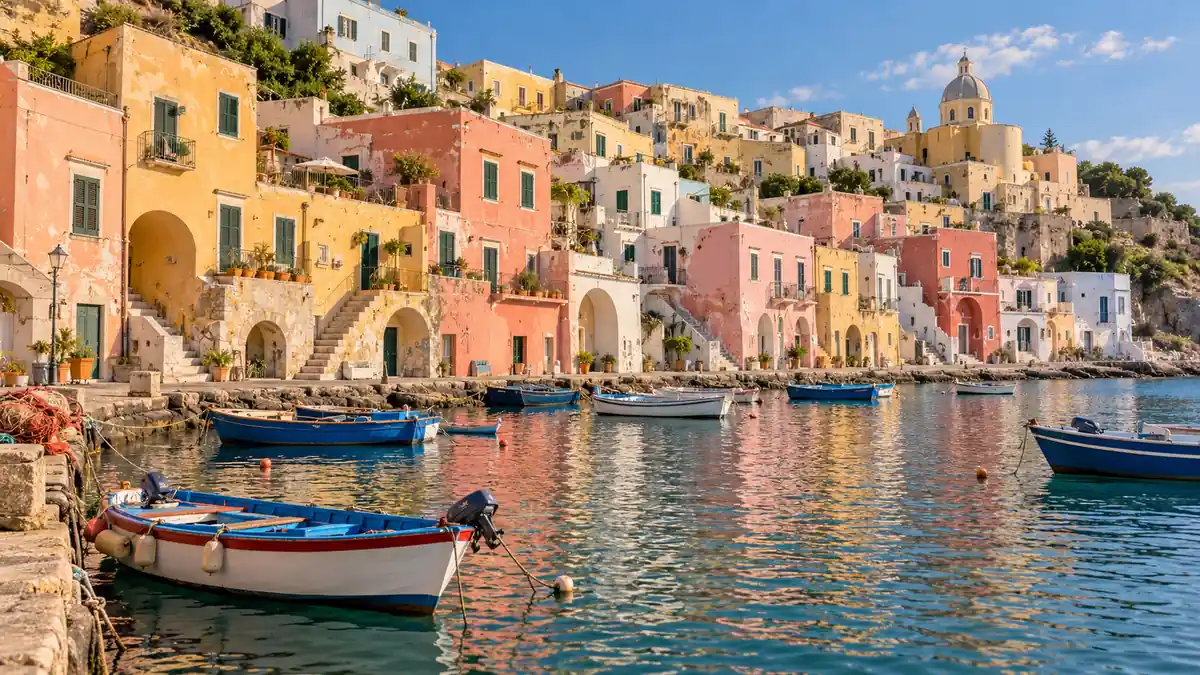
Procida is the easy half-day. The pastel houses of Marina Corricella and the old walled quarter of Terra Murata are the whole programme, and the island stays calm even when Capri is packed. It is the pick for photographers and for anyone with a free afternoon in Naples.
Sailings thin out outside the warm months and can stop in rough weather, so check the operator before you build a day around one. If the water matters more to you than any one island, a Gulf of Naples boat day takes in the coastline from the sea.
The Amalfi Coast is a long day from Naples: go guided, or give it a night
Sorrento, Positano and Amalfi can be done as a day from Naples, but in practice that means a guided small-group day, because public transport turns it into a long and awkward loop. The coast is better slept on. Sorrento is the natural base for this side, and anyone for whom the coast is the point of the trip should move there for a few nights.
Sorrento is the gateway town at the end of the Circumvesuviana, known for its lemons. Positano and Amalfi are the postcard towns, with Ravello on the heights above and Vietri sul Mare at the Salerno end. The Path of the Gods walk runs high above the sea from Agerola toward Positano, and Cetara’s colatura di alici (an anchovy sauce) is the coast’s food signature.
The guided Sorrento, Positano and Amalfi day from Naples is the honest shortcut. It buys you no bus changes, a driver who handles the coast road, and a stop in each of the three towns. It costs you time: you see all three and stay long enough in none of them to walk up from the waterfront or eat slowly. It is made for travelers who want to see the coast once on a Naples-based trip.
The alternative is a night or two on the coast, which lets you see the towns early and late, when they are at their best. In the warm months, coast ferries link several of the towns and make moving between them far easier than the road. This guide stays at that level; the coast town by town is a trip of its own.
Caserta, Salerno and Paestum: the train days most visitors skip
The inland and southern side is the least crowded day out from Naples, and regular FS trains reach all three stops. The Royal Palace of Caserta lies north of the city, Salerno is the quieter gateway at the far end of the Amalfi Coast, and Paestum’s Greek temples stand south of Salerno. Naples is the natural base, though Salerno itself works for Paestum and the eastern end of the coast.
The Reggia di Caserta, the Royal Palace, is on the UNESCO list for its staterooms and its long formal park of fountains and cascades. Train, bus and car all reach it. Give the park as much time as the palace; most visitors underestimate it.
Salerno is a working seaside city with a long promenade, a lower-key alternative to the coast towns. Further south, the temples of Paestum are among the best-preserved Greek temples in Italy, set in open fields with few people around. The farms around Paestum are where buffalo mozzarella comes from, so lunch is part of the reason to go.
- Campi Flegrei and Pozzuoli: a volcanic landscape on the western edge of Naples, and the second ferry port for Ischia and Procida.
- Benevento, Irpinia and the Cilento: inland towns, hills and a southern coast for return visitors, not for a first trip.
Second-timers, archaeology-first travelers and anyone dodging the coast crowds in high season get the most from this side. Paestum on a weekday can feel like a private site; Pompeii never does.
How many days do you need for Naples and around?
Four to five days is the sweet spot for Naples and around: enough for the city, one buried city and one island or Vesuvius, without a hotel change. Two to three days covers Naples plus Pompeii or Herculaneum. Six to eight days earns nights on the Sorrento and Amalfi side or the train days to Caserta and Paestum.
A short trip of two or three days works best as a city break with one excursion. Spend one day in Naples and one at a buried city; if a third day is free, add Procida or Vesuvius. It fits a weekend or a stop on a longer Italy route.
The middle length, four to five days, is where the region starts to make sense as a destination. Add an island day and the volcano, or Capri and a second archaeological site, all from one Naples hotel. Most first-timers should aim here.
Six to eight days allows the hybrid: Naples first, then several nights in Sorrento or on the coast, or a calmer pace with Caserta and Paestum added. Trying to squeeze the coast into a short trip is where plans usually break. One rushed coast day on a three-day trip costs you the buried city or the city itself, and neither is worth trading.
Getting around Campania without a car: Circumvesuviana, FS trains and ferries
You do not need a car in Campania. Three systems do the work: the Circumvesuviana commuter line from Porta Nolana and Napoli Centrale toward Ercolano, Pompei Villa dei Misteri and Sorrento; FS trains from Napoli Centrale toward Caserta and toward Salerno, stopping at Pompei, with high-speed services to Salerno; and ferries from Molo Beverello and Calata Porta di Massa, plus Pozzuoli for Ischia and Procida. The coast road is the one place a car makes the trip worse.
- Circumvesuviana: the line for Herculaneum, Pompeii and Sorrento, cheap and frequent. It is a commuter railway, so expect crowded carriages and basic trains.
- FS trains: the comfortable choice for Caserta, Salerno and Paestum, and an alternative route to Pompeii. The network stops short of the Sorrento peninsula and the Amalfi towns.
- Ferries: the only way to the islands and the easiest way along the coast in summer. Fast boats leave from Molo Beverello, slower ferries from Calata Porta di Massa. Services are seasonal and weather-bound.
Watch your bags on crowded trains, as on any busy commuter line. Ferry schedules are reduced or seasonal outside the warm months, so check the operator for the day you plan to sail.
Napoli Centrale, on Piazza Garibaldi, is the one hub worth learning. FS trains leave from the main station, and the Circumvesuviana, which starts one stop earlier at Porta Nolana, can be boarded in the same complex, so both rail systems are within reach of one square. A hotel within walking distance of it or of Molo Beverello saves a transfer on every day trip.
Go April to June or September to October; winter is for the city only
April to June and September to October are the best windows for Naples and around: the sea is warm enough, the ferries run full schedules and the crowds stay bearable. July and August are hot and at their busiest on the islands and the coast. In winter Naples itself works fully, but many coast hotels and restaurants close and the ferries run reduced schedules.
Families tied to the summer holidays can still make it work. Reach the islands early in the day, and pick Ischia over Capri for space and shade. City-and-archaeology trips are fine in winter: Naples, the museum, Pompeii and Herculaneum need no sunshine, and the sites are calmer.
The coast is the side most sensitive to season, so a trip built around Positano and Amalfi belongs in the spring or early-autumn window. For how this region compares with the rest of the country month to month, see the best time to visit Italy.
Naples is cheap to sleep in; Capri and the coast are not
A Naples-based trip is one of the better-value ways to see a famous part of Italy, because the base is cheap and the day trips run on regular trains and ferries. The money goes up sharply the moment you sleep on Capri or the Amalfi side. That is the question most people are really asking when they ask whether Campania is expensive.
On a tight budget, the region is kind. Sleep in Naples guesthouses or hostels, eat pizza and street food, and travel on the Circumvesuviana and regular ferries. Procida and Salerno stay affordable too. Capri and Positano punish this style; visit them by day and leave before dinner.
A comfortable middle trip means a good Naples hotel, sit-down meals and perhaps two or three nights in Sorrento, which costs more than Naples but less than the cliff towns. One guided day, for the coast or Vesuvius, fits easily.
A high-end trip in this region is mostly a coast trip: sea-view hotels in Positano or on Capri, restaurant dinners on terraces and private drivers or boats in place of trains. Naples still rewards this style with its grand old seafront hotels, for less than the coast asks.
The strongest first trip: a Naples base, one buried city, one island, then decide on the coast
The strongest first trip sleeps in Naples and spends one day in the city, one at Pompeii or Herculaneum with or without Vesuvius, and one on an island. The coast is added only as a guided day or as the closing nights. It suits first-timers who want variety without packing and unpacking. The region works as a standalone week and just as well as the southern leg of a Rome-based trip, which is how most people arrive.
As a standalone week, the region has room for the full hybrid: Naples and its day trips first, then the coast to finish. The catch is that a week here is a week not spent in the north, and that is a choice to make with open eyes.
As an add-on from Rome, the region usually gets three to five days, which means Naples, one buried city and one island, with the coast left for another trip. To place it inside a wider route, our Italy itinerary shows how the south fits a longer trip, and the Italy travel guide covers country-level planning.
A coast-led version moves to Sorrento after two Naples nights and spends the rest of the trip on Capri and the Amalfi side. It gives up Caserta and Paestum, and it costs more, but it is the right shape when the coast is why you came. If you are still deciding whether the south should be part of the trip at all, start with the best places to visit in Italy.
What to Decide Before You Book
- Sleep in Naples on a first trip, because it is the rail and ferry hub, costs less than the coast and reaches the buried cities, the islands and the inland train days from one hotel.
- Pompeii, Herculaneum, Vesuvius, Procida, Caserta, Salerno and Paestum all work as days out from Naples, while Ischia and the Sorrento and Amalfi side repay a night or more.
- Pick Capri for the famous and crowded island day, Ischia for a slow stay among thermal gardens, and Procida for a quiet half-day of pastel harbours.
- Four to five days covers Naples, one buried city and an island or the volcano; adding the coast properly takes closer to a week.
- April to June and September to October give full ferry schedules and bearable crowds, while winter suits a city-and-archaeology trip and little else.
- A Naples-based trip is good value, and the bill climbs sharply the moment you sleep on Capri or the Amalfi side.
Scope and Sources
This page plans Naples and the places around it: the buried cities, the islands, the Sorrento side and the train days inland and to the south. It is not a Naples city guide, a Pompeii visitor guide, an Amalfi Coast guide, a day-by-day itinerary or a where-to-stay page.
Written with AI assistance, this regional plan was then gone over by Alex Perrut, working in tourism since 2015, for the Tripstou editorial team. How pages are checked is set out in our editorial process.
Official sources consulted: Archaeological Park of Pompeii, Caremar, Alilauro, Reggia di Caserta, Italia.it, Italy’s official tourism portal.
Where to Go From Here
- Naples city guide: the city itself, with its neighbourhoods, sights and food.
- Pompeii guide: how to visit, from timed entry to entrances and routes.
- Italy itinerary: where the Naples region sits in a longer Italy route.
- Best places to visit in Italy: if you are still choosing which part of Italy to see.
Did this guide save you time or money? Tripstou is independent and reader-funded — if you'd like to give something back, you can support the site with a crypto contribution of any size.