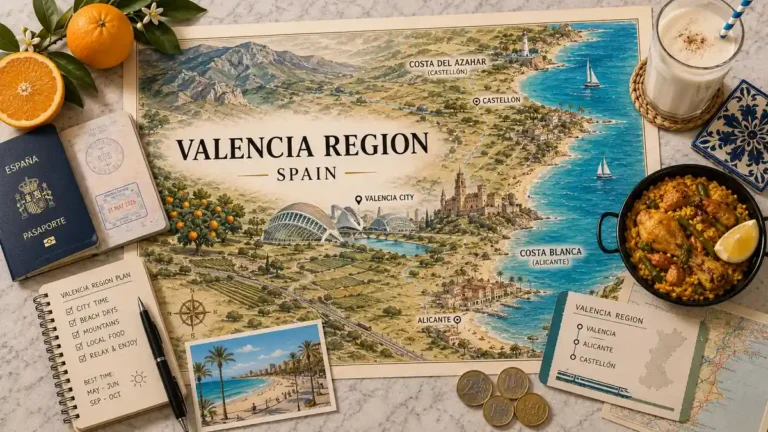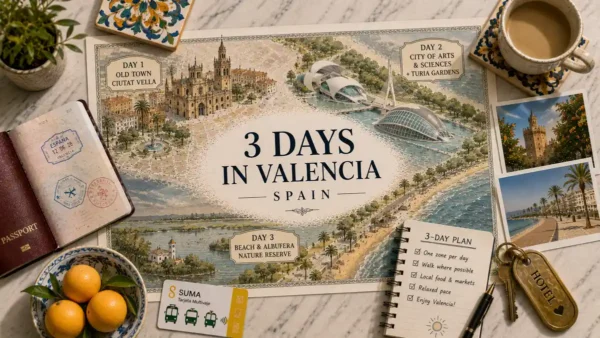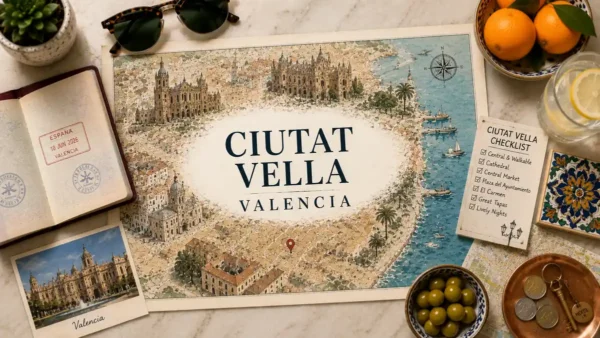
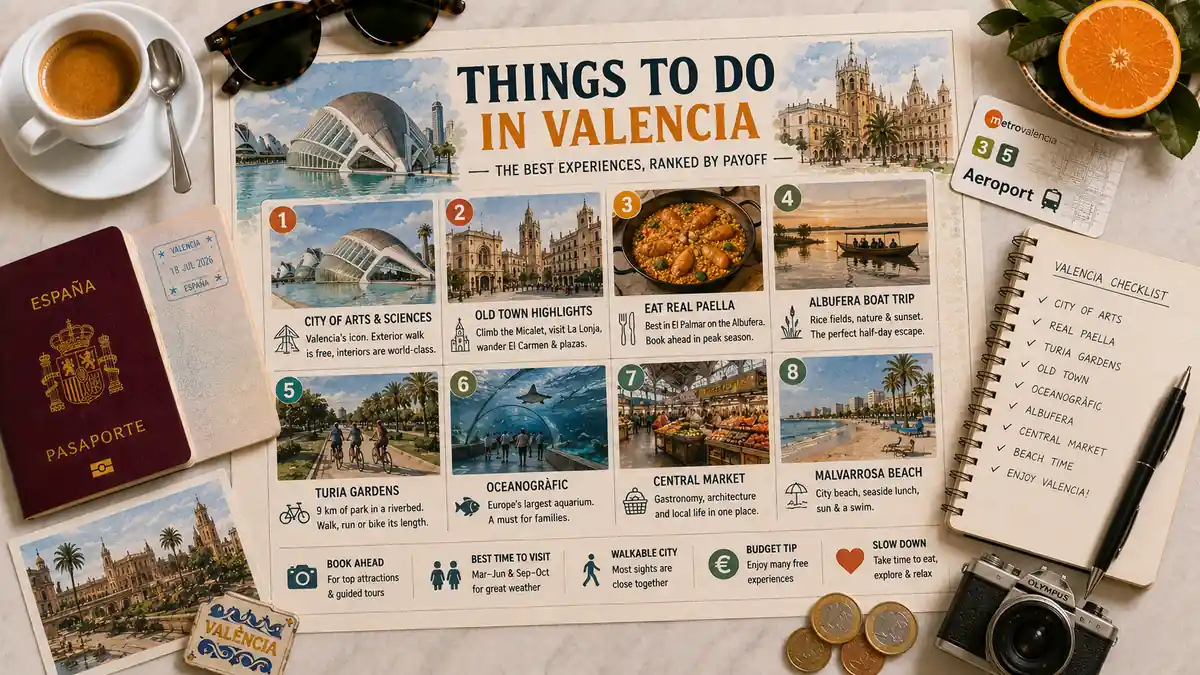
Valencia’s highest-payoff experiences are the City of Arts and Sciences, a real Valencian paella, and the Turia Gardens. Traveler type is what reorders that ranking: families should move the Oceanogràfic to the top, beach-first travelers should add a half-day at Malvarrosa, and architecture-first and food-first visitors will each shuffle the rest.
Valencia packs more headline experiences than a short trip can hold: futuristic architecture, one of Europe’s great food markets, the birthplace of paella, a riverbed turned into a park, and a genuine city beach. Trying to do everything is the fastest way to enjoy none of it. This list ranks Valencia’s experiences by payoff — the return you get for the hours and euros each one asks of you — so you know what to prioritize and what to skip without guilt. The frame is deliberate: these are things you do, not places you tick off. Climbing a Gothic bell tower beats photographing it, and grazing a market beats walking through one. Start at the top of the ranking, subtract from the bottom, and reorder as your traveler type demands.
The City of Arts and Sciences Is Valencia’s Top Payoff
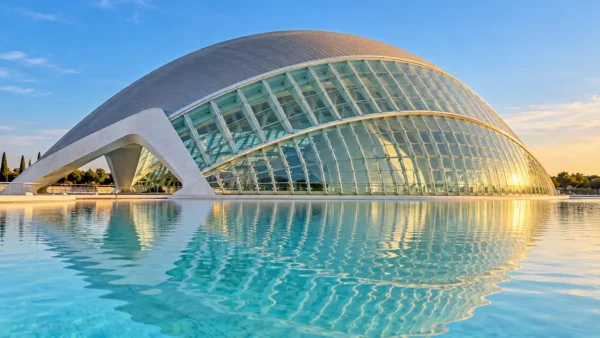
The City of Arts and Sciences is worth visiting, and it is the highest-payoff experience in Valencia. The exterior walk costs nothing and already delivers the spectacle; the paid venues are a choice, not an obligation. Whatever your traveler type, rank this complex first.
Santiago Calatrava and Félix Candela built the complex in the old bed of the Turia river, and the setting is half the effect — sweeping white structures rising from a sunken green park. An hour spent walking the promenades and circling the reflecting pools costs nothing. That free hour alone outranks most of the city’s paid attractions.
The paid layer is a separate decision. Individual venues run from single-digit to low-tens of euros, with combined tickets shifting the math:
- Free exterior walk — fits every visitor and every budget; you see the architecture but not the sea life or science inside.
- Oceanogràfic — Europe’s largest aquarium and the venue that most earns its ticket; ideal for families and animal lovers, though it swallows half a day.
- Hemisfèric — a giant-screen planetarium for a shorter indoor stop; it shows films instead of exhibits, so it can underwhelm restless kids.
- Science Museum — hands-on and interactive, best for curious kids and teens; adults expecting deep collections may find it plays young.
If you only pay for one venue, let your group decide it: the Oceanogràfic wins with kids, while two architecture fans get more from the free walk plus a return at dusk than from any ticket. The big venues are timed and popular, so book Oceanogràfic tickets ahead in warm months. Guided options exist too; they pay off only if context matters more to you than pace. Either way, this is Valencia’s signature experience, and it leaves you free to spend nothing on it or a whole day.
What should you do in Valencia with kids?
Take kids to the Oceanogràfic first — Europe’s largest aquarium and Valencia’s surest family win. Pair it with the Bioparc, an immersive zoo across the Turia, and let them burn energy at Gulliver Park, a giant free playground you climb like a slide. All three sit near the riverbed.
Tours and activities
Book skip-the-line tickets, day trips and local tours with free cancellation on most activities.
You can also browse everything on getyourguide.com.
Tripstou may earn a commission if you book through this link, at no extra cost to you.
Old Town Experiences Worth Prioritizing on Foot
Valencia’s Old Town holds three unmissable experiences: the Micalet climb, La Lonja, and the Central Market. They sit minutes apart on foot, which makes them one cluster, not three separate outings. Done together, they turn the historic centre into a single rewarding half-day of climbing, gawking, and eating.
Climb the Micalet at Valencia Cathedral
The Micalet climb makes the list because it is the Old Town’s one earn-the-view experience. Valencia Cathedral’s Gothic core and Holy Grail Chapel reward a look, but the bell tower is what you will remember: a tight spiral staircase opening onto rooftop views across the whole city. The climb turns the cathedral from a stop into an event. Make it your one earned view of the trip, provided a narrow stone staircase does not put you off.
Step Inside La Lonja de la Seda
La Lonja earns its slot as the Old Town’s most impressive interior. The medieval silk exchange has been a designated UNESCO World Heritage Site, and its main hall — a forest of twisting stone columns — is the kind of space photos undersell. It is a short visit, which is exactly the point: the highest awe-per-minute ratio in the city. Anyone whom Gothic architecture impresses more than museum collections do should give it the slot.
Graze Your Way Through the Central Market
The Central Market earns its slot as an eating experience — treat the building as a bonus. It is one of Europe’s largest fresh-produce markets, directly opposite La Lonja, and the way to do it is to graze: a juice here, some jamón there, whatever the stalls push at you. Treat it as a meal and it replaces a restaurant stop. It is the pick for anyone who would rather eat their sightseeing than queue for it.
The pairing logic is what makes this cluster efficient: start at any of the three and the other two are a short walk away. Save the market for last. After the tower and the trading hall, it doubles as the meal the walking earned. If your whole visit is tight, the 2-day Valencia itinerary shows how the Old Town cluster fits alongside the City of Arts.
Where Should You Eat Real Paella in Valencia?
Eat the classic version in El Palmar, the Albufera village where paella tradition lives. Good paella valenciana exists in the city too, so the real variable is time: the pilgrimage costs most of a day, while a city lunch costs nothing extra. Decide how much authenticity is worth to your trip.
Paella was born in the Valencia region, and El Palmar — a village among the Albufera rice fields — is its traditional home. That geography is the whole argument. Eating rice a few hundred metres from where it grew is a different meal from eating it on a tourist strip. Three ways to have the experience, in ascending commitment:
- City paella lunch — keeps the day flexible; the catch is choosing carefully, since tourist-strip pans outnumber serious kitchens.
- The El Palmar pilgrimage — made for food-first travelers who treat one meal as the day’s main event; it consumes most of a day and pairs naturally with the Albufera boat trip below.
- A paella cooking class — for anyone who wants the skill as well as the meal; it costs more time and money than eating out, and classes are small, so book ahead.
In Valencia, paella is a lunch dish. Planning it for dinner quietly filters out most of the kitchens that take it seriously. Give this experience priority when you need one meal on this trip to be an event in itself. Paella is Valencia’s dish to own; for food experiences across the rest of the country, the things to do in Spain guide covers the national shortlist.
The Albufera Boat Trip Is the Best Half-Day Out of the City
The Albufera boat trip is Valencia’s best half-day escape. A traditional boat takes you out onto the lagoon south of the city — flat water, rice fields, birdlife, and a pace nothing in town matches. It is strongest paired with a paella lunch in El Palmar, turning scenery and food into one outing.
The trip itself is simple: a boatman, a small group, and a slow loop through the lagoon’s channels. That simplicity is the appeal. It asks for no planning stamina and no fitness, and it delivers the one landscape — water, reeds, rice — the city cannot show you. Aim for the last departures of the day: the lagoon at sunset is the version worth photographing, and midday light flattens it. It is the answer for anyone who needs a few hours out of the city without committing to a full day trip.
Boat trips and combined tours are easy to book, and in busy months booking ahead beats hoping for a spare seat. Pair the ride with the El Palmar paella above and the half-day justifies itself twice over. With three days in the city, this escape is the natural use of the third — the 3-day Valencia itinerary shows where it fits.
Biking the Turia Gardens Is Valencia’s Best Free Hour
Biking the Turia Gardens is the best free experience in Valencia. The park fills the former riverbed, costs nothing, and never closes. On foot it is a pleasant stroll; on a bike it becomes an experience — a green corridor linking the Old Town to the City of Arts in one ride.
The park exists because of a disaster. After a catastrophic mid-century flood, Valencia rerouted the river around the city, and the empty bed became a garden of lawns, fountains, playgrounds, and sports fields, with the old bridges passing overhead. Three ways to take it:
- Walk a stretch — fine if you are already passing through; you will only ever see a fragment of the park.
- Rent a bike — the sweet spot for most visitors; self-paced and quick enough to cover the full riverbed in about an hour of easy riding.
- Join a guided bike tour — the better call for first-timers who want context with the ride; you trade freedom for commentary, and tours should be booked ahead.
Ride it one-way toward the City of Arts. The park delivers you straight to the top pick on this list, so the free hour doubles as your transport there. Nothing here fills a spare hour better when you have no appetite for another ticket line.
Are Valencia’s Beaches Worth Your Time?
Valencia’s beaches are worth a half-day if beach time is part of why you travel. Malvarrosa is a genuine city beach — wide, sandy, and backed by a long promenade — reachable without leaving town behind. Culture-first visitors on a short trip can skip it without regret; the strongest experiences sit inland.
The decision splits cleanly by traveler type. Beach-first travelers get real value here: Malvarrosa is broad enough to absorb summer crowds, the promenade is built for a slow seafood lunch, and a half-day of sand resets tired legs. City-first travelers face an honest trade: on a two- or three-day visit, Malvarrosa competes with the city for your hours, and every half-day of sand comes straight out of Old Town or City of Arts time. The test is personal: if a trip without sand time feels incomplete to you, give Malvarrosa its slot. If beaches are the reason for the whole trip, the real question is which destination to pick — the best places to visit in Spain guide handles that choice.
Free Things to Do in Valencia Beyond the Turia
Valencia’s free layer is unusually strong for a city this size. The City of Arts exteriors, the Turia Gardens, the streets of El Carmen, and the beach itself all cost nothing. You could fill a satisfying day here without buying a single ticket — the trick is knowing which free experiences earn a slot.
The free shortlist, with a skip signal for each:
- City of Arts exterior walk — covered at the top of this list; the free version alone justifies the trip across town.
- Turia Gardens — the ranked free champion above; walk or ride at least a stretch on even the shortest visit.
- Wander El Carmen — the Old Town’s street-art-and-alleys quarter rewards an aimless hour; skip it if crowds and graffiti aesthetics leave you cold.
- Browse the Central Market — entry is free and the spectacle is the point; skip it only if you already grazed it as a meal above.
- Walk the Malvarrosa promenade — the beach experience without the beach commitment; skip it on a one-day visit.
- Plaza-hop around the Cathedral — the squares of the historic centre are the city’s free living room, and you will cross them anyway.
Free experiences — the Turia, City of Arts exteriors, Old Town, and beach — never need reservations. For orientation and the practical basics that stitch these experiences into a trip, the full Valencia guide covers the city beyond its highlights.
What can you do in Valencia at night?
Spend the evening in the Old Town, where El Carmen’s lit-up plazas and tapas bars carry the city’s after-dark energy. Then walk or ride to the City of Arts, whose illuminated exteriors and reflecting pools look their best at night. Both cost nothing and need no booking.
Editorial Note
This page ranks Valencia’s experiences — the City of Arts, the Old Town, paella, the Albufera, the Turia, the beach and the free layer — by payoff and traveler fit; it is not a city guide, a day-by-day itinerary, or a catch-all list of every sight in Valencia.
Produced with AI assistance under our editorial process, then reviewed by Alex Perrut, working in tourism since 2015, for the Tripstou editorial team.
Last factual review: July 18, 2026.
Official sources consulted: Spain.info, Tourspain.es.
Rain, Winter and Las Fallas
What can you do in Valencia when it rains or in winter?
Head indoors to Valencia’s covered highlights: the Central Market for grazing, the Oceanogràfic and Science Museum for a half-day each, and La Lonja’s silk-exchange hall. Winter is mild and quiet, so museums and markets stay comfortable while crowds thin. Save the Turia and beach for a clear afternoon.
What is Las Fallas, and is it worth planning around?
Las Fallas is Valencia’s biggest festival, held each March, when neighbourhoods build giant satirical sculptures and burn them in a night of fireworks and crowds. It is worth planning around if you want spectacle over calm, but expect packed streets and booked-out beds. Skip it if you prefer a quieter city.
Did this guide save you time or money? Tripstou is independent and reader-funded — if you'd like to give something back, you can support the site with a crypto contribution of any size.