
Valencia is a compact Mediterranean city break where the old centre, a long city beach and the home of paella fit into one walkable trip. This guide settles the planning decisions in the order you make them — how many days, when to go, where to base yourself, how to arrive, what it costs and which day trips work — and hands the detail to the dedicated Valencia pages.
Quick Answer
Valencia is worth it for a first Spain trip that wants city, beach and food in one compact base. Three days is the sweet spot; two covers the core, and four or five leave room for day trips or a deliberate Las Fallas visit in mid-March. It suits first-timers, families, food and beach travelers, less so big-museum hunters.
Valencia Is Worth It for City, Beach and Food in One Trip
Valencia is one of the strongest-value city breaks in Spain: a compact old centre, a long city beach, paella’s home turf and the modern architecture of the City of Arts and Sciences all sit within one easy trip. It is weakest for travelers who measure a city by its museums, where Madrid and Barcelona carry far more weight.
Spain’s third-largest city works well on a first visit because it is manageable. The historic core is walked in an afternoon, the green belt of the Turia Gardens links it to the newer districts, and the Mediterranean is a tram ride away. Nothing about the city demands a plan drawn up weeks ahead, apart from a festival week and one ticketed attraction covered below.
The trade-off against the two big cities is scale. Valencia has fewer headline monuments and a slower evening rhythm, which is exactly why it suits a beach-and-food stretch between heavier stops. On a multi-city route it plays the role of the pause that still feels like a city.
What Valencia Is Known For: Landmarks to Orient Your Trip
Valencia is known for the futuristic City of Arts and Sciences with its Oceanogràfic aquarium, the Turia Gardens running through the city as a green spine, a Gothic old town around the Cathedral and its Miguelete tower, and Malvarrosa beach on the open sea. Knowing where these sit is what makes the base decision later on easy.
The old centre holds the densest cluster. The Cathedral and the Miguelete stand a short walk from La Lonja de la Seda, the old silk exchange, and from Mercado Central, the covered market where the city shops for produce. The Church of San Nicolás, with its painted ceiling, hides in the lanes nearby. All of these are covered on foot in the same morning.
The Turia Gardens curve around that core along the former riverbed and carry you east to the City of Arts and Sciences, which sits at the far end of the park. Beyond it the seafront opens up: the old fishing district of El Cabanyal, then Malvarrosa and the other city beaches. South of the city, outside the urban area, the Albufera lagoon and its rice fields close the picture. For what to see inside each of these, the full list of things to do in Valencia takes over.
How Many Days Do You Need in Valencia?
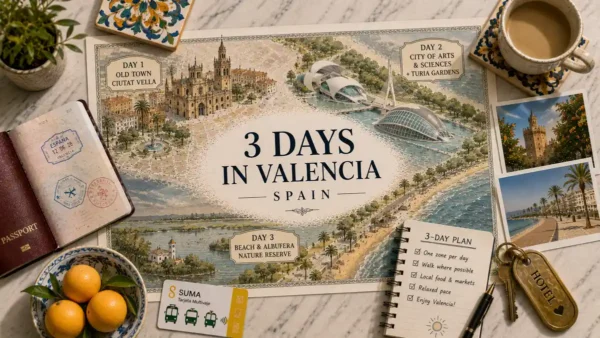
Three days is the first-timer sweet spot in Valencia, because the old centre, the City of Arts and Sciences and the beach each deserve unhurried time. Two days covers the core at a brisk pace; four or five add a day trip or a stay built around Las Fallas.
- Two days: the old centre and Mercado Central one day, the City of Arts and Sciences and the beach the next. Enough for a stop on a multi-city Spain route.
- Three days: the same ground at a gentler pace, plus an afternoon at the Albufera lagoon. The length to give a first trip with Valencia as the main base.
- Four or five days: room for a rail day trip to Sagunto or Xàtiva, more beach time, or the full run of the March festival. Families, slow travelers and anyone coming for Fallas get the most from it.
The third day earns its place on geography. The City of Arts and Sciences and the beach both pull you east, away from the old town, so a two-day visit forces a choice between a slow morning in the historic lanes and a proper afternoon by the sea. The two-day Valencia itinerary shows how to fit the core into a short stop, and the three-day Valencia itinerary lays out the fuller first-trip version day by day.
When to Go: Las Fallas, Beach Summer or the Quiet Months
Spring and early autumn are the best time to visit Valencia for most first-timers, with comfortable walking weather and the sea still in play. Las Fallas, from 15 to 19 March and ending with the cremà on the 19th, is a deliberate choice, not a default. Summer is for the beach and brings real heat; winter is quiet, mild and cheap.
Las Fallas turns the whole city into the festival. Giant sculptures fill the squares, firecrackers go off daily and the final night burns them all. It is unforgettable and also loud, crowded and hard on sleep. Beds sell out early, so book well ahead and expect prices to spike that week.
Autumn carries a risk that spring does not. September to November is the season for heavy rain on this coast, and a downpour can wipe out a beach day or a planned trip out of the city. Build one flexible day into an autumn visit.
August is the hottest month and the one when the city leans hardest on its beaches. February is the quietest, a good window for a cheap old-town break with the sights to yourself. For how Valencia compares with the rest of the country month by month, see the guide to the best time to visit Spain, and pack for the season with the Spain packing list: rain gear for autumn, sun cover for summer.
Where to Stay in Valencia on a First Trip
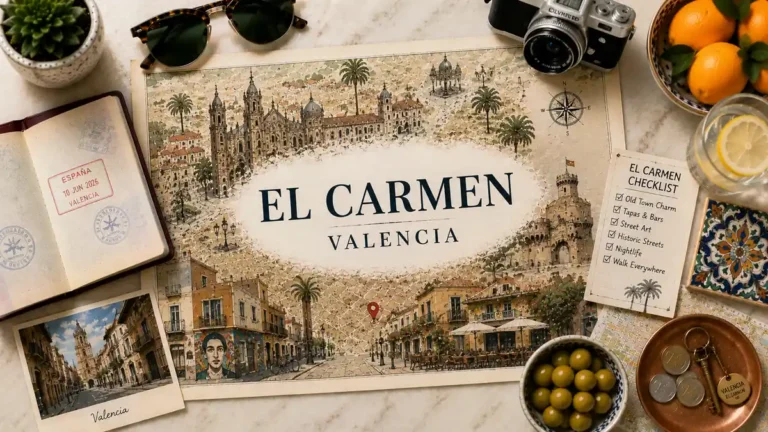
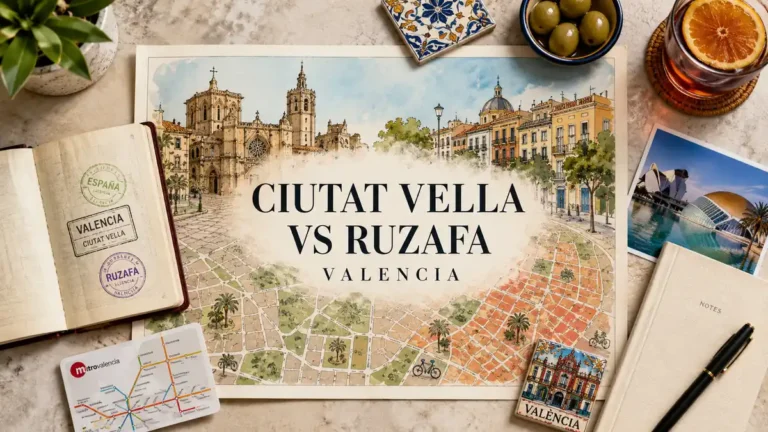
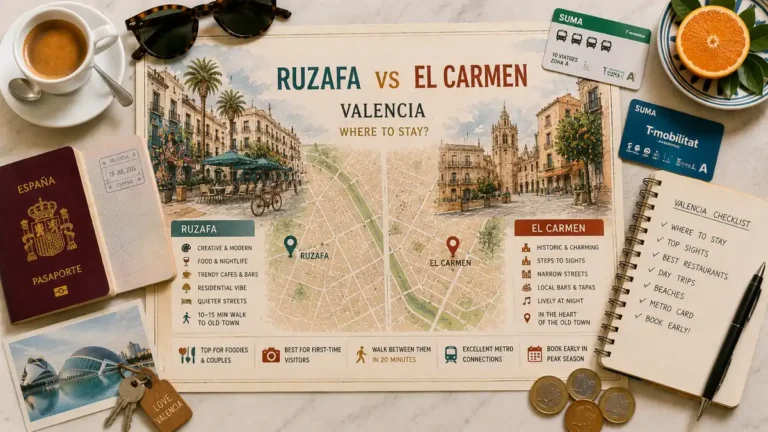
Ciutat Vella, and its El Carmen quarter in particular, is the best base for a first trip to Valencia because the main historic sights sit on the doorstep. Ruzafa suits food and nightlife, El Cabanyal and Malvarrosa suit a sea-first trip, and the streets near the City of Arts and Sciences suit families.
The old centre’s advantage is that you walk everywhere and come back to the hotel between sights. Its cost is noise: El Carmen’s bars run late, and narrow streets carry sound. Light sleepers do better on a quieter square at the edge of the quarter. The guide to staying in Valencia on a first trip narrows that choice to specific streets.
Ruzafa sits just south of the old centre and is where the city eats out, with a dense mix of restaurants, cafés and late bars. It works for travelers who plan their days around dinner. The nightlife base in Valencia page covers which part of it to pick. El Cabanyal and Malvarrosa put the sea outside the window, at the price of a tram or metro ride every time you head to the old town.
Couples often split the difference with a characterful old-town stay, and the Valencia stays for couples page sorts the romantic options by area. At the two ends of the budget, the luxury stays in Valencia and the budget stays in Valencia pages show where each spend goes furthest. To compare every area side by side, start with where to stay in Valencia.
Hotels and places to stay
Compare hotels, apartments and stays for your dates in one search.
Search hotels and stays on hotels.com →
Tripstou may earn a commission if you book through this link, at no extra cost to you.
How to Reach Valencia: Airport Metro and Two Train Stations
From Valencia Airport, Metrovalencia Lines 3 and 5 run from Aeroport station to the city centre at Xàtiva, beside Estació del Nord. From Madrid or Barcelona, high-speed trains arrive at Joaquín Sorolla station, while regional and Cercanías trains use Estació del Nord.
Xàtiva is the hinge of an airport arrival. Because the metro stop sits next to Estació del Nord, a traveler landing by air reaches the regional rail network, and the old centre, without changing to a taxi. Fares, the timetable and the bus and taxi alternatives are set out in the guide to getting from Valencia Airport to the city.
Which station you need depends on the trip. Joaquín Sorolla handles the fast long-distance services, so it is where a Madrid or Barcelona leg begins or ends. Estació del Nord is the one for the local Cercanías network and the regional lines used for day trips.
Many long-haul visitors arrive in Spain through Madrid or Barcelona and continue to Valencia by rail. That makes the city an easy stop on a seven-day Spain itinerary, a ten-day Spain itinerary or a two-week Spain itinerary, and the Spain train itinerary shows how the rail legs connect. If you would sooner drive the coast and the interior, the Spain road trip route places Valencia on a self-drive loop. Check the entry rules that apply to your passport before booking.
Is Valencia Walkable?
Yes, Valencia is walkable: the old centre is best covered on foot, metro and tram carry you to the beach and the airport, and the Turia Gardens work as a car-free bike route across the city.
The city splits into three mobility zones. The historic core is a tangle of lanes where walking beats every alternative. The City of Arts and Sciences is a long but pleasant walk, or a short cycle, along the Turia park. The beach is the one stretch where public transport earns its keep, with tram and metro lines running out to the seafront.
Cycling is the quiet advantage here. The former riverbed is flat, green and free of traffic from end to end, so a rented bike links the old town, the Arts and Sciences complex and the edge of the port district in one ride. Lines, tickets and whether a travel pass pays off for your trip are covered in the Valencia transport guide, and the tourist card question gets its own verdict among the Valencia travel tips.
What a Trip to Valencia Costs per Day
A trip to Valencia costs around €45–€70 per person per day on a budget, around €90–€140 mid-range, and about €200 and up for a luxury stay, before flights. Accommodation decides which band you land in more than anything else.
| Spend style | Per person per day | What it buys in Valencia |
|---|---|---|
| Budget | Around €45–€70 | Hostel or simple guesthouse, set-menu lunches, walking and metro |
| Mid-range | Around €90–€140 | Hotel in the old centre or Ruzafa, sit-down dinners, occasional paid sights |
| Luxury | About €200 and up | Upscale hotel, tasting menus, taxis and guided outings |
Valencia rewards the middle band. The same comfortable spend stretches further here than in Madrid or Barcelona, since walking replaces most transport and lunch is the main meal of the day. Fallas week is the exception that breaks every band: rooms that sit comfortably mid-range in February can climb well beyond it in mid-March. The full breakdown by category is on the Valencia trip cost page, and the Spain travel budget guide covers the wider trip if Valencia is one stop of several.
Which Day Trips from Valencia Are Real Day Trips?
The real day trips from Valencia without a car are, from closest to furthest, the Albufera lagoon and El Palmar by city bus, Sagunto and Xàtiva by Cercanías from Estació del Nord, and Requena by regional train. Montanejos hot springs, the Coves de Sant Josep at La Vall d’Uixó, Peñíscola and Morella need a tour or a car.
The Albufera is the easiest to bolt onto a beach afternoon, because it lies just south of the city along the same coast. EMT bus line 25 runs to El Palmar, the village in the rice fields, and a boat out on the lagoon is the classic way to see it; you can book a lagoon boat trip ahead if you want a set slot.
| Destination | How you get there | What kind of day |
|---|---|---|
| Albufera and El Palmar | EMT city bus line 25 | Rice fields and lagoon |
| Sagunto | Cercanías from Estació del Nord | Roman theatre and castle hill |
| Xàtiva | Cercanías from Estació del Nord | Castle town |
| Requena | Regional train | Wine town |
| Montanejos | Tour or car | Hot springs in the hills |
| Coves de Sant Josep | Tour or car | Underground river |
Montanejos is the day out most visitors from Valencia actually book. Its natural hot springs sit inland in the hills, with no rail link, so an organised trip or a hire car is the only practical way to reach them in a day.
The Coves de Sant Josep at La Vall d’Uixó follow the same logic: an underground river explored by boat, reached by road. A guided trip that bundles the transfer is the simplest option, and you can reserve a cave tour with the entry included. Further north, Peñíscola is a walled seaside town and Morella a hilltop town, both better as a driving day or an overnight. For the towns themselves and how to see more of the surrounding region, read the Valencia region guide.
Tours and activities
Book skip-the-line tickets, day trips and local tours with free cancellation on most activities.
You can also browse everything on getyourguide.com.
Tripstou may earn a commission if you book through this link, at no extra cost to you.
Who Valencia Suits (and Who Should Pick Another City)
Valencia suits families, couples, food travelers and first-timers who want a beach alongside a real city; travelers who want a big-museum capital will be happier in Madrid. The city’s strength is ease, not a list of world-famous collections.
Families get the most out of it. The Oceanogràfic and the Bioparc zoo give children two full days of animals, the beach is reached by tram, and the flat Turia park makes pushchairs and young cyclists easy. The aquarium runs on dated, timed tickets, so it pays to book a timed ticket before you travel. The family stays in Valencia page shows which areas work with children, and the shortlist of best family hotels in Valencia goes down to individual properties.
Couples find the old town’s evenings and the seafront an easy pairing. Food travelers come for the rice dishes, Mercado Central and Ruzafa’s tables. Beach-plus-city first-timers get the rare combination of a historic centre and an urban beach in the same day.
Valencia is a generally relaxed city for visitors, with the usual pickpocket caution in the old centre and on crowded transport. The Valencia safety guide covers the neighbourhoods and the night-time picture, the common scams in Spain page lists the tricks to recognise, and solo women travelers can read the Spain solo female safety guide.
Decide These First
- Give Valencia three days on a first trip, since two only covers the old centre, the City of Arts and Sciences and the beach at a brisk pace, and four or five make room for a day trip or Las Fallas.
- Spring and early autumn suit most first-timers, while Las Fallas (15–19 March) is a trip to choose on purpose and book well ahead, because beds sell out and prices spike that week.
- Base yourself in Ciutat Vella or El Carmen to walk to the sights, in Ruzafa to plan days around dinner, in El Cabanyal or Malvarrosa to wake up by the sea, and near the City of Arts and Sciences with children.
- Metrovalencia Lines 3 and 5 link the airport with the centre at Xàtiva, next to Estació del Nord, while high-speed trains from Madrid and Barcelona arrive at Joaquín Sorolla.
- Plan on around €45–€70 per person per day on a budget, around €90–€140 mid-range or about €200 and up for luxury, before flights, and expect Fallas week to break every band.
- The Albufera, Sagunto, Xàtiva and Requena work as day trips by bus or train, whereas Montanejos, the Coves de Sant Josep, Peñíscola and Morella need a tour or a hire car.
Sources and Scope
This is the broad first-trip planner for Valencia city, settling days, season, base, arrival, cost and day trips; sights, itineraries, neighbourhoods and airport transfers each have their own page on Tripstou.
Written with AI assistance, this planner was then read through by Alex Perrut, working in tourism since 2015, for the Tripstou editorial team, with the metro lines and ticket rules checked against the sources below. Our editorial process explains how pages are checked.
Official sources consulted: Spain.info, Visit Valencia (airport metro), Visit Valencia (Oceanogràfic tickets), Visit Valencia (city buses).
Valencia Questions First-Timers Ask
Do you need to book the Oceanogràfic in advance?
Yes. Oceanogràfic tickets are sold for a specific date and time of visit, so buy yours before you travel and plan the rest of your City of Arts and Sciences day around that slot.
Does Valencia have good beaches?
Yes. Valencia has a long city beach on the open Mediterranean, with Malvarrosa and Las Arenas the best-known stretches, and both are reached from the centre by tram or metro. They are urban beaches, busiest in August, and they suit a beach afternoon between sights. For a trip built around the sea, compare the best beaches in Spain and the Spain islands guide.
Is Valencia the home of paella, and where do you eat it?
Yes. Paella valenciana comes from the rice fields around the Albufera lagoon, just south of the city, and it is eaten at lunch. Order it at midday in El Palmar by the lagoon or at a traditional restaurant in the city, and see the raw ingredients at Mercado Central. The Spain food guide covers the other regional dishes worth ordering.
Keep Planning Spain
- Valencia region guide: the towns, coast and inland hills around the city.
- Spain travel guide: the country hub, for fitting Valencia into a wider trip.
- Spain itinerary: how long to give Spain overall and how to split the days.
- Best places to visit in Spain: other cities to pair with Valencia.
- Valencia travel tips: the tourist card, meal times and local habits.
Did this guide save you time or money? Tripstou is independent and reader-funded — if you'd like to give something back, you can support the site with a crypto contribution of any size.