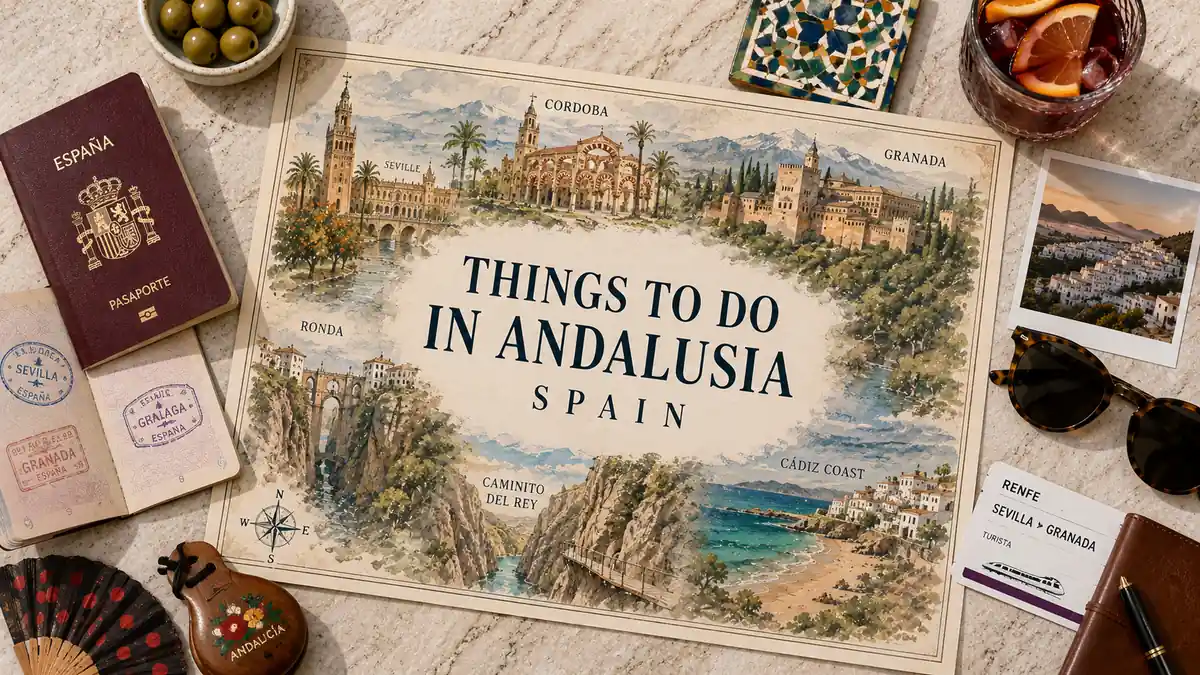
The best things to do in Andalusia are walking the Alhambra, seeing live flamenco, and hiking the Caminito del Rey. The full shortlist spans Moorish monuments, living culture, and wild outdoors, so your trip style decides the mix. History lovers build around the icons; outdoors-first travelers should anchor a trip on the Caminito and Cabo de Gata instead.
Andalusia hands you more standout experiences than any single trip can hold. In one region you can walk a thousand-year-old palace in the morning, watch flamenco land like a punch that night, hike a gorge boardwalk the next day, then drive between whitewashed villages or swim off an empty beach. The problem is never finding something to do — it is choosing.
This guide is about experiences: what you actually do in Andalusia, and who each thing is for. It picks ten experiences worth planning a trip around, grouped into three kinds — the Moorish icon monuments, the region’s living culture, and its outdoors and coast. For each one you get why it earns a place, what makes it different from the others, and the traveler it suits best. Where to base yourself and what to book ahead come at the end, once you know which experiences you want.
About This Shortlist
This is a curated shortlist of ten experiences in Andalusia, chosen for what makes each one distinct and who it suits. It is not a ranking of places to visit in the region, a day-by-day itinerary, or a guide to where to stay, how to get around, or when to go.
Alex Perrut, working in tourism since 2015, reviewed this guide for the Tripstou editorial team; it was produced with AI assistance. Our editorial process explains how.
Last factual review: July 18, 2026.
Official sources consulted: spain.info, tourspain.es.
What Is Andalusia Famous For?
Andalusia is famous for five signature experiences you plan a trip around. They are Moorish architecture, live flamenco, tapas culture, the white hill villages, and a wild Mediterranean coast. Each one is something you do — an afternoon, an evening, or a day built around it. Together they explain the region’s outsized reputation.
This guide differs from a places list on purpose. A “best places” page ranks where to go; this one ranks what to do once you arrive. A town like Ronda shows up here as the setting of a drive, valued for the experience it delivers. For the wider national picture of experiences beyond this region, see our guide to the best things to do in Spain. Everything below stays Andalusia-specific.
Is Andalusia worth visiting?
Absolutely. Few regions pack this many distinct experiences into one trip — Moorish palaces, live flamenco, a dramatic gorge walk, whitewashed hill villages, and wild Mediterranean beaches. The variety is the draw: you can pair monuments with mountains and coast within a few hours’ drive. For most travelers, the density of things to do makes it unmissable.
The Moorish Icons: Alhambra, Mezquita, and Seville’s Real Alcázar
If you can fit only one Moorish icon, make it the Alhambra in Granada. It combines palace, fortress, and garden in a single site that no other monument in Spain matches for scale or setting. The Mezquita and the Real Alcázar are close behind — and easier to book — but the Alhambra is the one people plan whole trips around.
The three icons split cleanly by booking pressure. The Alhambra is the one that can derail a plan; the Mezquita and the Real Alcázar almost always have room for a walk-up. Direct your booking effort accordingly, and treat these as experiences to move through slowly, not sights to photograph and leave. Seeing all three in one trip is realistic: they sit in different cities — Granada, Córdoba, and Seville — but all lie within a couple of hours of each other by train.
1. Walk the Alhambra and Generalife (Granada)
The Alhambra tops the list because no other site in Spain folds palace, fortress, and hillside gardens into a single walk. The Nasrid Palaces, the Generalife’s water gardens, and the Alcazaba ramparts each read like a separate visit. It carries UNESCO World Heritage status alongside the Generalife and the Albaicín quarter below. It sells out routinely — book well before you travel. If one unforgettable monument is the reason for your trip, this is the one to build it around.
2. Stand Under the Arches of the Mezquita-Catedral (Córdoba)
The Mezquita-Catedral made the list for the single most surprising interior in Spain: a forest of red-and-white double arches that seems to have no end. What sets it apart is the layering — you walk from the arch hall to the glittering mihrab, then straight into a full Renaissance cathedral nave dropped in the middle. It holds UNESCO World Heritage status. Of everything on this list, it is the most unexpected building you will enter in Andalusia. Give it an unhurried half-day.
3. Explore the Real Alcázar and Cathedral (Seville)
Seville’s Real Alcázar makes the cut as a living royal palace you walk through, not a ruin behind glass. The draw is the contrast: Mudéjar courtyards and tilework flow straight into terraced gardens full of orange trees and fountains. The neighbouring cathedral and its Giralda tower round out an easy half-day in the centre. It holds UNESCO World Heritage status with the Archivo de Indias. Choose it for palace gardens without Granada’s booking pressure.
Tours and activities
Book skip-the-line tickets, day trips and local tours with free cancellation on most activities.
You can also browse everything on getyourguide.com.
Tripstou may earn a commission if you book through this link, at no extra cost to you.
Flamenco, Tapas, and Sherry: Andalusia’s Living Culture
Andalusia’s living culture is best met live — in a flamenco tablao, a tapas bar, or a sherry bodega. For a first trip, an evening of flamenco delivers the most: it is the region’s emotional signature in ninety minutes. A tapas crawl and a Jerez bodega visit reward the curious, but flamenco is the one to protect a night for.
These four experiences share one trait — they only make sense in motion, ordered, poured, or performed in front of you. That is what a data table of “top attractions” always misses about Andalusia’s culture: the value is in the doing, so build at least one of these into an evening rather than treating it as a daytime tick-box.
4. See Flamenco in a Tablao
Live flamenco is the pick that turns Andalusia from sightseeing into feeling. Seen in an intimate tablao — Seville’s old quarter, Granada’s cave venues in Sacromonte, or the bars of Jerez — it lands with a force no recording carries. Each setting has its own accent, so where you watch shapes what you see. Flamenco is recognised by UNESCO as Intangible Cultural Heritage. Choose a small venue over a large dinner-show hall, and you will see the real art form up close: one live evening is enough to feel the region’s pulse.
5. Do a Proper Tapas Crawl
A proper tapas crawl is Andalusia’s everyday culture served small and standing up. The point is movement: one dish and one drink per bar, then on to the next, letting the street set the pace. In Granada many bars still bring a free tapa with each drink — a regional quirk that rewards bar-hopping. It costs little and needs no reservation. If grazing across a dozen bars sounds like a better night than a restaurant booking, this is your evening.
6. Taste Sherry at a Jerez Bodega
Tasting sherry in Jerez suits anyone who likes a drink with a real sense of place. What makes the sherry triangle distinct is the solera method — barrels blended across generations — walked through in cool, cathedral-tall cellars. Tastings run from bone-dry fino to syrup-sweet Pedro Ximénez, so one visit covers a whole spectrum. Pair it with a flamenco night in the same town.
7. Soak in a Hammam (Arab Baths)
An Arab-baths session is the living, physical end of Andalusia’s Moorish thread. Restored hammams in Granada, Seville, and Córdoba move you through warm, hot, and cold pools under lantern light, often with an optional massage. It works best as a reset between monument-heavy days, ideally booked for the evening. Treat it as one of the trip’s experiences in its own right, and the restful counterweight to long days on your feet.
Caminito del Rey, White Villages, and the Wild Coast
Andalusia’s outdoor half is three experiences: the Caminito del Rey, the white villages, and the beaches of Cabo de Gata. The Caminito is a half-day walk on an engineered gorge path. The white villages fill a full day of driving and stops. Cabo de Gata is a flexible beach day. Together they balance a trip of interiors and queues.
The Caminito del Rey looks lethal in its photos yet asks almost nothing of your legs — the whole path is flat and railed, so the only real barrier is a head for heights. That single fact reshuffles who this section suits: nervous walkers can attempt the boardwalk, while confident hikers who want elevation and distance are better served by the white-villages drive or a Cabo de Gata coast path.
8. Walk the Caminito del Rey
The Caminito del Rey delivers a genuine thrill with almost no fitness demand. You walk a metre-wide boardwalk pinned to the wall of the El Chorro gorge, high above the river, near Álora in Málaga province. It runs one direction only — dramatic the whole way, and flat and fully railed. Its daily capacity is capped, so book ahead. A helmet is mandatory on the walkway, and severe vertigo can make its exposed stretches genuinely uncomfortable.
9. Drive the White Villages (Ronda, Setenil, and Around)
Driving the white villages is an experience of the road itself. You string together whitewashed hill towns — Ronda on its gorge, Setenil with houses built under overhanging rock, and dozens more across Cádiz and Málaga provinces. The joy is the wandering: pulling over for a viewpoint, a plaza, a coffee. It fills a full day and works best with a car. It is made for anyone who would sooner drive and wander than tick off famous sights.
10. Find a Wild Beach at Cabo de Gata
Cabo de Gata is where Andalusia’s coast turns wild and undeveloped — ideal for the end of a busy trip. This volcanic headland in Almería province holds some of Spain’s last unbuilt Mediterranean beaches: coves reached by dirt track or a short walk, backed by desert hills instead of resorts. There are no promenades and few facilities, which is the whole appeal. Bring water and shade; emptiness is the point.
Which Base City Unlocks Which Experiences?
Most of the ten experiences cluster around three base cities: Seville, Granada, and Málaga. Granada owns the Alhambra and its hammams; Seville anchors flamenco, tapas, and the Real Alcázar; Málaga puts you within reach of the Caminito and the white villages. Cabo de Gata, over in Almería, is the outlier. Your base quietly decides your experience mix.
The pairing is straightforward once you see the clusters. Granada is the base for the Alhambra, its hammams, and Sacromonte’s flamenco caves. Seville puts the Real Alcázar, tapas, and tablaos within walking distance. Málaga is the launch point for the Caminito del Rey and a white-villages drive, and it anchors the coast. Cabo de Gata sits on its own in Almería, far enough east that it usually means a dedicated leg.
One province quietly breaks the base-city logic: the white villages spread across Cádiz and Málaga with no obvious hub, so they are the one experience that rewards a rental car over a fixed base.
| Experience | Province | Natural base | Getting there |
|---|---|---|---|
| Walk the Alhambra | Granada province | Granada city | easy on foot in Granada |
| Real Alcázar and flamenco | Seville province | Seville city | walkable in central Seville |
| Hike the Caminito del Rey | Málaga province | Málaga city | short train from Málaga |
| Drive the white villages | Cádiz and Málaga | Ronda or Málaga | needs a rental car |
| Swim at Cabo de Gata | Almería province | Almería or Níjar | best with a rental car |
For help deciding which of these cities to actually base in, see our guide to the best places to visit in Spain. For deeper regional orientation and trip planning, start with the Andalusia travel guide.
Can you do Andalusia without a car?
Mostly, yes. The headline experiences — the Alhambra, flamenco, the Mezquita, and the Real Alcázar — sit in cities linked by fast trains and buses, so no car is needed. A car only becomes worthwhile for the white villages and Cabo de Gata’s remote beaches, which public transport reaches poorly.
Train and bus tickets
Compare routes, schedules and prices across rail and bus operators in one search, with mobile tickets on your phone.
New to Omio? Code NEW10 takes 10% off your first booking — or APPNEW10 if you book inside the Omio app. Both apply to bookings up to €80.
Search routes and compare prices on Omio →
Tripstou may earn a commission if you book through this link, at no extra cost to you.
Which Andalusia Experiences Need Advance Booking?
Only two of the ten experiences need advance booking: the Alhambra and the Caminito del Rey. Both cap daily numbers and sell out in busy periods. Reserve them through official channels before you fly, as soon as dates are fixed. Everything else — flamenco, tapas, bodegas, villages, beaches — you arrange on the ground.
The Alhambra and the Caminito cap entry for opposite physical reasons — one meters visitors through fragile palace rooms, the other along a single-file walkway — but the fix is identical: book the moment your dates are set. Beyond those two, booking is about securing the best slot, not securing entry at all.
- Book before you fly: the Alhambra and the Caminito del Rey — capacity-capped, sell out in peak periods, official channels only.
- Reserve a few days out: flamenco tablaos, a hammam session, a Jerez bodega tour — rarely sold out, but the best evenings and slots go early.
- Walk up to everything else: tapas crawls, the white-villages drive, and Cabo de Gata’s beaches — no booking and no fixed plan required.
Guided tickets and small-group tours for the icons and the Caminito are worth comparing when official slots are tight, since they bundle timed entry with a guide. Which city you tackle first is a routing question; for sequencing a full trip, see our Spain itinerary guide.
Did this guide save you time or money? Tripstou is independent and reader-funded — if you'd like to give something back, you can support the site with a crypto contribution of any size.