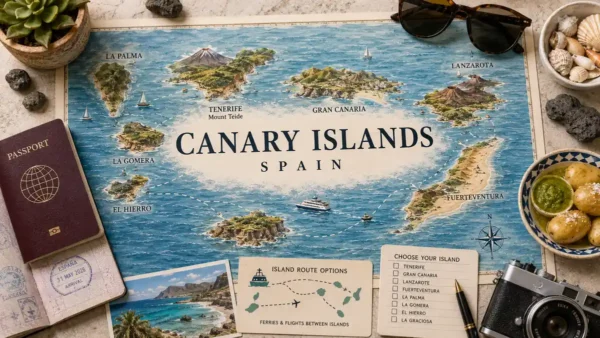
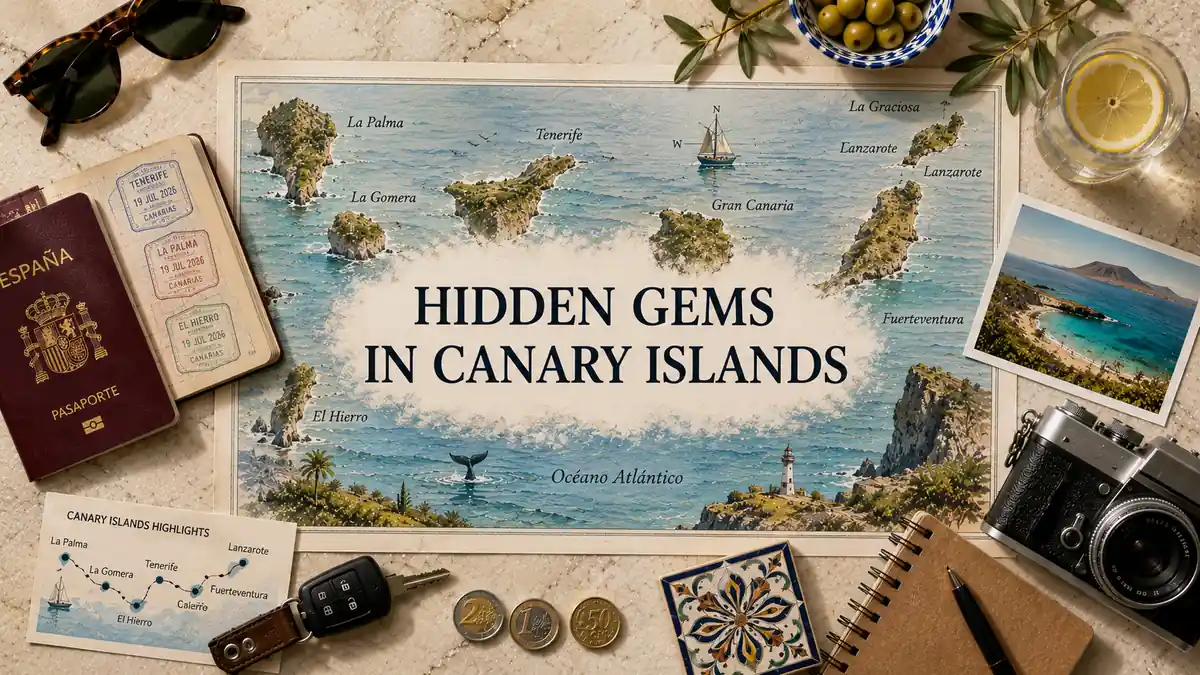
The best hidden gems in the Canary Islands are the quieter western islands — La Gomera, La Palma and El Hierro — plus car-free La Graciosa off Lanzarote. Choose a quiet island for slow nature travel, or a hidden village or ravine for a day-trip escape: El Hierro and La Graciosa feel most remote, while Garachico or Guayadeque suit travelers already based on Tenerife or Gran Canaria.
You have likely already settled on the Canary Islands. The open question is where to go once you step past the headline resorts of Tenerife’s south and Gran Canaria’s beach strips. That is where this guide comes in: a curated, crowd-free shortlist of the archipelago’s genuinely underrated places, split between the quieter western islands and the hidden villages, ravines and valleys that day-trippers routinely skip. Each pick comes with a concrete reason it stays off the standard circuit and the island it belongs to, so you can match a place to your travel style at a glance. Some are whole islands built for slow nature travel; others are half-day escapes reachable from a busy base. None of them are the famous names you already know — that is the point.
The Quieter Islands Worth Visiting: La Gomera, La Palma and El Hierro
La Gomera suits hikers, La Palma suits stargazers, and El Hierro suits travelers chasing genuine remoteness. These three western islands are the core quiet-escape picks in the archipelago, each built around one standout draw instead of resort infrastructure. None has a mass-market beach strip, which is exactly why they stay calm.
All three reward slow travel, and each earns its spot for a different reason. La Palma’s dark skies only pay off above the coast — the high ridge road, not the seafront, is where the stargazing reputation is earned. Pick by the experience you care about most.
La Gomera: Whistled Language and Ancient Laurel Forest
La Gomera is the hikers’ island, wrapped around the UNESCO-listed Garajonay laurel forest. Ancient laurisilva woodland covers its misty centre, threaded with trails that fan out to remote valleys and terraced hillsides. The island also keeps Silbo Gomero alive, a whistled language once used to carry messages across its deep ravines. Primeval forest on foot and a living whistled language, all a short ferry from Tenerife, make it the first island to add for walkers.
La Palma: Dark Skies and Ridgeline Trails
La Palma, nicknamed “La Isla Bonita,” is the island for stargazers and ridge hikers. Some of the clearest night skies in Europe sit above its high volcanic spine, protected by strict lighting rules. By day, the crater-rim and volcano-route trails deliver long, dramatic walks with almost no crowds. Together with La Gomera, it stays far quieter on foot than the popular paths around Tenerife’s Teide, so world-class stargazing comes paired with demanding volcanic hikes far from resort strips.
El Hierro: The Remotest, Smallest Escape
El Hierro is the smallest and most remote of the main islands, and a UNESCO biosphere reserve in full. It sees a fraction of the visitors of the eastern islands, and its dive sites off La Restinga rank among the best in Europe. The whole island feels genuinely off-grid. Divers come for the world-class cold-water diving; everyone else comes for the archipelago’s most remote, off-grid feel.
Tours and activities
Book skip-the-line tickets, day trips and local tours with free cancellation on most activities.
You can also browse everything on getyourguide.com.
Tripstou may earn a commission if you book through this link, at no extra cost to you.
La Graciosa: The Car-Free Island Escape
La Graciosa is the Canaries’ standout car-free island, a sandy, road-free speck off northern Lanzarote. Part of the protected Chinijo archipelago, it has dirt tracks instead of paved roads and a single small village. It suits travelers who want empty beaches and near-total quiet within easy reach of a busier base.
Getting there means a short boat hop from the north of Lanzarote, and that is as much logistics as this page covers. Once ashore, you move on foot, by bike or in the occasional 4×4 taxi along sandy tracks. Day-trippers clear out by evening, so an overnight in the lone village is where La Graciosa’s after-hours emptiness actually pays off. Bring what you need. Wild beaches like Playa de las Conchas draw the few who make the crossing.
Hidden Villages Most Visitors Skip
Garachico, on Tenerife’s north coast, is the standout hidden village, with lava-formed rock pools and an old port. Across the busy islands, a handful of villages stay overlooked because day-trippers cluster around resorts and headline sights. Each rewards a slow half-day of wandering colonial streets and local squares.
These villages survive as everyday Canarian towns, not staged attractions, which is why they stay quiet. Each pairs a distinct draw — lava pools, colonial balconies, palm valleys or clifftop views — with a slow, walkable centre. Go for the morning or late-afternoon light.
Garachico, Tenerife: Lava Pools and an Old Port
Garachico is a historic north-coast port town rebuilt around a volcanic eruption that reshaped its harbour. Its signature draw is El Caletón, a set of natural rock pools formed by cooled lava and filled by the Atlantic. Cobbled lanes, old convents and a quiet plaza fill the rest. It gives Tenerife visitors a photogenic historic town and natural lava pools without the island’s resort crowds.
Teror, Gran Canaria: Colonial Balconies and a Sunday Market
Teror is Gran Canaria’s prettiest inland town, known for carved wooden balconies and a hillside basilica. Its Sunday market draws locals for regional produce, cheeses and the town’s famous chorizo. Away from the coast, it stays firmly a Canarian town rather than a tourist stop. For colonial architecture and an authentic local market, it sits a short drive from Las Palmas.
Haría, Lanzarote: The Valley of a Thousand Palms
Haría is a green, palm-filled village in northern Lanzarote, a striking contrast to the island’s black lava fields. Known as the “Valley of a Thousand Palms,” it was also home to artist César Manrique, whose final house-studio sits nearby. A small weekly craft market adds to the slow charm. Lush palm valleys and Manrique’s legacy make it the Lanzarote stop for travelers keeping away from the island’s southern resorts.
Agulo, La Gomera: A Clifftop Old Town
Agulo is often called La Gomera’s prettiest village, a cluster of white houses stacked on a clifftop above the sea. Cobbled alleys wind past a domed church, with Tenerife’s Mount Teide framed across the water. It sees few visitors beyond passing hikers.
Secret Ravines, Valleys and Coves
Guayadeque Ravine on Gran Canaria is the top hidden natural spot, a green gorge dotted with cave homes. Gran Canaria’s interior hides ravines, slot canyons and farming valleys that most visitors never reach from the southern beaches. These places stay quiet because they take a deliberate detour inland.
What unites these spots is a detour: none sits on the main coastal tourist track, so reaching them takes intent. Barranco de las Vacas stays hidden largely because it is reached only by a small roadside pull-in, which quietly caps how many people are ever there at once. Frame each as a destination first. For the guided walks, coffee tastings and other activities at these places, our guide to things to do in the Canary Islands owns the what-to-do detail, while this page sticks to where.
- Guayadeque Ravine, Gran Canaria: a cave village. Guayadeque is a deep, green ravine where people still live in homes carved into the rock. The valley shelters cave dwellings, a cave chapel and cave restaurants built directly into the cliffs. Its lush slopes bloom in spring and stay far quieter than the coast.
- Barranco de las Vacas, Gran Canaria: a sandstone slot canyon. Barranco de las Vacas is a small sandstone slot canyon with smooth, wave-like walls sculpted by water. It is compact and easy to explore on foot, tucked just off a quiet inland road near Agüimes. The sculpted rock makes it a striking photo stop.
- Agaete Valley, Gran Canaria: coffee country. Agaete Valley is one of the few places in Europe where coffee is grown commercially, on green terraced slopes near the northwest coast. Small family fincas raise coffee alongside mango, citrus and vines, and some open for tastings. The nearby coast has natural seawater pools.
Hidden coves are mostly a small-island affair: El Hierro and La Gomera hold secluded coves well away from the resort strips, and La Graciosa’s Playa de las Conchas is a wild, golden bay reached only by boat and a walk.
Which Canary Island Is the Least Touristy?
El Hierro is the least touristy Canary Island, followed closely by La Gomera and La Palma. The three western islands sit farthest from the mass-tourism beaches of Tenerife, Gran Canaria, Lanzarote and Fuerteventura, so crowds thin out fast. They reward travelers who value quiet over nightlife.
Ranking least-touristy is really about distance from the four big beach islands. El Hierro, La Gomera and La Palma all sit west of the busy core, so they never developed large resort zones. Least touristy here does not mean hardest to reach — La Gomera is a quick ferry from Tenerife, while remote-feeling El Hierro needs a dedicated flight or a long crossing. La Gomera’s crossing leaves from Tenerife’s south, while La Palma also needs a longer ferry or a dedicated inter-island flight, and El Hierro is the most effort of all. Crowds also shift by season and coast. For the full picture on ferries, which island suits which traveler, budgets and the best time to go, lean on the parent Canary Islands guide — this page stays focused on where the quiet actually is.
Train and bus tickets
Compare routes, schedules and prices across rail and bus operators in one search, with mobile tickets on your phone.
New to Omio? Code NEW10 takes 10% off your first booking — or APPNEW10 if you book inside the Omio app. Both apply to bookings up to €80.
Search routes and compare prices on Omio →
Tripstou may earn a commission if you book through this link, at no extra cost to you.
How to Pick a Crowd-Free Canary Islands Gem
Choose a quiet island when you want a multi-day escape, and a hidden village when you only have a day. The Canaries split cleanly along a famous-versus-hidden axis: resorts and headline sights on one side, slow western islands and overlooked inland towns on the other. Match the pick to your pace.
The choice really comes down to how much time and effort you want to spend reaching the quiet. Whole islands like La Gomera or El Hierro reward several unhurried days; a village or ravine on a busy island slots into an afternoon. The quieter islands cost you a connecting flight or ferry that most visitors never bother taking — which is exactly the filter that keeps them empty. That effort is the point. If you want to widen the lens beyond the archipelago, our roundup of hidden gems in Spain covers the mainland’s overlooked corners, while the famous islands and resorts you are deliberately skipping sit on the other side of the axis in our guide to the best places to visit in Spain.
Editorial Note
This page is a curated shortlist of the Canary Islands’ quieter islands, villages and natural spots, chosen for how far each sits from the resort circuit and who it suits; it is not a full guide to the archipelago, an itinerary or a list of things to do there.
Produced with AI assistance, this shortlist was then reviewed by Alex Perrut, working in tourism since 2015, for the Tripstou editorial team. The editorial process page explains how.
Last factual review: July 19, 2026.
Official sources consulted: Spain.info, Turespaña.
Timing and Island-Hopping Questions
When is the best time to visit the quieter Canary Islands?
Spring and autumn suit the quieter Canary Islands best, with mild weather and even thinner crowds than the summer peak. The western islands stay pleasant year-round thanks to the archipelago’s steady subtropical climate. For month-by-month detail and island-specific timing, the parent Canary Islands guide has the full picture.
Can you island-hop between the quieter Canary Islands?
Yes, you can island-hop between the quieter Canary Islands using the inter-island ferry and flight network. The western islands connect through Tenerife, so most hops route via its ports or airport instead of running directly. Building a multi-island trip is realistic, though it rewards a slower, less rushed pace.
Did this guide save you time or money? Tripstou is independent and reader-funded — if you'd like to give something back, you can support the site with a crypto contribution of any size.