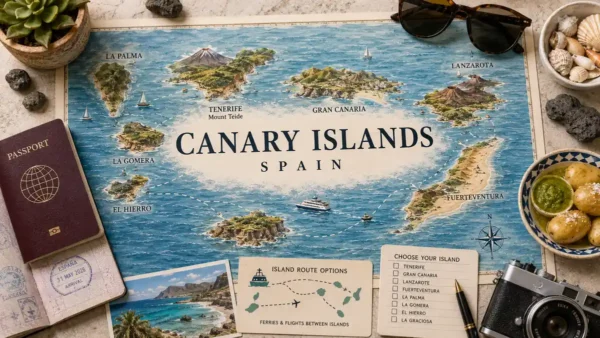
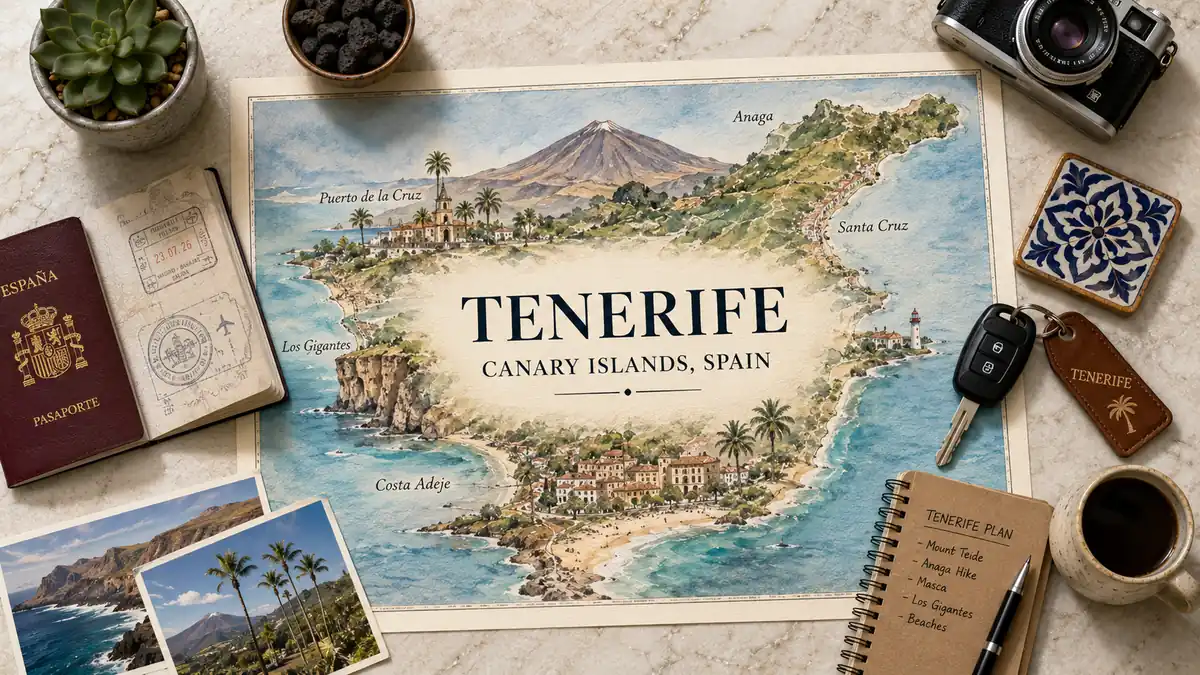
Travel to Tenerife, Spain, means visiting the largest of the Canary Islands, a Spanish island in the Atlantic off north-west Africa that is best for year-round winter sun, Mount Teide and a lot of landscape packed into a small area. Base yourself on the south-west coast if your trip is about sun and beaches. Base yourself in the north if you care more about hiking, culture and real Canarian towns. With a hire car, one base covers the whole island in a week.
Teide shapes everything else. The volcano splits Tenerife into a sunny, dry south and a green, cloudier north, so the side you sleep on decides what your days feel like.
Decide These Before You Book
- Sleep on the south-west coast for dependable sun and calm beaches, or in the north for hiking, older towns and greener valleys, because Teide splits the island’s weather in two.
- Fly into Tenerife Sur for a southern base and Tenerife Norte for a northern one; express bus line 343 links the two airports if your flight lands at the other.
- Hire a car if Teide, Masca and Anaga are on your list, since buses serve the main towns well but crawl through the mountains.
- Book the Teide cable car online before you go, and secure the separate summit permit weeks to months ahead if you want to reach the crater.
- Pack warm layers in any month, because the top of Teide stays cold all year even when the coast is beach-warm.
- A week covers beach days, Teide and a northern day on a first trip; only at ten days or more does a split stay repay the hotel change.
On This Page
Where Is Tenerife, and What Is It Known For?
Tenerife is part of Spain: it is the largest of the Canary Islands, sitting in the Atlantic off the north-west coast of Africa. It is known for reliable winter sun, for Teide (Spain’s highest peak), and for a sharp contrast between a dry volcanic south and a green north on a single island.
The island suits winter-sun breaks, families, hikers and stargazers alike. Its reputation rests on a short list of places: Teide National Park, the UNESCO-listed old town of La Laguna, the sheer Los Gigantes cliffs, whale and dolphin trips off the south-west coast, Loro Parque in Puerto de la Cruz and Siam Park in Costa Adeje.
A week on Tenerife alone is a complete trip. It also works as one stop in a longer island plan — La Gomera is a short ferry ride away — and if you are still choosing between islands, the Canary Islands travel guide sets out which one suits which trip, while Spain’s islands compared adds the Balearics to the picture. Combining Tenerife with the mainland means a flight; the Spain travel guide covers planning the rest of the country.
North or South Tenerife: Sun in the South, Character in the North
Base in the south for dependable sun, easy beaches and resort life; base in the north for greener landscapes, older towns, hiking and a milder, cloudier climate. Teide causes the split: the trade winds push cloud against the northern slopes, while the south sits in the mountain’s rain shadow.
| Factor | South | North |
|---|---|---|
| Climate | Sunnier, drier, warmer | Cloudier, cooler, more frequent showers |
| Landscape | Arid volcanic slopes, resort coastline | Green valleys, laurel forest, banana terraces |
| Beaches | Calmer water, many golden-sand resort beaches | Dark volcanic sand, rougher Atlantic sea |
| Atmosphere | Purpose-built resorts, busy and easy | Historic towns with everyday local life |
| Suits | First beach breaks, families, winter sun | Hikers, culture-led trips, slower travel |
| Natural bases | Costa Adeje, Los Cristianos, El Médano, Los Gigantes | Puerto de la Cruz, La Laguna, Garachico |
Anyone who would trade a guaranteed tan for walking trails and town squares belongs in the north. A split stay — a few nights on each side — gives you both without daily motorway drives. It costs one hotel change, which earns its keep on trips of ten days or more and rarely on a short break.
Tenerife’s Main Zones and What Each One Is For
Tenerife reads as a handful of zones, each with one clear anchor experience and a natural base. Pick the zone that matches your trip, not the island as a whole: the south-west coast for beaches, the west for cliffs, the centre for Teide, the north coast for old towns and the north-east for culture and forest hikes.
South-west coast: Costa Adeje, Las Américas, Los Cristianos
The south-west coast is Tenerife’s resort heart and where most visitors stay. Costa Adeje is the more polished end, Playa de las Américas the livelier middle and Los Cristianos an older fishing town turned resort, all joined by a seafront promenade.
Siam Park, the island’s big water park, sits in Costa Adeje. Families often build a whole day around its slides and wave pool, so treat it as a full day out, not a quick stop between beaches.
Whale and dolphin trips are the coast’s other signature outing, with boats leaving from the south-west harbours; from Los Cristianos you can book a whale-watching cruise that keeps its distance from the animals. Los Cristianos is also the ferry port for La Gomera. A fuller list of activities sits in our guide to things to do across the Canary Islands.
West coast: Los Gigantes and the Masca gorge
The west coast trades beaches for scenery. The Los Gigantes cliffs drop straight into the sea, and the town below them is a quieter base with sunset views.
Inland, the village of Masca clings to a ravine reached by a narrow, hairpin mountain road. Drive it yourself early in the day, or book this day tour that links Masca with Teide, Icod de los Vinos and Garachico if you would sooner not take the wheel.
Teide and the high centre
The centre of the island is Teide National Park: a lunar plateau of lava fields and rock formations around the volcano, with dark skies that draw stargazers after sunset. Nobody bases here. It is a day or evening visit from either coast, and the ways to see it are set out in the Mount Teide section below.
North coast: Puerto de la Cruz, La Orotava, Garachico and Icod
The north coast holds Tenerife’s older towns and its greenest valley. Its anchors:
- Puerto de la Cruz, the original resort town and home of Loro Parque.
- La Orotava, a hillside town of balconied mansions above the Orotava valley.
- Icod de los Vinos, famous for its ancient dragon tree, and Garachico, a small harbour town rebuilt after a volcanic eruption.
Loro Parque is the main paid draw in the north and fills a long morning or a full day, so it pays to reserve your entry before a busy holiday day. Garachico, by contrast, makes a calm base for anyone after the north without a resort feel; it and the Anaga hamlets appear among our quieter Canary Islands villages.
North-east: La Laguna, Santa Cruz and Anaga
The north-east is the island’s cultural end. La Laguna’s grid-planned old town is a UNESCO World Heritage Site and a university city with lively streets; Santa Cruz, the capital, is linked to it by tram. Beyond them, the Anaga mountains hold laurel forest, ridge-top hiking trails and tiny villages that feel far from the resorts.
Tours and activities
Book skip-the-line tickets, day trips and local tours with free cancellation on most activities.
You can also browse everything on getyourguide.com.
Tripstou may earn a commission if you book through this link, at no extra cost to you.
Where to Stay in Tenerife for Your Kind of Trip
Most first-timers do best with one base on the south-west coast, in Costa Adeje or Los Cristianos, because the sun is most reliable there and the main airport is close. Hikers and culture-led travelers do better in Puerto de la Cruz or La Laguna. One base is enough for a week with a car; a split stay pays off when you want both sides without the long drives.
- Costa Adeje — the family pick: calm beaches, Siam Park on the doorstep and the widest choice of resort hotels, at higher prices than its neighbours.
- Playa de las Américas and Los Cristianos — nightlife in Las Américas, a gentler town feel in Los Cristianos, and more budget-friendly apartments in both; expect crowds along the seafront.
- El Médano — a laid-back surf-and-kite town near the southern airport, where steady wind is the reason to come and the reason some visitors leave.
- Los Gigantes — cliffs and sunsets over a small marina; peaceful, though its beach is tiny and the best sand is a drive away.
- Puerto de la Cruz — the northern base for hikers and anyone after an older-town feel, with Loro Parque and the Orotava valley close; you accept more cloud.
- La Laguna or Santa Cruz — culture without a car, thanks to the tram and good bus links, at the cost of distance from the sunny beaches.
For a first week, stay in one place on the south-west coast and drive north for a day or two. A split stay only wins once you plan several northern hikes. Planning a longer remote-work stay? Our list of the best Spanish bases for digital nomads weighs the Canaries against the mainland cities.
Tenerife Has No Bad Month, Only Different Goals
Tenerife is mild all year, so the right time depends on what you came for. Winter is peak season for sun-seekers escaping colder Europe, spring and autumn suit hiking and Teide best, and summer is the hottest and busiest stretch, driven by family holidays.
Beach trips work in any month on the south-west coast, which stays the sunniest part of the island. Winter brings occasional wetter spells, felt most in the north, and the north keeps its cloud cover in every season.
Hikers and Teide visitors should watch altitude, not the coastal forecast. Teide is cold at the top all year and can carry snow in winter, so a beach-warm day in Los Cristianos can mean freezing wind near the crater. Spring and autumn give the best balance of clear air and comfortable walking.
The Carnival of Santa Cruz takes over the capital in February or March and fills hotels across the island, so book early if your dates overlap. Mainland Spain follows a very different seasonal rhythm; the guide to the best time to visit Spain covers how the peninsula’s seasons compare.
Getting to and Around Tenerife: Airport First, Then Car or Bus
Fly into Tenerife Sur for a south-coast base and into Tenerife Norte for the north when your route allows it. Once on the island, hire a car if you want Teide, Masca and Anaga on your own schedule; buses and the tram are enough for a stay based around towns.
Which airport should you fly into?
Tenerife Sur (TFS, Reina Sofía) is the airport most travelers should fly into, because it handles most international flights and sits close to the south-west resorts. Tenerife Norte (TFN, Los Rodeos) lies near La Laguna and Santa Cruz and is convenient for a northern base when a route serves it. The express bus line 343 links the two airports.
Do you need a car in Tenerife?
You need a car for the mountains and the remote corners; you can manage without one if you stay in towns. The options:
- Hire car. Full freedom for Teide, Masca and Anaga. The TF-1 motorway runs along the south and the TF-5 along the north, but mountain roads are slow, steep and winding, so judge distances by bends, not kilometres.
- TITSA buses. The island’s buses, known locally as guaguas, are cheap and connect the main towns well. They are slow for mountain areas, which makes a Teide day by bus hard work.
- Tram. Quick and simple, though it only runs between Santa Cruz and La Laguna.
- Organised tours. If you skip the car, a guided trip covers Teide or Masca in a day without any mountain driving, in exchange for a fixed schedule.
How to Visit Mount Teide: Viewpoints, Cable Car or Summit
You can see Teide at three levels: drive through the national park to the viewpoints, ride the cable car (tickets are sold online only), or walk the final summit trail, which needs a separate permit booked well in advance. At 3,715 metres, Teide is the highest peak in Spain.
- Viewpoints by car. The road through the national park passes lava fields, rock towers and wide views of the cone. No booking is needed and half a day is enough, though you never leave the plateau.
- Cable car. The ride climbs to the upper station at La Rambleta, 3,555 metres up, with short trails from the top. Book online in advance; the cable car can stop in bad weather, so keep a plan B for the day.
- Summit trail. The last stretch to the crater (the Telesforo Bravo trail) requires a special permit on top of any cable car ticket. Slots are limited, so book weeks to months ahead; without the permit, La Rambleta is as high as you go.
Dress for cold at altitude whichever level you choose, even when the coast is hot. After dark the park turns into a stargazing site, which is why many visitors return for an evening trip.
How Many Days Do You Need in Tenerife?
A week is the sweet spot for a first trip to Tenerife: enough for beach days, a Teide visit and a day in the north. A long weekend works if you stay put on one coast, and ten days or more opens a split stay or a day trip to La Gomera.
- 3–4 days: one base, mostly beach, plus a single Teide outing. Right for a winter-sun break, too short to see the north properly.
- A week: beach time, Teide, a northern day in La Laguna or Puerto de la Cruz, and a morning on the west coast. Covers the island’s highlights for most first-timers.
- 10 days or more: room for a split stay between south and north, Anaga hikes, or a ferry day to La Gomera. Suits hikers and repeat visitors.
The strongest first-trip shape is simple. Base on the south-west coast and hire a car for part of the week: one day up to Teide, one day along the north coast to La Orotava and La Laguna, and one early morning at Los Gigantes or Masca before the tour coaches arrive. Fill the remaining days with the beach.
What a Tenerife Trip Costs by Spend Style
Tenerife works on a tight, middle or high-end budget; what moves the cost is your base (self-catering apartment or all-inclusive resort), how you eat, and whether you hire a car.
A tight budget buys a self-catering apartment in Los Cristianos or Puerto de la Cruz, supermarket breakfasts, local bars and the bus. Tenerife is kind to this style: beaches, hiking trails and the Teide viewpoints cost nothing, and buses are cheap.
A comfortable middle buys an apartment-hotel on the south-west coast, a hire car for part of the trip and one or two paid outings, such as a boat trip or the cable car. Here the island starts to bite: water parks, animal parks and tours each add up quickly for a family.
A high-end trip buys a resort in Costa Adeje, private tours to Teide and Masca, and restaurant dinners every night. Little on the island is out of reach at this level; the premium goes on space, sea views and not having to drive.
Tenerife Questions Before You Go
Is it warmer in the north or the south of Tenerife?
The south is warmer, sunnier and drier than the north. The north is still mild by European standards, just cooler and cloudier, and the real cold on Tenerife sits at altitude on Teide, not on either coast.
Does it rain more in the north of Tenerife?
Yes, the north gets more rain and cloud, which is why it is so green. Showers there tend to come and go rather than settle in for days, so a wet morning in Puerto de la Cruz can still turn into a dry afternoon, and the south-west coast is the place to retreat to on a grey day.
Which side of Tenerife is best for families?
The south-west is the easier side for families, with calm resort beaches and Siam Park close by. Los Cristianos suits families who want a town feel on a smaller budget, and Loro Parque in the north works as a day trip by car without moving base.
Can you take a ferry from Tenerife to La Gomera?
Yes, ferries to La Gomera leave from Los Cristianos on the south-west coast. A day trip works from a southern base, and taking a hire car across lets you reach the island’s interior instead of staying near the port.
How This Guide Was Checked
This guide helps you plan Tenerife as a whole — which side to base on, when to go, how to get around and how to see Teide; it is not a resort or hotel guide, a day-by-day itinerary, or a comparison of the Canary Islands.
Alex Perrut, working in tourism since 2015, went over the island facts here for the Tripstou editorial team; the guide was written with AI assistance, and our editorial process sets out the steps.
Official sources consulted: Teide Cable Car (Volcano Teide), Turismo de Tenerife, Spain.info (Turespaña).
Did this guide save you time or money? Tripstou is independent and reader-funded — if you'd like to give something back, you can support the site with a crypto contribution of any size.