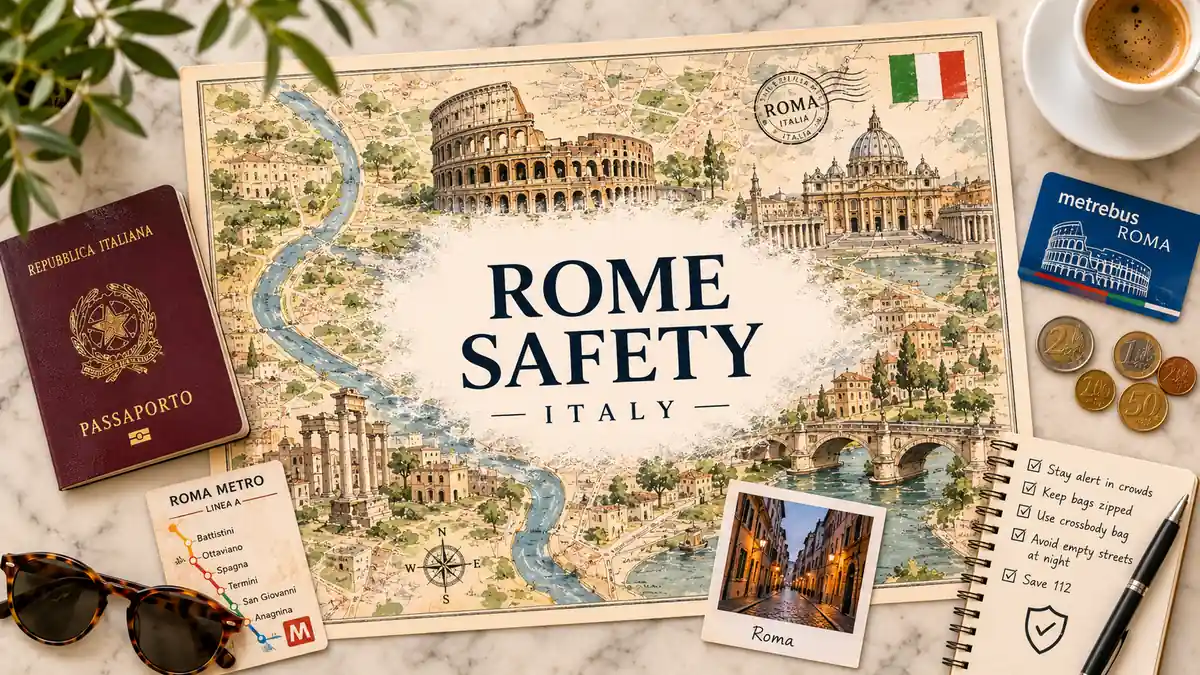
You have booked your flights to Rome, and now a quieter worry sets in: will you actually be safe there? It is the most common pre-trip question for first-time visitors, and it deserves an honest answer rather than blanket reassurance. Rome is a broadly safe city. Millions of tourists move through it every year without incident, and violent crime against travelers is rare. The real risk is smaller and more ordinary: pickpockets working crowded metro cars and scam artists circling the big monuments. This guide gives you the full picture — the overall verdict, the specific risks that matter, which areas call for extra attention and which you can walk freely, whether the city is safe after dark, and the exact habits that keep your valuables where they belong.
Quick Answer
Rome is a generally safe city for tourists, including solo travelers and those out at night. The real risk is petty theft — pickpocketing and tourist scams around crowded sites and public transport — not violent crime. Stay alert in crowds, secure your valuables, and most visitors find Rome comfortable and easy to navigate.
Trust Layer
Tripstou planning guide for travelers resolving one travel decision. Covers the main variable, traveler context, and practical tradeoffs.
Produced with AI assistance and reviewed by Alex Perrut, working in tourism since 2015, for the Tripstou editorial team. See our editorial process for details.
Last factual review: July 15, 2026.
Official sources consulted: Italia.it, ENIT.
Key Takeaways
- Rome is broadly safe for tourists — including solo and night visitors — with violent crime against travelers genuinely rare.
- The real risk is petty theft: pickpockets on crowded metro cars and scammers working the major monuments, not violence.
- Caution tracks crowds and transit, not neighborhoods — stay sharpest around Termini after dark and during the metro boarding crush.
- A zipped crossbody bag worn in front defeats most Rome pickpockets, who need a blind, reachable target to work.
- Central Rome stays safe after dark where streets are busy and lit; save your caution for quiet, emptying lanes.
- Save Italy’s emergency number, 112, and end almost any street scam with a flat, walking “no, grazie.”
Table of Contents
Is Rome safe for tourists?
Yes, Rome is generally safe for tourists. It ranks among Europe’s well-visited capitals where violent crime against visitors is uncommon, and everyday tourist life plays out without trouble. The genuine concern is petty theft — pickpocketing and opportunistic scams — concentrated where crowds gather. Treat Rome as safe but attention-worthy, not dangerous.
What makes Rome feel manageable is that its risks are predictable. You are not navigating random violence; you are managing a known, low-stakes threat that follows crowds and cameras. Understand where the pickpockets work, and the city opens up.
The travelers who get caught out in Rome are rarely careless people — they are careful people distracted at the exact wrong moment, phone raised at the Trevi Fountain or a bag hanging loose on a packed metro car. That single lapse is the whole game.
Rome’s profile broadly mirrors the country as a whole. If you want the national picture — emergency framing and country-wide context — read our overview of Italy safety. For planning the trip itself beyond safety, start with our Rome travel guide.
How bad is pickpocketing on the Rome Metro and buses?
Pickpocketing on Rome’s transit is real but entirely avoidable with basic care. It is the most common problem visitors actually encounter, and it clusters on crowded metro cars and busy tourist bus routes. Thieves rely on distraction and packed spaces, not force. Guard your bags in these settings and the risk drops sharply.
The theft concentrates on the routes tourists use most, because that is where crowds and valuables overlap. A few settings account for the bulk of it:
- Metro Line A, which links Termini to the Vatican, Spanish Steps, and other headline sights.
- Termini station itself, where luggage, confusion, and dense crowds combine.
- Popular bus routes running to the major monuments, especially at peak hours.
- Any moment of boarding crush, when everyone is pressed together and shuffling.
The moment of highest risk is not the ride — it is the doorway. Thieves work the crush as doors open and people shuffle on and off, because that is exactly when your hand leaves your bag and your attention drops to your footing. Keep bags zipped and held in front through that squeeze, and the metro becomes an easy, useful way to get around.
What are the most common scams in Rome?
Most scams in Rome are non-violent and concentrated around the major monuments. They target your attention and politeness, not your safety — the goal is your wallet, not a confrontation. The specific gimmicks shift over time, but the underlying pattern holds: an unsolicited approach near a famous site, followed by pressure to pay or hand something over.
You do not need to memorize a catalogue, because the setups recycle. The recurring patterns look like this:
- A “gift” pressed into your hand — a bracelet, a sprig, a rose — then a demand for payment.
- Someone asking you to sign a petition while an accomplice works your pockets.
- Overly helpful strangers at ticket machines or queues who expect a tip or skim your card.
- Overcharging by unofficial taxis or venues without posted prices near tourist hotspots.
Every Rome scam needs your cooperation to work. Nothing lands in your hand, no petition gets signed, and no “gift” is accepted unless you engage first. A flat, walking “no, grazie” ends almost all of them before they start.
Which areas of Rome should you be cautious in?
Rome has caution zones, not no-go districts. No tourist area of the city qualifies as genuinely dangerous; the difference is between places that demand a firmer grip on your bag and places where you can relax completely. Heightened caution tracks crowds and transit hubs — the Termini area, packed monuments, busy stations — not any neighborhood as a whole.
Thinking in terms of setting instead of district is the useful shift. The same square can feel effortless at 10 a.m. and call for more attention at midnight, and that is about crowd density and lighting, not about where you are on the map.
| Zone | Overall feel | When to stay alert |
|---|---|---|
| Centro Storico | Busy, well-policed tourist heart of the city | Around packed monuments and photo stops |
| Termini area | Functional transport hub, grittier after dark | Late evening and on crowded platforms |
| Trastevere and Monti | Lively and residential, easy on foot | Inside dense bar crowds at night |
| Vatican and Prati | Calm, orderly, family-friendly streets | In long queues and on Line A cars |
| Metro and buses | Efficient but the main theft setting | During the boarding crush at doors |
Is the area around Termini Station safe?
The area around Termini is safe to use but less polished than tourist Rome. As the city’s main transport hub, it draws crowds, luggage, and the pickpockets who follow them, and the streets just outside can feel busier and grittier after dark. By day it is unremarkable and fine to move through. At night, keep your bag close and stick to well-lit main streets.
Are Trastevere, the Vatican, and Monti safe to walk?
Yes, Trastevere, the Vatican area, and Monti are all comfortable to walk, day and night. These are among Rome’s most-visited neighborhoods — well-trafficked and well-lit — where the only real concern is the same petty theft found citywide. Testaccio and Centro Storico feel equally easy on foot. Normal city awareness is all you need.
Each neighborhood carries a slightly different evening rhythm, and that rhythm — not danger — is what changes from street to street. Trastevere buzzes with nightlife, so the crowds are your cover and your only real task is keeping bags secure in bar crushes. Monti is quieter and more residential. Vatican and Prati stay calm and orderly, and Testaccio keeps a local, unpretentious feel.
In Rome, the livelier the street at night, the safer it usually feels. The empty, dim lanes a few blocks off the tourist track are where visitors drop their guard, not the packed piazza. Choosing between these areas is a booking decision, not a safety one — for that, see our guide on where to stay in Rome.
Is Rome safe at night?
Yes, central Rome is generally safe at night. The historic center, Trastevere, and the main piazzas stay busy and well-lit well past midnight, and the after-dark risk is the same daytime theft, simply amplified where crowds thin out. Violent incidents against tourists remain rare. Quiet, empty streets and transit stops call for the most care.
The reasoning is the same one that governs the daylight hours, just sharper. Where there are people and light, you are fine; where a street empties out, you tighten up. Central Rome rarely goes fully dark or fully empty, which is why most visitors wander comfortably after dinner.
The riskiest part of a Roman night out is usually the walk home once the crowds have gone, not the night out itself. Plan that last stretch: favor main routes over shortcuts through deserted lanes, and use an official taxi rank or a ride app instead of walking a long, quiet distance alone. Late-night metro and stations deserve the same bag awareness you would use at rush hour.
How do you avoid getting pickpocketed and scammed in Rome?
The most effective habit is keeping valuables secured and out of sight in crowds. Nearly every theft in Rome depends on an easy, visible target — a phone in a back pocket, an open tote, a wallet left on a café table. Remove the easy grab and you remove most of the risk. Awareness in packed spaces does the rest.
A crossbody bag worn in front on the metro defeats the overwhelming majority of Rome pickpockets. They need a blind, reachable target, and a bag you can see and touch simply does not offer one. Build a few small habits and you rarely have to think about theft again:
- Wear a zipped crossbody bag in front on transit and in dense crowds.
- Keep phones and wallets out of back pockets and open bags.
- Split cash and cards; carry only what you need for the day.
- Ignore unsolicited approaches near monuments — bracelets, roses, petitions, “helpers”.
- Use official taxi ranks or a ride app, and confirm the meter or fare.
- Stay alert at the pinch points: boarding doors, ticket machines, photo stops.
Those habits cover safety specifically. For the wider practical playbook — transport passes, etiquette, timing, and the small things that make the city easier — see our Rome travel tips.
Frequently Asked Questions
Is Rome safe for solo female travellers?
Yes, Rome is a comfortable city for solo female travelers. Most report feeling at ease day and night in busy central areas, with unwanted attention limited to occasional catcalling rather than threats. The main precaution is the same citywide one: guard your bag against pickpockets and favor lit, populated streets after dark.
What is the emergency number in Rome and Italy?
The emergency number in Rome and across Italy is 112, the free EU-wide line that reaches police, ambulance, and fire. Operators can typically assist in English. It works from any phone, with or without credit or a SIM card. Save it before you travel so it is ready the moment you need it.
Is Rome safer than Paris or Barcelona?
Rome sits in broadly the same safety bracket as Paris and Barcelona. All three are major European tourist cities where the main visitor risk is pickpocketing around crowded sites and transit, not violent crime. Precise rankings shift and mean little in practice; the same bag-awareness habits keep you safe in any of them.
Is the Rome Metro safe?
Yes, the Rome Metro is safe to ride, including in the evening. It is a functional, well-used system where the only real concern is pickpocketing during crowded boarding, not personal danger. Stations and trains are busy with ordinary commuters and visitors. Keep your bag zipped and in front on packed Line A cars and you are fine.
Is the tap water safe to drink in Rome?
Yes, Rome’s tap water is safe to drink. The city is famous for its nasoni — free public drinking fountains that run cool, clean water sourced from the same supply as household taps. Fill a reusable bottle at them freely as you sightsee. Bottled water is widely sold but rarely necessary for health reasons.
What should you do if you’re pickpocketed or robbed in Rome?
If you are pickpocketed in Rome, report it at the nearest police station for a written insurance report. Cancel any affected cards immediately by phone, and use the emergency number, 112, for anything urgent. Most incidents are non-confrontational thefts, so prioritize documentation and card security over trying to chase down the thief.
Related Guides
- Rome travel guide — the overall planning hub for your whole trip.
- Where to stay in Rome — choosing the right base neighborhood.
- Rome travel tips — the broader practical playbook beyond safety.
- Italy safety — country-wide context and emergency framing.
- Getting around Rome — metro, bus and tram practicalities across the city.
- Rome airport transfer — the arrival leg, and which option suits a late landing.
Did this guide save you time or money? Tripstou is independent and reader-funded — if you'd like to give something back, you can support the site with a crypto contribution of any size.