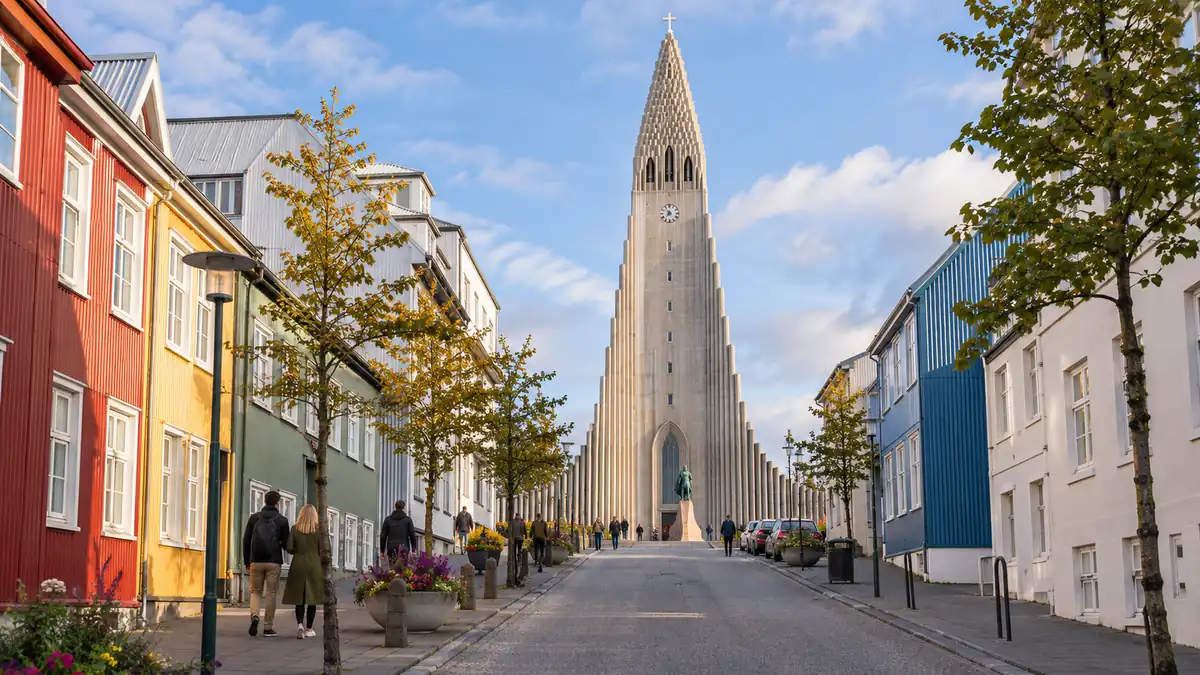
The core of a first visit to Reykjavik is one walk and one soak: climb Hallgrímskirkja and its tower, walk down through the centre to Harpa, the Sun Voyager and the Old Harbour, then end the day in hot water at a city pool or the Sky Lagoon. That pairing suits first-time visitors who use the city as a base between day tours, because it fits into a single day and most of it costs nothing.
How much time you have, and what the weather does, decides what comes next. A wet or dark day moves the plan indoors, led by Perlan and the museums. A calm spare half-day goes to the whales.
On This Page
The Reykjavik Shortlist: What a First Visit Should Not Skip
A first visit to Reykjavik should not skip Hallgrímskirkja, the walk down to Harpa, the Sun Voyager and the Old Harbour, and one geothermal soak. This set wins because it is compact, mostly free and the one every credible list of the city agrees on. Everything beyond it is a choice the trip makes for you.
The next tier is whale watching from the Old Harbour, Perlan on Öskjuhlíð and one museum picked by interest. Each costs real money and takes a good part of a day. Most visitors pick one of the three, and that is enough.
Three constraints sort the rest. Time decides how many paid picks fit. Weather decides whether they happen indoors or out. Budget decides whether the soak is a city pool or the Sky Lagoon.
What to Do in Reykjavik in One Day, on a Stopover or Over Two to Three Days
One day or a stopover covers the core walk plus one paid pick or one soak. Two to three days add a second paid experience, a museum and an unhurried pool visit, and still leave the option of giving a whole day to a tour out of town.
- A stopover of a few hours: the walk from Hallgrímskirkja to the harbour with the tower, or a soak, not both. The walk shows more of the city; the soak is the better reset after a long flight.
- One full day: the walk, one headline paid pick (whale watching, Perlan or FlyOver Iceland) and a city pool in the evening. A second paid headliner turns the day into a timetable.
- Two to three days: add whale watching, Perlan or a museum, the Grandi harbour district, and Nauthólsvík or the shoreline out to Grótta. This is also the length at which the Sky Lagoon fits without crowding out the sights.
A city day and a day tour compete for the same daylight. The Golden Circle and the South Coast are the classic full-day trips out of the capital, and on a stay of two days or less either one leaves only the evening soak for town. The routes, and which suits which trip, are compared in the guide to day trips from Reykjavik.
How many nights to spend, where to stay, the airport run and where to eat are covered in the Reykjavik travel guide.
Tours and activities
Book skip-the-line tickets, day trips and local tours with free cancellation on most activities.
You can also browse everything on getyourguide.com.
Tripstou may earn a commission if you book through this link, at no extra cost to you.
Reykjavik’s Defining Sights and Who Each One Suits
Reykjavik’s defining sights sit along one walkable line from the church on the hill down to the harbour. The only one that costs money or needs timing is the Hallgrímskirkja tower; the rest are there whenever you pass.
Hallgrímskirkja and the tower ticket
Hallgrímskirkja is the place to start the walk. The church stands at the top of Skólavörðustígur, the painted “rainbow” street that leads up to it, and its tower gives the view over the city’s coloured roofs to the sea. The tower runs on rules worth knowing before you climb the hill:
- Tickets are sold at the church shop and cannot be booked in advance.
- Adults pay 1,500 ISK; children aged 7–16 pay 200 ISK.
- Hours follow the season: roughly 10:00–17:00 in winter, with the last tower entry shortly before closing, and longer days from 09:00 in summer. Holiday hours vary.
- Access to the church and the tower is restricted during services, ceremonies and concerts, so check the church calendar on the day.
When a service closes the tower or the queue is long, Perlan’s deck is the alternative view, and it comes with every Perlan ticket. Climb the tower on a clear day: in low cloud, the view you paid for is gone.
Harpa and the Sun Voyager
Harpa, the concert hall on the waterfront, is open daily to walk through, and looking around inside costs nothing. The Sun Voyager (Sólfar) stands on the shore a short walk along from it. Together they are the architecture and photography stop of the walk, at zero cost.
The Old Harbour and Grandi
The Old Harbour is where the whale-watching boats leave, and the Grandi district beyond it gathers several paid picks: the Reykjavík Maritime Museum, Whales of Iceland, FlyOver Iceland and the Lava Show, each profiled below. Bæjarins Beztu Pylsur, the hot dog stand by the harbour, is the one food landmark the walk is known for. The harbour suits a second half-day once the church and Harpa are done.
Tjörnin, City Hall and Laugavegur
Tjörnin, the pond beside City Hall, and Laugavegur, the main shopping street, fill the gaps between bigger picks. Neither deserves a dedicated trip; both sit in the centre the walk already crosses.
Is the Sky Lagoon Worth It, or Is a City Pool Enough?
A city pool is enough if you want the local habit at a fraction of the cost; the Sky Lagoon is worth it if you want a spa ritual in a sea-view setting close to town. Budget against occasion decides it. A pool is an everyday bath. The Sky Lagoon is an event.
The best city pools: Laugardalslaug, Sundhöll and Vesturbæjarlaug
Reykjavik’s city pools charge 1,500 ISK for a single entry or 7,000 ISK for a 10-visit card, and towel rental costs 860 ISK, swimwear rental 1,270 ISK. Three cover every part of a stay:
- Laugardalslaug: the largest, in the Laugardalur area, for a long session with room to spread out.
- Sundhöll Reykjavíkur: the central one, behind Hallgrímskirkja, which makes it the natural end to the walk.
- Vesturbæjarlaug: the west-side local favourite, for a swim in a residential neighbourhood.
The Sky Lagoon
The Sky Lagoon is the lagoon for travelers who want the full spa occasion without leaving the capital area. It sits in neighbouring Kópavogur and is built around Skjól, a seven-step bathing ritual. It fits couples, a celebration or the last evening of a trip; if that sounds like your plan, book your lagoon entry before you arrive. On a tight budget, a city pool gives you the geothermal habit for far less.
Nauthólsvík geothermal beach
Nauthólsvík is Reykjavik’s geothermal beach, a curiosity for a fine day. It is a stop for swimmers who want something unusual to tell people about. For a long, warm soak, a city pool is the surer choice.
When the Blue Lagoon is the better call
The Blue Lagoon is the better call only for travelers set on that specific lagoon. It lies out of town on the Reykjanes peninsula, a separate outing on a different scale from a soak in the capital. The area can close at short notice, so check with the operator, almannavarnir.is and safetravel.is before you go. Tickets and the trade-offs are covered in the guide to visiting the Blue Lagoon.
Whale Watching from Reykjavik’s Old Harbour
Whale-watching boats leave from Reykjavik’s Old Harbour, a short walk from the centre, all year round. Sightings are likely but never guaranteed, and summer has the most departures.
Elding runs its boats from Ægisgarður 5c. Its Classic Whale Watching trip lasts 2.5–3.5 hours and costs 14,500 ISK for adults and 7,250 ISK for children aged 7–15; ages 0–6 go free. If no whales or dolphins are seen, Elding gives a complimentary ticket to try again another day, not a refund.
That re-try ticket is only worth something while days remain, so on a short stay the boat belongs on the first full day, never the last. Whichever boat you choose, book the whale cruise for early in the trip.
Whale watching is worth the half-day for wildlife lovers. Skip it on a one-day visit or when the sea is rough, and spend those hours in a museum or at an indoor show instead.
Things to Do in Reykjavik When It Rains or in Winter
Perlan is the strongest wet-day pick in Reykjavik because it packs an ice cave, a planetarium show and a viewing deck under one roof. Behind it come the museums, the paid indoor shows and a hot pool, which locals use in any weather. In winter the same list fills the short days, with the northern lights as the evening extra.
Is Perlan worth it?
Perlan is worth it for families, for wet days and for anyone who will not see a glacier or the aurora on this trip. It is less compelling on a clear day for travelers already heading out to the real thing.
Perlan stands on Öskjuhlíð. The visit covers an ice cave with a glaciers exhibition, Áróra, the northern-lights planetarium show, and the 360° deck around the dome; the deck is included with every ticket and cannot be bought on its own. The exhibitions open 09:00–21:00, late enough to fill a dark winter evening. On a day of steady rain, book Perlan entry and keep the walk for the drier hours.
Which Reykjavik museum to pick
The National Museum of Iceland is the museum for an overview of the country; the others win by interest:
- The overview: the National Museum of Iceland, adults 3,300 ISK, open daily 10:00–17:00, free for under-18s.
- The city’s origins: the Settlement Exhibition on Aðalstræti.
- Art: the National Gallery of Iceland, or the Reykjavík Art Museum across its three sites, Hafnarhús, Kjarvalsstaðir and Ásmundarsafn.
- The sea and the sagas: the Reykjavík Maritime Museum, Whales of Iceland and the Saga Museum, all by the harbour.
- Old Reykjavik in the open air: Árbær Open Air Museum.
- The aurora indoors: Aurora Reykjavík.
- The oddity: the Icelandic Phallological Museum.
The smaller collections, such as the Reykjavík Museum of Photography, suit a second rainy day.
FlyOver Iceland, the Lava Show and the shows inside Harpa
FlyOver Iceland and the Lava Show are the paid indoor hours that do not depend on the sky. FlyOver costs 5,690 ISK online and 6,250 ISK at the gate, and children must be at least 100 cm (40″) tall. The Lava Show runs all year round. Inside Harpa, the Volcano Express and the World of Icelandic Music add two more indoor options. Each is a show, not the landscape: worth it on a grey day in town, weaker for travelers who will stand at a real waterfall tomorrow.
Can you see the northern lights in Reykjavik?
You can see the northern lights in Reykjavik on a clear, dark night with aurora activity, but city light makes them faint. The better bets are a dark spot such as Grótta lighthouse on Seltjarnarnes, or a boat or tour that leaves the lights behind.
An evening bus tour is the simplest way out of the city glow for visitors without a car: it drives out to darker ground and brings you back to Reykjavik the same night. The aurora is never promised on any of these outings, because it needs darkness, clear skies and activity at the same time.
Elding’s Northern Lights Cruise is the sea-borne version. It runs in the dark months (September to April on its schedule), lasts 1.5–2.5 hours and costs 14,500 ISK for adults. Season planning for the whole country sits in the Iceland travel guide.
What Can You Do in Reykjavik for Free?
Most of Reykjavik’s core is free: the walk from Hallgrímskirkja to the harbour, the inside of Harpa, the Sun Voyager, Tjörnin and the shoreline out to Grótta. Only the tower, the soak and the headline shows cost money. The free outdoors adds a few more picks:
- Grótta lighthouse on Seltjarnarnes: sunsets over the sea, the midnight sun in summer and the aurora on dark winter nights.
- The Laugardalur area: home of the Botanical Garden and Laugardalslaug; the Family Park and Zoo there is a City Card entry, not a free one.
- Heiðmörk and Mount Esja: Heiðmörk for a walk away from the built-up city, and Esja, the mountain on the horizon, as a half-day hike.
- Viðey island: a near-free outing, since the ferry is included in the City Card.
Paid or Free: Where Spending Money in Reykjavik Is Worth It
Pay for one headline experience that matches the trip — a soak, the whales or Perlan — and let the free walk carry the rest. The paid pick with the best return for its price is a city pool at 1,500 ISK.
| Pick | Adult price | What it buys | Skip it when |
|---|---|---|---|
| Hallgrímskirkja tower | 1,500 ISK | The view over the city from the church | A service or concert closes it |
| City pool, single entry | 1,500 ISK | A geothermal soak the local way | The Sky Lagoon is already booked |
| National Museum of Iceland | 3,300 ISK | The country’s story in one visit | You have one day and a dry sky |
| FlyOver Iceland | 5,690 ISK online (6,250 ISK at the gate) | An indoor ride over Iceland’s scenery | A tour to the real landscape is booked |
| Elding Classic Whale Watching | 14,500 ISK | 2.5–3.5 hours at sea | One day in town, or rough seas |
| Reykjavik City Card, 24 h | 6,100 ISK | Museums, pools and Strætó buses for a day | The day is the free walk plus one headline pick |
The Sky Lagoon, Perlan and the Lava Show are the other paid picks; check their prices on each operator’s own page before you go. On a budget, the pool plus the free walk is a full Reykjavik day for 1,500 ISK.
Is the Reykjavik City Card worth it?
The Reykjavik City Card pays on a day built around museums and pools reached by bus. It does not pay for a visitor doing the free walk plus one paid headline experience, because those headliners are discounted, not included. The card comes in three tiers: 24 h 6,100 ISK, 48 h 8,500 ISK and 72 h 10,500 ISK. It covers:
- Free entry to 17 museums and attractions, among them the National Museum of Iceland, the Settlement Exhibition, the Reykjavík Maritime Museum, Árbær Open Air Museum, the Reykjavík Art Museum sites, the National Gallery of Iceland and the Family Park and Zoo.
- Entry to 8 geothermal pools, Laugardalslaug, Sundhöll Reykjavíkur and Vesturbæjarlaug among them.
- Unlimited Strætó buses in the capital area, except bus 55 to Keflavík Airport.
- The Viðey ferry.
- Discounts at Perlan, the Lava Show, the Saga Museum, Whales of Iceland, Aurora Reykjavík and Elding whale watching.
The break-even point is low. The National Museum (3,300 ISK), one pool entry (1,500 ISK) and two Strætó singles (690 ISK each) already come to slightly more than the 24-hour card at 6,100 ISK. Add a second museum and the card clearly wins; drop the bus rides and it loses. The clock starts when you activate the card, not when you buy it, so activate it on the morning of your museum day.
How This Shortlist Was Chosen
This page is a curated pick of sights and experiences inside Reykjavik and the capital area, sorted by the time, weather and budget a visitor has; it is not a city guide, a day-by-day itinerary or a list of day tours out of town.
Alex Perrut, working in tourism since 2015, went over these picks and their ticket figures for the Tripstou editorial team; the page was drafted with AI assistance, as our editorial process explains.
Official sources consulted: Elding, Visit Reykjavik, Hallgrímskirkja, National Museum of Iceland, FlyOver Iceland.
More Reykjavik Questions
What are the best things to do in Reykjavik with kids?
Perlan, a city pool and the Family Park and Zoo in Laugardalur are the strongest picks for children in Reykjavik. Perlan’s ice cave and planetarium show work in any weather, a pool gives the whole family the local habit, and the zoo is a City Card entry.
A few rules shape the rest of a family day. The National Museum of Iceland is free for under-18s. On Elding’s whale-watching boats, ages 0–6 go free and children aged 7–15 pay 7,250 ISK. FlyOver Iceland needs children to be at least 100 cm (40″) tall, and on a wet afternoon Whales of Iceland by the harbour is another indoor option.
What is Reykjavik nightlife like?
Reykjavik nightlife is compact: it is concentrated on and around Laugavegur in the centre, so moving between places is a short walk. An evening out starts in the same streets the daytime walk crosses, which makes it easy to fold into the day after a pool or a whale trip.
Did this guide save you time or money? Tripstou is independent and reader-funded — if you'd like to give something back, you can support the site with a crypto contribution of any size.