Two days cover Vienna’s essentials if you keep the old town to Day 1 and the outer palaces to Day 2, book the time-slot sights before you arrive, and settle for one big museum per day. The route suits a first visit at a brisk pace. A slower traveler, or anyone who wants a second museum day, needs the third day described near the end of this page.
Day 1 stays inside the Ringstrasse on foot, from Stephansdom to the Hofburg and the Opera. Day 2 heads out by U-Bahn and tram to Schonbrunn and the Belvedere, stops at the Naschmarkt, and ends with a glass of new wine in a vineyard village on the city’s edge.
Is two days enough for Vienna?
Two days are enough for Vienna’s essentials (the cathedral, the Hofburg, Schonbrunn, the Belvedere and one major art collection), as long as you move at a brisk pace. Three days is the comfortable first visit. What two days force you to skip is a second big museum and any day out of the city.
The route works because each day has one geography. Day 1 never needs transport: the Innere Stadt is compact, and the only fixed time in it is the Hofburg slot. Day 2 front-loads the two palaces that sell timed entry, with Schonbrunn first thing, when its rooms are quietest, and the Belvedere in the afternoon.
One big museum a day is the limit that keeps the plan honest. The Kunsthistorisches Museum alone can fill an afternoon, and stacking it with the Albertina and the Belvedere’s full collection turns Day 1 into a corridor walk. Pick one per day and the evenings stay free for the Opera and a Heuriger.
| Day | Morning | Afternoon | Evening |
|---|---|---|---|
| Day 1 | Stephansdom, Graben and Kohlmarkt | Hofburg, a coffee house and one museum | The Opera and the Ringstrasse by tram |
| Day 2 | Schonbrunn before the crowds | Belvedere, Karlskirche and a late Naschmarkt lunch | A Heuriger in the wine villages |
Day 1: the Innere Stadt, the Hofburg and the Ringstrasse
Day 1 never leaves the walkable centre: it starts at Stephansdom and ends on the Ringstrasse after dark. Every stop sits within a short walk of the next, and the only booking that fixes the order is the Hofburg time slot, so the morning runs from the cathedral toward the palace.
Morning: Stephansdom, Graben and Kohlmarkt
Stephansdom opens the day because it is the centre of the old town and the easiest landmark to reach from any base. The towers and the catacombs are visited separately from the nave; add them only if you want the view or the crypt. Take breakfast or a first coffee on one of the lanes around the cathedral square before the tour groups arrive.
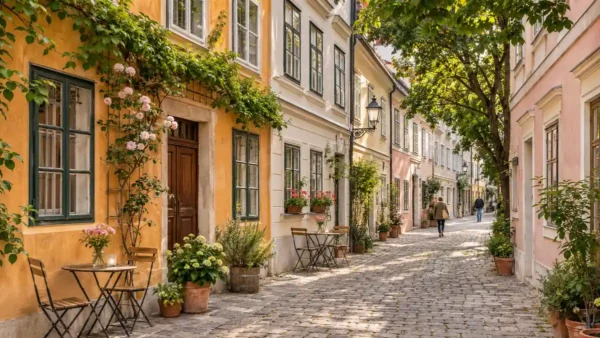
From the cathedral, the Graben and then the Kohlmarkt form the walk to the Hofburg. The Graben is the wide pedestrian street with the Plague Column at its middle; the Kohlmarkt narrows toward the domed Michaelertor, which is the palace gate. Walk them in that order and you reach the Hofburg without a single detour.
Afternoon: Hofburg, a coffee house and one museum
The Hofburg is the afternoon’s booked stop: the Imperial Apartments and the Sisi Museum are visited together, and you book a time slot on the official site. Around them, choose one extra if you have the appetite: the Spanish Riding School for the Lipizzaner horses, the Imperial Treasury for the crown jewels, or the State Hall of the National Library for its baroque interior. One is plenty on this route.
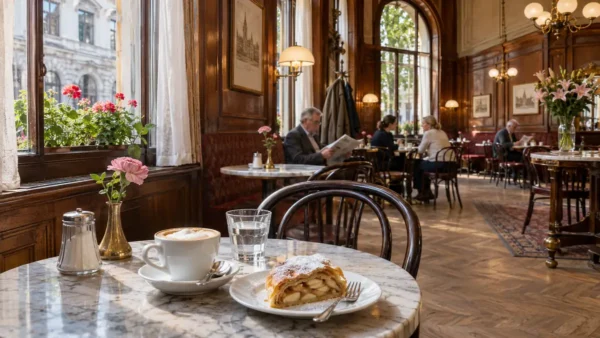
Demel is the coffee house to stop at on a two-day route: it sits on the Kohlmarkt, the street you walk to reach the Hofburg, so it slots in between the palace and the museum without a detour. If its queue is long, Café Landtmann by the Burgtheater serves the same purpose; Café Sacher is the pick if the cake matters more than the room. The Vienna food guide covers the coffee houses, the cakes and what to order in depth.
The museum slot takes one of two collections. The Kunsthistorisches Museum is for travelers who want the old masters (Bruegel, Vermeer, Velázquez) in a building that is itself part of the show. The Albertina, behind the Opera, makes the shorter visit, centred on modern art and graphic works. If a museum does not appeal at all, the MuseumsQuartier next to the Kunsthistorisches gives you courtyards, cafés and smaller galleries instead.
The afternoon’s real constraint is the Hofburg slot, not the museum. Book it early in the afternoon and the coffee house becomes the buffer between the two; book it late and the museum gets squeezed into the hour before closing.
Evening: the Opera and the Ringstrasse by tram
The Vienna State Opera anchors the evening, either from outside as the Ringstrasse lights come on or from inside with a performance or guided tour booked ahead; check the tour calendar before you travel. If the afternoon ends early, the Imperial Crypt, a short walk from the Albertina, adds the Habsburg tombs before dinner.
The Ringstrasse loop by tram closes the day. The boulevard circles the old town past the Parliament, the City Hall, the Burgtheater and the university, and seeing it from a tram window after dark is the easiest way to take in what the Habsburgs built when they tore down the city walls. You end close to where you started, a short walk from any central base.
Tours and activities
Book skip-the-line tickets, day trips and local tours with free cancellation on most activities.
You can also browse everything on getyourguide.com.
Tripstou may earn a commission if you book through this link, at no extra cost to you.
Day 2: Schonbrunn, Belvedere, the Naschmarkt and a Heuriger
Day 2 is built around two time-slot palaces and ends outside the centre: Schonbrunn at opening, the Belvedere after, a late market lunch, then an evening in a wine village. The order exists because both palaces sell timed entry, Schonbrunn is quietest first thing, and the Naschmarkt stalls close in the evening.
Morning: Schonbrunn before the crowds
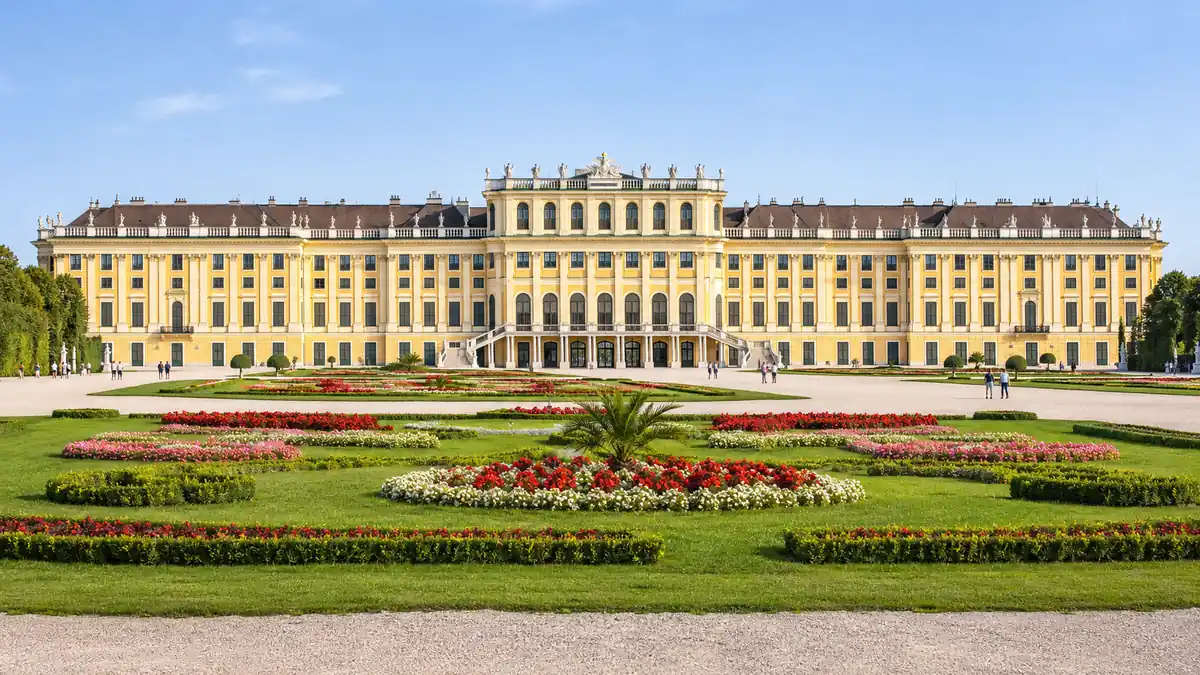
Schonbrunn needs a full morning: the palace tour first, then the gardens and the climb to the Gloriette for the view back over the palace and the city. Book your palace time slot through the official online channel linked from schoenbrunn.at; the booking details are in the checklist below.
The gardens open for longer than the palace and need no palace ticket. That gives the morning a simple order: take the first palace slot of the day, then walk the gardens at your own pace while the next waves of visitors queue for the rooms.
Schonbrunn rewards the earliest slot more than any other stop on this route, because the state rooms are a one-way corridor: at the first entry you walk it, by late morning you shuffle it.
Afternoon: Belvedere, Karlskirche and a late Naschmarkt lunch
The Belvedere and the Naschmarkt fit into the same afternoon, in that order. The Upper Belvedere is the one to book: it holds the Klimt collection, including “The Kiss”, along with the views down the terraced garden. The Lower Belvedere and its temporary exhibitions are optional on a two-day plan.
Karlskirche is the walk between the palace and the market. Its green dome and twin columns stand on the square at the edge of the old town, a short walk from the Belvedere, and the Naschmarkt begins just beyond it.
The Naschmarkt makes the late lunch: food stalls, delis and small restaurants along a long market street, best for eating at the counter and moving on. The stalls close on Sunday; see the swap rule below if your second day falls on one.
Evening: a Heuriger in the wine villages
A Heuriger is a wine tavern where the winemaker serves their own wine, usually with a cold buffet, in a garden or courtyard on the edge of the vineyards. Vienna is one of the few capitals with vineyards inside its city limits, and the Viennese Heuriger culture is on the UNESCO national inventory of intangible cultural heritage in Austria.
The villages sit on the city’s northern edge, below the Vienna Woods: Grinzing is the best known, while Nussdorf, Neustift am Walde and Sievering keep a more local evening. Across the Danube, Stammersdorf, Strebersdorf and Jedlersdorf have their own tavern lanes. A tram, or the U-Bahn plus a bus, gets you out from the centre.
Pick one or two taverns from this short list, by the village you head for:
- Mayer am Pfarrplatz (Heiligenstadt): the name to start with for a first Heuriger on the Heiligenstadt side.
- Wieninger am Nussberg: on the Nussberg, the vineyard hill itself, for an evening among the vines.
- Kierlinger (Nussdorf): for an evening in Nussdorf; Schübel-Auer is the alternative in the same village.
- Fuhrgassl-Huber (Neustift am Walde): the choice if Neustift is your village.
Taverns open on rotating, seasonal schedules, so check the tavern’s own calendar before going. Grinzing’s main street is the easiest to reach and the most tour-bus-heavy; the same wine, served one village over in Nussdorf or Neustift, comes with a far more local crowd.
Book these before you land
Three stops on this route cannot be relied on as walk-ups: Schonbrunn, the Belvedere and the Hofburg apartments all sell timed entry. The Opera and the Heuriger need a calendar check instead of a ticket.
- Schonbrunn: the operator strongly recommends booking online in advance, and walk-up entry cannot be guaranteed. Buy only through the official online channel linked from schoenbrunn.at; fake ticket sites exist.
- Belvedere: the Upper and Lower Belvedere admit visitors only with a valid time-slot ticket, bought online or at the ticket office. Online ticket holders go straight to the entrance.
- Hofburg (Imperial Apartments and Sisi Museum): book a time slot on the official site and build the afternoon around it.
- Spanish Riding School: book ahead if it is your Hofburg extra.
- Vienna State Opera: check the tour calendar, and book a performance early if you want to see one.
- Heuriger: check the tavern’s own calendar for the evening you plan.
Your transport ticket is the one purchase that needs no advance booking: buy it on arrival.
How to move between the stops
The route needs no car and no taxi. Day 1 is on foot inside the Ring, Day 2 is the U4 out to Schonbrunn, then a tram and short walks back toward the centre, and a tram or U-Bahn out to the wine villages in the evening.
To get to Schonbrunn from the city centre, take the U4 to the Schonbrunn stop. Trams 10 and 60 and bus 10A also run to the Schloss Schonbrunn stop, which works better from a base on the western side of the city. From Schonbrunn back toward the Belvedere is a few U-Bahn stops plus a tram, and from the Belvedere to Karlskirche and the Naschmarkt you walk.
You can see Vienna in 48 hours without a sightseeing pass: a 24-, 48- or 72-hour public transport ticket fits a two-day stay and covers every move on this route. Fares, passes and the trip in from the airport are in the guide to getting around Vienna and arriving from the airport.
Where to base yourself for two nights
Base yourself in one hotel for both nights, inside the Innere Stadt or in a district on a direct U-Bahn line, because Day 1 is walked and Day 2 starts early on the U4. Changing hotels costs you half a morning you do not have. The centre buys you walking distance to every Day 1 stop; a district on the U-Bahn usually buys better value for a short ride in. The guide to where to stay in Vienna compares the areas.
Hotels and places to stay
Compare hotels, apartments and stays for your dates in one search.
Search hotels and stays on hotels.com →
Tripstou may earn a commission if you book through this link, at no extra cost to you.
If your second day is a Sunday, or you have a third
The route has two adjustment rules. Swap the days if Day 2 falls on a Sunday, because the Naschmarkt stalls close. With a third day, spend it on a second museum day or out of the city instead of squeezing more into these two.
If your second day is a Sunday
The Naschmarkt stalls are not open on Sunday: they trade Monday to Saturday, while the market’s restaurants and bars stay open on Sunday. On Saturday, a flea market runs alongside the stalls. If your trip runs Saturday–Sunday, walk Day 2 on the Saturday and Day 1 on the Sunday, or keep the order and take a sit-down lunch at one of the market restaurants. In the cold season, shorter evenings favour a Heuriger with an indoor room.
Stops you can swap in
Three stops replace the Ringstrasse evening or the Heuriger when the weather turns or your interests run elsewhere:
- Prater and the Riesenrad: the park and its giant Ferris wheel, for an evening view over the city without the trip to a wine village.
- Hundertwasserhaus: the colourful, irregular housing block in the third district, a quick stop that pairs with a walk toward the Danube Canal.
- Danube Canal: the bars and street art along the canal bank, for a casual evening close to the centre.
For more sights and alternatives beyond this route, see more things to do in Vienna.
With a third day
A third day goes first to a second museum day in the centre: whichever of the Kunsthistorisches Museum and the Albertina you skipped, or the Lower Belvedere and the MuseumsQuartier. The alternative is a day out of the city, either the Wachau valley for vineyards and river villages along the Danube, or Bratislava, the Slovak capital close enough for a day visit. Either one turns this route into the comfortable three-day first visit.
How This Route Was Checked
This page plans one two-day route through Vienna (the order of the stops, the pacing and what to book) and is not a sights list, a city guide, a hotel roundup or a cost page.
Alex Perrut, working in tourism since 2015, went over this two-day route for the Tripstou editorial team after it was written with AI assistance. The editorial process behind it is described on our About page.
Official sources consulted: Schonbrunn Palace, Belvedere, City of Vienna, Vienna Tourist Board.
Did this guide save you time or money? Tripstou is independent and reader-funded — if you'd like to give something back, you can support the site with a crypto contribution of any size.