Eat Wiener Schnitzel with potato salad and Tafelspitz at a Beisl, a Melange with a slice of cake in a coffeehouse, Sachertorte or strudel at a cake house, a Käsekrainer standing at a Würstelstand, and a glass of the house wine with a cold plate at a Heuriger in the vineyard districts. That is eating in Vienna on a first visit. The kind of place decides everything here: what is on the menu, when it serves and how you order. So the choice to make is the venue, and the dish follows.
Each section below takes one kind of place and says what to order there and how it works. Districts appear only as places to eat and drink, never as bases for your stay.
Sources and Review
This page answers one question: what to eat in Vienna and which kind of place serves each dish. It does not rank restaurants, list prices, cover sights or plan your days.
Written with AI assistance, this dish-and-venue map was checked by Alex Perrut, working in tourism since 2015, for the Tripstou editorial team. How we work is set out in our editorial process.
Official sources consulted: Vienna Tourist Board: Heurige, Vienna Tourist Board: sausage stands, City of Vienna, Austrian Commission for UNESCO.
In Vienna the Kind of Place Decides What You Eat
Viennese food is a short, stable canon — schnitzel, Tafelspitz, goulash, strudel, Sachertorte, Käsekrainer and the Melange — and each dish belongs to one kind of place. Choose the venue and the menu is chosen for you. A coffeehouse will not grill you a sausage, and a sausage stand will not plate a Tafelspitz.
| Kind of place | What to order | How it works |
|---|---|---|
| Beisl | Wiener Schnitzel, Tafelspitz, goulash, Kaiserschmarrn | Sit-down hot meals; weekday lunch menu |
| Coffeehouse | Melange, Apfelstrudel, Buchteln | One coffee keeps the table |
| Cake house (Konditorei) | Sachertorte, Punschkrapfen | Eat at a table or take away |
| Würstelstand | Käsekrainer, Bosna, Burenwurst | Order at the hatch, eat standing, late |
| Heuriger | The tavern’s own wine, G’spritzter, cold buffet | Open when the pine branch hangs outside |
| Market | Deli food, cheese, snacks | Graze at the stalls, then sit down |
Most visitors only meet three of these six. The Heuriger and the Würstelstand are the two a sightseeing day tends to skip, and they show a side of the city a restaurant table never will.
For arrival, getting around and which district to stay in, the Vienna travel guide covers the practical side; this page stays at the table.
Where to Eat Wiener Schnitzel and Tafelspitz: the Beisl
A Beisl is Vienna’s neighbourhood tavern, a plain restaurant serving the hot classics, and it is where to eat Wiener Schnitzel and Tafelspitz. On weekdays many run a set lunch menu (Mittagsmenü), the way to eat these dishes well without ordering à la carte.
The hot classics a Beisl menu carries:
- Wiener Schnitzel with Erdäpfelsalat, the Viennese potato salad. The name means veal (see the question below).
- Tafelspitz: boiled beef, served with its broth and with apple-horseradish sauce.
- Goulash with Knödel (a dumpling) or a Semmel (a crusty roll).
- Frittatensuppe to start: beef broth with sliced pancake.
- Leberkäse and, for the adventurous, Beuschel, a sour ragout of offal.
Tafelspitz comes with its own soup. The broth the beef cooked in is part of the dish, so it suits a slow lunch more than a quick one.
A handful of names recur. Figlmüller on the Wollzeile is the schnitzel address, Plachutta is the Tafelspitz house, and Gasthaus Rebhuhn and Schnitzelwirt both turn up wherever classic Beisl cooking is discussed. Any Beisl with a lunch board serves the same canon, though.
The Mittagsmenü is what Viennese office workers eat: served fast, on weekdays only. Planning your schnitzel for lunch instead of dinner is the simplest way to eat the classics for less.
Dishes from the rest of Austria also reach Vienna menus. Kärntner Kasnudeln, the Carinthian pasta pockets filled with curd cheese and potato, appear alongside Tyrolean and Styrian plates, but they are visitors here: the Viennese canon is the reason to choose a Beisl.
How the Viennese Coffeehouse Works
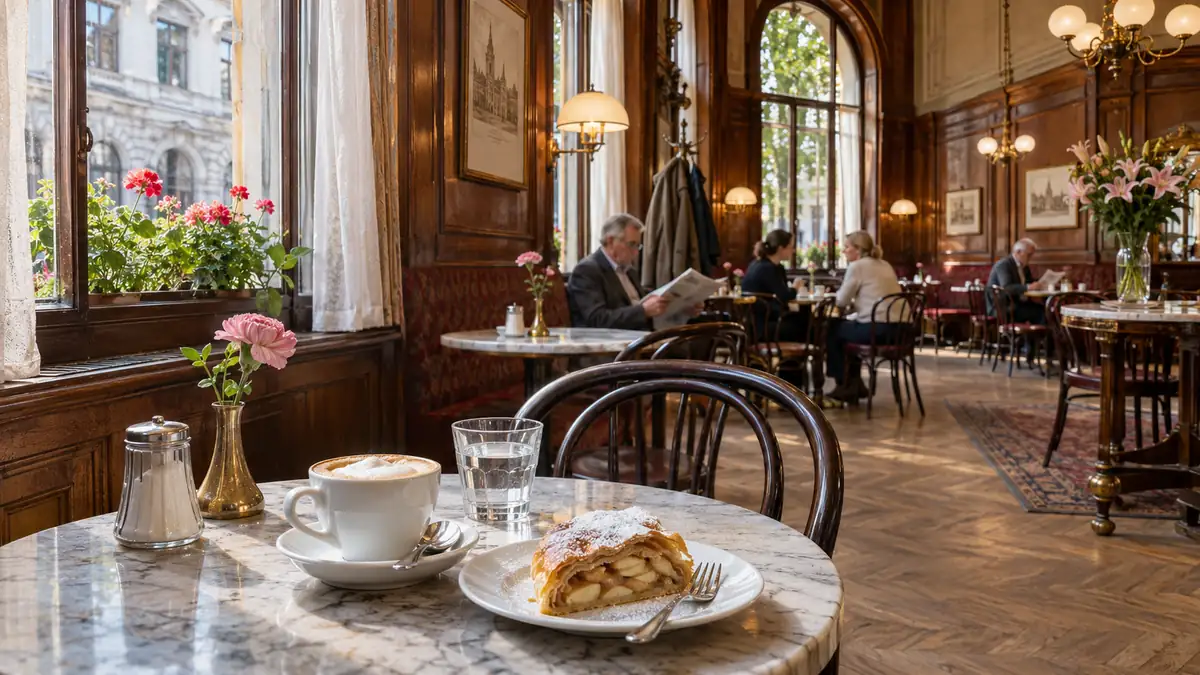
Order a Melange, the default, or an Einspänner. It arrives with a glass of water, you keep the table as long as you like, and the bill comes only when you ask for it. Viennese coffeehouse culture is listed as intangible cultural heritage, and the inventory’s own description is the house rule: time and space are consumed, but only the coffee is listed on the bill.
The setting is part of the order. Marble-topped tables, Thonet chairs and a table of newspapers are the elements the heritage listing names. Nobody will move you on after one cup.
The Melange is coffee with steamed milk and a cap of milk foam. The Einspänner is strong black coffee served in a glass under a thick layer of whipped cream. The water is a custom, not a rule.
Food is a second reason to sit down. Coffeehouses serve cake, breakfast and light dishes. Café Hawelka is the place for Buchteln, the jam-filled yeast buns, and that pairing of one dish with one house is worth planning around.
Paying works differently from a restaurant. Catch the waiter’s eye, say “Zahlen, bitte”, and pay at the table. Until you do, the table is yours.
Which coffeehouses should you go to?
Café Sperl, Café Hawelka, Café Jelinek, Café Korb, Café Schwarzenberg and Café Landtmann make a strong first list of traditional houses.
- Café Sperl, in the 6th district.
- Café Hawelka, in the 1st district, for Buchteln.
- Café Jelinek, in the 6th district.
- Café Korb, in the 1st district.
- Café Schwarzenberg, on the Ring in the 1st district.
- Café Landtmann, a grand house named wherever Viennese coffeehouses are listed.
Sachertorte, Strudel and Kaiserschmarrn: Where the Sweets Are Served
The cake houses (Konditorei) serve the famous cakes to eat at a table or take away, and for Sachertorte the two addresses are Café Sacher at the Hotel Sacher and Demel. Strudel, Kaiserschmarrn and Palatschinken work differently: they come as a dessert or a sweet main at a Beisl or a coffeehouse.
- Sachertorte: dense chocolate cake with apricot jam, served with unsweetened whipped cream → Café Sacher or Demel.
- Apfelstrudel: paper-thin pastry around spiced apple → coffeehouse or Beisl.
- Topfenstrudel: the same pastry around sweet Topfen, a fresh curd cheese → coffeehouse or Beisl.
- Kaiserschmarrn: thick pancake torn up in the pan, caramelised, with fruit compote → Beisl, often as a whole meal.
- Palatschinken: thin pancakes rolled around jam → Beisl or coffeehouse.
- Buchteln: baked yeast buns with a jam filling → coffeehouse, Café Hawelka above all.
- Punschkrapfen: a rum-soaked cake cube under pink icing → cake house.
- Manner wafers: hazelnut-cream wafers in a pink pack → the take-home, from shops.
The difference between the two sweet venues decides where you go. A Konditorei is built around its cake counter, so the choice is wider and the cake is the point; a coffeehouse is built around the table, so the cake is what you eat while you sit. Kaiserschmarrn belongs to neither: order it at a Beisl, where a portion sized as a main is normal.
What Do You Order at a Würstelstand?
Order a Käsekrainer, a lightly smoked pork sausage with cheese inside, with mustard and a Semmel, and eat it standing at the counter, late into the night if you like. Bosna, Burenwurst and a Frankfurter are the other staples. The Bosna is a sausage in bread with onions and curry spice; the Burenwurst is a plain boiled pork sausage; the Frankfurter is what the rest of the world calls a Wiener.
The stand works like a bar without stools. You order at the hatch, eat at the ledge and leave. The Viennese sausage stand is listed as intangible cultural heritage, and its hours are its point: many stay open long after the restaurants close, which makes the Käsekrainer the city’s after-theatre and after-bar meal.
Four stands make good starting points. Bitzinger stands on Albertinaplatz, beside the Albertina and the Opera, which puts it on most walks through the centre; for those two sights, see the things to do in Vienna. Würstelstand LEO sits on the Döblinger Gürtel in the 19th district, Zum goldenen Würstel on the Graben, and another stand on the Hoher Markt.
Trześniewski is the other standing lunch. This sandwich buffet in the 1st district sells small open sandwiches topped with spreads, eaten at the counter. Two or three make a quick lunch between sights.
What Is a Heuriger, and Which Districts Have Them?
A Heuriger is a wine tavern that serves only wine from its own vineyards, with cold plates and a buffet, and you know it is open when pine branches and an “Ausg’steckt” sign hang outside. The taverns sit in the vineyard districts at the edge of the city, from Grinzing and Nussdorf in the north to Stammersdorf across the Danube and Mauer in the south-west.
- North and north-west: Grinzing, Nussdorf, Neustift, Sievering and Heiligenstadt.
- Across the Danube: Stammersdorf, Strebersdorf and Jedlersdorf.
- Elsewhere in the city: Oberlaa, Ottakring and Hernals, plus Mauer.
In Vienna, Heuriger and Buschenschank mean the same thing. A Buschenschank may serve cold food, its own wine and products made on the premises — juice, cider and schnapps. Some taverns hold an extra licence that lets them add a hot buffet, beer or coffee, so the menu varies from one door to the next.
The pine branch is the sign to trust. A tavern with “Heuriger” on the wall but no branch hung out may simply not be open that week. The word also names the current vintage, the young wine the tavern pours.
Opening periods differ by tavern. Many open year-round, while smaller ones open only on set dates, so check the tavern’s own calendar before you travel out. The Viennese Heuriger is listed as intangible cultural heritage. For where a Heuriger evening fits in a short stay, see the Vienna 2-day itinerary.
Naschmarkt and Karmelitermarkt: Graze, Then Sit Down
Naschmarkt, in the 6th district on the Wienzeile between Getreidemarkt and Kettenbrücke, is for grazing: produce and deli stalls trade Monday to Saturday, and restaurants and bars along the market give you somewhere to sit down. Karmelitermarkt in the 2nd district is the quieter, local version.
At Naschmarkt, eat as you walk. The stalls sell deli food, cheese and snacks from Vienna and well beyond, so a lunch can be built stall by stall before you take a seat at one of the market restaurants. On Saturdays a flea market joins the stalls. The Belvedere is a walk away; the things to do in Vienna cover the palace.
Karmelitermarkt is a neighbourhood market with cafés around its stalls. It suits a slower breakfast or a coffee among locals doing their shopping.
Is Naschmarkt open on Sunday?
The stalls close on Sundays. The market’s restaurants and bars open on Sundays and holidays, so you can still eat there; you just cannot shop the stalls.
What to Drink in Vienna Beyond the Melange
Drink Grüner Veltliner or Welschriesling at a Heuriger, a G’spritzter almost anywhere, Austrian beer at a Beisl or a sausage stand, a schnapps to finish, and Almdudler when you want a soft drink. Each drink has its venue, just like the food.
- Grüner Veltliner and Welschriesling: the white wines to order at a Heuriger, where the glass comes from the tavern’s own vineyards.
- G’spritzter: white wine with sparkling water, the summer drink of Heuriger gardens and Beisl terraces.
- Heuriger: the young wine of the current vintage, poured by the tavern that made it.
- Austrian beer: the drink at a Beisl table and with a Käsekrainer at the stand.
- Schnapps: the closing glass, sometimes made on the premises at a Buschenschank.
- Almdudler: the herbal lemonade, for a soft drink at any of them.
In winter, Christmas markets add hot Punsch to the list.
Vegetarian Eating in Vienna’s Traditional Kitchens
The traditional menu has reliable vegetarian mains: Käsespätzle and Semmelknödel at a Beisl, the strudels, Kaiserschmarrn and Palatschinken as sweet mains, and Spargel (asparagus) in season. The markets add the widest choice.
On a Beisl menu, look for Käsespätzle, soft egg noodles baked with cheese and topped with fried onions, and Semmelknödel, bread dumplings. A sweet main such as Kaiserschmarrn counts as a full meal here, not a dessert. Watch the soups: Frittatensuppe is made with beef broth, so it is not vegetarian.
Coffeehouses fill the gap between meals with breakfasts, light dishes and cake. Naschmarkt stalls cover the rest, with cheese, deli food and snacks from many kitchens.
What to Eat Where, in Short
- A Beisl serves the hot classics — Wiener Schnitzel, Tafelspitz, goulash — and its weekday lunch menu is the simplest way to eat them for less.
- In a coffeehouse one Melange buys the table for as long as you like, and the bill comes only when you ask for it.
- Sachertorte belongs to the cake houses, where you eat it at a table or take it away, while strudel and Kaiserschmarrn are ordered at a Beisl or a coffeehouse.
- At a Würstelstand you order a Käsekrainer at the hatch and eat it standing, late into the night after the restaurants have closed.
- A Heuriger pours only wine from its own vineyards with a cold buffet, and the pine branch hung outside is the sign that it is open.
- At Naschmarkt you graze stall by stall and then sit down at a market restaurant; the stalls close on Sundays, but the restaurants and bars stay open.
Vienna Food Questions
Do you tip in Vienna restaurants?
Yes: round up the bill in a coffeehouse and add around 5–10% in a restaurant. The tip is not left on the table; tell the waiter the total you want to pay as you hand over the money, or say “Stimmt so” to let them keep the change.
Is Wiener Schnitzel veal or pork?
By name, Wiener Schnitzel is veal. A pork version is sold as “Wiener Schnitzel vom Schwein” or “Schnitzel Wiener Art”, and both are common on Vienna menus, so read the menu line to know which one you are ordering.
Keep Planning Vienna
- Vienna travel guide — arrival, getting around and which district to stay in.
- Things to do in Vienna — the sights around the food stops.
- Two days in Vienna — where the coffeehouse hour and the Heuriger evening fit.
Did this guide save you time or money? Tripstou is independent and reader-funded — if you'd like to give something back, you can support the site with a crypto contribution of any size.