
Travel to Seville, Spain, is worth it on a first trip to the country: the city packs a monumental old town, flamenco and a late-evening tapas culture into a centre you can cross on foot. Most first-timers need three days, go in spring or autumn and base in the old town; that is the plan this page builds.
The frame is the long-haul first trip. Most readers reach Seville by high-speed train from Madrid or fly straight into Seville airport, so the page also covers the arrival, the daily cost and the day trips that genuinely fit around the city.
Quick Answer
Seville is worth it for a first trip to Spain: a monumental, walkable old town, flamenco and a tapas culture that runs into the evening. Plan two days minimum, three for most first-timers, and four or more to use the city as an Andalusia base. It suits first-timers, couples and food travelers; July and August heat is the caveat.
In This Guide
Seville Is Worth It for the Old Town, Flamenco and Tapas
Seville is worth a first Spain trip because its best sights sit inside one compact, walkable historic centre, and the city comes alive again after dark with flamenco, terraces and tapas bars. The tradeoff is the summer: in July and August the heat dictates when you can be outdoors.
First-timers get more out of Seville than out of most Spanish cities. The palace, the cathedral and the old Jewish quarter are a short walk apart, so a first day is spent seeing things, not commuting between them. Evenings matter as much as mornings. Locals eat late, standing at the bar, and the river and Triana fill up once the heat drops.
Seville is not a beach city and not a big-museum city. The sea is a day trip away, and the great painting collections live in Madrid. Read the city as the monumental heart of Andalusia, the place a Spain route slows down for before or after Madrid, Córdoba or Granada.
A trip here is mostly about time of day. The same street that is empty at three in the afternoon in June is packed at ten at night, and planning around that rhythm makes or breaks the visit.
What Seville Is Known For: the Landmarks That Orient a First Visit
Seville is known for a small set of landmarks a first-timer should recognise before planning anything: the Real Alcázar, the Cathedral and its Giralda tower, Plaza de España in the Parque de María Luisa, the Metropol Parasol, Casa de Pilatos, Barrio Santa Cruz, Triana across the Guadalquivir, and flamenco.
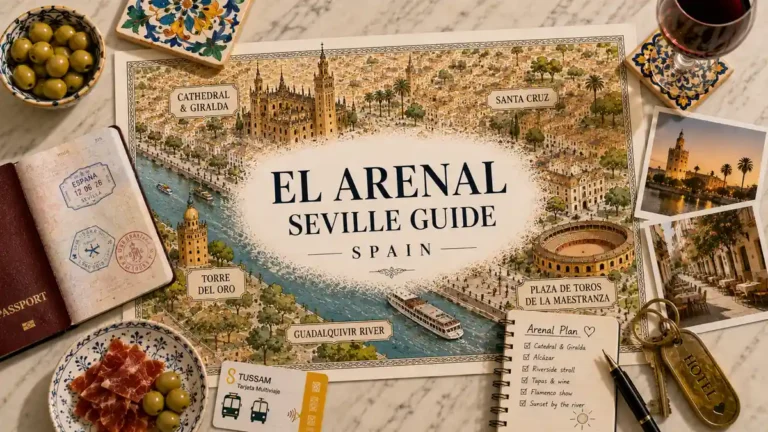
The Real Alcázar is the royal palace and gardens at the centre of the old town, the visit most first trips are built around. The Cathedral stands next to it, a vast Gothic church with the Giralda as its bell tower; if it is on your list, you can book a cathedral ticket before you go. Barrio Santa Cruz is the maze of lanes and small squares wrapped around both, best walked without a plan.
The Metropol Parasol, known locally as Las Setas, is the giant timber canopy over Plaza de la Encarnación, north of the cathedral quarter. It is the one modern landmark first-timers seek out, and the walkway on its roof gives the widest view over the old town’s rooftops and towers. Casa de Pilatos, a short walk east, is a noble palace mixing Mudéjar tilework and Renaissance patios.
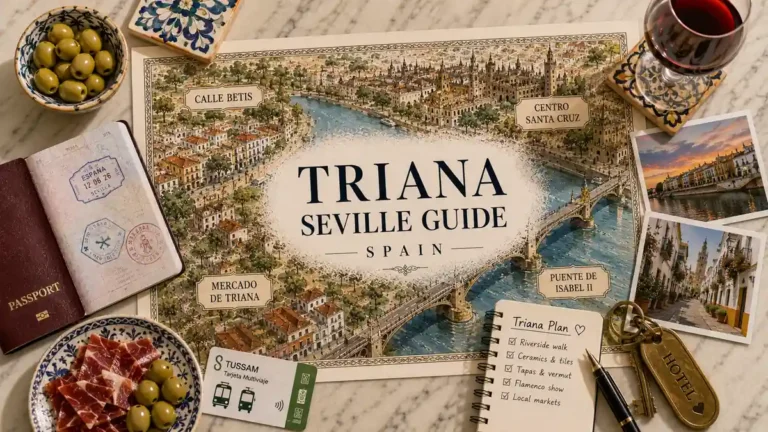
Plaza de España and the Parque de María Luisa sit south of the centre, a sweeping tiled plaza beside the city’s main park. Across the Guadalquivir lies Triana, the old potters’ and sailors’ district, where the riverbank and the evening bars draw the crowds. Flamenco ties the city together after dark, in small venues on both sides of the river.
The full selection, with what each visit involves, is on the things to do in Seville page.
How Many Days Do You Need in Seville?
Three days suit most first-timers in Seville. Two days cover the core but leave no slack, and four or more days turn the city into a base for Andalusia, with day trips folded in.
- Two days buy the old town: the Alcázar, the Cathedral, Santa Cruz and one evening out. There is no room for a day trip, and a sold-out morning slot costs you a sight.
- Three days add breathing space: the old town at a slower pace, a proper evening in Triana, and one day trip, usually Córdoba.
- Four days or more let Seville act as a hub. Two day trips fit, typically Córdoba plus Cádiz or Jerez, without rushing the city itself.
Is two days enough in Seville? It is enough to see the headline sights, not enough to feel the city’s evening life and its daytime sights in the same trip. In summer, when the middle of the day is lost to the heat, two days shrink to something closer to one and a half.
The two-day Seville itinerary and the three-day Seville itinerary turn each length into a day-by-day plan. If Seville is one stop on a wider route, the Spain itinerary guide shows where it fits, and the 7-day Spain itinerary, 10-day Spain itinerary and 14-day Spain itinerary each give it the share of the trip it can carry.
Spring and Autumn Beat Summer in Seville
Spring and autumn are the comfortable windows for Seville. July and August regularly pass 35°C and change how you can use the day, while the two festival weeks — Semana Santa and the Feria de Abril — are the busiest and most expensive of the year.
Summer forces a split day. Sightseeing happens early, the afternoon goes to shade and rest, and the city restarts in the evening. It works for travelers who plan around it; it punishes anyone who tries to walk the old town at midday.
Semana Santa and the Feria are a choice, never an accident. Semana Santa moves with Easter, in March or April, and the Feria de Abril follows it. In both weeks rooms sell out and rates climb, so either book far ahead and make the festival the reason for the trip, or move your dates and avoid it.
Winter is the quiet, mild option. Days are cooler, crowds thin out and the monuments keep shorter hours, which matters more on a two-day trip than on a long one.
For how Seville compares with the rest of the country month by month, see the best time to visit Spain; the Spain packing list covers what the heat and the festival crowds ask of your bag.
Where to Base Yourself: Old Town or Triana
First-timers should base in the old town, in Santa Cruz or Centro/Arenal, so every major sight is a walk away. Triana suits a second visit or anyone who values evenings over monuments, and Macarena/Alameda is the local, nightlife-leaning option.
The old town wins on time. Staying within walking distance of the Alcázar and the Cathedral means early starts before the heat and a short walk back at siesta hours. The cost is noise in the busiest lanes and the sharpest price pressure during festival weeks. It is the choice for a first trip with three days or fewer.
Triana trades proximity for atmosphere. It sits across the river from the centre, a bridge’s walk from the main sights, with a riverbank and a bar scene that feel less staged than the old town. Couples and repeat visitors tend to prefer it.
Macarena and the Alameda area, north of the centre, are where Seville goes out at night. They suit travelers who want bars on the doorstep and do not mind a longer walk to the monuments.
The where to stay in Seville guide compares the areas in depth. For a narrower brief, see the pages on where to stay in Seville for a first visit, Seville stays for couples, family-friendly bases in Seville, staying near Seville’s nightlife and boutique hotels in Seville.
Hotels and places to stay
Compare hotels, apartments and stays for your dates in one search.
Search hotels and stays on hotels.com →
Tripstou may earn a commission if you book through this link, at no extra cost to you.
How to Get to Seville and Get Around Once You Arrive
Seville has two gateways. Seville airport (SVQ) is linked to the centre only by the Tussam EA bus, and Sevilla Santa Justa is the main rail station, where high-speed trains from Madrid arrive. Once you are in, the historic centre is walked, not ridden.
Airport or Santa Justa: which arrival suits your trip?
Santa Justa suits the Madrid rail route most long-haul travelers take; SVQ suits anyone with a direct flight. Santa Justa handles AVE high-speed, Avant and Media Distancia trains, so it is also the station you will use for day trips.
At the airport, Tussam line EA “Especial Aeropuerto” is the only public transport into the city: there is no rail or metro link. A single ticket costs €6 and can be paid on board by bank card. Málaga is the alternative gateway when the trip starts on the coast.
The Seville airport transport guide covers the EA route and the taxi option in detail. For the rail side, the Spain train itinerary shows how Seville links to Madrid and the rest of the network, and the Spain travel guide places the city in a country-wide plan.
Is Seville walkable?
Seville is walkable across the whole historic core and Triana. A bus, tram or taxi earns its place in three situations: the hottest hours of summer, the luggage run to and from Santa Justa, and the trip out to Plaza de España in August. The Seville transport guide explains tickets, lines and taxis.
Check the entry rules that apply to your passport before booking.
How Much Does Seville Cost per Day?
Seville costs around €50–€80 per day on a budget, around €100–€160 per day mid-range, and from €250–€400+ per day for a luxury trip. These figures are per person per day and exclude flights.
| Spend style | Daily band | What it buys in Seville |
|---|---|---|
| Budget | around €50–€80 per day | Hostel bed or simple room, tapas standing at the bar, the city on foot |
| Mid-range | around €100–€160 per day | Hotel room in or near the old town, sit-down meals, the odd taxi in the heat |
| Luxury (high-end) | from €250–€400+ per day | Palace or boutique hotel, tasting menus, private guides and transfers |
Walking is why Seville stays cheap. The core needs almost no transport spend, and the best of the evening — the river, the squares, the street life — costs nothing. Tapas reward budget travelers too: eating at the bar, a dish at a time, keeps meals small and flexible.
Festival weeks are where the city punishes every style. During Semana Santa and the Feria, room rates climb across all three bands, and a budget that works in November can break in April.
The Seville trip cost breakdown shows how each band is built, and the Spain travel budget sets Seville against the rest of the country. For the two ends of the range, see budget places to stay in Seville and luxury stays in Seville.
Which Day Trips from Seville Are Real Day Trips?
Córdoba is the easy rail day trip from Santa Justa. Cádiz and Jerez de la Frontera sit on one rail line south and work as day trips, Carmona and Ronda (with Setenil de las Bodegas) are car, bus or tour days, and Granada is not a comfortable day trip: give it a night.
| Destination | How you get there | Verdict |
|---|---|---|
| Córdoba | High-speed train from Santa Justa | Day trip, the easiest one |
| Cádiz | Train from Santa Justa, on the line south | Day trip |
| Jerez de la Frontera | Train from Santa Justa, on the same line | Day trip |
| Carmona | Car, bus or tour | Day trip, often paired with another stop |
| Ronda and Setenil | Car or tour | Day trip, long but workable |
| Granada | Train from Santa Justa | Overnight, not a day trip |
Córdoba ranks first because the train does the work: you leave Santa Justa in the morning, walk to the Mosque-Cathedral and the old quarter, and are back for dinner in Seville. It is the one day trip that fits even a three-day stay. Some visitors fold Carmona into the same outing; you can book this day trip as a guided pairing of the two.
Cádiz and Jerez share the line south, which makes them an either-or on a four-day trip. Cádiz suits travelers who want the sea and an old port city; Jerez suits sherry and horses. Carmona is the closest of all but works better by road, and Ronda with Setenil is a full day of driving or a tour, worth it for the gorge and the white-village scenery.
Granada fails the day-trip test because the train ride each way eats a large share of the day, leaving too little time for the city and the Alhambra. Treat it as its own stop with at least one night, ideally on the way to or from Seville.
The Andalusia guide covers what to do in each of these towns, and the best places to visit in Spain show which deserve their own stay. If you would rather drive the region, the Spain road trip guide covers the routes through Ronda and the white villages.
Tours and activities
Book skip-the-line tickets, day trips and local tours with free cancellation on most activities.
You can also browse everything on getyourguide.com.
Tripstou may earn a commission if you book through this link, at no extra cost to you.
Who Seville Suits — and Who Should Think Twice
Seville suits first-time Spain visitors, couples and food travelers best. Families do well outside July and August, and anyone who needs a beach or major art museums should pair Seville with the coast or Madrid, because neither is here.
First-time visitors get the clearest picture of southern Spain in the least time, with the landmarks close together and easy to read. Couples tend to stay on for the evenings: courtyards, rooftop terraces and late dinners in Triana. Food travelers come for the tapas bars, where the city eats in small plates and at the counter; the Spain food guide explains what to order and when.
Families are the group the calendar matters to most. Spring and autumn give children walkable days and parks to rest in, while summer afternoons are too hot for long walks with young kids, so a family trip in July or August needs a pool and a slow middle of the day.
Solo and female travelers find Seville an easy first city, and the solo female safety guide for Spain covers the practical side. For what to watch for in the busiest tourist zones, see the Seville safety guide and the common scams in Spain page. For everyday practicalities, from siesta closures to tipping, see the Seville travel tips.
Book the Real Alcázar Online Before the Day
The Real Alcázar is the one visit to fix before your trip. Tickets are sold online through the official ticketing site and at the Patio de Banderas office, which takes card only; in spring, book online before the day you want to visit, and expect shorter hours in winter than in summer.
The Alcázar is Seville’s defining sight, and the one most likely to sell out on the day. Its hours follow the season: from 1 October to 31 March it opens 09:30–17:00, and from 1 April to 30 September 09:30–19:00. It closes on 1 and 6 January, Good Friday and 25 December.
Booking ahead is mainly about the time slot. A morning entry beats the heat and the crowds, and in the busiest weeks those slots go first. If you prefer to sort it through a reseller, you can reserve an Alcázar entry there too.
What to Settle Before You Book
- Three days suit most first trips to Seville: two cover the old town with no room for a day trip, and four or more turn the city into a base for Andalusia.
- Spring and autumn are the comfortable windows, while Semana Santa and the Feria de Abril are worth choosing on purpose and booking far ahead, because rooms sell out and rates climb.
- A first visit is best based in the old town (Santa Cruz or Centro/Arenal), with Triana kept for a second trip or a stay built around evenings.
- From Seville airport, the Tussam EA bus is the only public transport into the centre, and its €6 single ticket can be paid on board by bank card.
- Córdoba is the easy rail day trip from Santa Justa, but Granada needs at least one night of its own.
- The Real Alcázar is the visit to book online before the day, ideally for a morning slot in spring and festival weeks.
Sources and Review
This page plans a first trip to Seville as a whole (how long to stay, when to go, where to base, how to arrive, what it costs and which day trips work); for sight-by-sight visits, neighbourhoods in depth, day-by-day plans or transport detail, follow the linked Seville pages.
Written with AI assistance, this planner had its fares, hours and cost bands read through by Alex Perrut, working in tourism since 2015, for the Tripstou editorial team; the steps are set out in our editorial process.
Official sources consulted: Real Alcázar de Sevilla, Aena, Renfe, Spain.info.
Keep Planning Spain
- Andalusia travel guide: the region Seville sits in, with the day-trip towns in depth.
- Best beaches in Spain: Seville has no beach, so this covers the nearest coast and the best of Spain’s.
- Spain’s islands: for a trip that continues to the Balearics or the Canaries.
Did this guide save you time or money? Tripstou is independent and reader-funded — if you'd like to give something back, you can support the site with a crypto contribution of any size.