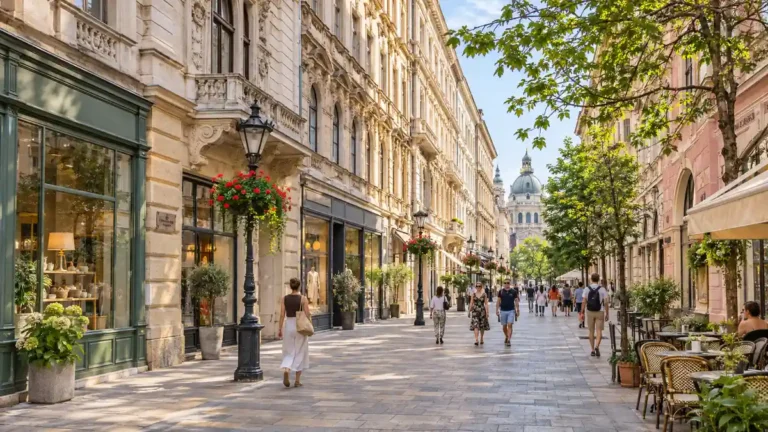
The four things a first-timer should not miss in Budapest are the Hungarian Parliament, Castle Hill with Fisherman’s Bastion, the Danube after dark and one thermal bath, with Széchenyi as the default. A history-led traveler swaps in the House of Terror, Dohány Street Synagogue and the Shoes on the Danube Bank; a night-led traveler adds the ruin bars of District VII. With one day, give Castle Hill the daylight and the river the evening. With a weekend, add Parliament and a bath.
The city splits along the river. Buda, on the west bank, holds the hills, the castle and the viewpoints; Pest, on the east bank, is the flat city of Parliament, the Basilica, the boulevards and the nightlife. The picks below follow that split, then the themes that cut across it: memory, water and night.
Which Budapest Sights Are Worth It for a First-Timer
Budapest is known for four things: its Parliament on the river, its thermal baths, its castle hill and its ruin bars. Of everything on this page, a first-timer should see Parliament, Castle Hill with Fisherman’s Bastion, the Danube after dark and one bath. Those four cover both banks, the city’s architecture, its water culture and its night, which is why they beat any museum on a short break.
The rest of the page groups the picks five ways. Castle Hill and Gellért Hill hold Buda’s views; Pest’s landmarks run from Parliament to City Park; the history sights explain the twentieth century; the baths get their own choice; the river and the ruin bars fill the evening. Not every reader wants the same four:
- First visit, short break: Parliament, Fisherman’s Bastion, the river at night, Széchenyi.
- History first: Dohány Street Synagogue, the Shoes on the Danube Bank, the House of Terror.
- Night first: the lit riverfront, then Szimpla Kert and the District VII courtyards.
If you only have a day, spend the morning on Castle Hill, walk the river bank across the Chain Bridge in the afternoon and see the lights from a boat or from the Bastion after dark. If you only have an evening, take the river first and a ruin bar after it. For the order that fits all of these into a long weekend, the 3-day Budapest itinerary lays them out day by day.
Castle Hill and Buda’s Viewpoints
Castle Hill is the half-day every first-timer does, and the trio of Fisherman’s Bastion, Matthias Church and Buda Castle is the reason. Do the Bastion first, early in the morning or at dusk, when the terraces are quiet and the light falls on Parliament across the river. Gellért Hill, to the south, is the other viewpoint worth climbing.
Fisherman’s Bastion
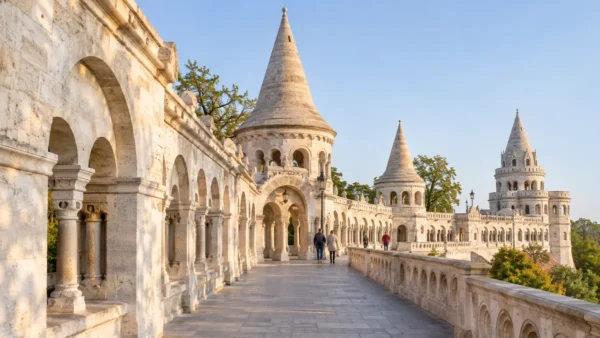
The view from Fisherman’s Bastion is the postcard of Budapest: Parliament spread along the opposite bank, framed by white neo-Romanesque arches and turrets. The terraces sit on the edge of Castle Hill, directly above the river. Every first-time visitor belongs here. The terraces are free to walk at any hour; the upper turrets are ticketed. The best view in the city costs nothing before breakfast.
Matthias Church
Matthias Church is the coronation church of Hungary, recognisable from anywhere on the hill by its patterned, glazed-tile roof. It stands beside the Bastion, so anyone already on the hill passes its door. The interior is ticketed. Pair it with the Bastion and the two take an hour together.
Buda Castle: the Hungarian National Gallery and the History Museum
Buda Castle is worth a visit for its museums only if Hungarian art or the city’s story is your reason for coming. The palace complex holds the Hungarian National Gallery, which gathers Hungary’s own art in one building, and the Budapest History Museum. For art-and-history travelers it is a morning well spent. For a short break it is optional: the courtyards and terraces are free to wander, while the museums take hours.
Gellért Hill, the Citadella and the Cave Church
Gellért Hill gives the one panorama that includes Castle Hill itself. The walk up starts near the Liberty Bridge on the Buda side and climbs through parkland to the Citadella and the Liberty Statue above it. The Cave Church, cut into the rock at the foot of the hill, is the natural stop on the way up. This is the pick for walkers; the climb is the point.
The funicular, the changing of the guard and what lies under the hill
The Castle Hill Funicular is the scenic way up from the Chain Bridge end, a short ride with the river opening behind you. Walking up costs nothing and takes little longer.
The changing of the guard outside Sándor Palace, the President’s office on the hill, is a free few minutes if you happen to be passing.
Hospital in the Rock is a hospital and Cold War nuclear bunker carved into the hill, now a museum visited on a guided, ticketed tour. History travelers will get more from it than from the castle museums.
The cave labyrinth runs under the Castle District as a network of natural caves and cellars, seen on a guided underground visit.
Pest’s Landmarks: Parliament, the Basilica and the River Bank
Parliament is the one Pest sight that needs planning. The panorama terrace of St Stephen’s Basilica is the easiest high view in the flat half of the city. The walk across the Chain Bridge ties the two banks together for free, and it is where most visitors first understand the layout of Budapest.
Hungarian Parliament
The Hungarian Parliament is Budapest’s defining building: a neo-Gothic block stretched along the Pest bank with a central dome. It is visited by guided tour from the Visitor Centre on Kossuth Square. Tickets are sold online in advance, so book your Parliament visit before you travel.
The interior tour is for those with a morning to give it. The exterior is the free version, and arguably the better one: seen from the Buda bank or from the river, the whole façade fits in one frame. Liberty Square, a few minutes’ walk inland, is a free open square on the way back into the centre.
St Stephen’s Basilica and its panorama terrace
St Stephen’s Basilica is the largest church in Budapest, and its dome terrace gives a 360° view over the centre of Pest. Inside, it holds the Holy Right, the mummified hand of Hungary’s first king. The terrace and the treasury are ticketed and bought online via the official site, or you can reserve a terrace ticket in advance. This is the view for anyone who skips Gellért Hill.
Chain Bridge and the river bank walk
The Chain Bridge was the first permanent bridge across the Danube in Budapest, and walking it is the free hour that shows the city. From the Buda end you look up at Castle Hill; from the middle, Parliament sits downstream on the Pest bank. Everyone should cross it on foot at least once. Dusk is best, when the bridge and both banks light up.
Great Market Hall
The Great Market Hall, the iron-framed covered market near Liberty Bridge, is a lunch stop, not a sight to schedule. Downstairs smells of paprika and cured sausage. Upstairs, the counters fry lángos and ladle goulash, and kürtőskalács (the chimney cake) turns on spits nearby. Come hungry, stay an hour.
Andrássy Avenue to Heroes’ Square and City Park
Andrássy Avenue is the Pest walk for anyone with half a day. The boulevard leaves the centre past the Hungarian State Opera, its grand façade the high point of the first stretch, and runs straight out to Heroes’ Square, where the statues of Hungary’s founding chieftains stand in a colonnade. Behind the square, City Park opens up: Vajdahunyad Castle sits by the lake, the Museum of Fine Arts faces the square, and Széchenyi Baths lie within the park. The House of Terror stands on the avenue too, covered with the history sights below. On the Grand Boulevard, the New York Café is the coffee-house landmark people photograph, worth a look, not a detour.
Tours and activities
Book skip-the-line tickets, day trips and local tours with free cancellation on most activities.
You can also browse everything on getyourguide.com.
Tripstou may earn a commission if you book through this link, at no extra cost to you.
Budapest’s History Sights: the Synagogue, the Shoes and the House of Terror
For the history-led traveler, three stops explain the twentieth century in Budapest: Dohány Street Synagogue, the Shoes on the Danube Bank and the House of Terror. If you only do one, make it Dohány with the Shoes, which pair easily on foot through central Pest.
Dohány Street Synagogue and the Jewish Quarter
Dohány Street Synagogue is the largest synagogue in Europe and the one site that holds the Jewish Quarter’s story. The complex includes the Jewish Museum and the Raoul Wallenberg Memorial Park, where the Tree of Life, a metal weeping willow, carries the names of victims on its leaves. It is ticketed. Go whether or not history is your reason for travelling. The streets around it show the quarter’s daytime face of street art and courtyards; at night the same blocks fill with the ruin bars covered further down.
Shoes on the Danube Bank
The Shoes on the Danube Bank is a memorial of iron shoes along the Pest embankment, a short walk south of Parliament, to the Jews shot into the river here in the war. It is free, always open, and takes ten minutes. Pair it with Parliament.
House of Terror
The House of Terror is worth visiting for anyone with an interest in Hungary’s two dictatorships, fascist and communist. The museum occupies Andrássy út 60, the building both regimes used as their political police headquarters, and the exhibition ends in the basement cells. It is the most-asked “is it worth it” museum in the city, and the answer is yes for readers of the period. For a family afternoon it is heavy going.
Memento Park, outside the city centre, gathers the communist-era statues removed from Budapest’s streets into one open-air collection. It is for completists with time to spare; the history sights above tell the story more directly.
Which Thermal Bath to Choose (and Why Gellért Is Not on the List)
Choose Széchenyi for a first visit and the outdoor pools, Rudas for the Ottoman pool and the rooftop, and Lukács for a quieter, more local bath. Gellért Baths are closed for renovation and should not be planned for. Each of the three open baths answers a different reader:
- Széchenyi is the yellow neo-Baroque complex in City Park, with large outdoor pools steaming in winter. It is the classic first bath and the one in every photograph; the cost is the crowd.
- Rudas sits at the foot of Gellért Hill on the Buda bank, built around an Ottoman domed pool, with a rooftop pool looking over the Danube. Come here for the old bath atmosphere and a view; it is smaller and less of a day out.
- Lukács, in north Buda, is where locals swim and soak. It is the calm choice for a second bath or for anyone avoiding queues, and it has less of the spectacle.
A visit works the same way at all three. Bring swimwear and flip-flops; towels can be rented; you change in a locker room or a private cabin. Széchenyi’s outdoor pools stay open year-round, which is half the reason to go in winter. Széchenyi, run by the city’s bath company, sells tickets online via its official site, or you can book a Széchenyi pass; peak-season weekends are crowded. In summer, Palatinus on Margaret Island adds outdoor pools for a swimming day.
Széchenyi wins on spectacle, Rudas on the view: from its rooftop pool you look straight out over the Danube.
The Danube by Night and the Ruin Bars After It
The evening a first-timer should plan is the river after dark followed by District VII. A cruise on the Danube at night is the one evening experience worth paying for, because it shows every landmark on this page lit at once. Margaret Island is the river’s daytime half.
The Danube by night
The lit riverfront of Budapest is the view that joins every other pick on this page. From the water after dark, Parliament glows gold on the Pest bank, Buda Castle and Fisherman’s Bastion stand floodlit on the hill, and the Chain Bridge strings its lights between them. An evening sightseeing cruise is the easiest way to see all of it from the middle of the river, and it works for everyone, including readers with only one evening in the city.
On a tight budget, the same lights cost nothing from the Pest embankment or from the Chain Bridge on foot. The boat gives the full sweep; the walk gives the closer, slower version.
Ruin bars and Szimpla Kert
Ruin bars are bars built into the formerly derelict courtyards and buildings of District VII, and Szimpla Kert is the original. Mismatched furniture, old bathtubs and car parts fill rooms that were left to decay; the effect is the city’s signature night out. They are worth seeing even if you do not drink. Go early on a weeknight to see the rooms before the crowd. Non-drinkers can see Szimpla’s daytime face as a market and garden.
Margaret Island
Margaret Island is the park island in the Danube between Buda and Pest, free to enter and the city’s green day out. Families and anyone needing a slow morning will find:
- the musical fountain near the southern tip;
- the ruins of the medieval convent;
- the Palatinus outdoor pools in summer;
- long, flat paths for walking or running.
What Costs Nothing in Budapest
The best free hour in Budapest is the river walk from the Chain Bridge to Parliament and the Shoes on the Danube Bank at dusk. After it, the Bastion’s open terraces, Heroes’ Square, Liberty Square, Margaret Island, the Castle courtyards and the Sándor Palace guard change are all free. The table covers the first-timer picks where the free-or-ticketed question actually comes up.
| Pick | Bank | Free or ticketed | Best for |
|---|---|---|---|
| Fisherman’s Bastion | Buda | Free terraces, ticketed turrets | The Parliament view |
| Buda Castle | Buda | Courtyards free, museums ticketed | Art and history |
| Hungarian Parliament | Pest | Ticketed, book online in advance | First-timers |
| St Stephen’s Basilica terrace | Pest | Ticketed | A central high view |
| Chain Bridge walk | Both | Free | Dusk, everyone |
| Thermal baths | Both | Ticketed | A half-day soak |
A short break should still pay for four things: the Parliament tour, one bath, the Basilica terrace and an evening on the river. Everything else on the free list fills the hours between them, and the free list is where Budapest is unusually generous: its two best views, from the Bastion and from the Chain Bridge, need no ticket at all.
When the Famous Pick Is Not the Right One
Three swaps save a short break in Budapest. Go to Rudas or Lukács when Széchenyi is packed. Visit Fisherman’s Bastion before breakfast or after dark instead of at midday. See Parliament from the Buda bank or from the river when the tour is sold out.
Széchenyi is at its most crowded on summer weekend afternoons. Rudas gives the older bath and a rooftop over the river; Lukács gives quiet water and a local crowd. Either suits a traveler who wants to soak more than to be photographed soaking.
At midday the Bastion’s terraces fill with tour groups and the sun flattens the view. Early morning brings empty arches and soft light on Parliament; after dark, the whole Pest bank is lit below you. Both are free.
A sold-out Parliament tour is less of a loss than it feels. The building is designed to be seen from the water and from the far bank, and the view from the Buda embankment below Castle Hill takes in the full length of the façade, which no interior tour can.
The history-led reader can skip Buda Castle’s museums altogether. Dohány Street Synagogue and the Shoes on the Danube Bank, together on foot in Pest, say more about the city in two hours than a gallery morning does. How many days to give all of this, where to sleep and how to move between the two banks are covered in the Budapest city guide.
Before You Book Anything
- A first visit to Budapest belongs to Parliament, Castle Hill with Fisherman’s Bastion, the Danube after dark and one thermal bath.
- Parliament is the one sight to plan ahead for: its guided tours are booked online in advance.
- Széchenyi is the default first bath, Rudas the one with the Ottoman pool and the river view, Lukács the quiet local choice, while Gellért Baths are closed for renovation.
- The best free hour in the city is the river walk from the Chain Bridge to Parliament and the Shoes on the Danube Bank at dusk.
- Fisherman’s Bastion’s terraces cost nothing and look their best before breakfast or after dark, not at midday.
- When Széchenyi is packed, Rudas or Lukács gives a quieter soak with a more local crowd.
How This List Was Put Together
This page picks the Budapest sights and experiences worth a first-time visitor’s time and says who each one suits; it is not a planning guide to the city, a day-by-day route or a ticket and price guide for any single sight.
Produced with AI assistance, this selection was read through by Alex Perrut, working in tourism since 2015, for the Tripstou editorial team. What that review covers is set out in our editorial process.
Official sources consulted: Széchenyi Baths, Gellért Baths, St Stephen’s Basilica, Visit Hungary.
Plan the Days Around These
When the list above is done, the classic day out is the Danube Bend, where the river turns north of the city past Szentendre, Visegrád and Esztergom. The city guide compares it with the other day trips.
- Budapest city guide: how many days, which bank to stay on, transport, money and the day trips.
- Three days in Budapest: the order to see these sights in, day by day.
Did this guide save you time or money? Tripstou is independent and reader-funded — if you'd like to give something back, you can support the site with a crypto contribution of any size.