Visitors with no residence in Serbia can get Serbian VAT back on goods bought in a shop for RSD 6,000 or more (VAT included) from one seller. Three things keep the claim alive: the goods leave Serbia unused in your personal luggage before the end of the third calendar month after the month of purchase, the seller fills in a refund request at the till, and Serbian customs certify the goods and documents on your way out. The one choice you make is who pays you back: the seller, on the paper form ZPPPDV, with the full VAT or minus its commission, or a refund operator, on an electronic request, minus a commission. That choice is made at the till.
Serbia runs its own scheme under its Law on VAT, where VAT is called PDV. The tax-free schemes in the EU countries next door are separate, and nothing below follows their logic: the steps are the Tax Administration’s procedure for foreign travelers.
The Short Version Before You Shop
- Only visitors with no permanent or temporary residence in Serbia qualify, and the RSD 6,000 minimum (VAT included) counts per seller, so receipts from different shops never add up.
- Ask the seller for a VAT refund request before you pay, on paper form ZPPPDV or electronically through a refund operator, because that choice decides who pays you later.
- The goods must leave Serbia unused, in your personal luggage, before the end of the third calendar month after the month of purchase.
- Serbian customs must see the goods, the invoices and the request on the way out, so at Belgrade Nikola Tesla Airport get the certification before you check in a bag.
- Customs only certify the claim; the seller or the operator pays it once the certified documents reach them, within 12 months of the goods leaving Serbia.
- What comes back is the VAT already inside the price — one sixth of what you paid at the standard rate — minus any commission, in dinars: cash immediately or to an account within 15 days.
Is a Serbia VAT refund worth the paperwork?
A Serbia VAT refund is worth it for one larger purchase from a single shop that clears RSD 6,000, and rarely for scattered small buys, because the threshold counts per seller. What comes back is the VAT already inside the price, not 20% added on top of it. At the standard rate that is one sixth of what you paid, and the seller or operator may deduct a commission before paying you.
The arithmetic is simple once the price is read as VAT-inclusive. Most goods carry 20% VAT, some items a lower rate. Take a hypothetical purchase of RSD 12,000 at the standard rate: one sixth of it, RSD 2,000, is VAT, so that is the most the refund can return, and less once a commission comes off. On the same maths, a purchase that only just clears RSD 6,000 returns about RSD 1,000 before any fee. That is why the refund pays on one considered buy and barely moves the needle on a bag of souvenirs.
The cost is time, not money. Expect a few minutes at the till, a stop at Serbian customs before you leave, and the job of getting the certified documents back to the seller or the operator afterwards. One considered purchase — clothing, electronics, a piece of craft — justifies that effort. Small souvenirs spread across several shops never reach the threshold together, so skip the paperwork there. The scheme covers goods only, never services.
Who Qualifies and What Counts: Non-Residents, Unused Goods and RSD 6,000 per Seller
You qualify when four conditions hold together: you have neither permanent nor temporary residence in Serbia; you bought the goods in the shop itself, for personal, non-commercial use, and they leave Serbia unused in your personal luggage; your total from one seller is RSD 6,000 or more with VAT included; and the goods leave before the end of the third calendar month after the month of purchase. Miss one and there is no refund.
Residence is the condition everything else hangs on. Entry rules for Serbia depend on your nationality, and Serbia is outside the Schengen Area, so check the Serbian foreign ministry’s visa-regime page for your passport before you book. Our guide to Serbia’s entry rules covers that side of the trip.
The RSD 6,000 counts per seller. One invoice can clear it, or several invoices from the same seller can add up, counted from the first invoice to the end of the third calendar month after it. Receipts from different shops never add up, however close together they are. The type and quantity of the goods must also not suggest resale.
| Condition | Rule | What it means for you |
|---|---|---|
| Residence | No permanent or temporary residence in Serbia | Visitors qualify; residents do not |
| Where bought | In the seller’s shop | Ask for the request in person at the till |
| Goods | Unused, personal, non-commercial, in personal luggage | Do not use them before customs has seen them |
| Minimum | RSD 6,000 including VAT, per seller | Concentrate the spend in one shop |
| Export deadline | Before the end of the third calendar month after the month of purchase | Bought on 17 May, out of Serbia by 31 August at the latest |
| Claim deadline | Within 12 months of the goods leaving Serbia | Certified documents must reach the seller or operator in that window |
Two things that look similar are not part of this. The VAT refund for foreign businesses is a separate scheme with its own forms and deadlines, and this page does not cover it. Duty-free shops at the airport are a different thing too, with no link to the refund described here.
The export deadline counts in calendar months, not 90 days
The goods must leave Serbia before the end of the third calendar month after the month you bought them. The official example is a purchase on 17 May that must be exported by 31 August at the latest.
Counting by calendar month changes the window depending on the day you shop. A purchase late in a month gets barely more than three months; a purchase on the 1st gets close to four, because the clock runs to the end of a month, not from the day. The same counting sets the invoice window for adding up purchases from one seller.
Step 1, at the till: ask for the refund request before you pay
The claim exists only if the seller fills in a VAT refund request at your request, at the moment of sale, so ask before you pay and have your passport ready. Customs can only certify a purchase that has a request attached.
- Tell the seller you want a VAT refund request before the payment goes through.
- Hand over your passport so your details go on the request.
- Choose the paper form or the electronic request, if the shop offers both.
- Check the invoice total and your name before you walk out.
The request comes in one of two forms. On paper, the seller completes form ZPPPDV in three copies and signs it with the invoice; you leave with the original and one copy, and the seller keeps the third. Electronically, the seller enters the request on the document of a refund operator it has a contract with and prints you a copy.
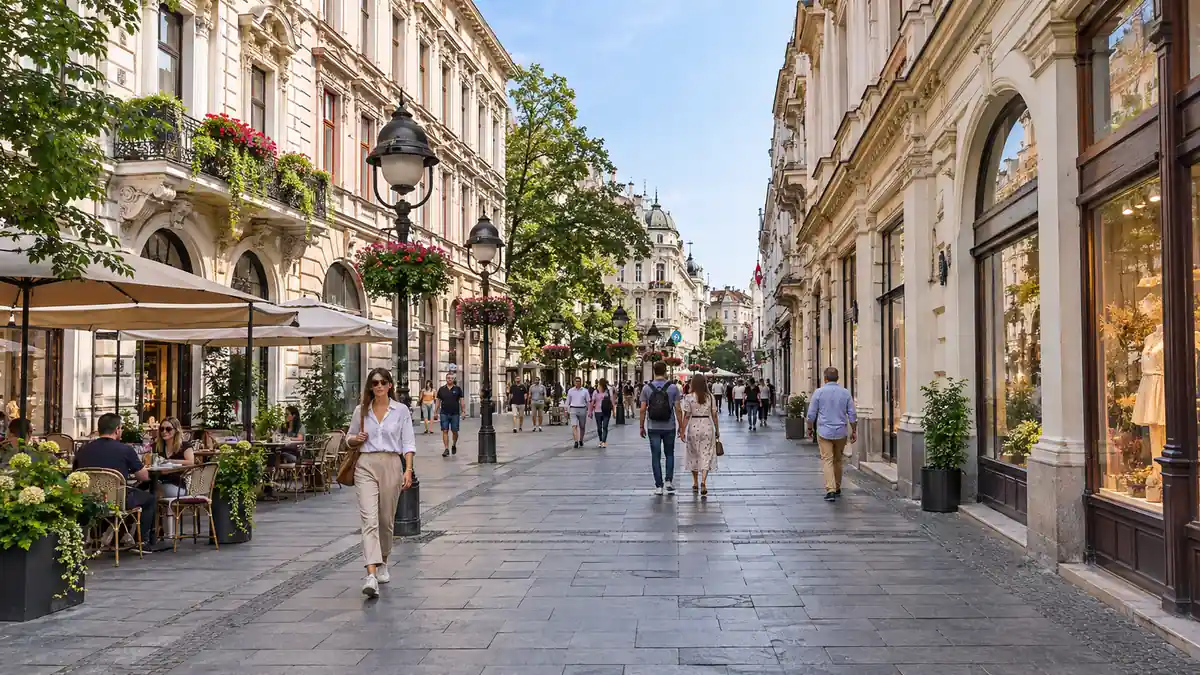
That choice decides who pays you later and whether a commission is certain, and it cannot be switched at the border. Keep the invoice, the request and the goods together from this point on. Shops on Knez Mihailova and in Belgrade’s malls are where most visitors cross the threshold; the Belgrade guide covers where to shop.
Step 2, leaving Serbia: show the goods to customs before you check in a bag
On the way out of Serbia you present the goods themselves, the invoice or invoices and the request to Serbian customs, who certify them. At Belgrade Nikola Tesla Airport that means going to customs before you check in your luggage, or keeping the goods in your hand luggage, because customs must see them.
Do not check in a bag holding the goods until the request is certified.
Certification looks different on each route. On paper, customs sign and stamp the original request and the invoices and hand them back, keeping the copy. On the electronic route, the request is certified in the customs system with an electronic seal, and on paper only if that system is down. If a condition is not met, customs write the date and the reason for rejection on the request, and the claim ends there.
The same certification applies whatever the crossing: at a land border or on a train, it happens with Serbian customs at the exit. You can also get the refund when crossing with an ID card or another document valid for crossing the border under Serbian law. Photograph the stamped documents before you leave the counter; that picture is your only record if the originals go missing later.
Step 3: Serbian customs certify the claim, but the seller or operator pays it
Customs never pay out. Within 12 months of the date the goods left Serbia, you get the certified documents to the seller on the paper route or to the operator on the electronic route, and the refund is paid in dinars: in cash immediately, or to your account within 15 days of the request being received.
Which route you are on was settled at the till, and each has its own catch:
- Seller route (paper ZPPPDV): the certified documents go back to the shop, in person, by post or through another person. The seller refunds the full VAT or deducts its commission. It depends on the shop’s cooperation after you have left Serbia, so it works best when you will pass the shop again or trust it to process a mailed request.
- Operator route (electronic): the documents go to the refund operator, which may charge a commission, so you receive the VAT minus that fee. For someone who will not return to the shop, it is usually the practical route.
You do not have to hand the documents in yourself. Another person may submit the request for you. If you send it by mail, you must give the account the refund should be paid into; a mailed request without one has nowhere to go.
The refund comes in dinars only, so a cash payout is money to spend before you leave, and a transfer arrives as RSD to your account. The Serbia travel guide covers how dinars, cash and cards fit the rest of the trip.
Spending money abroad
A Wise account converts your money at the mid-market exchange rate and shows every fee upfront, with a card you can spend in the local currency.
Check Wise’s rates and fees for your currency →
Tripstou may earn a commission if you sign up through this link, at no extra cost to you.
What cancels a Serbia VAT refund claim
Almost every lost refund dies on one of a short list of avoidable mistakes, and the first happens at the till: no request filled in by the seller means no claim, whatever you bought. The rest are about the goods, the stamp and the deadlines.
- No request from the seller. Ask before paying; a receipt alone does not start a claim.
- Goods used, or packed in a checked bag before customs saw them. Keep them unused and within reach until the request is certified.
- Goods exported too late. Leave before the end of the third calendar month after the month of purchase.
- No stamp or electronic certification, or a rejection written on the request. Go to customs with goods, invoices and request together, and check each condition before you queue.
- Documents not back within 12 months. Post or hand in the certified papers soon after the trip, not at the end of the window.
- Receipts from different shops counted together. Only one seller’s invoices add up to RSD 6,000.
- Expecting VAT back on services. Hotels, restaurants, transport and tours are outside the scheme, which covers goods only.
- A mailed request with no account given. Write the account details on what you send.
One habit prevents most of these. Passport, invoices, request and the unused goods travel together until Serbian customs have certified them.
How We Checked the Rules
This page settles one question: whether and how a visiting non-resident claims Serbian VAT back on goods. It is not a Belgrade shopping guide, a business VAT-refund explainer, an EU tax-free page or an entry-rules page.
Produced with AI assistance, this procedure was gone over step by step by Alex Perrut, working in tourism since 2015, for the Tripstou editorial team. Our editorial process sets out how.
Official sources consulted: Tax Administration of the Republic of Serbia, Customs Administration of the Republic of Serbia, Customs Administration FAQ for tourists, Ministry of Foreign Affairs of the Republic of Serbia.
Serbia VAT Refund: The Questions That Come Up at the Till
Can I combine receipts from different shops to reach RSD 6,000?
No. The threshold counts per seller, so purchases from two shops never add up, however close together they are. Several invoices from the same seller do count together, as long as the later ones fall before the end of the third calendar month after the month of the first. Keep every invoice from that seller with the request.
Can I get a Serbia VAT refund if I leave by bus, car or train?
Yes. The rule is about taking the goods out of Serbia, not about flying: Serbian customs at the exit certify the request whatever the crossing. What changes on the ground is reach. Customs must see the goods, so on a bus or a train keep them with you, not in the hold, and in a car keep them where you can show them at the Serbian exit point, not at the next country’s border.
Can I claim the refund with an ID card instead of a passport?
Yes. The Customs Administration states that the refund can be obtained when you cross the border with an ID card or another document valid for crossing under Serbian law. The condition that decides the claim is still residence: the refund is for people with no permanent or temporary residence in Serbia, whatever document they travel on. Which documents get you into Serbia in the first place is covered in our guide to Serbia’s entry rules.
Do online purchases qualify for a VAT refund in Serbia?
Online orders do not fit the official wording, which covers goods bought at the seller’s premises, where the seller sells goods. To keep the refund open, buy in the shop itself and ask for the request at the till, with your passport in hand.
Can tourists get VAT back on hotels and restaurants in Serbia?
No. The scheme refunds VAT on goods taken out of Serbia, never on services, so hotel rooms, restaurant meals, transport and tours stay taxed whatever you spend. Things you buy in a shop and carry out unused are the only purchases that count, under the same RSD 6,000 per-seller rule.
Where This Fits in Your Serbia Trip
- Serbia travel guide: the trip-wide planner for money, getting around and where the refund fits in a Serbia itinerary.
- Belgrade guide: where the shopping that clears the threshold actually happens.
- Serbia’s entry rules: the rules that decide the non-resident question before any of this matters.
Did this guide save you time or money? Tripstou is independent and reader-funded — if you'd like to give something back, you can support the site with a crypto contribution of any size.