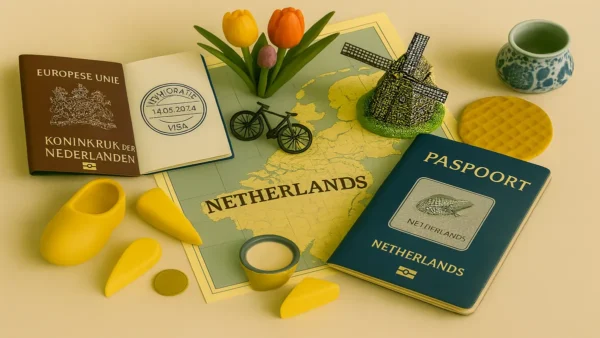

Your passport decides whether you need a visa for the Netherlands, and most visitors do not. EU, EEA and Swiss citizens need no visa and travel on a valid travel document. Visa-exempt non-EU passports, among them the US, UK, Canada, Australia and New Zealand, enter without a visa for up to 90 days in any 180 and are registered biometrically at the border. Every other passport needs a short-stay Schengen visa, applied for before travel. Because the Netherlands is one Schengen country, those 90 days are shared with every other Schengen country on the same trip.
The sections below set out how long you can stay, what passport control at Schiphol checks, and how the visa route works if your passport needs one. Living, working or studying in the Netherlands is a separate track.
How We Checked the Entry Rules
This page settles one question: whether your passport needs a visa for a short stay in the Netherlands, and what EES, ETIAS and the 90/180 rule mean for that trip. It is not a residence or work-permit guide, and it does not plan the trip itself.
Alex Perrut, working in tourism since 2015, checked these entry rules for the Tripstou editorial team; the page was written with AI assistance. How that works is set out in our editorial process.
Official sources consulted: Netherlands Worldwide, Government of the Netherlands, European Commission Migration and Home Affairs, GOV.UK Foreign Travel Advice, EU Travel to Europe portal.
Who Needs a Visa for the Netherlands: Three Passport Routes
Three routes cover every short-stay visitor to the Netherlands. EU, EEA and Swiss citizens use free movement and need no visa. Visa-exempt non-EU nationals need no visa either, but they stay within 90 days in any 180 and are registered by EES at the border. Everyone else needs a short-stay Schengen visa (type C) before boarding.
| Passport group | Visa needed? | Stay limit | At the border |
|---|---|---|---|
| EU, EEA, Swiss | No | No 90/180 count | Valid travel document |
| Visa-exempt non-EU (US, UK, Canada, Australia and others) | No | 90 days in any 180, across Schengen | EES registration; no ETIAS to apply for yet |
| Visa-required | Yes, Schengen visa (type C) | The days and dates on the visa | Visa sticker plus EES registration |
The quickest way to find your group is the official visa check on netherlandsworldwide.nl. You enter your nationality and travel plans and it tells you whether a visa applies. Its result is guidance, not a legally binding decision, so the rules printed on that site and on the visa itself are what count.
Visa-exempt does not mean condition-free. A US or Canadian traveler still has to meet the Schengen entry conditions: a passport that passes the validity rule, a reason for the trip, somewhere to stay and enough money to cover it. An officer at Schiphol can ask about any of them.
Working, studying or settling in the Netherlands falls under the Immigration and Naturalisation Service (IND), not under these short-stay rules. Once the entry question is settled, the trip itself is planned in our Netherlands travel guide.
Ninety Days in Any 180, Counted Across the Whole Schengen Area
Visa-exempt visitors may stay up to 90 days in any rolling 180-day period across the Schengen area as a whole, not per country. For a Netherlands trip, every day spent in Belgium, Germany, France or any other Schengen country draws on the same 90 as your days in Amsterdam or Rotterdam.
The window rolls. On any day of your stay, look back 180 days and add up every day you spent anywhere in Schengen; the total must stay at 90 or below. Days only drop off the count once they fall more than 180 days behind you, so leaving Schengen for a while does not restore the full allowance.
Earlier trips are where people get caught. A traveler who spent 60 days in Spain and Portugal over the summer and lands at Schiphol in early autumn has roughly 30 days left, not 90. EES now records each entry and exit, so the border sees the same arithmetic you do.
The European Commission’s short-stay calculator does the counting if you enter your past and planned dates. Once you know how many days you have, decide how to spend them with our guide to the best places to visit in the Netherlands.
Going past the limit is a serious breach: an entry ban can follow.
Passport Validity: Issued Within Ten Years, Valid Three Months Past Your Exit
A non-EU passport used to enter the Netherlands must meet two tests: it must have been issued less than 10 years before the day you arrive, and it must be valid for at least 3 months after the day you plan to leave the Schengen area. Fail either and the airline or the border can refuse you.
The two tests are separate. A passport can pass on its expiry date and still fail on its issue date, so read both dates on the photo page before you book.
EU, EEA and Swiss citizens are outside this two-part rule. Their passport or other valid travel document only needs to be valid for the trip.
At Schiphol Passport Control: EES Is Running, ETIAS Is Not, and What the Officer May Ask For
A non-EU traveler arriving at Schiphol is registered biometrically under EES instead of having the passport stamped, has no ETIAS to apply for, and may be asked to show the standard entry conditions. The same applies at any other Schengen external border, whether you arrive in Amsterdam or connect through another Schengen airport first.
EES: the biometric registration that replaced the passport stamp
The Entry/Exit System registers non-EU travellers biometrically at the border and is fully operational across the Schengen area. It applies to every non-EU traveler crossing a Schengen external border, visa-exempt or visa-holding, and there is nothing to apply for in advance: the registration happens at the desk or kiosk.
Status: EES has been fully operational at all Schengen external borders since 10 April 2026; ETIAS is not in operation and no start date has been announced.
The first registration takes longer than a stamp did, because your face and fingerprints are captured and linked to your passport. Later crossings check against that record, and the system logs each entry and exit, which is how overstays are now detected automatically.
ETIAS: not in operation, so there is nothing to apply for yet
ETIAS is a pre-travel authorisation for visa-exempt nationals that is not yet in operation; the European Union will announce the start date several months before launch. When it runs, it will cost €20 and stay valid for up to three years or until the passport expires, whichever comes first.
It will cover travelers from 59 visa-exempt countries visiting 30 European countries, the Netherlands among them. Any website that sells you an ETIAS today is a fraud.
What to have ready at the desk
Officers at Schiphol can ask non-EU travelers to prove the purpose and means of the trip, so keep these within reach rather than in checked luggage:
- a passport that passes the issue-date and three-month rule above
- a return or onward ticket
- the address of where you are staying (booking confirmation or host details)
- proof of sufficient funds for the stay
- proof of travel insurance, if you travel on a visa
- the visa itself, if your passport needs one
Passport checks can also take place on land crossings from Belgium or Germany, so carry your passport on a train or road trip from a neighbouring country too.
How to Apply for a Schengen Visa for the Netherlands
A visa-required traveler applies for a short-stay Schengen visa through the Netherlands when the Netherlands is the main destination, using the route listed for their country of residence on netherlandsworldwide.nl, which is often a VFS Global centre. The application goes in no earlier than six months and no later than 15 days before the trip.
Which consulate when the Netherlands is one stop of several
The main destination decides the consulate. That is the country where you spend the most days; when the stays are equal, it is the country you enter first. Five nights in Amsterdam and three in Brussels means a Dutch application, while three in Amsterdam and five in Paris means a French one.
You apply in the country where you legally live, which is not always the country that issued your passport. A traveler resident abroad picks the Dutch route listed for the country of residence, not the one for the passport. A visa the Netherlands issues is valid in the other Schengen countries for the dates and days it shows.
The application steps, in order
- Check the application route for your country of residence on netherlandsworldwide.nl.
- Book an appointment, usually with VFS Global.
- Submit the application form and supporting documents.
- Give your biometrics (photo and fingerprints) at the appointment.
- Wait for the decision.
- When the passport comes back, check the dates and number of entries on the visa sticker before you book anything non-refundable.
VFS charges a service fee on top of the visa fee. It varies by country, so check it on the booking page for yours.
Single or multiple entry: which to ask for
Ask for multiple entry when your trip leaves the Schengen area and comes back, such as a few days in London between Amsterdam and Paris. A trip that stays inside Schengen from arrival to departure needs only single entry. The consulate decides what it actually grants, which is why the sticker check in the last step matters.
Visa Fee, Decision Time and the €30,000 Insurance Rule
A Schengen visa for the Netherlands costs €90 for an adult and €45 for a child aged 6 to 12. The decision normally comes within 15 days and can stretch to 45. You also need travel medical insurance of at least €30,000, valid in all Schengen countries for the whole stay.
The insurance has to cover the costs of falling ill or getting hurt on the trip:
- hospital stays
- emergency medical treatment
- medicine
- repatriation for medical reasons
Carry the insurance certificate with you; having a policy is not enough if you cannot show it at the border.
The 45-day ceiling is the number to plan around. An application lodged 15 days before departure is legal but can still be undecided on the day you fly, so applying at the start of the six-month window protects any flight booked around a fixed event.
Entry Rules in Five Lines
- Your passport sets the route: EU, EEA and Swiss citizens need no visa, visa-exempt nationals such as US, UK and Canadian citizens need none but count their days, and every other passport needs a Schengen visa before travel.
- The 90 days in any 180 are shared across the whole Schengen area, so earlier days in Spain, Belgium or Germany cut what is left for the Netherlands.
- A non-EU passport must have been issued less than ten years before you arrive and stay valid for three months after you leave Schengen.
- At Schiphol, non-EU travelers are registered by fingerprints and a face scan under EES, and there is no ETIAS to apply for.
- Visa applicants go through the route for their country of residence, pay €90 per adult and do best to apply early in the six-month window, since a decision can take up to 45 days.
Netherlands Entry Questions Travelers Still Ask
Do I need an airport transit visa to change planes at Schiphol?
Some nationalities do, even when they stay airside and never pass Dutch passport control. The Government of the Netherlands publishes which passports need an airport transit visa for a Dutch airport, and the official visa check on netherlandsworldwide.nl gives the answer for your own nationality and route. Check it before you book a connection through Schiphol.
Do I need a separate visa for Aruba, Curaçao or Bonaire?
The European rules do not decide it: Aruba, Bonaire, Curaçao, Saba, St Eustatius and St Maarten use a separate visa system, so a Schengen visa or a Schengen visa exemption does not settle entry to the Caribbean parts of the Kingdom. Check the Caribbean visa pages on netherlandsworldwide.nl for your passport before booking that leg.
What happens if I overstay 90 days in the Schengen area?
You risk an entry ban from the Schengen area; GOV.UK warns that it can last up to three years. The overstay is measured against your Schengen days as a whole, and EES logs the date you leave, so the border knows how long you stayed without having to read stamps.
How much cash can I bring into the Netherlands?
Cash of €10,000 or more has to be declared to customs when you enter or leave the EU through the Netherlands. That declaration is separate from tax-free shopping: getting VAT back on purchases when you leave is covered in our guide to the VAT refund in the Netherlands.
Where to Plan the Rest of the Trip
- Netherlands travel guide: the trip itself, once the entry question is settled.
- Best places to visit in the Netherlands: deciding where your Dutch days go.
- VAT refund in the Netherlands: getting tax back on purchases when you leave.
Did this guide save you time or money? Tripstou is independent and reader-funded — if you'd like to give something back, you can support the site with a crypto contribution of any size.