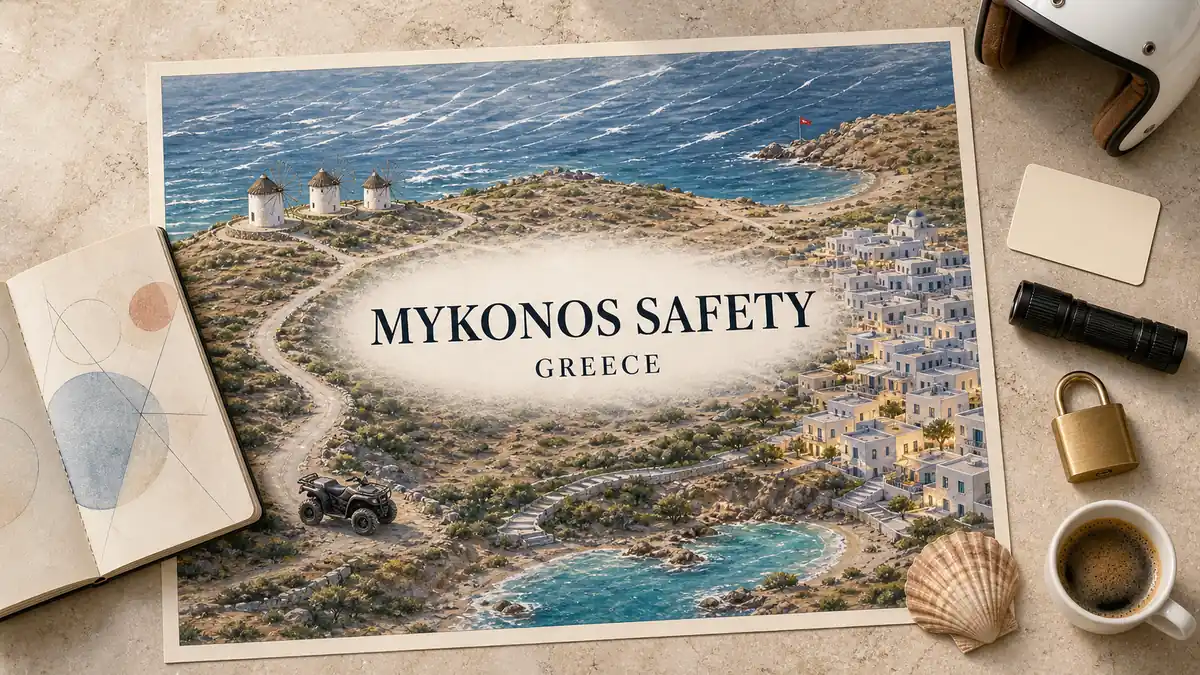
Mykonos arrives with a reputation that makes people ask the question twice: a party island — packed in high season, loud until sunrise. The honest answer is reassuring, though not for the reasons most safety pages give. Mykonos is safe. The island is small, its centres are busy late, and nothing about a normal trip here asks you to stay on guard.
What actually hurts visitors on Mykonos is mostly self-inflicted: a rented quad on a gravel-edged bend, a 4am walk home along an unlit road, an afternoon swim on the wrong coast with the north wind up. Those three moments account for most of the trips that go wrong, and all three are decided before they happen.
This page breaks the risks down in the order they actually matter, names the scam patterns worth recognising, and hands over the short list of precautions that change outcomes.
Quick Answer
Mykonos is a safe island, and violent crime against visitors is rare. The real risk concentrates in rented ATVs and scooters, getting home from nightlife, and swimming on windy days. The precautions that matter most: skip the quad unless you are properly licensed and insured, and arrange your late-night ride home before you go out.
Trust Layer
Tripstou safety guide for travelers deciding how safe a destination is and what precautions actually matter. Covers real risk levels, common scams, situational awareness, and protection choices.
Produced with AI assistance and reviewed by Alex Perrut, working in tourism since 2015, for the Tripstou editorial team. See our editorial process for details.
Last factual review: September 1, 2026.
Official sources consulted: Visit Greece, Greek Ministry of Tourism.
Key Takeaways
- Mykonos is a safe island; its real hazards are rented vehicles, late-night logistics and a windy sea, not crime.
- Rented quads and scooters are where the island’s real danger sits; helmets are mandatory for driver and passenger alike.
- Arrange your ride home before you go out, because clubs empty faster than the island’s transport can absorb the crowd.
- The Meltemi decides where you swim: north-facing bays turn rough while south-facing bays stay sheltered the same afternoon.
- Unlicensed taxis and unpriced menus are the two scam patterns here; get the price confirmed before you commit either way.
- Many standard travel policies exclude quad biking, and riding without a helmet can invalidate a claim even under cover.
Table of Contents
Is Mykonos Safe for Tourists?
Mykonos is safe for tourists, and crime is not where the island’s risk sits. The real hazards are practical ones: rented vehicles, late-night logistics and a sea that turns rough when the north wind blows. Safety here is decided by what you do, not by where you walk.
Safety on Mykonos shifts with the situation you put yourself in. Daytime in Mykonos Town is as low-stakes as travel gets — dense, walkable, and watched by sheer footfall. The same lanes at 4am, after the clubs empty, ask more of you: you are tired, possibly drunk, and further from your bed than you planned. The place did not change. Your margin did.
Greece-wide safety, including how the national advisory picture is framed, belongs to a different page: our guide to safety in Greece covers the habits that apply across the country rather than on one island. For everything outside the safety question — when to come, how long to stay, what the island is actually like — start with the Mykonos travel guide.
Is It Safe to Rent an ATV or Scooter in Mykonos?
Rented ATVs and scooters are the biggest genuine safety risk on Mykonos. Renting one is legal and easy; riding one well on narrow, gravel-edged island roads is neither. Most quad accidents follow one pattern: a visitor on a vehicle they have never driven before.
The vehicle is the easy part to underestimate. Mykonos roads are steep in places, sandy at the edges, and shared with buses and taxis that know every bend better than you do. A quad feels stable at rest and behaves nothing like a car in a corner. Add a first ride, an unfamiliar throttle, sandals and an evening return, and the accident writes itself.
Four checks are worth making before you sign anything:
- Helmet, every time. Helmets are mandatory for the driver and the passenger on quads and mopeds, and riding without one can invalidate your insurance after an accident.
- The right licence. A moped requires at least a category A1 licence, and a UK provisional licence is not valid in Greece. Turning up hopeful at the rental desk is not a licence category.
- Cover that names the vehicle. Quad biking is excluded from many standard travel-insurance policies and needs specific cover added before you travel.
- One question for the operator. Rental rules have been tightening, so ask the operator what licence and documents they currently require, and take that answer over anything you read secondhand.
The insurance point deserves its own decision, and it gets one further down this page. The rental desk and your insurer run two different checks, and only one of them happens before you drive away.
Is Mykonos Safe at Night?
Mykonos nightlife is safe; the real risk is getting home between 3 and 5am. Clubs empty faster than transport can absorb the crowd, and the roads back are dark, narrow and mostly without pavements. Decide how you are getting back before you go out.
The gap exists because Mykonos nightlife ends all at once. Venues close within a short window, a large crowd wants transport at the same minute, and the island has a finite number of vehicles. Waiting is the default outcome. The people who avoid the problem arranged the return in advance — a hotel transfer, a pre-agreed pickup, a group splitting one ride, or a base within walking distance of the venue. Which options run late, and how they behave in high season, is resolved in the Mykonos transport guide.
Walking home is the hazard that follows from the same moment. Island roads are unlit outside the built-up centres, largely without pavements, and busiest with vehicles at exactly the hours the clubs empty. If you end up on foot, face oncoming traffic, stay wide of blind bends, and carry a light. A phone torch changes how early a driver sees you.
Keep your own drink in sight, too. Order at the bar, watch it poured, and decline open drinks from people you have just met. That is ordinary bar-going discipline, and it applies on Mykonos for the same reason it applies in any loud, packed nightlife scene.
The ride home is the only part of a Mykonos night worth booking while you are still sober.
Are Mykonos Beaches Safe for Swimming?
Mykonos beaches are safe for swimming on calm days; the Meltemi wind changes that quickly. This dry north wind pushes hard against the island’s north-facing coast, building short, steep chop against the shore, while the south coast stays sheltered. Wind direction decides where you swim.
The Meltemi blows through the Aegean in summer, sometimes for days at a stretch, and its direction is the whole story. North-facing bays take it head-on and turn choppy, with blowing sand and water that is hard work to swim in. South-facing bays sit in the island’s wind shadow and can stay flat on the same afternoon. Nobody local cancels the beach on a windy day. They drive to the other side of the island.
| Coast orientation | Exposure when the Meltemi blows | Typical sea state | What it suits that day |
|---|---|---|---|
| South-facing bays | Sheltered behind the island’s high ground | Often flat or lightly rippled | Swimming, families, long beach afternoons |
| Southeast-facing bays | Partly sheltered, exposed in strong gusts | Mild chop that builds through the afternoon | Morning swims before the wind strengthens |
| North-facing bays | Fully exposed to the northerly airflow | Short steep chop and blowing sand | Windsurfing, walking, watching the sea |
Two rules cover the rest. A red flag means do not enter the water, whatever the surface looks like from the sand. Never dive into water whose depth you have not checked, since the island’s rocky coves hide shallow shelves close to shore. And on a strong northerly, the wind picks your beach for you.
Which Mykonos Beaches Get Hit by the Meltemi Wind?
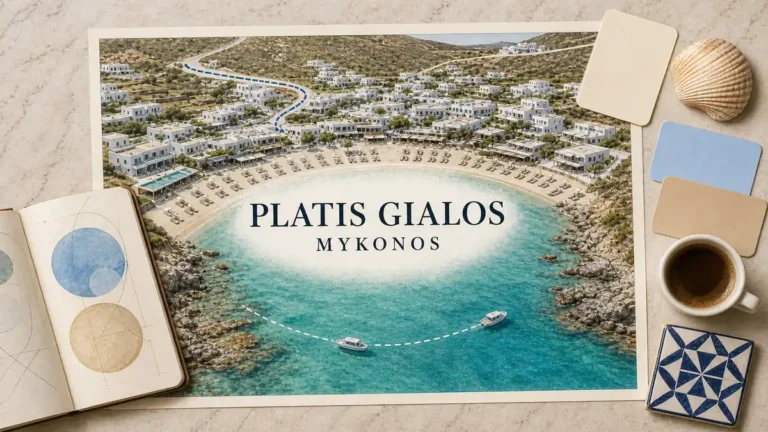
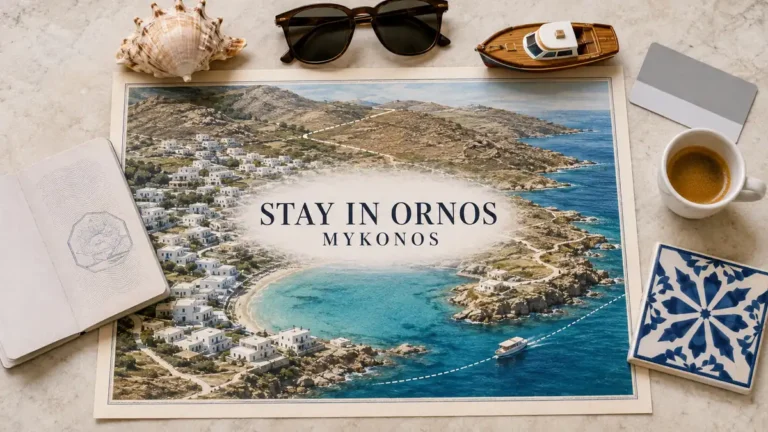
The north-facing coast takes the Meltemi directly, while the south-facing coast stays sheltered. Northern bays such as Ftelia, Panormos, Agios Sostis and Fokos face into the wind and get choppy, which is why the north side is where the island’s windsurfing happens. On the southern side, Platis Gialos, Psarou, Ornos, Paradise and Super Paradise sit behind the island’s high ground and usually stay swimmable on the same day. Orientation is the whole point here: a northern bay is a fine choice on a calm day and a poor swim on a blowing one, and the forecast tells you which day you have.
Do Mykonos Beaches Have Lifeguards?
Assume most Mykonos beaches are unguarded. Greek law requires lifeguard cover only at bathing areas classed as highly frequented — broadly, those averaging around 300 or more bathers per kilometre at peak hour — and only from 1 June to 30 September, between 10:00 and 18:00, with each lifeguard covering 200 metres either side of the post. That framework comes from Presidential Decree 71/2020 and Law 4688/2020.
The practical consequence matters more than the legal text. A quiet cove outside the busy months, a small bay that never reaches the threshold, or any beach after early evening falls outside the requirement entirely. Swim within your depth, swim with someone else present, and stay closer to shore when the wind is up. Treat supervision as your own job unless you can see otherwise.
Crime and Scams on Mykonos: What to Watch For
Crime sits last on Mykonos’s real risk list, and the exposure is opportunistic theft. The losses that actually happen are small and quick — a bag left on a beach lounger, a phone on a crowded dancefloor, a wallet in a packed alley in town. Two scam patterns are worth recognising in advance.
Both share a tell: they start at the moment you have no alternative — no other taxi, no other table.
- Unlicensed “pirate” taxis. Where: outside clubs and around the port once official transport thins out. How to recognise it: no meter, no roof sign, no visible licence, and a fare agreed through a car window. What to do: use the official rank, a hotel transfer or a booked pickup, and if you are already moving and something feels off, get out at the next lit, populated stop.
- Unpriced menus and inflated bills. Where: a small number of tourist-facing venues in the busiest parts of town and along the beach strips. How to recognise it: no printed prices, verbal quotes for “fresh” items sold by weight, sunbeds with no posted rate. What to do: get the price confirmed in writing before you order, read the bill line by line, and pay by card so there is a record.
Ordinary theft habits cover everything else. Bags do not stay on loungers while you swim, phones do not stay on tables in packed bars, and a passport belongs in a hotel safe. These patterns are not unique to Mykonos — they repeat in every busy island port in Greece, which is why the habits travel well. The wider set of practical habits worth adopting before you arrive is in our Mykonos travel tips.
Mykonos by Traveler: Solo Women, Families and LGBTQ+ Visitors
Mykonos is safe for solo women, families and LGBTQ+ travelers alike; what changes is which precaution matters most. The verdict does not move by group here, because the island’s risks are situational: vehicles, late nights and wind affect everyone who meets them.
Is Mykonos Safe for Solo Female Travelers?
Mykonos is a comfortable island for solo female travelers, and the precautions that matter are shaped by night logistics. The island is small, busy and well lit in its centres, and solo travel here is common enough to be unremarkable. The two habits worth keeping are the ones from the night section: know how you are getting home before you go out, and keep your own drink in sight. The lever here is timing and transport, and it holds whichever part of the island you are staying in.
Is Mykonos Safe for Families with Kids?
Mykonos is safe for families, and the risk worth planning around is the sea. Family beach days go best on the sheltered south coast, where the water stays flatter on the same afternoon the north side is churning. Assume no lifeguard is on duty and supervise on that basis. The other family-specific point is the vehicle question: quads and mopeds are a poor fit with children aboard, and a taxi or a pre-booked transfer removes the decision entirely.
Is Mykonos Safe for LGBTQ+ Travelers?
Mykonos is safe for LGBTQ+ travelers and is one of Europe’s most established LGBTQ+-friendly islands. Same-sex couples are visible and unremarkable across the island’s bars, beaches and hotels, and that welcome is part of how the island built its reputation. No special precaution set applies. The standard nightlife habits — a planned ride home, an eye on your own drink, awareness in a dense crowd — are the same ones every visitor should keep, for the same reasons.
Where you base yourself changes the logistics far more than it changes the risk. A base in Mykonos Town puts dinner and nightlife within walking distance and takes the late-night ride out of the equation; a beach base is quieter and better for young children but turns every evening into a transport decision. That tradeoff, and what each area actually suits, is resolved in our guide to where to stay in Mykonos.
Travel Insurance Is Worth It on Mykonos — Mainly for the Quad
Travel insurance is worth buying for Mykonos, mainly because many standard policies exclude quad biking. A normal holiday policy covers the ordinary problems — medical treatment, theft, cancellation — but the one activity plenty of visitors add on arrival can sit outside it. Check that clause before you book.
A standard policy earns its keep here in three unglamorous scenarios: treatment after an accident, theft of a phone, camera or bag, and a disrupted or cancelled trip. The first is the expensive one. A vehicle accident on a Greek island can mean treatment, a transfer to a larger hospital elsewhere, and a rearranged flight home, all at once.
Two exclusions decide whether the policy you already own is any use. Quad biking is treated as a hazardous activity by many standard policies and needs specific cover added. And riding without a helmet — mandatory for driver and passenger — can invalidate a claim even under a policy that does cover the vehicle. Both traps are trivial to avoid at the point of purchase and impossible to fix afterwards.
The tradeoff is thin. Adding the cover protects the one activity most likely to put you in a clinic, and if you skip the quad entirely a standard policy is enough on its own. What the rest of the trip costs, and where protection sits alongside it, is covered in what a Mykonos trip costs.
The policy question on Mykonos is settled at home. By the time a rental agent hands you a key, the useful decision has already been made.
Travel medical insurance
SafetyWing Nomad Insurance provides travel medical coverage designed for travelers and digital nomads, with flexible Monthly and Annual plans.
Check Nomad Insurance coverage and current pricing →
New Nomad Insurance Essential members can get 8 weeks of electronic theft coverage free with reward code TRIPSTOU8.
Apply the reward before creating your SafetyWing account by looking for the pink camera icon on the Nomad Insurance page.
Tripstou may earn a commission if you purchase through this link, at no extra cost to you.
Frequently Asked Questions
What is the emergency number in Mykonos?
Call 112, the European emergency number, which works in Greece. Use it for anything needing an immediate response: a road accident on a rented quad, a medical emergency, or trouble in the water. Save it in your phone before you land, because the moment you need it is not the moment to look it up.
Can you drink the tap water in Mykonos?
Bottled water is the norm on Mykonos. The island’s supply is widely reported as not ideal for drinking, and visitors and locals alike tend to buy bottled or filtered water instead of drinking from the tap. If you are unsure, buy bottled — it is sold everywhere on the island and the question stops there.
Is Santorini or Mykonos safer?
Neither is meaningfully safer than the other. Both are small, busy Cycladic islands where the real risks look the same: rented quads and scooters, getting home late at night, and a sea that turns rough when the north wind blows. Pick between them on the trip you want, not on safety.
Does travel insurance cover quad biking in Greece?
Often not. Quad biking is excluded from many standard travel-insurance policies, which treat it as a hazardous activity requiring specific cover added before you travel. Riding without a helmet — mandatory for driver and passenger — can also invalidate a claim. Read the activity clause before you buy, not after you rent.
What does a red flag on a Mykonos beach mean?
A red flag means do not enter the water, whatever the sea looks like from the sand. It overrides your own read of the conditions. The related rule is never to dive into water whose depth you have not checked, because rocky Greek coves hide shallow shelves close to shore.
Related Guides
Safety is one decision on a Mykonos trip; these guides resolve the rest. Each one picks up where this page stops — how to move around the island, where to base yourself, what the trip costs in practice, and how to shape two or three days without wasting them.
- Mykonos travel guide — the full island planner, from timing to what the trip actually feels like.
- Getting around Mykonos — ferries, buses, taxis and how late-night transport really works.
- Where to stay in Mykonos — which base suits your trip shape and nightlife plans.
- Mykonos travel tips — the practical habits worth knowing before you land.
- 2 days in Mykonos — a tight itinerary for a short island stop.
- 3 days in Mykonos — the fuller version, with beach time built in.
Did this guide save you time or money? Tripstou is independent and reader-funded — if you'd like to give something back, you can support the site with a crypto contribution of any size.