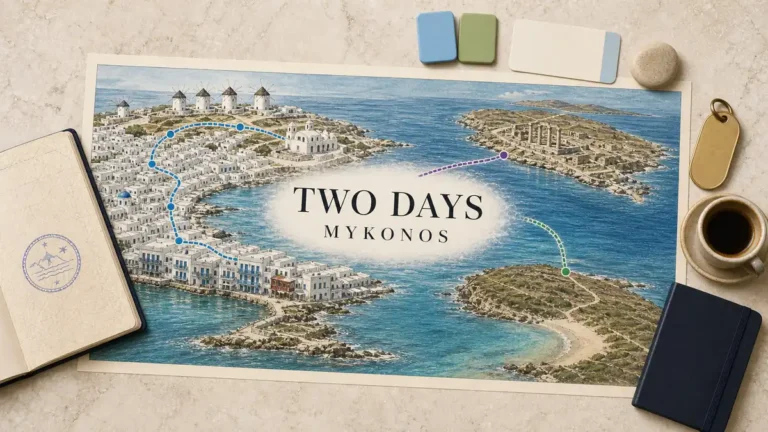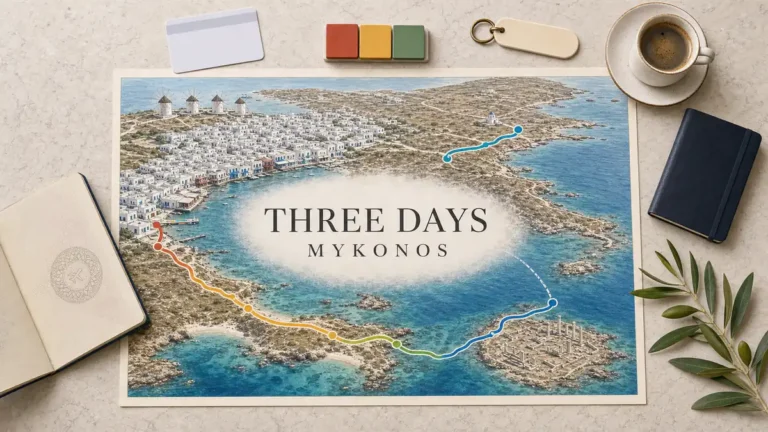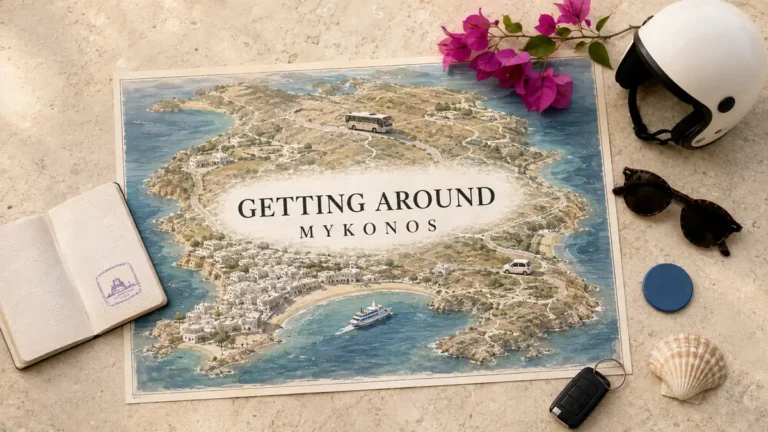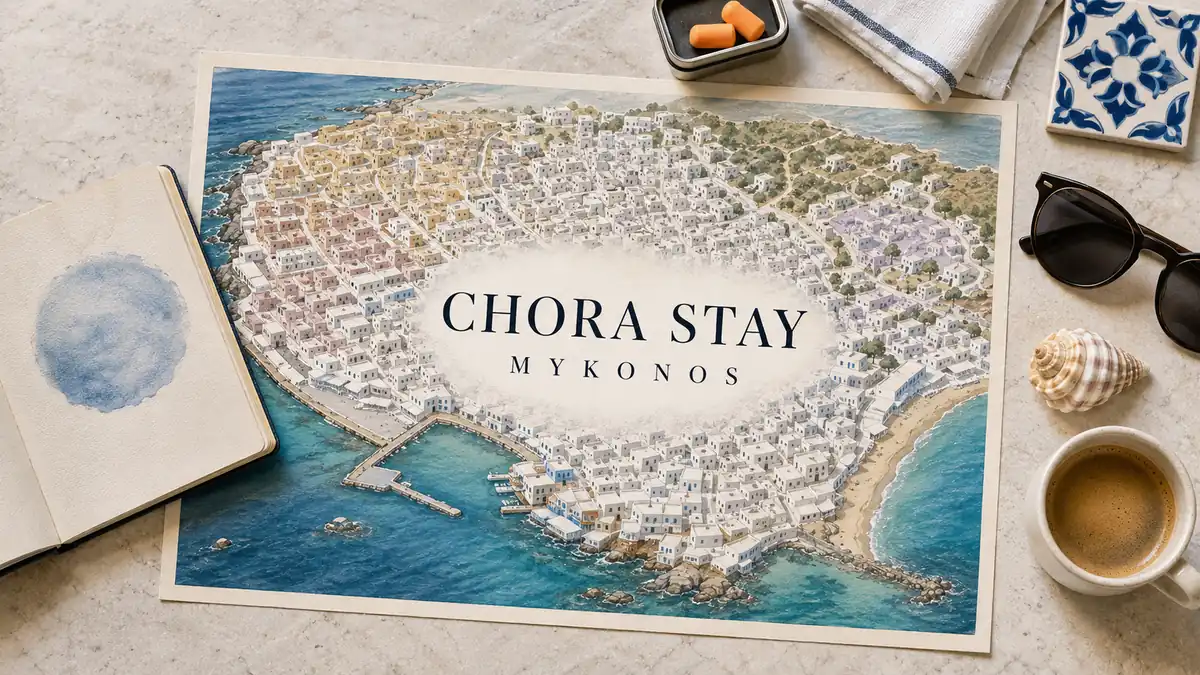
Mykonos Town — Chora to everyone who lives there — is the island’s only base you can run entirely on foot. Dinner, bars, shops, the harbour and the bus links out to the beaches all sit inside a walkable knot of whitewashed lanes, which is why it sits at the top of most first-time shortlists. It also carries the island’s most misread tradeoff. The same lanes that make the town walkable are the lanes that carry the noise, block the taxi and turn the last hundred metres of your arrival into a luggage haul over stone.
That tradeoff is not evenly spread. A room three lanes off the main spine is a different holiday from a room above it, and nothing on a booking page tells you which one you booked. This guide answers the two questions that decide the stay: which corner of the town to pick for the way you sleep, and what arriving there actually involves.
Quick Answer
Mykonos Town suits travelers who want dinner, bars and shops on foot; the corner you book decides how you sleep. Noise concentrates in the Matogianni lanes and along the Little Venice waterfront in season. Light sleepers take the Old Port hillside or Megali Ammos; nightlife-first travelers stay in the core.
Trust Layer
Tripstou stay guide for travelers choosing where to base. Covers area atmosphere, budget, convenience, noise, and traveler fit.
Produced with AI assistance and reviewed by Alex Perrut, working in tourism since 2015, for the Tripstou editorial team. See our editorial process for details.
Last factual review: September 1, 2026.
Official sources consulted: Visit Greece, Greek Ministry of Tourism.
Key Takeaways
- Mykonos Town is the island’s only base you can run entirely on foot, which is its whole argument and its whole cost.
- The noise is localised: the Matogianni spine, its bar lanes and the Little Venice frontage carry it, and the edges do not.
- Light sleepers should book the Old Port hillside or Megali Ammos; nightlife-first travelers should book the core and accept the trade.
- Every arrival ends on foot: vehicles stop at the Old Port and Fabrika lots, and luggage crosses stone from there.
- The town’s edges cost less than its core for a structural reason: they are the addresses photographers skip, not lesser rooms.
- Book the lane, not the area name — in a maze this dense the address on the booking page tells you almost nothing.
Table of Contents
Is Mykonos Town the Right Base for You?
Mykonos Town is the right base if you want your evenings on foot and can sleep through noise. Everything the island does after dark — dinner, bars, late shopping, harbour walks — sits within a few minutes of your door. Beach-first travelers and light sleepers pay for that.
Walkability is the whole argument, and it is stronger here than the phrase usually implies. The town is not a walkable centre surrounded by driveable sprawl; it is a pedestrian organism where cars are simply absent from most of the ground you will cover. That removes the daily friction that shapes a beach-base holiday: no evening taxi to book, no last bus to catch, no designated driver, no parking decision at eleven at night. For couples and solo travelers who want the option of changing their mind about dinner at nine o’clock, the town is the only base on Mykonos that grants it.
The same density is what punishes light sleepers. Sound in Chora does not disperse — it bounces between close stone walls in lanes narrow enough that it has nowhere to go, so a bar two streets away can be as loud in your room as one below it. Beach-first travelers pay a different tax: the sea is a bus ride away every single day, and there is no drifting from the sunbed back to the room. If you are still weighing the town against the island’s beach areas as a whole, the island-wide where-to-stay picture lays out how the areas compare.
The lane below your window matters more than the area name on the booking page. In a town this dense, two addresses a lane apart can produce two different holidays.
Hotels and places to stay
Compare hotels, apartments and stays for your dates in one search.
Search hotels and stays on hotels.com →
Tripstou may earn a commission if you book through this link, at no extra cost to you.
Is Mykonos Town Noisy at Night — and Where Are the Quiet Edges?
Yes, Mykonos Town is noisy at night in season — but the noise has an address. It concentrates along the Matogianni spine, the bar lanes feeding off it, and the Little Venice waterfront. Step two or three lanes out and the town gets quiet fast.
The loud zone is small and predictable. Matogianni is the main shopping and dining lane, and the bar lanes around it carry the late traffic; the sound holds until the bars themselves empty. Little Venice runs on its own rhythm: the frontage fills at sunset and stays full afterwards, so the quarter is busy on both sides of the evening. Between them, the shopping maze holds foot traffic and conversation late into the night through July and August.
The quiet edges are equally locatable. The hillside above the Old Port sits uphill and outside the noise field, with residential lanes that hold ordinary island life. The outer lanes towards Fabrika, on the town’s landward side, sit off the bar circuit entirely. So does the stretch running south towards Megali Ammos, which is inside walking range but outside the maze. All of this is season-dependent: outside the summer peak the loud zone contracts, and in the off-season, with the nightlife economy shut, it effectively disappears.
If the bars are the reason you are coming, none of this is a warning — it is a map, and the pages on where to stay in Mykonos for nightlife read it in the opposite direction. Book the core deliberately and you get what you paid for.
Before booking, ask which side the room faces and how high it sits. In the maze, elevation and orientation do more for sleep than distance does.
The Matogianni Core Puts You Inside Everything — Including the Noise
The Matogianni core is the full-immersion pick. It suits travelers who want zero commute between their room, dinner and the last bar of the night. You stay inside the pedestrian maze, so everything is a short walk and nothing is more than a lane or two away. Sleep is the price.
Day-to-day, this corner feels like a stage set that never quite empties. Mornings are calm and the lanes belong to deliveries and cats; by late afternoon the day crowds funnel through, and by evening the shopping spine is shoulder-to-shoulder. The whitewash, the bougainvillea and the painted doorframes are genuinely as good as the photographs — that is why this is where everyone wants to be, and why it never fully rests in season.
Convenience is total on foot and zero on wheels. Nothing in the core is more than a few lanes from anything else, including the harbour and the departure points for island boat trips. No vehicle reaches the door. Taxis, transfers and hire cars all stop at the town’s edge, which means every arrival, departure and airport run starts with a walk.
On price, this is high-end territory even by Mykonos standards, because a central address inside a pedestrian maze cannot be replicated. The premium buys location, not space — rooms here run small and old-town-shaped.
Best for: nightlife-first travelers who want the town at the door and will trade sleep for it.
Little Venice Buys the Best Evening Address in Town — at the Cost of Sleep
Little Venice buys the best evening address in Mykonos Town and the worst sleep. The waterfront quarter — historically Alefkandra — puts sunset bars and sea-slapped balconies at your door. It suits evening-led couples and short stays, where two or three atmospheric nights matter more than a full night’s rest.
The character here is unlike anywhere else on the island. Buildings sit directly on the southwestern harbour edge with the water hitting the walls below the balconies, and the whole quarter reorients itself around the sunset hour, when the frontage bars fill and stay full. The windmills on the rise above are the orientation marker most people use to find it. It is the most photographed corner of Mykonos, and it behaves accordingly.
Convenience mirrors the core: everything on foot, nothing by car, and the walk to the shopping lanes is short. The specific catch is that the quarter’s own draw is what keeps you awake — the crowd that comes for sunset does not leave afterwards, and the frontage stays lively deep into the night.
Prices sit at the high end, with waterfront and sea-view rooms carrying the steepest premium in town. Set back one lane and the positioning softens noticeably.
Best for: couples on a short stay who rate evenings and views over quiet nights.
The Old Port and Hillside Edge Is the Quiet Sleeper’s Pick
The Old Port edge and the hillside above it are the quiet sleeper’s pick. You stay within walking range of the centre while sitting outside the noise field, with harbour views and residential lanes instead of bar frontage. It suits light sleepers and anyone staying longer than a few nights.
The atmosphere on this northern edge is closer to a working island town than to a resort. Lanes widen enough for the occasional vehicle, laundry hangs above doorways, and the views open out over the harbour and the sea as you climb. It is a genuinely different register from the maze below — you visit the postcard rather than sleep inside it.
Convenience is good with one condition attached: the hill. The Old Port car park sits on this edge, and the port doubles as the town’s second bus node, so arrivals and beach runs are straightforward. The walks are uphill, though, and they are uphill on stone. That is a minor detail with a daypack and a real one with two suitcases at the end of a travel day.
Price positioning runs mid-range to high-end by the standards of the town, which makes this one of the better value-per-quiet corners inside Chora.
Best for: light sleepers who still want the town on foot.
The Fabrika Side Wins on Arrival, Parking and Buses
The Fabrika side is the practical corner of Mykonos Town. The southern edge holds the Fabrika car park and the main KTEL bus terminal, which makes it the easiest place to arrive with a car and the easiest to leave from each morning. It suits travelers who move around the island daily.
Nobody photographs this edge, and that is part of its case. It is the workaday side of Chora — parking, buses, everyday shops, ordinary tavernas — with less of the postcard whitewash and much less of the night noise. The old-town lanes start within a short walk, so you get the town’s evenings without living inside them.
Convenience is what this corner sells. Fabrika is the island’s main bus hub and the terminal the south-coast beach routes run from, which means a beach-hopping stay from here skips both the taxi problem and the parking problem entirely. The fringe is vehicle-accessible, so luggage and hire cars have somewhere to go that is not the far side of a pedestrian maze.
Prices are mid-range for the town — this is generally the softest positioning inside Chora, precisely because it lacks the view and the address.
Best for: beach-hoppers using the town as a transport base.
Megali Ammos Adds a Beach Without Leaving the Town
Megali Ammos gives you a beach without leaving Mykonos Town. The sand sits roughly a 10–15 minute walk south of the centre, close enough to walk in for dinner and far enough out that the nights are quieter. It suits travelers torn between a town base and a beach one.
The feel here is edge-of-town, not resort strip: an exposed stretch of sand with a view back towards the windmills and none of the maze’s density. Wind is the local variable — on meltemi days an open stretch like this one is breezier than a sheltered bay, which is part of why it stays quieter when it blows.
Convenience is a straight tradeoff. You gain morning swims and evening quiet; you lose the ability to step out of your door into the lanes, and every dinner involves the walk back in each direction. That walk is flat and easy in daylight and perfectly fine at night, but it is a walk you will do twice a day, every day.
Prices land mid-range to high-end depending on how close to the sand you sit, with the beachfront line carrying its own premium.
Best for: travelers who want one base to cover both sea and town.
Arriving with Luggage: Parking, Taxis and the Pedestrian Core
Arrival in Mykonos Town ends on foot. Vehicles stop at the edges — the Old Port lot to the north, Fabrika to the south — because the central lanes are pedestrian and too narrow for cars. The last stretch is you, your luggage and stone.
The logic chain is short and it decides a lot:
- The core is pedestrian. Most central addresses have no vehicle access at all, so door-to-door drop-off is not an option regardless of what you are paying for the room.
- Parking happens at the edges. The Old Port lot serves the northern approach, Fabrika the southern one. Both fill early in high season, so an afternoon arrival in July or August is a different experience from a morning one.
- Taxis are scarce and they stop short. Mykonos runs a famously small island taxi fleet, and even when you get one it can only reach the edge of the pedestrian zone.
- Luggage crosses stone. Wheeled cases do not roll well on stone lanes, and the ground is uneven. Pack for carrying, not for towing.
- A car is a liability inside the town. It cannot reach your door, it needs an edge lot every night, and the base itself removes most of the reasons to have one.
This is why the corner you book matters more than the star rating. A room on the Fabrika fringe or the Old Port edge means a short, mostly level luggage run; a room deep in the maze can mean a long, unglamorous haul with cases while your phone loses the plot among identical white walls. Ask your property for walking directions from the nearest car park before you arrive — the good ones send them unprompted, and that is a signal in itself.
Can You Swim from a Mykonos Town Base?
Not from the centre — Mykonos Town has no swimming beach in its harbour. Megali Ammos, on the southern edge, covers the quick swim within walking distance. The bigger south-coast beaches are a bus ride from the Fabrika terminal, which is how most town-based travelers reach the water.
Day to day, a town base turns the beach into an outing instead of a setting. You go out in the morning, you come back in the afternoon, and the swim is something you travelled to rather than something you drifted into. Fabrika is the hub that makes this workable, connecting the town to the south-coast beach strips without a car or a taxi in the equation. For travelers who want two or three beach days out of a week and evenings in the lanes, that structure works well.
For travelers whose holiday is the beach itself, the calculation shifts, and the two beach bases most often weighed against the town are Platis Gialos and Ornos. Platis Gialos trades the town’s evenings for an organised beach at the door and easy hops along the south coast; Ornos trades them for a calmer, family-shaped bay. Both tradeoffs turn on how much of your day happens on sand, and both have their own page: Mykonos Town vs Platis Gialos compared and Mykonos Town vs Ornos compared.
How Expensive Is Staying in Mykonos Town?
Mykonos Town sits among the island’s most expensive bases, alongside Psarou. Scarcity drives it: a pedestrian core cannot expand, so the supply of central rooms is fixed while demand climbs every summer. Relief comes from two directions — the town’s edges over its core, and shoulder season over peak.
Within the town, the spend styles land roughly like this. Budget travelers are looking at the outer lanes and the Fabrika side, in simple rooms without a view, and should expect the town’s floor to sit above most of the island’s; the cheapest areas to stay in Mykonos are mostly not in Chora at all. Mid-range means the edges — the hillside, the Fabrika fringe, the Megali Ammos side — where you keep the walk and drop the address premium. High-end means the maze itself, Little Venice frontage and sea views, which is the territory covered by Mykonos’s luxury stay areas.
The edges are cheaper for a structural reason, not a quality one: they are simply the addresses the photographers skip. When you are ready to move from choosing a corner to shortlisting actual hotels in Mykonos, that is the shortlist to work from.
Is Mykonos Town Open in Winter?
Yes, in a way the beach strips are not. Mykonos Town keeps a residual year-round life through the roughly November–March off-season: it is where islanders actually live, so a small number of tavernas, cafés and shops stay open. The nightlife economy, though, closes almost entirely.
Staying here off-season is a genuinely different proposition. The lanes empty of crowds and fill with residents; the maze becomes navigable; the whitewash sits under grey sea light instead of glare. What disappears is most of the reason people book Mykonos in the first place — the beach clubs, the sunset bars and the majority of the seasonal restaurants all shut, and the ones that remain keep shorter and less predictable hours. Weather is a real factor too, with wind and rain shaping which days work.
An off-season town base suits travelers who want the architecture, the walking and the quiet without the price and the pressure, and who are content to make the town itself the trip. Anyone planning that kind of visit should read the town alongside the rest of the island in the full Mykonos guide, since the off-season calculation depends on what else you were hoping to reach.
Best Corner of Mykonos Town by Traveler Type
Each sleeper type has one corner of Mykonos Town that fits. Nightlife-first travelers belong in the Matogianni core, evening-led couples in Little Venice, light sleepers on the Old Port hillside, beach-hoppers on the Fabrika side, and anyone wanting sea plus town at Megali Ammos.
| Corner of town | Night-time noise in season | Getting to the centre | Best for |
|---|---|---|---|
| Matogianni core | Loudest; bar traffic until the lanes empty | You are already in it | Nightlife-first travelers |
| Little Venice | Loud from sunset onwards along the frontage | Short walk into the shopping lanes | Evening-led couples on short stays |
| Old Port and hillside | Quiet; uphill and outside the noise field | Short walk down, uphill on the return | Light sleepers wanting the town on foot |
| Fabrika side | Quiet; workaday edge away from the bars | Short, mostly level walk into the lanes | Beach-hoppers using the bus hub |
| Megali Ammos | Quietest; beach edge outside the maze | Roughly a 10–15 minute walk each way | Travelers wanting sea and town in one base |
Read those rows as a within-town map, not an island verdict. First-time visitors weighing Chora against the island’s other bases will find that question answered in full on where first-timers should stay in Mykonos. Couples deciding between an atmospheric town address and a beach-side one should start with where couples should stay in Mykonos. Families, for whom the stone lanes, the luggage haul and the lack of a central beach all weigh differently, are better served by where families should stay in Mykonos before committing to a corner here.
One pattern cuts across all five profiles: the corner sets the ceiling on your stay, and the property only decides how comfortably you sit under it.
Frequently Asked Questions
Do you need a car if you stay in Mykonos Town?
No. The base argues against one: the core is pedestrian, so a car cannot reach your door, and it needs an edge lot every night. Fabrika’s bus terminal covers the beaches. Rent one only for a short stretch of the trip, if you plan to cover the whole island on your own schedule.
Can a taxi drop you at your hotel in Mykonos Town?
Usually not, if your room is inside the pedestrian core. Taxis reach the edge of the lanes and no further, and the island’s taxi fleet is famously small, so one may take a while to appear at all. Plan the last stretch on foot with your luggage.
How far is Mykonos Town from the airport and ferry port?
Both sit close to Mykonos Town, on opposite sides of it, and neither is a long trip. Transfers are short by design on an island this size. The distance that actually matters is the last stretch, which is on foot from wherever your taxi or transfer has to stop.
What time does Mykonos Town quiet down at night?
Late, and later than most visitors expect in July and August. The bar lanes off Matogianni and the Little Venice frontage stay busy until the bars themselves empty. The quiet edges — the Old Port hillside, the Fabrika side, the Megali Ammos stretch — settle well before that.
Can you stay in Mykonos Town if you have trouble with uneven ground?
It is difficult in the core. The lanes are stone and uneven, and the hillside above the Old Port climbs steadily. No vehicle reaches most central doors. The workable choice is the Fabrika fringe or the Megali Ammos side, where the approaches are level and the streets are vehicle-accessible.
Related Guides
- Where to stay in Mykonos — the island-wide picture, area by area, if you are still choosing between Chora and the beach bases.
- Mykonos guide — what the island offers beyond the stay decision, including how the town fits the wider trip.
- Mykonos Town vs Platis Gialos — the town base against the island’s most organised beach base.
- Best beach hotels in Mykonos — the shortlist to work from once your corner is chosen.
- Where to stay in Mykonos for nightlife — if the bars are the reason for the trip.
Did this guide save you time or money? Tripstou is independent and reader-funded — if you'd like to give something back, you can support the site with a crypto contribution of any size.