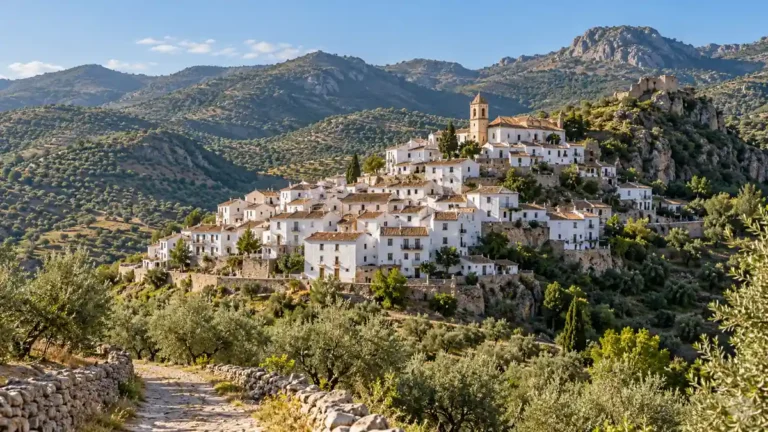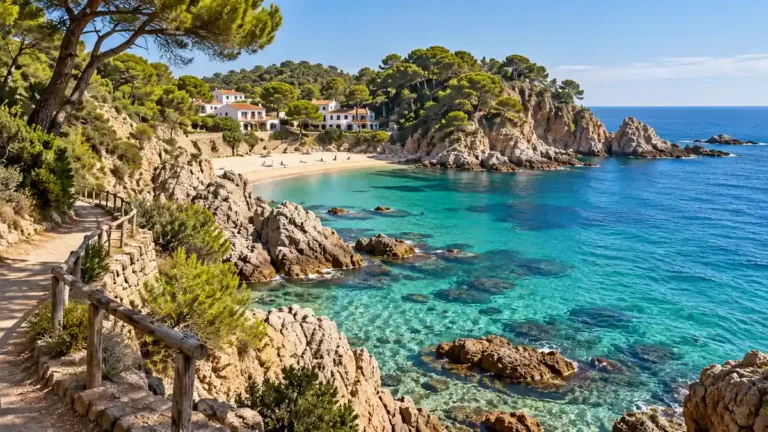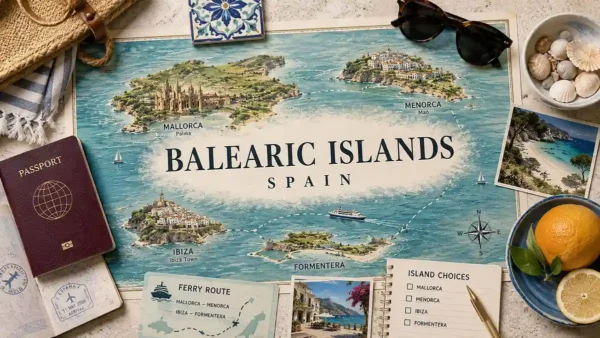
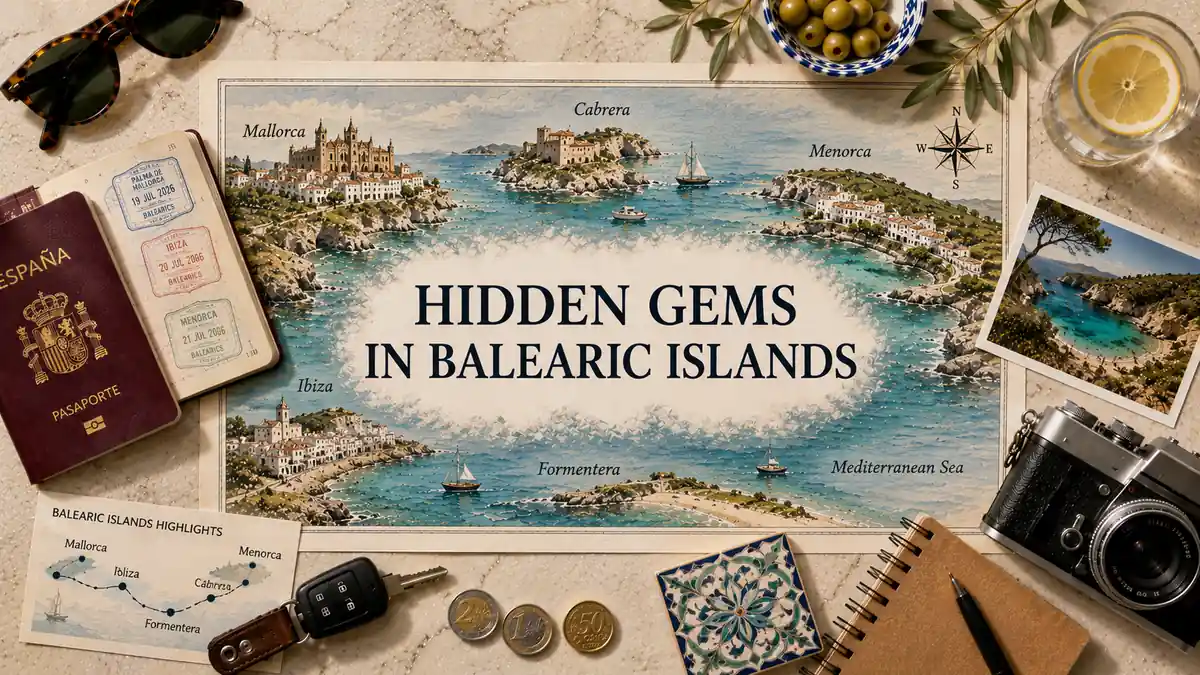
The Balearic Islands are famous for the wrong reasons: Mallorca’s resort strips and Ibiza’s clubs pull the crowds, while the archipelago’s quieter half stays almost invisible. Beyond the headline names sit whole islands with no airport, whitewashed villages that never went touristy, and coves you can only reach on foot or by boat. This is a curated, by-island shortlist of genuinely underrated Balearic places — the ones that reward travelers wanting calm over spectacle. Every pick here earns its spot on one test: it stays off-radar because of access or protection, not because a marketing team overlooked it. Use it to build a quieter, more local trip, whether you want a whole low-key island or one perfect hidden beach for the day.
Quick Answer
The strongest hidden Balearic escapes — Cabrera, Formentera, and Menorca’s quiet north — beat the Mallorca and Ibiza crowds. For travelers wanting calm, they sort into three types: quieter islands, low-key inland villages, and off-radar coves reached on foot or by boat. Menorca suits a whole least-touristy trip; a walk-in cove suits beach-focused day-trippers.
Trust Layer
Tripstou selection guide for travelers choosing between multiple places. Covers selection criteria, traveler fit, and trip value.
Produced with AI assistance and reviewed by Alex Perrut, working in tourism since 2015, for the Tripstou editorial team. See our editorial process for details.
Last factual review: July 18, 2026.
Official sources consulted: spain.info, tourspain.es.
Key Takeaways
- Menorca is the safest pick for a whole quiet trip — biosphere protection keeps it low-rise and calm in shoulder months.
- Cabrera, Formentera, and S’Espalmador stay near-empty because you reach them only by boat or ferry, never by air.
- The best hidden villages cluster on Menorca — Binibeca Vell, Fornells, and Es Mercadal trade beach frontage for local character.
- Menorca’s finest coves, like Cala Macarella and Cala Fustam, stay quiet because the final stretch is only on foot.
- Access friction is the whole point: the harder a spot is to reach, the emptier it stays.
- Pick an underrated island for several slow days, and save a hidden cove for one standout beach day.
Table of Contents
What makes a Balearic spot a genuine hidden gem
A genuine Balearic hidden gem is a place kept off-radar by access or protection, not fame rebranded. The archipelago’s real secrets stay quiet because you cannot drive to them, build on them, or reach them without effort. Fame and hiddenness sit on one axis here.
That test does real work. It rules out the usual “secret paradise” lists that just recycle spots already sold on every postcard. A place qualifies when one of two things protects it: physical friction — no road, no airport, a walk or a boat ride in — or legal status, such as a national park or biosphere designation that blocks development. Both keep numbers down without a paywall.
This is deliberately narrower than the wider hidden gems in Spain picture, and it is the opposite of the famous places to visit in Spain that pull the big crowds. Here the unit is always a place, not an activity, and always underrated by design.
The friction that annoys most visitors is the whole point. A cove with a car park and a beach bar stops being hidden the week the road opens; the ones that stay empty are the ones that stayed hard.
Which Balearic island is quietest and least touristy?
Menorca is the quietest and least touristy of the main Balearic islands. A UNESCO biosphere designation caps overdevelopment, so building stays low and beaches stay wild. Formentera runs it close off-season but fills fast in summer. For a whole quiet trip, not just a quiet day, Menorca wins.
It helps to think in quiet tiers, not a single ranking:
- Quietest overall: Menorca — low-rise, biosphere-protected, quiet even in shoulder season.
- Quiet but seasonal: Formentera — beautifully empty off-season, busy at the height of summer.
- Quiet in pockets: Mallorca — huge, so calm survives in the mountains and interior even as the coast fills.
- Loudest by reputation: Ibiza — but its rural north stays surprisingly low-key.
For the full Mallorca-versus-Ibiza-versus-Menorca comparison and how the islands connect, lean on the Balearic Islands guide rather than rebuilding it here. The short version: Menorca is the safe pick for calm.
The catch is that Menorca’s quiet lives in the calendar, not the map. Its wild coves fill in the peak weeks like anywhere else, so the calm you came for really means the shoulder months on the quietest island — timing and place working together.
The Balearics’ quieter islands worth the extra effort
Cabrera, Formentera, and S’Espalmador are the Balearics’ quietest islands because reaching them takes real effort. None has a busy airport strip; you arrive by boat or ferry, and one is a protected park with limited access. That friction is exactly what keeps the crowds out.
These three sit at the top of the effort scale — and the payoff scale with them.
Cabrera
Cabrera is a protected national park and the emptiest island in the group. It made the list because access is capped by design: you arrive by licensed boat, and the park limits how many people can land, so the anchorage never feels crowded. What sets it apart is total absence of resort infrastructure — no strip, no hotels, just clear water and protected marine life.
Pick this if: you want the most protected, least-developed spot in the Balearics and you are happy to plan a permitted boat day around it.
Cabrera’s permit-and-boat system does your crowd control for you. The same friction that makes it a hassle to reach is the reason the water stays empty once you are there.
Formentera
Formentera is the quiet answer to Ibiza next door. It earns its place because it has no airport at all — every visitor arrives by ferry, which naturally thins the numbers compared with fly-in islands. Its long, pale sandbars and low-slung coast feel a world away from the club scene a short crossing north.
Pick this if: you want a genuinely low-key island base with barefoot beaches, and you will trade nightlife and easy access for calm.
S’Espalmador
S’Espalmador is a tiny uninhabited islet off Formentera’s northern tip. It made the shortlist as the ultimate day-trip escape: no development, no residents, just dunes and shallow water. Reaching it depends on a short boat hop or, when conditions allow, a shallow crossing from Formentera — which is precisely why it stays near-empty.
Pick this if: you already have a Formentera base and want one truly wild, uninhabited beach day with nothing built on it.
Hidden villages across the Balearics, away from the crowds
The Balearics’ most authentic villages sit inland or on quiet coasts, where package tourism never took hold. Binibeca Vell, Fornells, and Es Mercadal stay low-key because they trade beach frontage for character — whitewashed lanes, working harbours, and local kitchens. They reward travelers who slow down.
All three are on Menorca, which is no accident: the biosphere island guards its villages as carefully as its coast.
Binibeca Vell (Menorca)
Binibeca Vell is a maze of blindingly white, low houses on Menorca’s south coast. It made the list for its unusual architecture — a compact, car-free tangle of lanes designed to feel like an old fishing village. It stays calm because most visitors come for a quick photo walk, not to linger, so early mornings are almost yours alone.
Pick this if: you want striking whitewashed architecture and a short, atmospheric wander close to quiet beaches.
Fornells (Menorca)
Fornells is a working fishing village on a sheltered northern bay. It belongs here because it stayed a real port instead of a resort — the harbour still lands the catch that its kitchens are known for. The wide, calm bay draws sailors and windsurfers, but the village itself keeps an unhurried, local rhythm.
Pick this if: you want a genuine harbour village, slow lunches by the water, and a calm bay instead of a crowded beach.
Es Mercadal and inland Menorca
Es Mercadal sits at the island’s centre, at the foot of Menorca’s highest hill. It represents the inland Menorca most beach visitors skip entirely — plazas, bakeries, and a foothold for climbing Monte Toro for the island-wide view. It stays quiet simply because the crowds cling to the coast.
Pick this if: you want to see how Menorcans actually live, away from the shore, with a short climb to the best panorama on the island.
Mallorca’s hidden gems beyond the resorts
Cala Tuent is Mallorca’s clearest hidden gem, a quiet Tramuntana cove most resort visitors never reach. Mallorca is the busiest island, but its size hides real calm away from the southern resort strip. The mountainous north and interior stay overlooked because the crowds cluster near the airport and Palma.
On an island this large, the hidden picks are simply the ones the day-trippers cannot be bothered to drive to. For what to actually do around them, the things to do in the Balearic Islands guide carries the experiences; here the focus stays on the places themselves.
Cala Tuent
Cala Tuent is a broad, quiet cove tucked under the Serra de Tramuntana. It made the list because it sits beside the famous Sa Calobra yet gets a fraction of the traffic — most tour buses stop next door and never reach it. The mountain backdrop and shingle-and-sand shore stay peaceful even when the coast is busy.
Pick this if: you want dramatic mountain-meets-sea scenery without the crush that hits its famous neighbour.
Orient
Orient is a tiny stone village hidden in a Tramuntana valley between Bunyola and Alaró. It represents the inland Mallorca almost no beach visitor sees — a handful of houses, terraced orchards, and trailheads into the mountains. It stays off-radar because there is no coast and no reason to pass through unless you are hiking.
Pick this if: you want mountain-village quiet, walking routes from the door, and zero resort atmosphere on the busiest island.
Menorca’s hidden gems and off-radar coves
Cala Macarelleta is Menorca’s most off-radar cove, reached only on foot through pine woods. Menorca is the quietest large island, and its wild south coast holds coves with no road access. Reaching them on foot filters out casual crowds and keeps the water almost empty outside peak weeks.
The pattern on Menorca’s south coast is consistent: park inland, walk in, and the further the walk, the emptier the sand.
Cala Macarella and Cala Macarelleta
Cala Macarella and its smaller twin Macarelleta are among Menorca’s most beautiful south-coast coves. They make the list because the last stretch is on foot — a coastal path from a car park set well back, or a walk along the Camí de Cavalls. That short effort is what keeps the turquoise water from turning into a car-park beach.
Pick this if: you want postcard Menorca and you are willing to walk the final stretch to earn a quieter patch of sand.
Cala Fustam
Cala Fustam is a small, undeveloped cove on Menorca’s southern coast, reached by a walk-in path through low woodland. It belongs here precisely because there is nothing built at it — no bar, no facilities, just a quiet stretch of shore between better-known neighbours. The walk keeps it genuinely off-radar.
Pick this if: you want a truly undeveloped beach day, you carry your own water and shade, and you value emptiness over amenities.
Ibiza and Formentera’s quieter side
Cala d’en Serra is Ibiza’s quiet counterpoint, an undeveloped northern cove far from the club scene. Ibiza’s reputation is all nightlife, yet its rural north and Formentera’s low-slung coast stay calm. The quiet side survives because visitors rarely stray beyond the famous resorts and the island’s south.
The trick with Ibiza is direction: head north and inland and a completely different, slower island appears.
Cala d’en Serra
Cala d’en Serra is a small, largely undeveloped cove at Ibiza’s northern tip. It made the list as the clearest proof that quiet Ibiza exists — a bumpy approach and minimal building keep it low-key while the south fills up. The clear, sheltered water feels a world away from the island’s party image.
Pick this if: you want to see the calm, rural side of Ibiza and you will accept a rough final approach to reach it.
Caló des Mort (Formentera)
Caló des Mort is a tiny, tucked-away cove near Formentera’s Migjorn coast. It represents the quiet island next door to Ibiza — a small pocket of sand below low cliffs, with no resort behind it. It stays hidden because it is easy to walk straight past and there is nothing built to draw a crowd.
Pick this if: you are basing on Formentera and want a small, sheltered cove that most day-trippers never find.
How to choose between an underrated island and a hidden cove
Choose an underrated island for a whole quiet trip, and a hidden cove for one standout day. Islands like Menorca or Formentera reward several days of slow exploring; coves reward effort with a few perfect hours. Trip length and your tolerance for logistics decide it.
A simple way to match the pick to the traveler:
- Several days, want immersion: base on a quieter island — Menorca for calm all round, Formentera for barefoot beaches.
- One free day, beach-focused: target a single hidden cove and build the day around the walk or boat in.
- Low tolerance for logistics: favour an island base with easy road access over a boat-only spot.
- Happy with effort: the hardest-to-reach coves and Cabrera deliver the biggest reward per crowd avoided.
Here is the honest filter: if losing half a day to ferries and a walk would frustrate you, choose an underrated island base, not a boat-only cove. The coves punish travelers on a tight clock — they only pay off when you have the time to reach them slowly.
Frequently Asked Questions
When is the best time to visit the Balearics to avoid the crowds?
Late spring and early autumn are the best times to visit the Balearics for quiet. The shoulder months keep the weather warm and the sea swimmable while the peak-summer crowds thin out. Even Menorca’s busiest coves stay calm outside the height of summer, so timing matters as much as choosing the right island.
Can you visit Cabrera, and how do you get there?
Yes, you can visit Cabrera, but only by licensed boat as a day trip. The island is a protected national park, so operators run permitted crossings and the number of daily landings is capped to keep it wild. There are no resorts or regular ferries, which is exactly why the anchorage stays empty.
Are there secret beaches or hidden coves in the Balearics?
Yes, the Balearics hold many hidden coves, most of them reached only on foot or by boat. Spots like Cala Macarella, Cala Fustam, and Caló des Mort stay near-empty because the last stretch takes effort and nothing is built at them. The harder a cove is to reach, the quieter its sand stays.
Which Balearic island is best for a quiet first-time trip?
Menorca is the best Balearic island for a quiet first-time trip, balancing calm with easy logistics. It is compact, walkable, and low-rise, so you reach wild coves and local villages without boat-only complications. First-timers get authentic quiet alongside enough amenities, which makes it a gentler introduction than the harder-to-access islands.
Is Formentera less crowded than Ibiza?
Yes, Formentera is noticeably less crowded than Ibiza for most of the year. With no airport, every visitor arrives by ferry, which naturally thins the numbers and filters out the club-focused crowd next door. The gap narrows at the height of summer, when day-trippers pour across, but off-season Formentera stays genuinely quiet.
How do you visit these hidden spots without spoiling them?
Travel light, follow local rules, and leave no trace behind. Many of these places stay wild because they are protected — national parks, biosphere zones, or undeveloped coves with no facilities — so carry out your rubbish, respect access limits, and bring your own water and shade. Visiting in shoulder season also spreads the pressure that peak crowds create.
Related Guides
Keep planning with the wider cluster:
- Balearic Islands guide — the region overview, with the full Mallorca-versus-Ibiza-versus-Menorca comparison and how the islands connect.
- Things to do in the Balearic Islands — the experiences and activities to pair with these hidden places.
- Best places to visit in Spain — the famous headline destinations, for the other side of the famous-versus-hidden axis.
- Hidden gems in Spain — the wider national picture of underrated places beyond the Balearics.
Did this guide save you time or money? Tripstou is independent and reader-funded — if you'd like to give something back, you can support the site with a crypto contribution of any size.