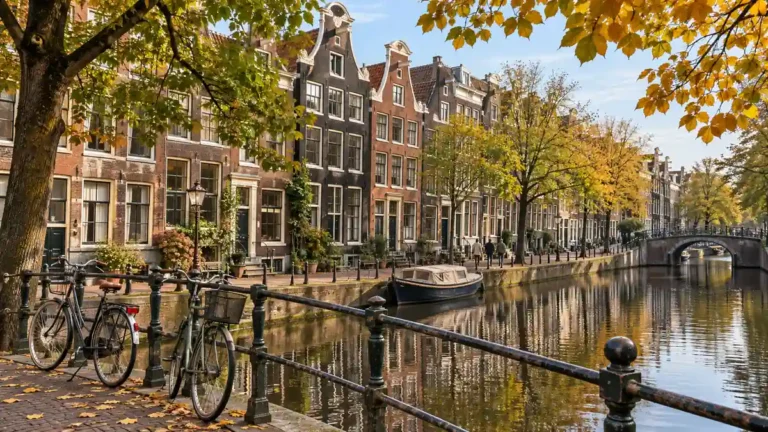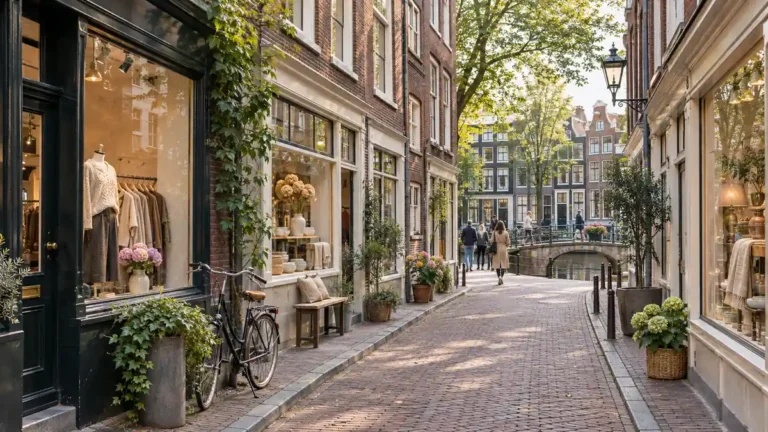
For a first trip to the Netherlands, base yourself in Amsterdam and add one or two places chosen by taste: Rotterdam for modern architecture, the Hague or Utrecht for a calmer canal city with top-tier art, Delft or Haarlem for a small historic town, and Kinderdijk or Zaanse Schans for windmills. Giethoorn, Maastricht and the Wadden islands are the picks once you have more than a few days. Most of this list works as a day trip from Amsterdam; the south and the islands need at least one night.
The places below are grouped by the kind of trip they make: the big cities, the small historic towns, windmills and canal villages, the south, and nature and the islands. Each one is marked as a day trip or an overnight, and the last section shows which of them pair well.
The Short Version
- On a first trip, keep Amsterdam as your base and add one or two places picked by taste; the country is compact enough that most of them are day trips.
- Add Rotterdam for a modern skyline, the Hague for Vermeer and an afternoon on the beach, or Utrecht for quieter canals within easy reach of Amsterdam.
- Delft and Haarlem are the small historic towns to see first, while Leiden, Gouda and Den Bosch are better kept for a second trip.
- Kinderdijk is the windmill landscape worth the longer journey; Zaanse Schans is the quick, close option that fills with tour groups in the middle of the day.
- Giethoorn is best with an overnight stay or a very early start, and Maastricht and the Wadden islands each need at least one night.
- With more than a few days, the hilly, Burgundian south or a slow stay on a single Wadden island shows a Netherlands the canal cities do not.
Where to go in the Netherlands on a first trip
Amsterdam is the default first stop and the easiest base, and the rest of a first trip is one or two additions picked by what you enjoy. The country is small and the train network is dense, so a first-timer travelling without a car can reach almost every place on this page and be back for dinner. Pick the trip type below that sounds like you, take its first pick, and the shortlist writes itself.
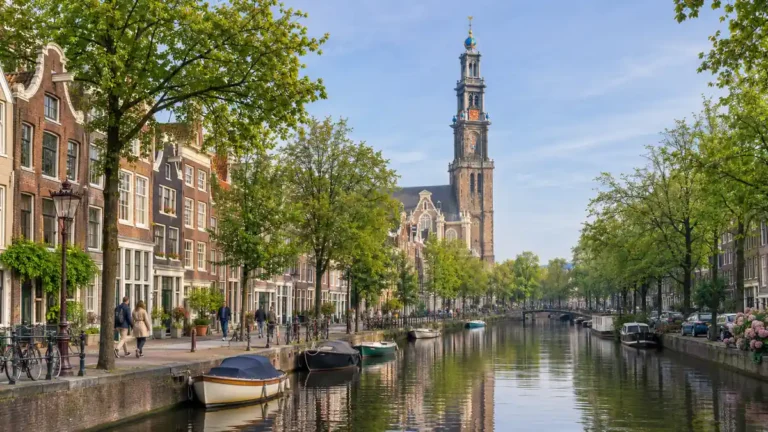
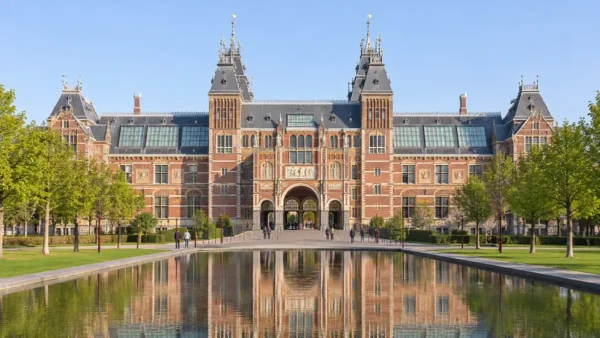
Amsterdam earns its place at the top on density alone. The Rijksmuseum, the Anne Frank House, a canal cruise and an hour in Vondelpark cover the city’s defining sights, and all of them sit within walking distance of the canal ring. The Van Gogh Museum is the visit most first-timers build an Amsterdam day around: it follows the painter from his dark early Dutch canvases to the colour of his French years, and it stands on Museumplein beside the Rijksmuseum, so the two make one art-heavy day. If it is your first time in the country, Amsterdam is where you sleep and come back to; the places below are what you add.
Amsterdam itself is covered in two companion pages: the Amsterdam guide for planning your days in the city, and the full list of things to do in Amsterdam once you know how many of them you have.
Tours and activities
Book skip-the-line tickets, day trips and local tours with free cancellation on most activities.
You can also browse everything on getyourguide.com.
Tripstou may earn a commission if you book through this link, at no extra cost to you.
Rotterdam, the Hague or Utrecht: which city should you add?
Add Rotterdam for modern architecture and the port, the Hague for museums, government and a beach, and Utrecht for the calmest canal city and the easiest half day. All three are an easy day trip from Amsterdam. The choice comes down to whether you want a city that looks nothing like Amsterdam (Rotterdam), one with world-class paintings and the sea (the Hague), or a smaller, quieter version of the canals you already know (Utrecht).
Rotterdam is the Netherlands’ modern-architecture city
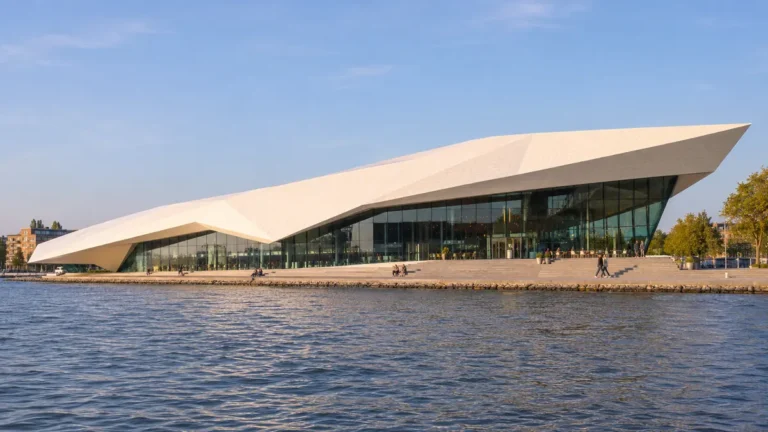
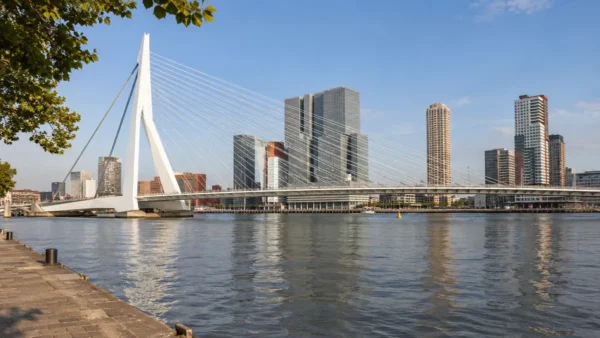
Rotterdam is the Dutch city to visit for contemporary design. Its centre was rebuilt after the Second World War, and the result is a skyline of towers, bold bridges and experimental housing that no other Dutch city matches. Europe’s largest port runs along the river, and the scale of it is part of the visit.
The Erasmus Bridge, the horseshoe-shaped Markthal food hall and the tilted Cube Houses are the three sights everyone photographs. The Euromast gives the view over the port, and Delfshaven is the one corner where the old harbour survived, with gabled houses along a single canal. Fenix Food Factory, in a former warehouse on the water, is where the city eats and drinks on a weekend.
Rotterdam suits design lovers, food travelers and anyone who has seen enough gabled canal houses. It is also the gateway to the windmills of Kinderdijk (see the windmills section), which makes it the strongest single day out of Amsterdam if you want city and countryside together.
The Hague: Mauritshuis, Binnenhof and the sea
The Hague is the art-and-government city, and the only one of the three with a beach. It is the seat of the Dutch government and home to the international courts, so the centre feels formal and green, with wide streets around the parliament buildings.
- Mauritshuis — a compact museum of Dutch Golden Age painting, Vermeer included, small enough to see properly in a morning.
- Binnenhof — the historic parliament complex at the heart of the city.
- Kunstmuseum Den Haag — the modern art museum, strong on Mondrian.
- Escher in Het Paleis — the optical-illusion prints of M.C. Escher in a former royal palace.
- Panorama Mesdag — a vast circular painting of the coast that surrounds you.
- Madurodam — the whole country in miniature, a hit with children.
- Scheveningen — the seaside district with the beach, pier and boulevard.
Choose the Hague for paintings in the morning and a beach walk in the afternoon. It works as a day trip, and a night by the sea at Scheveningen turns it into a short coastal break.
Utrecht is the quieter Amsterdam
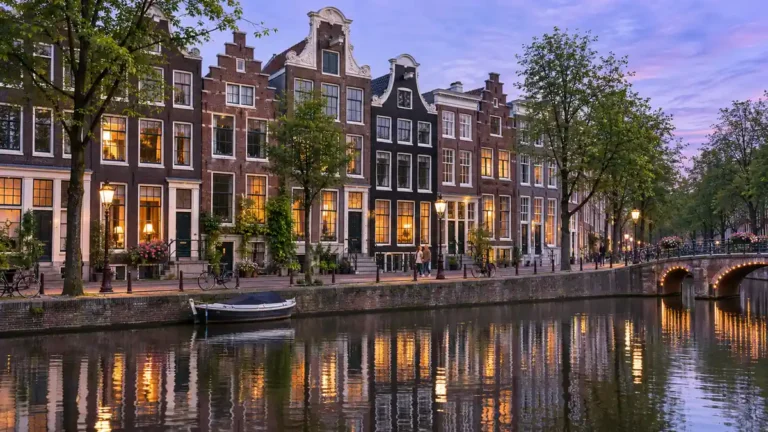
Utrecht gives you canals, cafés and a lively centre with a fraction of Amsterdam’s crowds. Its canals are different from the capital’s: the old wharves sit below street level, and the cellars along them now hold terraces right on the water. The Dom Tower, the tallest church tower in the country, anchors the old town and is worth the climb.
Two museums give the city its character beyond the water. The Rietveld Schröder House is a small modernist landmark of De Stijl design, and Museum Speelklok is a collection of self-playing instruments that are wound up and played for visitors. A large student population keeps the centre young and the cafés busy into the evening.
Utrecht is the one city of the three you can fit into an afternoon without giving up a full day of Amsterdam. To choose between them:
- Rotterdam, if you want skyscrapers, a food hall and a city that feels like nowhere else in the country.
- The Hague, if Vermeer, Escher and a beach in one day sound like the perfect balance.
- Utrecht, if you liked Amsterdam’s canals and want them calmer, smaller and closer.
Delft, Haarlem and the small historic towns worth a day
Delft and Haarlem are the two small towns to pick first: Delft for Vermeer, blue-and-white pottery and one of the prettiest squares in the country, Haarlem for the easiest and closest old town to Amsterdam. Leiden, Gouda and Den Bosch are the second-trip towns, each with one strong reason to go. All of them are day trips from Amsterdam.
Delft for Vermeer, pottery and a postcard Markt
Delft is the small town that looks most like a Dutch painting, which is fitting for Vermeer’s hometown. The Markt is the centre of everything, with the ornate City Hall at one end and the Nieuwe Kerk facing it, and narrow canals spreading out from it in every direction.
The Oude Kerk, with its visibly leaning tower, and the Eastern Gate, the town’s surviving medieval gateway, are the two landmarks to walk between. The Vermeer Centrum tells the painter’s story, the Prinsenhof museum covers the town’s role in Dutch history, and Royal Delft is the place to see the famous blue-and-white Delftware being made.
Delft is the right choice if you want one compact, beautiful town with a clear story. It sits right beside the Hague, so the two pair naturally in a single day.
Haarlem is the closest old town to Amsterdam
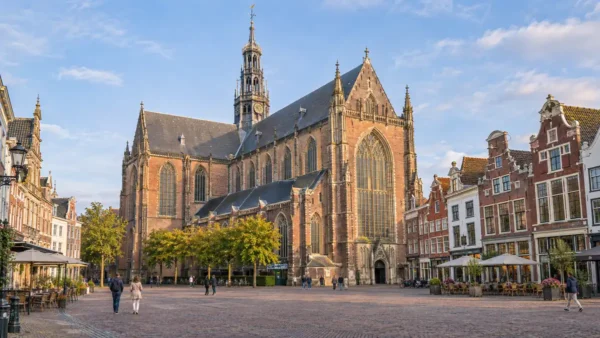
Haarlem is the quickest escape from Amsterdam into a calmer, smaller Dutch town. The Grote Markt, framed by the great church of St Bavo, is one of the finest squares in the country, and the streets around it are lined with independent shops and cafés.
Two museums set Haarlem apart. The Frans Hals Museum holds the portraits of the Golden Age master who lived and worked here, and the Teylers Museum is a wonderfully preserved cabinet of fossils, instruments and drawings. In spring, the bulb fields begin just outside town.
Haarlem wins when time is short, and some travelers use it as a quieter base for Amsterdam itself.
Leiden, Gouda and Den Bosch: the second-trip towns
Leiden is a university town of canals and almshouse courtyards. The Hortus Botanicus is one of the oldest botanical gardens in Europe, the National Museum of Antiquities holds an Egyptian temple, and Museum De Valk lets you climb inside a windmill in the middle of town. Go for gardens, scholarship and a windmill without leaving the city.
Gouda is cheese and stained glass. The Gothic Town Hall stands alone in the middle of the market square, and Sint Janskerk holds some of the finest stained-glass windows in the country. It is the small-town stop for food lovers.
Den Bosch, officially ‘s-Hertogenbosch, is the southern choice: a lively medieval centre with a cathedral, canals running under the houses and Het Noordbrabants Museum for art of the region. It is the place to try once you have seen the towns around Amsterdam.
The train or bus connections for each of these towns, and how to fit them around Amsterdam, are on the page about day trips from Amsterdam.
Where to see windmills and canal villages in the Netherlands
Kinderdijk is the windmill pick for most travelers, because it shows the mills in the working landscape they were built to drain. Zaanse Schans is the easy windmill stop close to Amsterdam, and Giethoorn is the canal village that takes the most effort and rewards an early start or an overnight. The waterland villages north of Amsterdam fill a half day, and tulip country is a spring-only add-on.
Kinderdijk: the UNESCO windmills near Rotterdam
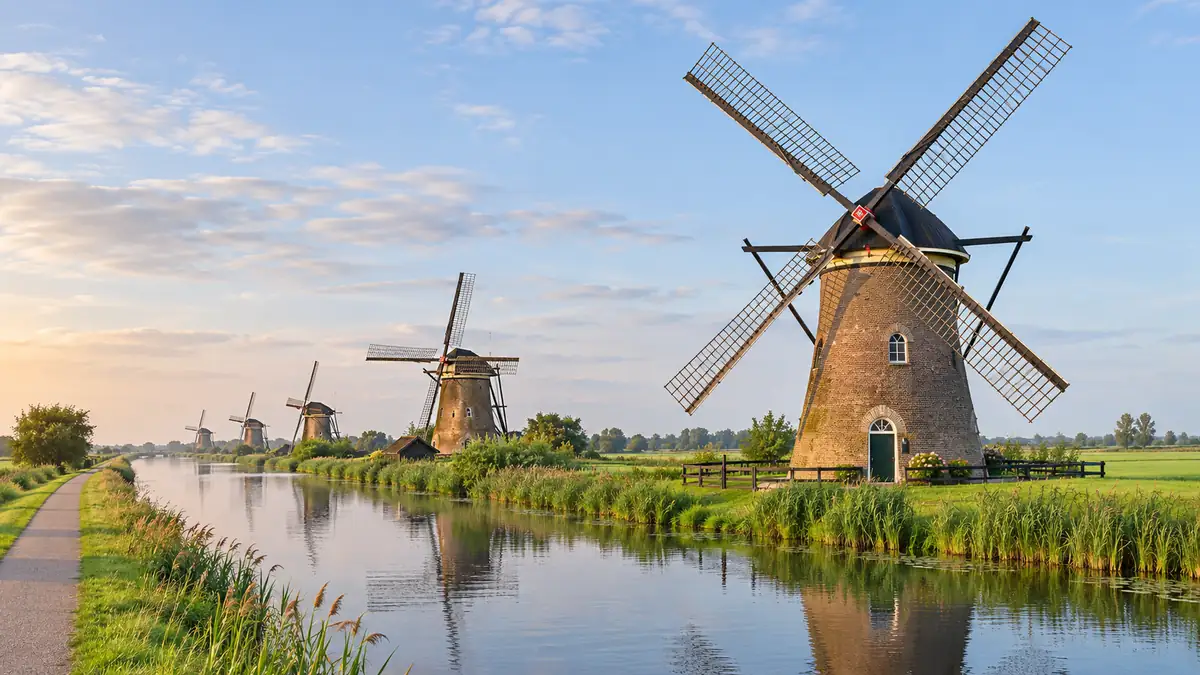
Kinderdijk is the most authentic windmill landscape in the Netherlands and a UNESCO World Heritage site. Rows of historic mills stand along the canals of a low-lying polder, and the whole site explains how the Dutch kept their land dry. Walking or cycling the paths between the mills is the way to see it.
Zaanse Schans shows you windmills; Kinderdijk shows you the polder they were built to drain. That difference is why it is worth the longer journey. It pairs with Rotterdam, and it rewards anyone after a view that has barely changed in centuries, best seen early or late in the day.
Zaanse Schans is the easy windmill stop, crowds included
Zaanse Schans is the quickest way to see working windmills from Amsterdam. A cluster of mills stands along the river beside a heritage village of green wooden houses, with workshops for cheese and clogs.
Its closeness to Amsterdam brings the crowds, and in the middle of the day the village fills with tour groups. It suits short visits and families with young children. For a quieter, larger windmill landscape, Kinderdijk is the alternative.
Is Giethoorn the most beautiful place in the Netherlands?
Giethoorn is the most photographed village in the Netherlands, and for many visitors it is the most beautiful. The village has no streets in its old centre: thatched farmhouses stand on little islands linked by wooden bridges, and the way around is on foot or by quiet electric whisper boat. Weerribben-Wieden National Park, a wide area of reed beds and lakes, starts right next door.
Whether it is the most beautiful place depends on taste. Kinderdijk at dawn, Delft’s Markt and the open tidal flats of the Wadden Sea all have a claim. Giethoorn gets very busy in the middle of the day, so it is best with an overnight stay or an early arrival before the boats fill the canals.
How do you get to Giethoorn without a car?
Take the train to Steenwijk, then a local bus to Giethoorn. The village has no train station of its own, so the bus connection is the link that every car-free visit relies on.
The journey is long enough that a day trip from Amsterdam needs a very early start. The route from Amsterdam step by step is on the Amsterdam day trips page.
Volendam, Edam, Marken and Broek in Waterland: the villages north of Amsterdam
The villages north of Amsterdam give a half day of old Dutch scenery without long travel. Volendam is the busy fishing harbour, lined with fish stalls and very much on the tour-group circuit. Edam is the quiet cheese town with small canals and an old weighing house. Marken, a former island, keeps its green wooden houses and its sense of separation. Broek in Waterland is the calmest of the four: a canal hamlet of painted houses that most coaches pass by.
Tulip fields and Keukenhof, in spring only
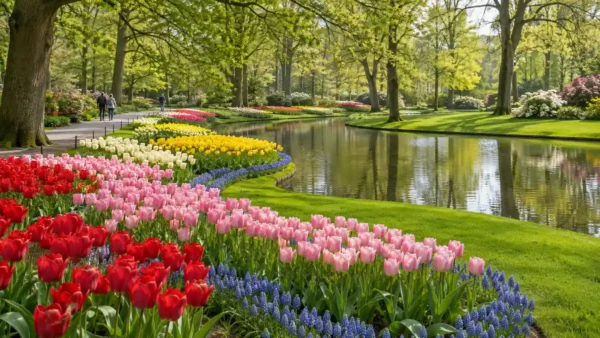
The tulip fields bloom in spring, in the bulb-growing area around Lisse and Haarlem. Keukenhof is the famous flower garden at the centre of it. Blooming times and how to visit are on the Keukenhof guide.
Is Maastricht worth visiting? The south feels like another country
Yes, Maastricht is worth visiting if you have more than a few days or are on a second trip to the Netherlands. It is hilly, it eats and drinks in the Burgundian style, and it sits between Belgium and Germany, so it feels like a different country from the flat, canal-lined north. It needs at least one night.
The Vrijthof is the city’s grand square, lined with café terraces and overlooked by the Basilica of Saint Servatius. The Helpoort is the old city gate on the medieval walls, and the Sint-Pietersberg hill hides a maze of man-made caves dug out over centuries. Boekhandel Dominicanen, a bookshop inside a Gothic church, is the sight that ends up on everyone’s camera roll.
Maastricht suits food lovers, second-time visitors looking for a different Netherlands, and anyone travelling on towards Liège, Aachen or Cologne. It is the one Dutch city where a long lunch counts as sightseeing.
Valkenburg, Thorn and the rest of Limburg
Valkenburg is a small hill town with castle ruins on the hilltop and caves cut into the rock beneath it. It is the easy half day from Maastricht for families and walkers.
Thorn is the “white town”, where almost every house is painted white. It is a short, quiet stop for photographers.
Efteling, the fairy-tale theme park in neighbouring Brabant, is the family day out on the way south.
The best nature in the Netherlands: Wadden islands, Hoge Veluwe and Zeeland
The Wadden islands are the nature pick in the Netherlands: a UNESCO-listed tidal sea, wide empty beaches, cycling and guided mudflat walking (wadlopen). They need at least one night. Hoge Veluwe National Park, reached with Arnhem, is the inland alternative, and Zeeland is the quiet coast for drivers and families.
The Wadden islands: Texel, Vlieland, Terschelling, Ameland, Schiermonnikoog
The Wadden Sea is a UNESCO World Heritage site, a shallow sea of tidal flats where you can walk across the seabed at low tide with a guide. Its five inhabited Dutch islands share dunes, beaches and cycle paths, but each has its own character:
- Texel — the largest Wadden island, with sheep, dunes and villages; the first-timer’s island.
- Vlieland — remote and quiet, reached by ferry from Harlingen; the island for sand and silence.
- Terschelling — long beaches, forests and a lively summer scene, also by ferry from Harlingen; for cyclists and groups of friends.
- Ameland — family-friendly, with a lighthouse and four small villages; for a relaxed beach week.
- Schiermonnikoog — the quietest and wildest of the five, almost entirely a national park; for birdwatchers and walkers.
Harlingen itself, an old harbour town, is worth an hour before the ferry. The islands reward slow travel: picking one and staying a few nights beats trying to hop between them.
Groningen is the city to pair with the islands. It is a lively northern student city with the Groninger Museum, an eye-catching modern building and collection, and it is the natural base before heading out to Schiermonnikoog.
Hoge Veluwe National Park and Arnhem
Hoge Veluwe National Park is the inland answer to the islands: a large protected landscape of heath, drift-sand dunes and forest that is best explored by bike. It is a park you cycle more than one you walk, and the open heath is the closest the Netherlands gets to wilderness.
The city of Arnhem lies next to it and adds the Netherlands Open Air Museum, where historic farmhouses, mills and workshops from across the country have been rebuilt in a large wooded park. Together they suit cyclists, families and anyone in need of a green day away from the cities. It works as a long day, and better with a night in Arnhem.
Zeeland, in the far southwest, is the quiet Dutch coast: wide beaches, dunes and small seaside villages on a maze of former islands and dams. It is a coast for drivers and summer families who want sand without the big-city crowds.
Which Dutch places to combine, and when to skip the cities
A first trip of a few days is Amsterdam plus one city and one windmill stop. A week adds Delft and the Hague, or Rotterdam and Kinderdijk as a pair, or trades the cities of the west for Maastricht or the islands. Cities and countryside combine easily, because the countryside icons sit right next to the cities.
| Place | Best for | From Amsterdam | Day trip or overnight |
|---|---|---|---|
| Haarlem | Closest old town | Under 20 minutes by train | Half day |
| Utrecht | Calm canals | About 30 minutes | Half day or day trip |
| Rotterdam and the Hague | Architecture; art and a beach | About 40 minutes on the fastest trains | Day trip, or a night by the sea in the Hague |
| Delft and Leiden | Vermeer, pottery, gardens | Within about an hour | Day trip |
| Giethoorn | Car-free canal village | Around two hours or more by public transport | Long day or overnight |
| Maastricht | Food, a different Netherlands | About two and a half hours by direct train | Overnight |
The west of the country is so compact that changing hotel rarely pays until the trip heads north to Giethoorn and the islands or south to Maastricht. How many days to give the whole country and when to go are on the Netherlands travel guide.
Cities or countryside in the Netherlands?
Do both: in the Netherlands, cities and countryside fit into the same trip with almost no extra travel. The cities give you museums and rain-proof days; the countryside gives you windmills, water and cycling. The choice only matters on a trip of two days or less, and then the answer is one city plus Zaanse Schans or Haarlem, both close enough to leave the evening free.
Can you combine several places in one Netherlands trip?
Yes. The country is compact, and its best places fall into natural pairs:
- Rotterdam with Kinderdijk, for skyline and windmills in one day.
- The Hague with Delft, two neighbours that share an art story.
- Leiden with Haarlem and the bulb fields, a spring circuit in the west.
- Giethoorn with Groningen or the Wadden islands, for a trip into the quieter north.
- Maastricht with Valkenburg, for the hills and caves of the south.
How This List Was Chosen
This page picks Dutch places by the kind of trip each one suits and says whether it works as a day trip from Amsterdam or needs a night; it is not an itinerary, a day-trip route guide or an Amsterdam sight list.
Alex Perrut, working in tourism since 2015, went over this selection for the Tripstou editorial team after it was written with AI assistance. Our editorial process sets out how pages are checked.
Official sources consulted: Holland.com.
Where to Go Next
- Netherlands travel guide — how many days you need, when to go and how to get around the country.
- Day trips from Amsterdam — the train and bus routes to the places on this list.
- Amsterdam guide — planning the Amsterdam days of your trip.
- Keukenhof guide — when the tulips bloom and how to visit the garden.
Did this guide save you time or money? Tripstou is independent and reader-funded — if you'd like to give something back, you can support the site with a crypto contribution of any size.