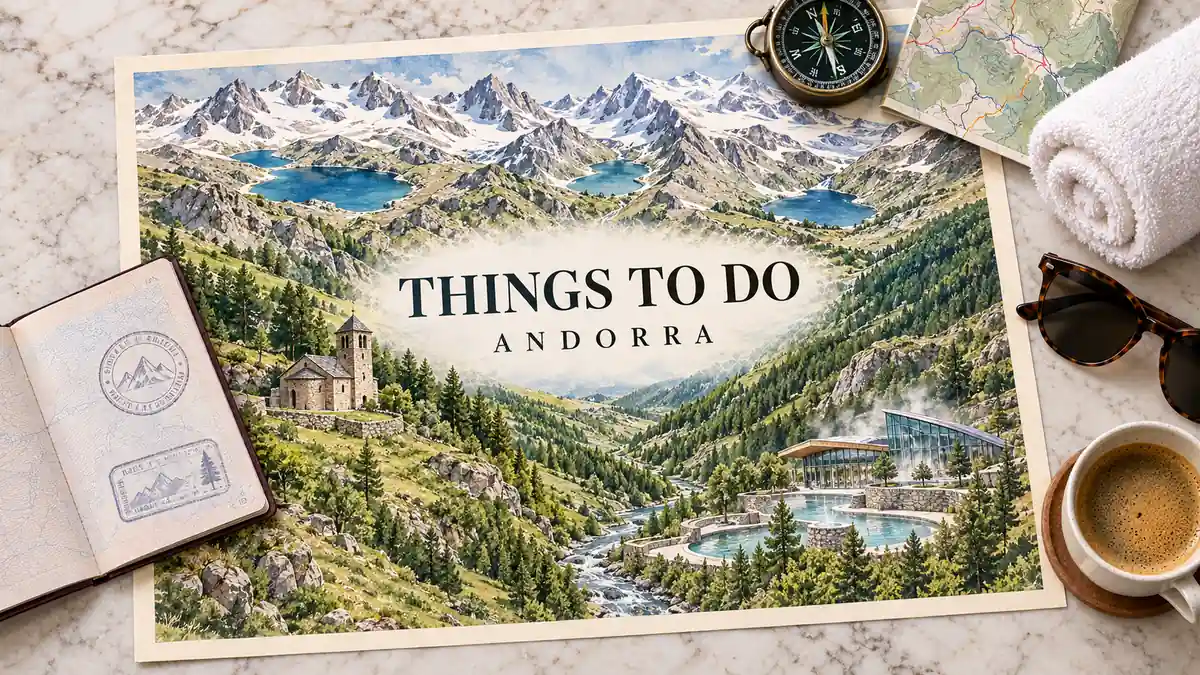
Andorra packs more into its mountains than a short trip can hold, and most lists hide the detail that matters: many of the best experiences only work in one season. The lakes and trails that make the country worth the drive sit under snow for much of the year. The spas and the slopes carry the winter instead.
This guide groups the picks by trip style and flags what works in summer, in winter or all year. The best overall pick is the high lakes and protected valleys, walked once the snow clears. The strongest winter alternative is snow by day and warm thermal water by evening. Every pick carries a one-line condition, so you can keep the ones that fit your trip and drop the rest without second-guessing.
Quick Answer
The high lakes and protected valleys are Andorra’s best experience, led by Tristaina and Madriu-Perafita-Claror in the snow-free season. Season decides the rest: summer buys lakes, viewpoints and the adventure park, while winter buys snow and thermal spas. For a rest or a rainy day, pick Caldea; for a culture-first trip, follow the Romanesque churches.
Trust Layer
Tripstou selection guide for travelers choosing between multiple places. Covers selection criteria, traveler fit, and trip value.
Produced with AI assistance and reviewed by Alex Perrut, working in tourism since 2015, for the Tripstou editorial team. See our editorial process for details.
Last factual review: September 28, 2026.
Official sources consulted: Visit Andorra, Government of Andorra, Visit Andorra Romanesque churches guide.
Key Takeaways
- The high lakes and protected valleys, led by Tristaina and Madriu-Perafita-Claror, are Andorra’s strongest experience once the snow clears.
- Winter swaps trails for snow: build the trip around skiing, then give non-skiers snowshoeing, dog sledding or a day in thermal water.
- The headline scenery is reached on foot and sits under snow for much of the year, so check the season before promising anyone a lake.
- Caldea and the Romanesque churches work in any weather, which makes them the safest backup when rain or late snow closes the trails.
- Families get the most from Naturland, Engolasters and Caldea’s main lagoons, while couples after quiet should choose Caldea’s adults-only Inúu area.
- Day-trippers should pick one valley or the capital, and shoppers should add a lake or church, because shopping is the least Andorran experience.
Table of Contents
Andorra’s best things to do are outdoors, and the season decides them
Andorra is worth visiting for its high valleys and lakes, and the season decides which of them you can reach. The country is also known for thermal water, Romanesque churches and duty-free streets. Season is the first filter, ahead of budget: summer opens the trails and viewpoints, while winter closes them and opens the slopes and spas instead.
Sort the shortlist by season before anything else:
- Summer: the high lakes, the protected valleys, the viewpoints and Naturland’s rides. This is when the headline scenery is open on foot.
- Winter: skiing, snowshoeing and the other snow activities, then an evening in thermal water.
- All year: the Romanesque churches, the capital’s old town and the spas. These are the weather-proof picks.
| Pick group | Summer | Winter | Best for |
|---|---|---|---|
| High lakes and valleys | Open on foot once the snow clears | Snow-covered and out of reach for most visitors | Hikers and anyone chasing the signature scenery |
| Viewpoints and Naturland | The main season for lifts and rides | Naturland opens in winter too; check operating days | Families and travelers short on time |
| Romanesque churches | Free guided tours run in July and August | Weather-proof, and most churches are free to enter | Culture-first trips and rainy days |
| Skiing and snow activities | Slopes closed while the trails take over | The main reason most winter visitors come | Skiers and the non-skiers travelling with them |
| Caldea and Inúu | A warm soak after a day on the trails | Thermal water after a day in the snow | Couples, families and anyone needing a rest day |
Andorra has no airport, so every visit starts by road from Spain or France. The Andorra travel guide covers getting there, when to go and where to base yourself.
The weeks between the ski season and the snowmelt are the awkward gap. The slopes have shut, the high trails can still be buried, and the churches and spas end up carrying the trip. Plan a visit in that window around the all-year picks.
High lakes and protected valleys are the best overall pick
The high lakes and protected valleys are the best overall thing to do in Andorra, in the snow-free season. They show the country at its most distinctive, with alpine water and walk-in valleys that most visitors skip. The tradeoff is access. Most picks here need a walk, and the headline lakes sit under snow for much of the year.
Pick one headline walk per day. Tristaina fills a morning, while Madriu-Perafita-Claror needs a whole day on foot. Stacking them wastes the better half of both.
Tristaina lakes (Arcalís)
The Tristaina lakes are Andorra’s reference hike: a chain of high mountain lakes above the Arcalís ski area. The classic loop is a half-day walk at an easy pace, climbing from one lake to the next with bare peaks close on every side.
Its strength is payoff per hour. The lakes come in quick succession, so a short climb buys a lot of high-mountain water, and it is the scenery most travelers picture when they think of Andorra. The trail opens on foot once the snow clears, which makes this a summer pick.
Pick this if: you want one half-day loop that delivers Andorra’s signature alpine scenery.
Madriu-Perafita-Claror valley
The Madriu-Perafita-Claror valley is Andorra’s UNESCO World Heritage cultural landscape, covering about 9% of the country with no road access. You walk in, or you do not go.
That makes it the most complete escape on the list. Stone huts, old terraces and high pastures run up the valley with no lift or car in sight, and the upper reaches reward the effort with real solitude. A full day on foot shows it properly. Effort is the price: there is no shortcut to the upper valley, so carry food and water for the whole day.
Pick this if: you want a full day with no road, no lift and no crowds.
Engolasters lake
Engolasters lake is the accessible pick: mountain water close to the capital, reachable by road, with an easy path around the shore. The Romanesque church of Sant Miquel d’Engolasters stands nearby, so one stop pairs a lake with a medieval bell tower.
It suits families with young children, travelers with a spare half-day and anyone who wants the lake feeling without a hike. Easy access brings more people, though, and the setting is gentler and greener than the bare peaks around Tristaina. Treat it as a first taste or a rest-day walk.
Pick this if: you want mountain water without a long hike, with a Romanesque church beside it.
Vall de Sorteny
Vall de Sorteny is the botanical valley: a protected natural park known for mountain flowers and quiet trails. It has no headline lake, and that is the point.
The walks are gentler and usually quieter than the Tristaina circuit, and the meadows reward travelers who slow down to look. Summer is its season, when the flowers are out. What it lacks is drama: Sorteny trades big views for detail, so it works best as a second hike once the lakes are done, or as the main walk for anyone who prefers meadows to summits.
Pick this if: you care more about flowers, quiet trails and a natural park than about a headline lake.
Viewpoints and adventure: the picks for a thrill or the photo
Roc del Quer, the Tristaina solar viewpoint and Naturland give Andorra’s big views and thrills without a full hike. Each trades effort for a platform, a lift or a ride, which suits families, travelers short on time and anyone who wants the photo first. The limit is timing: two of the three depend on lift or park operating days.
Pair the solar viewpoint with the Tristaina loop on the same morning. Both start from Arcalís, so one drive covers the lake walk for the hikers and the lift ride for anyone who stays behind. Via ferrata routes and mountain cycling round out the summer options for travelers who already climb or ride.
Mirador Roc del Quer
Mirador Roc del Quer is one of Andorra’s best-known viewpoints: a platform cantilevered over the valley above Canillo, reached by a short, easy walk from the road. The walkway juts into open air above the drop, and the valley floor spreads out far below.
It is the quick-stop pick. A big view fits into a day that is really about something else, whether a church circuit or the drive to the spa. Expect company. Fame and easy access mean you rarely have the platform to yourself, so an early or late visit gives the calmest photos.
Pick this if: you want the country’s best-known view for almost no walking.
Tristaina solar viewpoint
The Tristaina solar viewpoint is a ring-shaped platform set high above the Arcalís area and reached by lift. The ring works as a giant sundial, and the platform looks out over the peaks around the Tristaina basin.
That makes it the view-without-the-hike version of the lakes, useful when legs, weather or time rule out the loop. It also keeps the non-walkers in a group busy while the others hike. The catch is operation. The lift runs on set days only, so check operating days before driving up to Arcalís.
Pick this if: you are already at Arcalís and want the high view without the lake loop.
Naturland and the Tobotronc
Naturland is Andorra’s mountain adventure park, the pick built for rides, not walks. Its headline ride is the Tobotronc, one of the longest alpine toboggan runs.
Riders control their own speed on a rail down the slope, so it works for teenagers chasing thrills and for parents riding with younger children. Smaller activities around the park fill a half-day without a single trail. It is also a built attraction, the least natural pick in this group, and one that nature lovers can skip. Opening days change with the season, so check operating days first.
Pick this if: you are travelling with children or teenagers who need a ride, not a trail.
Tours and activities
Book skip-the-line tickets, day trips and local tours with free cancellation on most activities.
You can also browse everything on getyourguide.com.
Tripstou may earn a commission if you book through this link, at no extra cost to you.
Romanesque churches and the capital suit a culture-first or rainy-day trip
Andorra’s Romanesque churches and the capital’s old town are the picks that work in any season and any weather. They carry a rainy day and suit culture-first travelers who prefer stone and history to trails. The tradeoff is scale. The churches are small and best seen as a circuit, and the capital’s streets lean toward shopping more than heritage.
Three of the picks in this guide share one short stretch of road through Canillo: Sant Joan de Caselles, Meritxell and Roc del Quer. Drive it once and a wet morning still delivers two churches and a viewpoint.
Sant Joan de Caselles and the Romanesque circuit
Sant Joan de Caselles is the best single Romanesque church in Andorra, standing alone above Canillo with its detached bell tower. It dates from the 11th–12th century and is the strongest example in a country with more than 30 Romanesque churches.
Most of them are free to enter; Santa Coloma, visited with the Espai Columba museum, is the exception. Sant Miquel d’Engolasters, Sant Martí de la Cortinada and Sant Climent de Pal turn one church into a day-long circuit by car. In July and August, the Romanesque For All programme adds free guided tours.
Pick this if: you want the best single church and a route through the others in a day.
Meritxell sanctuary
Meritxell sanctuary is Andorra’s national shrine, dedicated to the country’s patron saint and set above the valley road in Canillo parish. A modern sanctuary stands beside the old chapel, so one stop shows both the devotional heart of the country and a striking modern building.
It sits on the same stretch of road as Sant Joan de Caselles and Roc del Quer, which makes the three an easy half-day pairing. The visit itself is short, and travelers after medieval stone will find more at the churches. Come for the setting and the national story it tells.
Pick this if: you want the national shrine and a modern building in one stop.
Andorra la Vella’s old town and duty-free streets
Andorra la Vella’s old town and shopping streets are the only urban pick on this list. The small historic quarter holds the stone Casa de la Vall and a few quiet lanes, while the long commercial avenue draws most of the crowds.
An afternoon covers the streets, a museum and a round of duty-free shopping without leaving the valley floor. The tradeoff is identity. Shopping is the main pull for many visitors, yet it is the least Andorran experience in the country. The Andorra la Vella guide covers the old town, museums and shopping streets in depth.
Pick this if: you want an afternoon of streets, a museum and shopping without leaving the valley floor.
Winter beyond the pistes: skiing, snow activities and thermal spas
In winter Andorra swaps lakes for snow: skiing leads, while snow activities and thermal spas fill the rest. Skiers build the trip around the slopes, non-skiers travelling with them get snowshoes, sleds and snowmobiles, and everyone ends the day in warm water. The split matters because only one of the three needs a lift pass.
Save Caldea for the day the weather closes the upper slopes. It rescues the skiers and the non-skiers at once, which no snow activity can do.
Skiing
Skiing is Andorra’s top activity and the reason most winter visitors come. Two large ski domains — Grandvalira and Pal-Arinsal — anchor the winter, and each suits a different kind of trip.
Give snow at least two full days. A single morning barely covers the drive, the kit and the first lift, so a short visit tips the balance toward the spa and the snow activities instead. The tradeoff is focus: a ski trip leaves little daylight for anything else on this page. The Andorra ski guide compares the resorts, passes and season for choosing where to ski.
Pick this if: snow is the reason for the trip and you have at least two full days.
Snow activities beyond the pistes
Snowshoeing, dog sledding and snowmobile outings give non-skiers a real winter day in Andorra. They run at or near the resorts, so a mixed group can split up in the morning and meet again at lunch. None of them needs ski skills.
Snowshoeing is the gentlest start, dog sledding the most memorable for children, and snowmobiles the quickest thrill. Naturland also opens in winter for rides in the snow. Availability is the limit: outings depend on snow cover and set departures, so check operating days before planning a day around one.
Pick this if: you are a non-skier travelling with skiers.
Caldea vs Inúu
Caldea is Andorra’s thermal spa complex, and the choice inside it is between two moods. The main lagoons are lively and family-oriented, a place for warm water, children and a bit of noise more than silence.
Inúu is an adults-only area, quieter and built for a slow recovery day. Both work in any weather, which makes the spa the strongest rainy-day plan in the country and the natural end to a ski day. Pick by mood: families belong in Caldea’s main lagoons, while couples after calm get more from Inúu.
Pick this if: you want a recovery day or a rainy-day plan with warm water and views.
Which things to do in Andorra fit your trip style?
Hikers should build the trip around the lakes; families around Naturland and Engolasters; couples around Caldea and the churches. Day-trippers should pick one valley or the capital, never both, and shoppers should add at least one lake or church so the trip feels Andorran. Each style also has something to skip, listed below.
- Hikers: Tristaina, Madriu-Perafita-Claror and Sorteny in the snow-free season. Skip Naturland and the shopping streets, which eat trail time.
- Families: Naturland, Engolasters and Caldea’s main lagoons, with Roc del Quer as a quick photo stop. Skip Madriu-Perafita-Claror, which demands a full day on foot.
- Couples on a wellness break: Inúu, Sant Joan de Caselles and Meritxell, plus the solar viewpoint when the lift runs. Skip the busiest shopping avenue at weekends.
- Day-trippers from Barcelona or Toulouse: one valley or the capital, chosen before you set off. Skip the full-day valley walks entirely.
- Shoppers: the capital’s streets, then one lake or church for contrast. Skip nothing, but protect an hour outside the shops.
A day trip works best when the pick is settled before the drive, so the hours go to one place instead of the road between several. For getting there, when to go and where to base yourself, start with planning your Andorra trip.
Frequently Asked Questions
What are the best things to do in Andorra with kids?
Naturland’s Tobotronc, the easy shore path at Engolasters lake and Caldea’s main lagoons are the best picks for children. In summer, add the short walk to the Roc del Quer platform for a big view with little effort. In winter, dog sledding and snowshoe outings give younger children a snow day without ski lessons. Check Naturland’s operating days.
Is one day in Andorra enough for a day trip from Barcelona?
One day is enough for a single focus, not for the whole country. Choose either one lake, such as Engolasters, or the capital’s old town and shops, and decide before you leave Barcelona. Stay longer if you want the high lakes. Our Andorra travel guide covers getting there, timing and where to base yourself.
What can you do in Andorra when it rains?
Caldea is the best rainy-day plan in Andorra, with warm thermal water for families and the quieter adults-only Inúu area for couples. Pair it with the Romanesque churches, most of which are free to enter, or an afternoon in the capital’s old town, museums and shops. Leave the high lakes and viewpoints for a clear day.
Is Andorra good for shopping?
Andorra is good for shopping: duty-free streets are the main pull for many visitors, above all in the capital. The catch is identity: shopping is the least Andorran experience in the country, so pair it with a lake or a church. The Andorra la Vella guide covers the shopping streets in detail.
Is Andorra worth visiting if you do not ski?
Andorra is worth visiting without skiing, and summer is the strongest season for non-skiers. The snow-free months open the high lakes, the UNESCO-listed Madriu-Perafita-Claror valley, the viewpoints and Naturland. In winter, non-skiers still get snowshoeing, dog sledding and thermal water, while the Romanesque churches and Caldea work in any season.
Can you visit the Tristaina lakes in winter?
Not on foot for most visitors: the Tristaina lakes lie under snow in winter. The loop is a hike for the snow-free season, when the trail is clear enough to walk. For a high view in the cold months, the Tristaina solar viewpoint is lift-served, but check operating days before driving up to Arcalís.
Related Guides
- Andorra travel guide: plan the trip, from getting there and when to go to cost and where to base yourself.
- Andorra ski guide: choose a resort if snow is the reason for the trip.
- Andorra la Vella guide: the capital’s old town, museums and shopping streets.
Did this guide save you time or money? Tripstou is independent and reader-funded — if you'd like to give something back, you can support the site with a crypto contribution of any size.