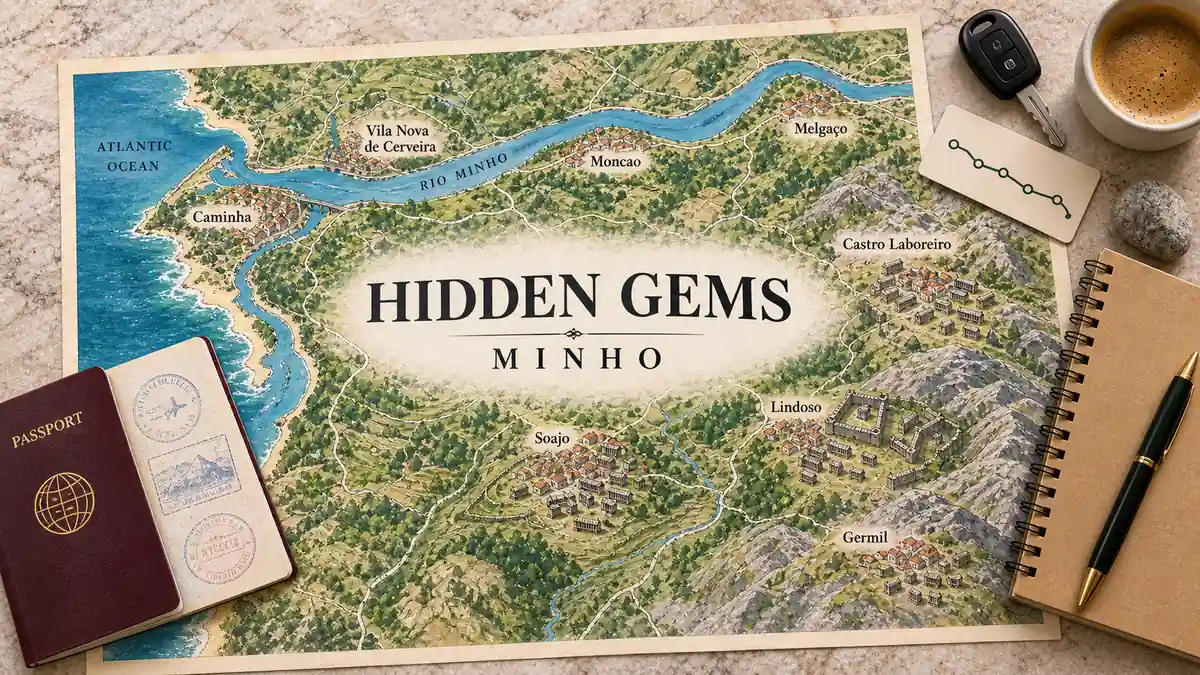
You already have Braga, Guimarães, Viana do Castelo and a day in Peneda-Gerês. This page fills what sits between them. The Minho’s genuinely overlooked places are concentrated in one area — the interior of the Viana do Castelo district and the Serra Amarela side of the park — and this shortlist stays there instead of drifting back to the famous names.
Eight places are decided here: what is actually in each one, why it stays quiet, who it suits, and what reaching it costs you. Nearly all of it assumes a car; two of the picks do not, and that difference shapes the whole list.
One more thing this page does that the lists do not: it says when a hidden gem has stopped being hidden. Sistelo is the clearest case in the Minho, and it gets a straight verdict instead of a place on the shortlist.
Quick Answer
The Minho’s real hidden gems are its Peneda-Gerês villages, the Serra Amarela hamlets, and the upper Rio Minho towns. It suits travelers based in Porto, Braga or Viana with the famous sights covered, and nearly all of it needs a car. Without one, choose Caminha or Vila Nova de Cerveira on the Linha do Minho.
Trust Layer
Tripstou selection guide for travelers choosing between multiple places. Covers selection criteria, traveler fit, and trip value.
Produced with AI assistance and reviewed by Alex Perrut, working in tourism since 2015, for the Tripstou editorial team. See our editorial process for details.
Last factual review: September 12, 2026.
Official sources consulted: Visit Portugal, Turismo de Portugal.
Key Takeaways
- With a car and one spare day, Lindoso beats Soajo: more espigueiros, a castle above, and far fewer visitors.
- Travelling by train, Caminha and Vila Nova de Cerveira are the only picks here you can reach without driving.
- Germil and Castro Laboreiro deliver real emptiness, but you pay for it in slow, narrow mountain driving.
- Monção and Melgaço stay quiet for one reason only: the Linha do Minho railway stops short of them.
- Sistelo still earns a visit, but it is no longer hidden — go early, go midweek, or skip it.
- The Minho’s quiet sits in the Alto Minho interior and the Serra Amarela, not the Braga–Guimarães triangle.
Table of Contents
The Minho’s quiet is in the Alto Minho interior, not on the Braga–Guimarães axis
The overlooked Minho is the interior of the Viana do Castelo district and the Serra Amarela side of the park. The Braga–Guimarães triangle holds the region’s famous sights and its coach traffic; the quiet starts north and east of Ponte de Lima, where the roads narrow and the villages thin out.
A place counts as hidden here if it is hard to reach, thinly signposted and absent from the lists — not simply marketed as a discovery. Plenty of Minho names are sold as secrets while filling their car parks by midday. The working test is blunt: would you still meet other visitors there on a Tuesday in August?
Distance from a railway station predicts quiet in the Minho far better than distance from Porto does. The places nobody reaches are rarely the farthest ones — they are the ones with no line, no coach park and no signposted attraction at the end of the road.
The Minho province covers two districts, Braga and Viana do Castelo. Alto Minho is the Viana do Castelo district — Viana, Ponte de Lima, Arcos de Valdevez, Monção, Melgaço, Valença, Caminha and Paredes de Coura — and it holds almost everything on this list. Braga’s half of the province carries the monuments and the day-trip traffic, and it is the busier side by a wide margin. It is not empty of quiet corners: Bezeguimbra and Póvoa Dura, near Vila Verde, are real ones. They are exceptions in a district built for day-trippers.
Braga, Guimarães and Viana do Castelo are worth your time and are covered everywhere, including in our roundup of Portugal’s best places to visit; this page assumes you already have them and does not describe them again. If the question you actually want answered is which Portuguese region is most underrated overall, that comparison lives in hidden gems in Portugal.
Soajo, Lindoso and Castro Laboreiro: the Peneda-Gerês villages worth the drive
Lindoso and Soajo are the granary villages; Castro Laboreiro is the remote one most visitors never reach. All three sit inside Peneda-Gerês, and all three effectively require a car. Choose Soajo for the famous cluster of espigueiros, Lindoso for more of them with fewer people, Castro Laboreiro for emptiness.
These are villages, not trailheads. The park’s walks, waterfalls and viewpoints are a separate decision and belong to things to do in the Minho; what follows judges each place as somewhere to stand, not something to do.
Seeing both granary villages in one day costs you almost nothing extra. Seeing either of them at midday costs you the quiet — on this pair, the hour matters more than the choice.
Soajo — the 24-granary threshing floor
Soajo’s draw is a single field of 24 stone granaries standing together on a communal threshing floor. The espigueiros are raised on stone legs, slab-roofed and topped with crosses, the oldest carrying an eighteenth-century date, and the group is classified as a Property of Public Interest. Several are still in use, which is what separates Soajo from an open-air museum.
It is also the most visited of the three. Coaches and summer weekends concentrate the crowd into the middle of the day, and the village empties again by late afternoon; arrive early or late and the threshing floor can be yours alone. The road in is paved but slow, and a car is strongly advised — bus coverage into these villages is sparse and not something to plan a day around.
- Pick this if: you have one spare day, want the granaries, and can time your arrival outside the middle of the day.
Lindoso — more granaries, fewer people, a castle above
Lindoso holds the largest concentration of espigueiros on the Iberian Peninsula, and it does it with a fraction of Soajo’s visitors. The granaries sit in a tight field directly below a medieval castle, so the whole scene — stone granaries, castle walls, the valley behind — reads in one glance from a single spot.
If you only see one granary village, see Lindoso. Soajo is the better-known name and the busier stop; Lindoso gives you more of the same thing in a stronger setting, with quieter mornings. The castle is there as a monument to walk up to, but access arrangements change, so check before you build a visit around going inside. A car is strongly advised, on roads that are perfectly fine and never fast.
- Pick this if: you want the biggest espigueiro field in a single frame and would trade the famous name for a quieter village.
Castro Laboreiro — the remote highland village
Castro Laboreiro is the village people look up and then skip. It sits in the park’s northern highlands, a long way from everything else on this list, and the driving is the real cost of the visit: narrow, slow mountain roads that take far longer than the distance suggests.
What you get for that is a stone highland village with almost no visitor infrastructure and almost no visitors. There is no marquee sight — no espigueiro field, no queue, nothing a coach would stop for — and that absence is exactly why it stays quiet while Soajo fills up. Go for the uplands it sits in and the silence it keeps. Treat a car as mandatory; there is no practical alternative.
- Pick this if: you are happy to spend most of a day driving to reach one very quiet village.
Tours and activities
Book skip-the-line tickets, day trips and local tours with free cancellation on most activities.
You can also browse everything on getyourguide.com.
Tripstou may earn a commission if you book through this link, at no extra cost to you.
Germil: the Serra Amarela village almost nobody reaches
Germil is the most genuinely hidden place on this list, high on the Serra Amarela side of Peneda-Gerês. It appears in Portuguese-language sources and almost nowhere else in English, it has no monument to queue for, and the road in is narrow and slow.
Germil’s distinction on this page is a negative one, and that is the point: there is nothing to see in the sense the other picks offer. No espigueiro field, no castle, no riverside promenade. What is there is a small stone hamlet on a mountainside, still lived in, in a part of the park that visitors cross on a map and not on the ground.
The Serra Amarela is the emptiest corner of Peneda-Gerês for visitors, and Germil is its clearest case — quiet on an August weekend, when Soajo and Sistelo are anything but. The whole cost sits in the driving: mountain roads that are narrow, slow and unforgiving of a hurry, with no bus service you could plan a day around. Come for what a place feels like when nobody has arranged it for you.
- Pick this if: you want the emptiest place on this list and count the drive itself as part of the experience.
Caminha, Vila Nova de Cerveira, Monção and Melgaço: the Rio Minho border towns
Caminha and Vila Nova de Cerveira sit on the Porto–Valença railway; Monção and Melgaço, further upriver, need a car. The four face Spanish Galicia across the Rio Minho and run downstream to upstream in that order, with Valença between Cerveira and Monção. Monção and Melgaço are the Alvarinho towns.
Alvarinho explains why the two upper towns have the shape they do — they anchor the Alvarinho sub-region of Vinho Verde — but the tastings and quinta visits are a different decision and sit in things to do in the Minho. Here the only question is whether each town earns a stop.
The railway is what keeps Caminha and Cerveira in the guidebooks and Monção and Melgaço out of them. The upper towns are not less interesting; they are simply harder to reach, which on this river is the same thing as being quieter.
Caminha
Caminha is where the Rio Minho meets the Atlantic, and it is the easiest place on this page to reach: the Linha do Minho from Porto calls here. The old centre is small, walkable and built around a granite square, with the estuary on one side and the Galician shore in plain view across the water.
Its distinction among the four is the water itself — river mouth, estuary and open sea in one town, where the other three are river towns only. Summer brings a beach crowd to the sands near the mouth while the centre stays comparatively calm, and midweek it is quiet in any season. No car needed, which makes it the default choice for anyone travelling by rail.
- Pick this if: you are travelling by train and want an old centre, an estuary and the ocean in one stop.
Vila Nova de Cerveira
Vila Nova de Cerveira is the quieter of the two railway towns, and the one with an art habit. It sits directly on the river between Caminha and Valença, with a historic core above the water, sculpture scattered through the streets, and the Aquamuseu do Rio Minho — a public aquarium and museum devoted to the river and its fish.
Against Caminha, the trade is simple. Caminha gives you the sea and more people; Cerveira gives you the river, a smaller centre and, most days, more room in it. The museum’s opening arrangements shift, so treat it as a bonus and not as the reason for the trip. It is a Linha do Minho stop, so no car is required.
- Pick this if: you want a riverside town reachable by train where art and the river outrank any single monument.
Monção
Monção is a border town facing Galicia across the river, and the first of the two Alvarinho towns upriver. Its centre turns on a broad square that is genuinely used and not merely preserved, and the remains of its fortifications and the riverfront give the town a stature its visitor numbers do not match.
What separates it from Melgaço is size and daily life: Monção is the larger and busier of the pair, with more happening on an ordinary weekday, while still seeing very few foreign visitors. The Alvarinho vineyards are the countryside around it and part of the view on the way in. The railway does not reach here, so a car is advised; arriving without one means depending on sparse regional buses.
- Pick this if: you want a lived-in border square with Alvarinho country around it and have a car for the day.
Melgaço
Melgaço is the furthest town upriver and the least visited of the four. It is a small hillside border town with a castle keep at its high point, the second of the Alvarinho towns, and the end of the line in every sense — past it the roads climb away toward the Peneda highlands.
Its distinction is remoteness without roughness: it has the services of a working town and almost none of the visitors who reach Caminha. That also makes it the most awkward stop to add to a day, which is precisely why most trips stop at Monção and turn back. A car is effectively required, and the drive from the coast is longer than the map makes it look.
- Pick this if: you want the quietest of the river towns and will make it the furthest point of your day.
Train and bus tickets
Compare routes, schedules and prices across rail and bus operators in one search, with mobile tickets on your phone.
New to Omio? Code NEW10 takes 10% off your first booking — or APPNEW10 if you book inside the Omio app. Both apply to bookings up to €80.
Search routes and compare prices on Omio →
Tripstou may earn a commission if you book through this link, at no extra cost to you.
Sistelo is worth seeing, but it is no longer a hidden gem
Sistelo’s terraces are worth the trip, and the village has stopped being hidden. Its stepped hillsides are a classified cultural landscape and genuinely unlike anywhere else in the Minho. They are also the region’s most photographed, most listed and most crowded rural sight on a summer weekend.
The terraces — socalcos in Portuguese — are the whole point. Generations of stone walls step down the Vez valley in narrow platforms that are still farmed, and the village is protected as a national monument in the form of a living cultural landscape, not a preserved ruin. Casa do Castelo stands at the centre of it. English lists file Sistelo under nicknames borrowed from the Himalayas; Portuguese writers who actually know the place have spent years objecting, and they are right. The comparison flatters nobody.
What changed is volume. Summer weekends and the middle of the day are when the village is at its worst: parking spills onto the approach road, the walkways fill, and a landscape whose appeal is silence delivers the opposite. The pattern is predictable, and that is what makes it manageable — early mornings, weekdays and the shoulder months still deliver the Sistelo the photographs promised.
Sistelo has not got worse. It has been found. The visit still earns its place on any Minho trip, but the hour you choose is now the entire decision.
Three responses work. Go early or midweek and accept the drive. Walk in instead: the Ecovia do Vez runs about 11 km up from Ponte de Vilela and is the quieter approach, though the walk itself is a separate subject from the village. Or skip it and spend the day in the Serra Amarela, where the emptiness Sistelo is famous for is still routine. The same test applies further up this page: Soajo at coach hours is a busy village, and Ponte de Lima, lovely as it is, has been on every list for decades.
Which Minho hidden gem should you choose?
With a car and one spare day, choose Lindoso; with three days, add the Serra Amarela. Travelling by train, choose Caminha or Vila Nova de Cerveira. The car is the one tradeoff that decides most of this list, and where you are based decides the rest.
- Driver, one spare day: Lindoso, with Soajo added if the morning runs well. Suits a first visit to the highland Minho; the tradeoff is that both are known quantities, so your timing matters more than your choice.
- Driver, three days: Germil and Castro Laboreiro alongside the granary villages. Suits travelers who want genuine emptiness; the tradeoff is hours of slow mountain driving toward places with no headline sight at the end.
- No car: Caminha and Vila Nova de Cerveira on the Linha do Minho. Suits anyone travelling by rail from Porto or Viana; the tradeoff is that the entire highland half of this list stays out of reach.
If you only have the car for one day, spend it on the granary villages. The Serra Amarela repays a second day and punishes a rushed one.
Base geography does most of the sorting for you. From Braga, the granary villages are the natural reach. From Viana do Castelo or Ponte de Lima, the river towns and the Vez valley are closer than the park. From Porto, the railway towns are the realistic day and the mountains are not. Where to stay, when to go and how many days the region deserves are parent questions, answered in our Minho region guide.
| Group | Places on this list | Nearest base | Car needed |
|---|---|---|---|
| Peneda-Gerês granary villages | Soajo, Lindoso and Castro Laboreiro | Braga, or Ponte de Lima for a shorter drive | Yes — no practical alternative exists |
| Serra Amarela hamlets | Germil, on the park’s quietest side | Braga or Ponte de Lima, a long drive either way | Yes — narrow, slow mountain roads |
| Rio Minho border towns | Caminha, Cerveira, Monção and Melgaço | Viana do Castelo, or Porto by rail | Two by train, two by car |
Frequently Asked Questions
Can you visit the Minho’s hidden gems without a car?
Partly. Caminha and Vila Nova de Cerveira sit on the Linha do Minho and need no car at all. Everything inland does: bus coverage into the granary villages and the Serra Amarela is sparse and seasonal, and not something to build a day around. Monção and Melgaço also need driving.
Which Minho hidden gems work as a day trip from Porto or Braga?
Two of the three groups do. The river towns work as a rail day from Porto, and the granary villages work as a driving day from Braga. The Serra Amarela does not: Germil and Castro Laboreiro absorb so much slow mountain driving that squeezing either into a day trip wastes the visit.
Is Valença worth visiting, or is it just shopping?
Yes, for the fortress. Valença’s bastioned stronghold faces Tui across the river and is a genuine piece of border architecture, not a backdrop for the shops. The catch is timing: the walled town fills with Galician shoppers at weekends, and the lanes inside turn commercial. Come midweek and it reads as a fortress again.
Is Paredes de Coura worth visiting?
Only if you are already in the Alto Minho interior. Paredes de Coura is a small inland town in the Viana do Castelo district, known nationally for the music festival that carries its name and quiet for the rest of the year. As a place it is pleasant, not a destination.
Is Barcelos worth a stop outside market day?
Yes, but briefly. Barcelos rests its reputation on the Thursday open-air market that fills its very large central square, and on being the origin of the Barcelos rooster. Come on any other day and that square is simply a big empty one: a short stop on the way past, not a detour.
What is the quietest part of the Minho coast?
The stretch north of Viana do Castelo, toward Caminha. Afife and Moledo sit on that coastal strip between the two towns, far enough from Viana to miss its summer traffic and too small to draw a crowd of their own. Choose them if you want the Minho coast without the resort edge.
Related Guides
- Minho region guide — where to base yourself, when to go and how many days the region deserves.
- Things to do in the Minho — the walks, tastings and experiences this page deliberately left out.
- Hidden gems in Portugal — how the Minho compares with the country’s other underrated regions.
- Best places to visit in Portugal — the famous set this list moves away from, including Braga, Guimarães and Viana do Castelo.
Did this guide save you time or money? Tripstou is independent and reader-funded — if you'd like to give something back, you can support the site with a crypto contribution of any size.