You have already read the same twenty dishes on every page about Portuguese food, and you still cannot say what you will actually be eating in the town you booked. That is because a dish list is the wrong shape for this country. Portuguese cooking is organised by a small number of divisions — where the food comes from, how far it had to travel, and how a meal is built — and none of them survive being flattened into a numbered inventory.
This page sets out those divisions, then hands you to the regional or city guide that answers your actual question. Along the way it resolves the two things visitors get wrong most often at the table: how a Portuguese meal is assembled and when it happens, and what the couvert is in law. Read the structure first. The dishes make sense afterwards.
Quick Answer
Portuguese food splits by region and by coast versus interior, not by a national dish list. The region changes what you eat: meat, stews and rye in the north; olive oil, fish and vegetables in the south; the islands separate again. A full meal is soup, a main and dessert or fruit, with lunch the main meal.
Trust Layer
Tripstou planning guide for travelers resolving one travel decision. Covers the main variable, traveler context, and practical tradeoffs.
Produced with AI assistance and reviewed by Alex Perrut, working in tourism since 2015, for the Tripstou editorial team. See our editorial process for details.
Last factual review: September 10, 2026.
Official sources consulted: Visit Portugal, Turismo de Portugal, Diário da República, DGADR.
Key Takeaways
- Portuguese food divides four ways — north against south, coast against interior, mainland against islands, and the meal itself as a structure.
- Choose your region by the eating you want: meat, stews and dark bread in the north, olive oil and fish in the south.
- An Atlantic coastline feeds only a narrow strip, so inland kitchens still run on salted cod and cured pork, not fresh fish.
- A full meal is soup, a main and dessert or fruit, and lunch — not dinner — is the day’s serious meal.
- The couvert must appear on the price list, and unrequested items, couvert included, cannot legally be charged to you.
- Read this page for the structure, then the regional or city guide for the town you actually booked.
Table of Contents
Portuguese Food Divides Four Ways, Not by Dish
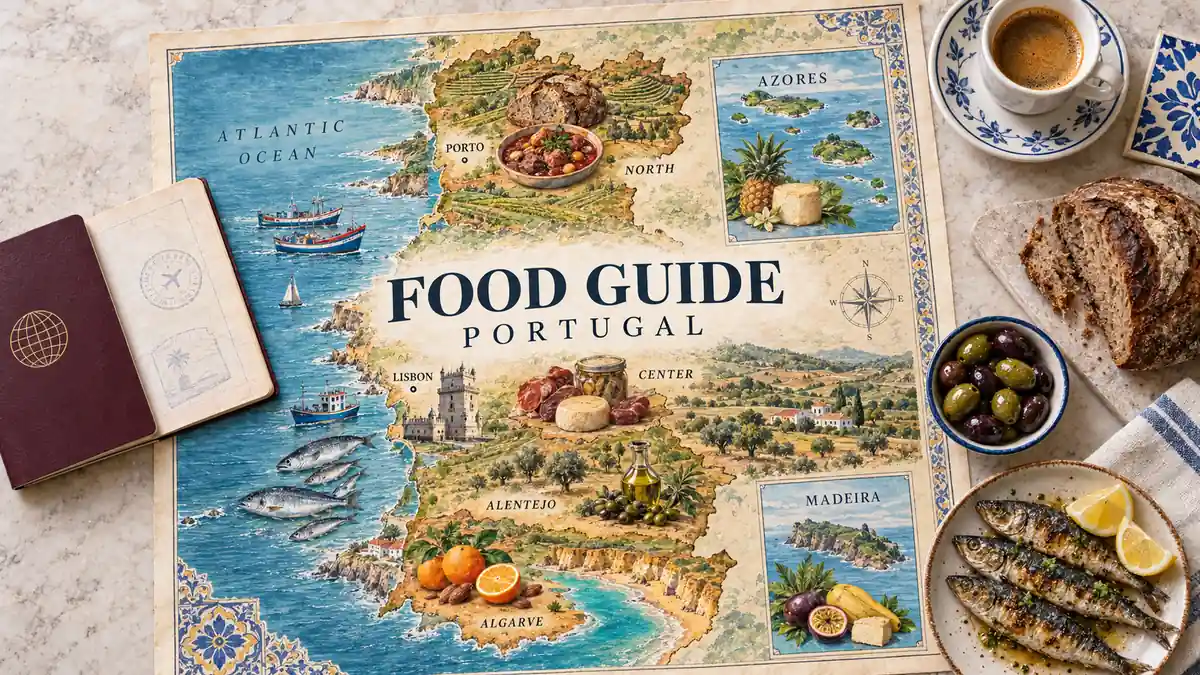
Portuguese food divides four ways: north against south, coast against interior, mainland against islands, and the meal as a structure. Those four splits, not a list of twenty dishes, decide what lands on your table. Learn them once and every regional menu in the country becomes readable.
The first division is north against south, and it is a division of climate. The north is wet, green and mountainous, so it cooks meat, offal and slow stews and eats dense bread. The south is hot and dry, so it cooks with olive oil, leans on bread-thickened soups, and puts vegetables and fish forward. The frontier is soft, but the poles are unmistakable.
The second division is coast against interior, and it is the one that explains the puzzle. Portugal has a long Atlantic coastline, yet its most emblematic ingredient is preserved, not fresh. Inland kitchens could not get fish that was still fish by the time it arrived, so they built on salt, smoke and cure. Coastal towns grill what came off the boat. Ten kilometres apart, the two traditions barely overlap.
The third division separates the mainland from the archipelagos. Madeira and the Azores are not the mainland with a sea view; they grow different produce, land different fish and keep different animals, and their menus follow from that.
The fourth division is not geographic at all — it is the shape of the meal itself. A Portuguese meal has parts, in order, and lunch outranks dinner. Miss that and you will order correctly from the wrong section of the menu.
Portugal’s own national register of traditional products is organised by geographic area — North, Centre, Lisbon, Alentejo, Algarve, Madeira, Azores — crossed with protected-origin classes. The country files its food by the same frame this page reads it by. If you want the wider planning context around all of this, start from our Portugal travel guide.
What the North Eats Versus What the South Eats
The north eats meat, tripe, slow stews and rye bread; the south eats lighter, olive-oil-led food. Fish and vegetables lead there. The split follows the land. Northern Portugal is wet, green and grazing country; the south is dry, hot and planted with olives, wheat and cork oak.
Neither half owns a dish outright. Grilled sardines turn up in the north and salt cod turns up in the Algarve. What changes is the default — the thing a kitchen reaches for when nobody has ordered anything unusual.
The north: meat, stews and dark bread
Northern cooking is built on pork, offal and long cooking. Tripe stewed with white beans is the signature of Porto, roast kid and pork loin belong to the mountain interior, and cured sausages appear as an ingredient more than as a snack. Bread is dark and heavy: broa, the dense maize-and-rye loaf, is a component of the meal, not an accompaniment. Portions are frank, and the wine is often young, sharp and slightly fizzing.
Move inland and eastwards and the food gets harder and better at keeping — smoked sausage, dried meats, sheep and goat cheese. The Minho guide covers the green, rainy corner where that cooking is at its richest, our Porto guide covers the city where it meets the sea, and the Douro Valley guide covers the terraced river country where the wine drives the table. In the north, the strongest food is inland, not on the waterfront — the fishing ports are compact, and the region’s real specialities were designed to survive a winter, not a boat trip.
The south: olive oil, vegetables and fish
The south has two distinct characters, and travelers routinely collapse them into one. The Alentejo is interior food: bread-based soups built on olive oil, garlic and coriander, black pork raised under cork oaks, sheep’s cheese, and a table that treats bread as the base of the dish. It is farm cooking from a hot, empty plain, and it is heavier than its reputation suggests.
The Algarve is coastal food: grilled fish and shellfish, the copper cataplana pan, clams, tuna in the east, and citrus and almonds in the sweets. Olive oil runs through both. The Alentejo guide handles the interior south, and the Algarve guide handles the coast — and the useful test when you are choosing between them is whether you want food that came off a boat this morning or food designed to be eaten far from any boat at all.
Why Salted Cod Beat Fresh Fish Across the Interior
Salted cod won because the interior had no fresh fish. Portugal’s coastline fed a narrow strip; inland, refrigeration did not exist and the roads were slow, so kitchens built on what kept — salt cod, cured and smoked pork, goat and sheep. That inheritance still sets the menu inland.
Bacalhau is not one dish. It is an ingredient tradition: a preserved fish that had to be soaked, then cooked in whatever a household had — potatoes, eggs, onions, olive oil, chickpeas, bread. Portuguese people say there is a way to cook it for every day of the year, and the saying is doing what sayings do, but it points at something true. The constant is the ingredient, and the variation is regional and domestic.
The same logic produced the cured meats. Pigs were killed in the cold months, and the whole animal was turned into things that would still be edible in August: smoked sausages, air-dried hams, blood sausage, fat rendered and kept. Sheep and goats gave cheese, which is milk that survives. None of this is nostalgia — it is why an inland menu today reads as salt, smoke and slow cooking while a coastal one reads as a grill.
The fresh-fish tradition is real, but it is geographically narrow. It belongs to the fishing towns, and the further you sit from one, the more the kitchen relies on preservation. The Silver Coast guide covers the Atlantic stretch where the fishing-port tradition is strongest, our Lagos guide covers a southern port where the same pattern plays out on warmer water, and if you are mapping the coastline itself, our guide to Portugal’s coastline beach by beach shows how thin that strip actually is. The practical consequence is that “we are in Portugal, so the fish will be fresh” is a coastal statement wearing a national costume; inland, the good order is the cured or salted one, and it is the dish the kitchen has spent generations refining.
Madeira and the Azores Are Separate Food Systems
Madeira and the Azores are separate food systems, not mainland cooking with an ocean view. Each archipelago grows its own produce, lands its own fish and keeps its own meat and dairy culture. Volcanic soil, an Atlantic climate and centuries of isolation built menus the mainland never had.
Madeira’s kitchen is subtropical and skewer-led. Beef cooked on a bay-laurel skewer, black scabbardfish from deep water, often served with banana, wheat-flour flatbread cooked on a hot stone, and sugar-cane and honey-cake sweets that come from the island’s own sugar history. Tropical fruit is grown locally, not imported for tourists. The Madeira guide covers the island, and our Funchal guide covers the capital, where most of the eating happens.
The Azores are dairy and beef country with a volcanic trick. The pastures are green year-round, so the cheese and butter are genuinely central, the beef is grass-fed and the tuna is local. On São Miguel, a stew is cooked underground in volcanic heat — a cooking method the mainland has no equivalent for. The Azores guide covers the archipelago, and if you are still deciding between the two, our comparison of Portugal’s islands sets out the difference. Choosing between them on food alone is simple: Madeira is the sweeter, fruit-and-fish island, and the Azores is the dairy-and-beef one.
What a Portuguese Meal Actually Looks Like
A full Portuguese meal is soup, then a main dish, then dessert or fruit. Lunch is the main meal of the day, not a light break before dinner. Order a two-course northern European dinner and you have misread the menu, and usually eaten at the wrong hour.
The soup is not a starter in the northern European sense. It is a plain vegetable soup, often puréed, and it is the opening of the meal by default rather than a choice you make. Ordering it does not mean you have ordered a large first course; skipping it means you have skipped the part most Portuguese diners consider standard. Dessert is often just fruit.
Visit Portugal describes the day as a light breakfast, lunch as the main meal running from roughly midday into mid-afternoon, a late-afternoon snack, and dinner in the evening. Treat those as ranges, not opening hours. Kitchens work in services, and turning up at the very start of the evening frequently finds one that has not begun cooking yet.
| Meal | Roughly when | What it usually is |
|---|---|---|
| Breakfast (pequeno-almoço) | Early, before the working day starts | Light: coffee with bread or a pastry |
| Lunch (almoço) | Roughly midday into mid-afternoon | The main meal, usually soup and a main dish |
| Late-afternoon snack (lanche) | Between lunch and the evening meal | Coffee with a pastry or a toasted sandwich |
| Dinner (jantar) | In the evening, after most northern schedules | A full meal, often lighter than the midday one |
The practical move is to eat your serious meal in the middle of the day and treat the evening as the smaller one. That inverts most visitors’ instincts, and it is also when kitchens are at their best staffed and most confident. Everyday table conventions beyond the meal itself — payment, tap water, etiquette — sit in our guide to practical Portugal travel tips.
What Is the Couvert, and Do You Have to Pay for It?
The couvert is the bread, olives, cheese or spread brought before the meal, and it is not free. Portuguese law provides that it may be charged only when the price list shows it as couvert and the customer asks for it. That is the whole rule.
Portuguese law published in Diário da República sets out two provisions that matter to a diner. First, the price list must show the couvert and its price, identified as couvert. Second, no dish, food product or drink — the couvert included — may be charged to a customer who did not request it. The obligation runs on what was listed and what was asked for.
That is the legal substance, and it is worth knowing before you sit down, because the couvert is the item visitors most often misread as hospitality. What a meal costs overall belongs to our breakdown of what a Portugal trip costs, and if you are worried about being charged for things you did not order more generally, that is covered in our Portugal safety guide.
Which Region to Go To for the Food You Want
Choose the region by the kind of eating you want, because the poles are far apart. The north gives you meat, stews and dark bread in a cool, wine-heavy setting. The south gives you grilled fish, olive oil and vegetables under heat. Everything else sits between those two.
The table below maps the country onto the same geographic frame Portugal’s own register of traditional products uses, and points you at the guide that goes deeper. Character, not ranking — every one of these regions eats well, and the question is which kind of well you want.
| Region | What the eating is like | Read next |
|---|---|---|
| North, including Porto and the Douro | Meat, tripe, slow stews, dark bread, young wine | The northern city and wine-country guides above |
| Centre and Silver Coast | Fishing-port grills, roast pork, convent-style sweets | Comparing Portugal’s regions before choosing a base |
| Lisbon and Sintra | Grilled fish, tascas, strong pastry and coffee culture | Our Lisbon guide, plus the Sintra guide |
| Alentejo | Bread-based soups, black pork, olive oil, sheep’s cheese | The Alentejo guide, linked in the section above |
| Algarve | Grilled fish and shellfish, cataplana, citrus and almonds | Our Albufeira guide for resort-coast eating |
| Madeira and the Azores | Island produce, skewered beef, deep-water fish, dairy | The Madeira and Azores guides linked above |
Porto or Lisbon for food?
Porto and Lisbon eat differently, and the difference is inland versus Atlantic. Porto’s food is northern: tripe with white beans, pork, offal, dark bread, heavier plates and a wine culture pulled in from the Douro just upriver. It is a compact city, so its food scene feels concentrated, and the traditional end of it is unusually intact.
Lisbon’s food is a capital’s food. It draws in the Alentejo from the south, the Atlantic from the west, and the former colonies through decades of migration — which is why Lisbon is where you meet Mozambican and Goan cooking alongside grilled fish and salt cod. Its pastry and coffee culture is more developed than Porto’s, and its range is wider.
Neither city is the better one to eat in, and the honest split is by appetite: Porto if you want the traditional northern table done seriously, Lisbon if you want breadth and the food of a port that kept importing. If you are travelling to both, do not expect the second city to confirm the first.
What Visitors Get Wrong About Eating in Portugal
Four assumptions cause most visitor mistakes in Portugal. They are that dinner starts early, that the bread is free, that the country eats one cuisine, and that an Atlantic coastline means fresh fish everywhere. Each is corrected by one of the divisions above.
- Arriving too early for dinner. Evening service starts later than most northern visitors expect, and the fix is the meal structure: eat your main meal at lunch and the timing problem disappears.
- Reading the couvert as free bread. It is a chargeable item defined in law, listed on the price list, and charged only when requested. Knowing that before you sit down removes the surprise entirely.
- Assuming one national cuisine. A menu in Braga and a menu in Faro overlap far less than the phrase “Portuguese food” implies. Choose the region first.
- Expecting fresh fish everywhere. Fresh fish is a coastal tradition, not a national one; inland, the preserved dishes are the ones the kitchen actually does well.
- Ignoring season. Some of the best eating is seasonal, and the calendar side of that belongs to our guide on when to visit Portugal.
- Underestimating how far apart the food regions are. Crossing between them is a planning decision: by car via our Portugal road trip route, or by rail via our Portugal train itinerary.
- Arriving without data. Menus, opening times and translation all run on your phone, which is covered in our Portugal SIM card and eSIM guide.
Frequently Asked Questions
Is Portuguese food spicy?
Portuguese food is not spicy by default; it is seasoned with garlic, olive oil, bay, coriander and paprika. Heat comes from piri-piri, and it usually arrives as a sauce or a bottle on the table, under your control. The exception is dishes cooked with piri-piri deliberately, mostly chicken.
What is prato do dia in Portugal?
Prato do dia is the dish of the day, a single main the kitchen cooks in quantity and serves at lunch. It changes daily, often follows a weekly rhythm, and is written on a board instead of the printed menu. Ordering it is how most Portuguese diners eat at midday.
Is it hard to be vegetarian in Portugal?
It takes planning outside the cities. Traditional Portuguese cooking is built on pork, salted cod and the sea, and even vegetable soups are sometimes finished with sausage. Lisbon, Porto and the bigger coastal towns handle vegetarians comfortably; small inland towns are where the menu narrows and asking directly matters most.
What is a tasca in Portugal?
A tasca is a small, plain, family-run restaurant serving traditional cooking to a local crowd. Expect paper tablecloths, a short handwritten list of dishes and lunch as the busiest service. It is where the Portuguese meal structure — soup, a main, then fruit — is most reliably intact.
Why do the Portuguese eat so much salted cod when the coast has fresh fish?
Because salted cod is now a taste, not a substitute. Generations of soaking, flaking and baking it turned a preserved fish into the ingredient Portuguese cooking knows best, and the celebratory table still expects it. Fresh fish belongs to the grill; cod belongs to the oven and the pot.
Related Guides
- Portugal travel guide — the country hub and where every regional decision starts.
- Practical Portugal travel tips — everyday etiquette, payment and tap water.
- What a Portugal trip costs — what eating and travelling actually add up to.
- Porto guide — northern eating concentrated in one city.
- Lisbon guide — the capital’s wider, port-city food character.
- Algarve guide — grilled fish and shellfish on the southern coast.
Did this guide save you time or money? Tripstou is independent and reader-funded — if you'd like to give something back, you can support the site with a crypto contribution of any size.