You already have fourteen days. That settles the only question most Portugal planning pages spend their time on, and it leaves the harder one open: what shape should those days take?
At shorter lengths Portugal is a line. You string it between two airports, put Lisbon at one end and Porto or Faro at the other, and hang the interior off that line as a set of afternoon excursions. The Douro becomes a bus tour. The Alentejo becomes a service station. The coast between Lisbon and Porto becomes something you drive past.
Fourteen days is the first length where those excursions can hold their own nights. That single change does something structural to the map: once the interior has beds in it, the route no longer needs two airports to make sense. It stops being a line and becomes a loop out of Lisbon and back.
What follows is one committed route, the reasoning behind the order it runs in, and a straight answer on whether Madeira or the Azores belong in it.
Quick Answer
Fourteen days in Portugal works best as a loop out of Lisbon and back, seven bases, thirteen nights. The added nights land in the Douro, the Alentejo and the Silver Coast, which is why the trip is driven and not railed. It suits a first visit wanting depth over distance; the islands stay a separate trip.
Trust Layer
Tripstou itinerary guide for travelers planning a route. Covers pacing, stop count, stop order, base logic, and trip length.
Produced with AI assistance and reviewed by Alex Perrut, working in tourism since 2015, for the Tripstou editorial team. See our editorial process for details.
Last factual review: September 10, 2026.
Official sources consulted: Visit Portugal, Turismo de Portugal, CP – Comboios de Portugal.
Key Takeaways
- Fourteen days changes the shape of a Portugal trip, not its length: the strongest day trips are promoted to overnight bases.
- Once the interior holds its own nights, the route stops being a line between two airports and closes into a Lisbon loop.
- The route runs seven bases across thirteen nights: Lisbon, the Silver Coast, Porto, the Douro, the Alentejo, the Algarve, Lisbon.
- The Douro’s promotion from day trip to overnight is the move that points the trip south instead of doubling back to Porto.
- Driving is a consequence of those interior nights, not a preference; a car-free two weeks is a different route entirely.
- Madeira and the Azores stay a separate trip, because an island week costs roughly half the mainland loop’s nights.
Table of Contents
Fourteen Days Is Where Portugal’s Day Trips Become Nights
Fourteen days is enough for the whole Portuguese mainland, because the interior finally earns its own nights. What the extra days buy is not a longer list of places. It is depth in the places a shorter trip can only visit between breakfast and dinner. The map barely changes. The clock does.
Three promotions define the difference. The Douro Valley stops being a coach excursion out of Porto and becomes a place you wake up in. The Alentejo stops being the ground between Lisbon and the Algarve and becomes two nights of its own. And the Silver Coast, the stretch of Atlantic between Lisbon and Porto, stops being a drive-through and becomes a stop.
Notice what did not happen: the stop count barely moved. Two extra nights and one extra base separate a well-built two-week route from a well-built shorter one. This is a change of shape, not of length. The route gets slower where slowness pays and stays dense where density pays, which is why the parent guide on how many days Portugal needs treats fourteen as a threshold and not as a total.
The promotions are not distributed evenly, and that is the point. Two weeks upgrades the places that are slow to reach and leaves the places that are easy to reach exactly where they were.
Two weeks still leaves things out, and it is worth naming them once. Coimbra falls between Lisbon and Porto in a way that costs a night to fix and gains little on a first visit. The far interior — Monsanto, the Serra da Estrela, the Spanish border villages — needs a route built around it, not a detour bolted onto this one. A second island is not on the table at all. If those are the regions you came for, the ranked regional breakdown of Portugal is the better starting point, and the wider Portugal country guide covers what sits outside this loop.
The 14-Day Route: Bases, Nights and the Order They Go In
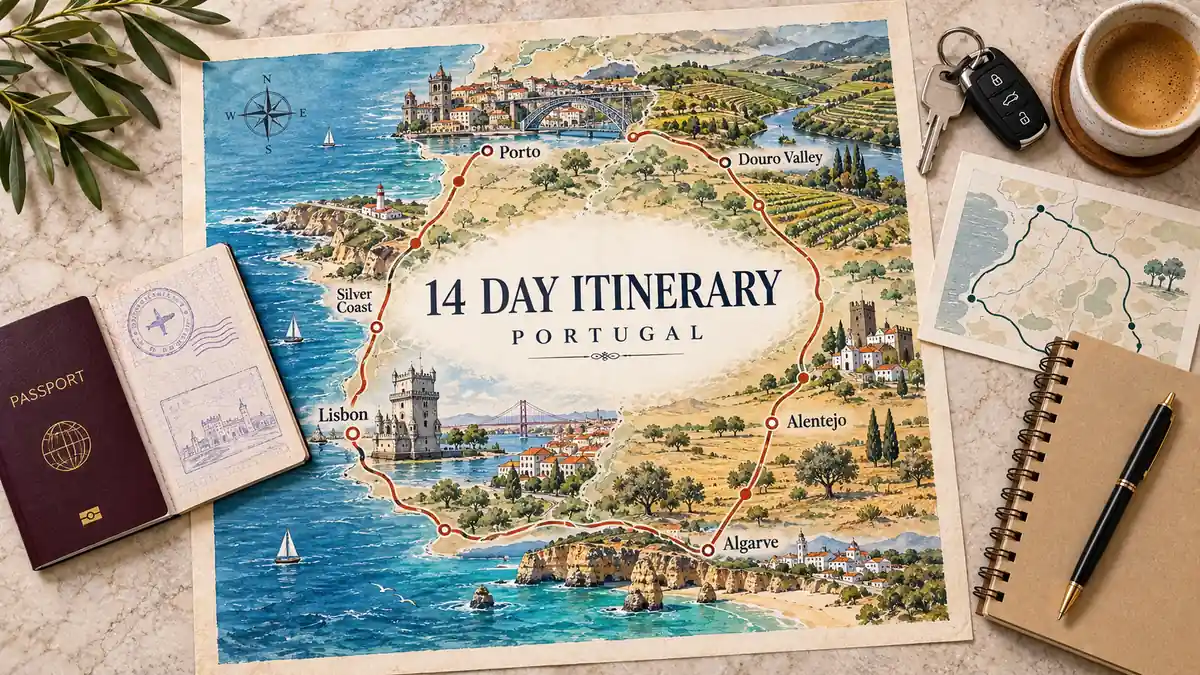
The route runs Lisbon out and Lisbon back across seven bases and thirteen nights. It goes Lisbon, the Silver Coast, Porto, the Douro Valley, the Alentejo, the Algarve, then home to Lisbon for the flight. The order does the real work: north first, interior second, the southern coast last.
- Days 1–3: Lisbon — city base, Sintra by day
- Day 4: Silver Coast — breaks the northbound leg
- Days 5–7: Porto — city base, one rail day north
- Day 8: Douro Valley — the promoted overnight
- Days 9–10: Alentejo — the route’s slow interior
- Days 11–13: Algarve — the deliberate soft ending
- Day 14: Lisbon — close the loop, fly out
Days 1–3 — Lisbon, three nights
Lisbon takes three nights and gives one of its days to Sintra. Two of those days stay in the city, which is enough for the Alfama and Baixa on foot, Belém as a half-day, and one evening that is not a transfer. The third day runs out to Sintra and back.
Sintra does not earn a base, even at this length, and that is the thesis working in reverse: a place close enough to reach before the queues and return after dinner gains nothing from a bed. The Lisbon guide covers what fills two city days, and the Sintra guide covers how to run the day trip without losing half of it to transport. Collect the car on the morning of Day 4, not before.
Day 4 — the Silver Coast, one night
The Silver Coast takes one night and converts the drive north into a stay. This is the leg most two-week routes swallow whole, arriving in Porto tired and having seen a motorway. One night breaks it in half and puts you on the Atlantic for an evening and a morning.
Óbidos inside its walls after the day-trippers leave, and Nazaré’s cliff and beach, are the two anchor moments worth planning around; a third would turn the day into a sprint. Leave Lisbon late morning, arrive with light to spare, and drive on to Porto the following day at an unhurried pace. The Silver Coast guide covers which town suits the single night.
Days 5–7 — Porto, three nights
Porto takes three nights and spends one of its days on rail into the Minho. Two days cover the Ribeira, the Gaia cellars across the river and the city’s steep centre without forcing an itinerary. The third goes north, and it goes by train because the car has no advantage there.
CP’s Porto urban network radiates from São Bento and includes the Braga and Guimarães lines, so both towns are reachable as a rail day from the middle of the city. That is the mechanic worth understanding: the Minho gets real hours without costing a base or a night. Park the car for three days and forget it. The Porto guide handles the city days and the Minho guide covers what the rail day can realistically hold.
Day 8 — the Douro Valley, one night
The Douro takes one night, and this is the promotion that proves the whole thesis. On any shorter route the valley is a day trip out of Porto: hours of driving or riding wrapped around a short window on the terraces. Sleeping in it changes both the day and the route.
The day changes because the valley is at its best in the light a day trip never sees — late afternoon on the river, and early morning before the tour boats. The route changes because a night in the Douro means you do not have to return to Porto at all. You wake up already east and already committed, and the trip carries on south instead of doubling back. That is one recovered half-day and one recovered decision. The Douro Valley guide covers which bank and which quinta suit a single night.
Days 9–10 — the Alentejo, two nights
The Alentejo takes two nights, and the drive to reach it is the longest of the route. Treat it as a full travel day. Leaving the Douro in the morning and crossing the country to the plains is the price the loop charges for having gone north at all, and it is better paid honestly than underestimated.
Because of that, the first Alentejo night is a recovery night and the second is the real one. Évora’s walled centre, the cork oaks and the wine estates south of the town are the anchor moments; the region rewards a slow morning more than a full schedule. Do not plan an early start on Day 9. The Alentejo guide covers what two nights can hold and where to put them.
Days 11–13 — the Algarve, three nights
The Algarve takes three nights and is the route’s deliberate slow end. After a full travel day and a driving week, the last stretch is built to be under-programmed. Three nights in one Algarve base means two full days with no transfer in them, which is something no earlier stretch of the route offered.
The western end around Lagos suits this best: cliffs, small coves, and a town centre that works on foot in the evening. One day for the coast west toward Sagres, one for the beaches nearer the base, and no more than that. The Algarve guide covers how the coast differs from end to end, and the Lagos guide covers the base itself.
Day 14 — back to Lisbon and out
Day 14 drives north from the Algarve to Lisbon and closes the loop. The motorway run up the west of the country is the most straightforward long leg of the route, which is precisely what makes the loop work: the return costs a morning, not a day, and the last night is still spent on the coast instead of in an airport hotel.
Leave after breakfast, return the car at the airport where you collected it, and the trip ends without a final scramble. If the flight is late in the day, one unhurried stop on the way is possible without any risk to the schedule. The loop’s closing leg is the cheapest thing about it, in time and in money both.
Tours and activities
Book skip-the-line tickets, day trips and local tours with free cancellation on most activities.
You can also browse everything on getyourguide.com.
Tripstou may earn a commission if you book through this link, at no extra cost to you.
The Route Comes Home to Lisbon Because One Airport Costs Less
Closing the loop on Lisbon removes the open-jaw fare and the one-way car drop in one move. Two weeks in Portugal is usually planned as a line, north to south, flying into Porto and out of Faro. That shape charges you twice for the convenience, once at the airline and once at the rental desk.
A return fare into and out of one city is a single, ordinary booking. A car collected at Lisbon airport and returned to Lisbon airport is a single, ordinary rental. The line shape breaks both of those into two transactions, each priced worse than the one it replaced, and it does so at the two points in a trip budget with the least flexibility. Fare bands, drop fees and toll totals are the Portugal trip cost guide‘s territory, and that is where to check the numbers before booking.
The loop pays for the saving with one extra drive: the run back north on the last day. That is the honest trade, and it is worth stating plainly because a loop is not free. But it is the shortest of the route’s long drives, and it falls on the day you are leaving anyway — a day that a point-to-point route also spends getting to an airport, only with a different set of fees attached.
The quiet reason the loop closes on Lisbon and not on Porto is the geometry of that final leg. Lisbon sits roughly midway down the country with fast motorway in both directions, so it can absorb a return from the far south without eating a day of the trip. Closing on Porto would put the longest drive at the end. That is the whole argument, and it is topological, not preferential.
The Douro Night and the Alentejo Are What the Extra Days Buy
The Alentejo earns two nights at fourteen days and none at all below it. It is one of only two regions on this route that changes character once it has its own nights; the Douro Valley is the other. Both are day trips at any shorter length, and both are diminished by it.
The reason is the same in both places, and it has nothing to do with what there is to see. A region you only ever drive through is experienced at the pace of the vehicle. The Alentejo’s whole appeal — the emptiness, the slowness, the way the light falls across the plains at either end of the day — is invisible at driving speed and obvious after one night. You cannot day-trip a landscape whose entire quality is duration.
The Douro night buys direction, not just wine. A day trip from Porto samples the valley and returns you exactly where you started, which forces the whole route to double back. One night in the valley points the trip south and keeps it pointed there. That is why this is the promotion the page keeps returning to: it is the only one that changes the route as well as the day.
The route is deliberately slow in two places and dense in two others. Lisbon and Porto are dense, because cities reward being worked through and both have more inside three days than most first visits will use. The Alentejo and the Algarve are slow, because both are diminished by scheduling. Getting that distribution wrong — pacing the Alentejo like a city, or the city like a beach — costs more than any single choice of base. Season shifts the interior more than the coast, and the best time to visit Portugal covers how much.
Why This Loop Is a Drive, and What It Costs to Do Without a Car
The car is a consequence of the route, not a preference. Three of the seven bases — the Silver Coast, the Douro and the Alentejo — sit where Portuguese rail is thinnest. Once those nights are in the plan, driving stops being a style choice and becomes the only way the order holds together.
This is worth naming as a cost. Portugal’s rail spine is genuinely good between the big cities, and the loop trades that comfort away in exchange for the three regions that make fourteen days different from a city trip. You pay for the car most in the two places you need it least: Lisbon and Porto, where it becomes a nightly parking fee attached to a vehicle you will not touch for three days. Collecting it on Day 4 and parking it for the Porto block are the two moves that limit the damage. Rentals, motorway tolls and one-way rules belong to the Portugal road trip guide.
A car-free two weeks in Portugal exists and works well, but it is a different route with different bases, not this route with the car removed. Take the car out and the Silver Coast night, the Douro night and the Alentejo stop all become impractical or awkward, which removes the three things this itinerary is built around. What replaces them is a rail-shaped trip with more nights in the cities and the interior handled as excursions. That is a legitimate two weeks, and it is planned properly in the Portugal train itinerary.
Train and bus tickets
Compare routes, schedules and prices across rail and bus operators in one search, with mobile tickets on your phone.
New to Omio? Code NEW10 takes 10% off your first booking — or APPNEW10 if you book inside the Omio app. Both apply to bookings up to €80.
Search routes and compare prices on Omio →
Tripstou may earn a commission if you book through this link, at no extra cost to you.
Madeira and the Azores Do Not Fit Into Fourteen Days
The islands stay a separate trip, because the obstacle was never the flight. Fourteen days does not turn Madeira or the Azores into a mainland add-on. Adding either one means subtracting a week of mainland, and a week is what makes the loop worth driving. The arithmetic that decides this runs in nights.
Start with the flight, because it is the thing people assume is the barrier. It is not. Lisbon to Funchal is a short nonstop hop flown by more than one carrier, and it costs you a morning at each end. As a piece of logistics it is no harder than the drive to the Algarve.
The nights are the problem, and this is the part most itineraries skip. Madeira reads as a five-to-seven-day trip and the Azores as ten to fourteen, which is a trade to weigh and not a rule to obey — but even at the low end, an island stay is roughly half of a fourteen-day trip. Half a trip is not a detour off a route. It is a second trip sharing a ticket. And the mainland loop does not survive being halved: cut it to six or seven nights and the interior nights are the first to go, which removes the only reason this route exists.
| Option | Mainland nights | Island nights | What it costs you |
|---|---|---|---|
| The mainland loop | All thirteen, seven bases | None on this trip | The islands wait for another trip |
| Split the trip in half | About a week out of Lisbon | About a week on one island | The Douro and Alentejo nights disappear |
| Island bolted on | Ten or eleven, badly paced | Two or three, not enough | Both halves are compromised at once |
So the honest choice is a fork with two arms, and the third option is not one of them. Run the mainland loop as written and keep the islands whole for later. Or split the trip roughly down the middle: about a week of mainland out of Lisbon, then about a week on one island, flying back to Lisbon to go home. Both work. What does not work is a two- or three-night island stop wedged into the loop, which delivers a compressed island and a broken mainland route in a single decision.
For a first visit, take the loop. Portugal’s mainland is the country most travelers came for, and the loop is the version of it that includes the interior; the islands are strong enough to carry a trip on their own and lose the most from being rushed. When you do go, the Portuguese islands overview covers the choice between them, and the Madeira guide, the Funchal guide and the Azores guide cover each in depth.
How to Adapt the Loop: Shorter Legs, Reverse Order, No Car
The loop has six pressure points, and the Silver Coast night is the first to go. Each lever below changes one thing and pays for it somewhere else. None of them requires rebuilding the route: the bases, the order and the single airport all survive every adaptation on this list.
Cut the Silver Coast night if the northbound drive is unwelcome
Cutting the Silver Coast night is the cleanest edit available, and it costs the least. Give the night to Porto, making it four, and drive Lisbon to Porto in one go on Day 4. The trip loses its only stretch of quiet Atlantic coast and its only small-town night, which is a real loss but not a structural one. Everything downstream stays exactly where it was.
Give the Douro night back to Porto if wine is not the point
Give the Douro night back to Porto if the valley’s appeal is mostly the wine and the wine is not the draw. This is the honest reversal of the promotion this page has spent most of its length defending, and it is sometimes right. Run the valley as a day trip from Porto instead, and accept the consequence: you will return to Porto that evening and start the southbound day from further north.
Run the loop in reverse, south first
Running the loop in reverse works, and it suits arrivals that land late. South first means the Algarve early, the Alentejo second, then the Douro, Porto and the Silver Coast before returning to Lisbon. The cost is real: the trip ends with a driving week and a city instead of three unhurried coastal nights, and the long transfer day lands mid-trip in the opposite direction. Choose it if a beach start matters more than a soft finish.
Run it without a car
Running two weeks without a car means running a different itinerary, not this one minus the vehicle. The three interior and coastal nights the loop is built around are the exact ones rail cannot reach cleanly, so removing the car removes the route’s spine. The properly planned rail version is in the Portugal train itinerary, and it is a better answer than a compromised drive.
Swap the western Algarve base for the central coast
Swap Lagos for Albufeira if the priority is resort infrastructure over cliff scenery. The central Algarve puts more hotels, restaurants and organised beach access within walking distance of one base, at the cost of the quieter coves and the small-town evening that the west end offers. The Albufeira guide covers the central base, and the region’s best beaches are ranked separately if the beach is what decides it.
Take the island fork instead
Take the island fork if one island matters more than the interior does. This is the split described earlier: about a week of mainland out of Lisbon, about a week on one island, no bolt-on. Treat it as a genuine alternative, because the decision here is between two whole trips. Nothing in the fork changes the mainland route’s order — it simply stops it after the northern half.
Frequently Asked Questions
Is two weeks in Portugal too long?
No. Two weeks is the first length where Portugal’s interior earns its own nights instead of afternoon visits. The extra days do not stretch the same route; they change its shape, letting the Douro, the Alentejo and the Silver Coast hold beds and closing the trip into a loop.
Can you do Braga and Guimarães as a day trip from Porto by train?
Yes. Both towns sit on CP urban lines that run out of Porto São Bento, in the middle of the city, so neither needs a car or a base of its own. One of the three Porto days covers them comfortably, which is why the Minho costs no nights.
Do you need a night in the Douro Valley, or is a day trip enough?
A day trip is enough to see the valley and not enough to change your route. The night buys the light a day trip never sees — late afternoon on the river and early morning before the boats — and it releases you eastward, so the trip continues south instead of returning to Porto.
How long is the drive from Lisbon to the Algarve?
Plan a morning, not a day, in either direction. The whole run is motorway, the western Algarve is the furthest point on it, and no break is needed to make it comfortable. That is why the loop can spend its last day getting back to Lisbon and still catch an evening flight.
What is the best month for a two-week Portugal trip?
The shoulder seasons suit this route best, because it spends real nights inland. The Alentejo and the Douro swing much harder between hot and cold than the coast does, so a loop that includes the interior is more season-sensitive than a city-and-beach trip would be.
Is Sintra worth its own night on a two-week trip?
No, and the reason is the mechanic this route runs on in reverse. A base earns a night when distance or light makes the day trip poor value. Sintra is close enough to reach before the queues and be back for dinner, so a bed there buys nothing.
Related Guides
- Portugal itinerary planner — how many days Portugal needs and what each length can hold.
- Portugal travel guide — the country-level planner behind every route on the site.
- Portugal road trip guide — rentals, motorway tolls, one-way rules and driving mechanics.
- Portugal trip cost — fares, rental pricing and what two weeks actually costs.
- Best time to visit Portugal — how season changes the interior and the coast.
- Portuguese islands overview — Madeira and the Azores, and how to choose between them.
Did this guide save you time or money? Tripstou is independent and reader-funded — if you'd like to give something back, you can support the site with a crypto contribution of any size.