Most seven-day Portugal plans start the same way: Lisbon, Porto and the Algarve, three or four nights split between them, pencilled in on the assumption that a small country is a quick one. It isn’t. Portugal’s three headline regions sit at the top, the middle and the bottom of a single north–south spine, and the leg that closes the triangle — Porto to the Algarve — is the longest rail run in the whole plan, served by only two direct trains a day. Add it and you spend a day of a seven-day week in transit, at the end, out of a third airport.
So this page picks two anchors and commits. Lisbon for three days with Sintra, Porto for four with a day in the Douro, connected by one train and booked open-jaw. Below that: how to move between the two, the one swap that genuinely works and who should take it, what the week gives up, and what to cut if you have five or six days instead of seven.
Quick Answer
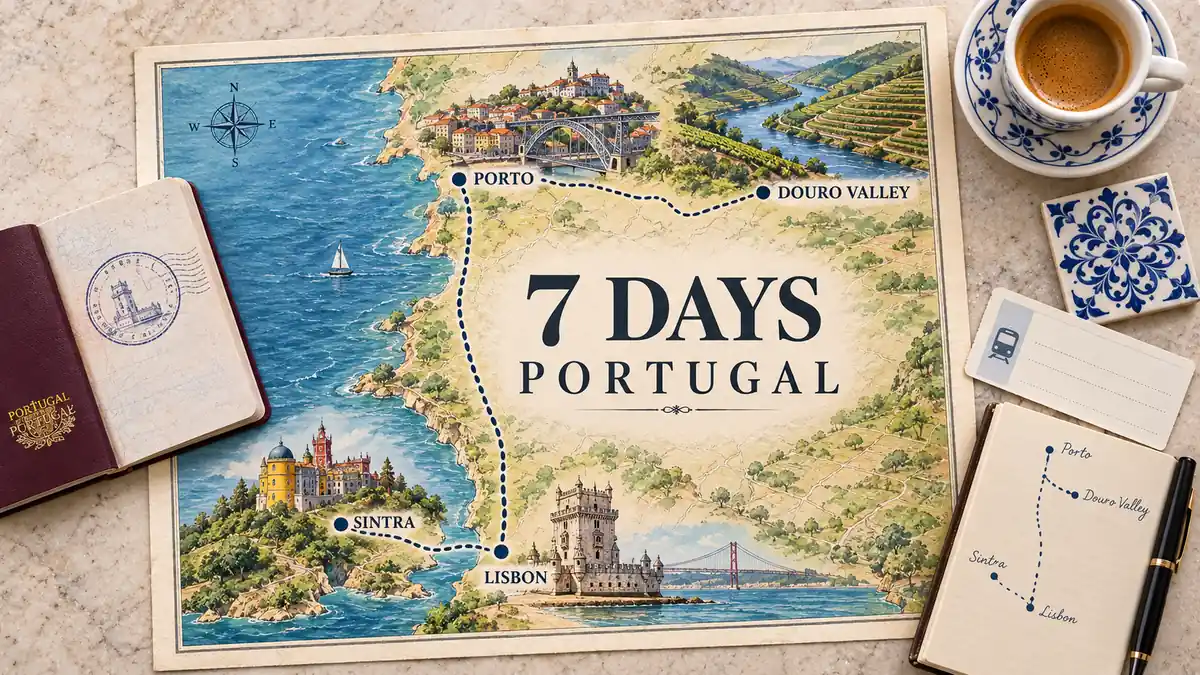
Seven days in Portugal fits two anchors, not three: run Lisbon and Porto. Give Lisbon three days including Sintra, and Porto four including a Douro Valley day, linked by a single CP train. Fly into Lisbon and out of Porto. Beach-first travelers swap Porto for the Algarve — never Lisbon.
Trust Layer
Tripstou itinerary guide for travelers planning a route. Covers pacing, stop count, stop order, base logic, and trip length.
Produced with AI assistance and reviewed by Alex Perrut, working in tourism since 2015, for the Tripstou editorial team. See our editorial process for details.
Last factual review: September 10, 2026.
Official sources consulted: Visit Portugal, Turismo de Portugal.
Key Takeaways
- Seven days in Portugal holds two anchors comfortably; a third costs a full travel day, not an afternoon.
- Run Lisbon for three days with Sintra, then Porto for four with a Douro Valley day.
- Porto to the Algarve breaks the triangle: only two direct CP trains a day, and Ryanair is the sole direct flight.
- Book open-jaw — into Lisbon, out of Porto — and the week keeps the day a backtrack would eat.
- Beach-first travelers take the one swap: drop Porto for the Algarve, never Lisbon, because the southern leg is short.
Table of Contents
Seven days in Portugal buys two anchors, not three
Seven days holds two anchors comfortably and three badly. The third anchor does not cost you an afternoon; it costs a full travel day, taken out of the middle or the end of the week, plus a second round of packing, checking in and finding your feet somewhere new.
Two of the triangle’s three sides are genuinely easy. Lisbon to Porto is a short hop on a direct CP train that runs through the day. Lisbon to the Algarve is also a straightforward long-distance run, south on CP from Lisboa Oriente. The triangle looks feasible on a map because two-thirds of it is.
Porto to the Algarve is the leg that breaks it. Only two direct CP trains a day link them in each direction, and it is the longest domestic rail leg in this route set — the best part of a travel day, not a morning. Flying does not rescue it. Ryanair is the only operator flying Porto–Faro direct, and TAP sends you back through Lisbon; once you add the transfer to the airport and the transfer out the other side, that is still a day gone.
The damage also lands at the worst point in the week. A third anchor squeezed into seven days almost always sits at the end, so the trip’s last full day is spent in motion and its final night is spent near an unfamiliar airport. In Portugal the arithmetic is unusually blunt: the three headline regions sit at the two ends and the middle of one north–south spine, so a third anchor always means doubling back along it.
Readers who genuinely want all three regions should plan a longer trip, and the Portugal itinerary hub is where those routes live. If the real question is whether Lisbon and Porto are the right two anchors in the first place, Portugal’s strongest destinations lays out the alternatives — but for a first week, they are.
The 7-day route: Lisbon and Sintra, then Porto and the Douro
This route runs Lisbon for three days, Sintra included, then Porto for four with a Douro Valley day, booked open-jaw. Lisbon comes first because it is the bigger arrival airport and the heavier city; you want it while your energy is highest, and Porto rewards a slower finish.
- Days 1–2: Lisbon — the historic core on foot
- Day 3: Sintra — full day trip from Lisbon
- Day 4: Porto — travel north by rail
- Days 5–6: Porto — riverfront, port lodges, Foz
- Day 7: Douro Valley — day trip, then fly home
Days 1–2: Lisbon, and how long the city really needs
Two full days and three nights cover Lisbon itself. That is enough for Alfama and the Baixa on foot, Belém and its monuments as one half-day block, and one evening that is not spent planning the next thing. Lisbon is hilly and slow to cross, so two days of walking here does the work of three in a flatter city.
What two days will not do is give you the neighbourhoods at leisure — Príncipe Real, Graça and the market halls all get compressed. If the city itself is the reason for the trip, take a night from Porto, not from Sintra. What to do with three days in Lisbon breaks down what fits at this pace. Book one bed for all three nights and leave it in place; you are moving on day 4 anyway, and day 3 goes out and comes back.
Day 3: Sintra, and why it earns a full day
Sintra earns a full day, and it earns it as a day trip from your Lisbon base. Half a day is the standard mistake. The palaces and estates sit spread across a wooded hillside above the town, the transfers between them eat more time than the map suggests, and a rushed morning means seeing one property properly and queueing for a second.
The tradeoff is real, and it is a Lisbon day you are spending. Travelers whose interest is city life — food, neighbourhoods, nightlife — are better off giving Lisbon three unbroken days and letting Sintra go; travelers who came for architecture and landscape should give it the whole day without apology. Planning the Sintra day covers which properties to pair. Either way you sleep in Lisbon again, because day 4 is the travel day.
Day 4: north to Porto on the Alfa Pendular
Day 4 moves you north by train and does not cost the whole day. CP runs direct services between Lisbon and Porto through the day: the Alfa Pendular is the fast train, the Intercidades the slower alternative. Departures leave Lisboa Santa Apolónia or Oriente and arrive at Porto Campanhã, with a short suburban connection onward to São Bento in the centre. The move costs a morning, not a day.
Take a morning departure and day 4 becomes a Porto afternoon — drop bags, walk the Ribeira, eat. The one detour worth weighing is a midpoint break at Óbidos or Nazáré, which turns the transfer into a slow half-day along the Silver Coast. It costs you that Porto afternoon, so take it only if a walled town and an Atlantic beach matter more to you than an extra evening in the city you are about to spend four nights in.
Days 5–6: Porto, and how many days it holds
Porto holds two full days easily and a third comfortably, which is why this route gives it four nights. Two days covers the Ribeira and the Sé, the walk over the Dom Luís I bridge to the port lodges in Vila Nova de Gaia, and an afternoon out at Foz where the Douro meets the ocean. Porto is compact. You cover it on foot.
The city also rewards a slower gear than Lisbon, which is the argument for putting it second: by day 5 you have stopped counting sights. Porto in detail covers the lodges, the markets and where to stay. Keep one base for all four nights — day 7 leaves the city in the morning and comes back to the same bed.
Day 7: the Douro Valley, and whether it beats a third city day
A Douro day beats a third city day in Porto for most travelers on this route. Porto is the smaller of the two anchors and by day 7 you have seen its centre; the valley gives you the landscape the port in your glass came from — terraced vineyards dropping to the water, reached by rail along the riverbank or by road through the hills.
The counter-case is honest. Travelers who dislike day trips, or who arrived mainly to eat and drink in one place, will get more from a quiet Porto day and a lodge tour across the bridge. The Douro is the one part of this week where the journey is the attraction, so treat the getting there as the day, not as overhead. The Douro Valley day trip sets out the rail and road versions. Fly out of Porto that evening or the next morning — either way the week ends without a backtrack.
Tours and activities
Book skip-the-line tickets, day trips and local tours with free cancellation on most activities.
You can also browse everything on getyourguide.com.
Tripstou may earn a commission if you book through this link, at no extra cost to you.
Getting between the stops without losing a day
This route needs one train and no car. A single CP service links Lisbon and Porto, both cities are walkable, and everything else in the week is reachable on foot or by day-trip transport. The airport logic follows from that: fly into Lisbon, fly home from Porto, and never retrace ground.
The Lisbon–Porto leg is the only long move in the week, and it is a comfortable one. CP operates it directly, the Alfa Pendular is the fast service and the Intercidades the slower one, departures run through the day from Santa Apolónia and Oriente, and you arrive at Campanhã with a suburban hop into São Bento. On the Alfa Pendular that is about three hours, seat to seat. Reserve when you book the trip, because Alfa Pendular seats are assigned and the convenient departures fill first.
Fares sit outside this page’s scope on purpose — what a week in Portugal costs handles money properly. If you are building something more rail-heavy than a two-anchor week, or want to know whether a pass earns its price, Portugal by train covers full routing.
Do you need a car for this route?
No. A car is a liability on this itinerary. Both anchors are dense historic cities where parking is expensive, scarce and usually a long walk from where you want to be, and on a seven-day route the car would sit still for six of them. The one long leg is faster and calmer by train.
What a car actually buys is the corridor between the anchors — Óbidos, Nazáré, the Alentejo detours, the back roads above the Douro. That is a different trip with a different shape, and driving Portugal end to end is the page for it. If you do drive, motorway travel here is tolled, and the Algarve’s A22 uses electronic tolling only, which hire companies handle through a transponder arranged at pickup.
Should you fly into Lisbon or out of Porto?
Both. Lisbon, Porto and Faro all have international airports, so an open-jaw booking — in through one, out through another — is straightforward here. Flying in and out of Lisbon forces a return leg south on day 7, or an extra night to absorb it, and that is a day of a seven-day week spent on ground you already covered.
Book it as one multi-city itinerary and the whole route stays linear: south to north, one train, no repeats. The same logic carries over to the Algarve version of this week — in through Lisbon, out through Faro. The day open-jaw saves is the reason this route can afford four nights in Porto at all, and it is the cheapest structural upgrade available to a Portugal week.
Train and bus tickets
Compare routes, schedules and prices across rail and bus operators in one search, with mobile tickets on your phone.
New to Omio? Code NEW10 takes 10% off your first booking — or APPNEW10 if you book inside the Omio app. Both apply to bookings up to €80.
Search routes and compare prices on Omio →
Tripstou may earn a commission if you book through this link, at no extra cost to you.
The one swap: beach-first travelers drop Porto, not Lisbon
If the trip is really about coastline, cut Porto and run Lisbon plus the Algarve. The reason is the route map, not preference: Lisbon to the Algarve is a short, direct run on CP’s southern line, while Porto to the Algarve is the longest domestic rail leg in this route set.
This swap is for families with young children and for anyone whose main goal is beach time. It keeps Lisbon and Sintra as the front half of the week and moves the back half south, so the week still holds two anchors and one long move. The structure does not change. Only the second anchor does.
The move itself is simple. CP long-distance trains leave Lisboa Oriente for the Algarve; Faro is direct, and most other Algarve towns need a change at Tunes. Pick one base and stay in it — Lagos for cliffs, coves and a walkable old town, Albufeira for resort infrastructure and easy family logistics. The Algarve region by region covers the rest of the coast, and Portugal’s best beaches ranks the ones worth planning a base around.
What you give up is the entire north: Porto, the Douro, the port lodges, the second river. That is a genuine loss and this page will not pretend otherwise. But a week split between the north and the south coast delivers neither properly. Choose the coast or choose the river.
What a Lisbon and Porto week leaves out
This route skips the Algarve, the Alentejo, the Minho and the islands. That is the price of committing, and it is worth naming before you book rather than discovering on day 5. If that list of omissions feels unacceptable, the trip you are describing is not a seven-day trip.
Committing is what makes the week work, and the honest response to wanting more is more days, not more stops. Readers in that position should start from the Portugal itinerary hub, where longer routes are built properly instead of being bolted onto a week that cannot carry them.
The mainland regions this week skips
The Alentejo is the mainland omission that costs you the most. It is a slow region — cork oaks, whitewashed hill towns, Évora’s Roman temple — and slow regions do not survive a seven-day route with a city anchor bolted to either end of it. It needs its own nights, and this week has none spare. The Alentejo is where to read it up for the trip after this one.
Two corridor stops fall out with it. Coimbra sits roughly midway between Lisbon and Porto and makes a defensible break on day 4, but it takes the day and Porto gets shorter for it. Óbidos and Nazáré are the same trade in a prettier package. On a week, take the direct train and keep the afternoon.
Madeira and the Azores need their own trip
Madeira and the Azores are flights, not detours. Both sit far out in the Atlantic, and reaching either means an airport day at each end — a large slice of a seven-day week spent in transit for two or three real days on the ground. Neither island group can be routed into a mainland week without wrecking it.
Treated as separate holidays they are excellent ones. Portugal’s islands compares the two archipelagos, Madeira covers the levada walks and the volcanic interior, Funchal handles the island’s one real city, and the Azores is the wilder, wetter, less developed choice. A week is the minimum for either — which is precisely the week you were about to spend on the mainland.
How to adapt this route to a shorter trip
Cut the day trips before you cut an anchor. At six days, drop the Douro and give Porto three straight city days. At five, drop Porto entirely and run Lisbon with Sintra, which keeps a whole travel day in your pocket instead of spending it on a move you no longer have room for.
- At six days: drop the Douro. Porto keeps three days, the sequence and the open-jaw booking are unchanged, and nothing else has to move.
- At five days: drop Porto. Lisbon and Sintra fill five days without strain, and you save the transfer day the second anchor costs you.
- At four days: drop Sintra as well. Lisbon alone, one bed, no trains, and the city still does not run out.
If a day appears instead of disappearing, add it in the north. The Minho — Guimarães, Braga, the Lima valley — sits close enough to Porto to work as an extension of a base you already have, and the Minho sets out what a night or two there buys. A second Douro night is the other good use of a spare day; the valley reads completely differently when you are not watching for a return train.
Season shifts the maths at the edges. A winter week loses the afternoons early and the Douro loses its colour, so a short trip in the cold months leans harder on the two cities and lighter on the day trips; a long-daylight week carries both day trips without feeling rushed. When to visit Portugal has the month-by-month picture.
Frequently Asked Questions
How long is the train from Porto to the Algarve?
Long enough to cost a travel day. Porto to the Algarve is the longest domestic rail leg on this route set, and only two direct CP trains run each way daily. Plan it as a whole day in motion, not a morning, and build the day around the departure.
Is Coimbra worth a stop between Lisbon and Porto?
Not on a seven-day trip. Coimbra is a hill university city with one of Europe’s great old libraries, and it deserves better than a rushed afternoon. Fitting it in costs Porto a day. Save it for a longer route and take the direct train instead.
Can you fit Madeira into a week in Portugal?
No, not without spending the week on logistics. Madeira sits far out in the Atlantic, so reaching it burns an airport day at each end and leaves three or four real days on the ground. A week is the minimum Madeira needs on its own. Treat it as a separate holiday, not a detour.
How do you do Portugal in 5 days instead of 7?
Drop the second anchor, not the first. Five days runs Lisbon with a full Sintra day and nothing else — one bed, no trains, no transfer day spent on a move you no longer have room for. That is a complete trip, not a compromised one. Porto keeps for another visit.
Related Guides
- The complete Portugal travel guide — the broad planner behind this route, covering regions, logistics and trip shapes beyond a single week.
- Portugal itinerary routes by trip length — the hub to start from if a week is not enough for the regions you want.
- The Lisbon city guide — what to do with the three days this route gives the city, neighbourhood by neighbourhood.
- The Porto city guide — the Ribeira, the port lodges and where to base yourself for four nights.
- What a trip to Portugal costs — the money side this page deliberately leaves alone, including what a week actually adds up to.
- The best time to visit Portugal — month by month, and how the season changes what this route can carry.
- Portugal by train — full rail routing and whether a pass earns its price on a longer, more rail-heavy trip.
Did this guide save you time or money? Tripstou is independent and reader-funded — if you'd like to give something back, you can support the site with a crypto contribution of any size.