Santorini is the most photographed island in Greece and the one travelers most fear will disappoint. The caldera is real. So is the crowd that gathers along its rim on a July afternoon. This guide gives the verdict first, then the shape of the trip: how many days the island actually repays, when to go and which hours to protect, whether to sleep on the rim in Oia or Fira or down on the flat beach side, how you move around a small island with slow roads, and where the money goes. It does not resolve the fine detail — day plans, base selection, budgets and transport mechanics each have their own page and are linked where they belong. What it does is stop you arriving with the wrong expectations, on the wrong days, in the wrong part of the island.
Quick Answer
Santorini is worth visiting for its caldera views, volcanic landscape and food, provided you time the trip deliberately. Three to four days is the sweet spot; two days feels thin. Couples wanting views sleep on the caldera rim, while families and value-seekers do better on the flat beach side.
Trust Layer
Tripstou city guide for travelers planning a city trip. Covers trip length, stay style, season, cost, and mobility tradeoffs.
Produced with AI assistance and reviewed by Alex Perrut, working in tourism since 2015, for the Tripstou editorial team. See our editorial process for details.
Last factual review: September 2, 2026.
Official sources consulted: Visit Greece, Greek Ministry of Tourism.
Key Takeaways
- Santorini repays travelers who come for the caldera view; those chasing cheap, quiet or beach-first Greece should choose another island.
- Three to four days is the sweet spot: the Fira–Oia rim, a day at Kamari or Perissa, and one inland.
- Sleep on the caldera rim — Oia, Imerovigli, Firostefani, Fira — for views; on Kamari, Perissa or Perivolos for space and value.
- The caldera towns hold the island’s longest season; the beach side is built around swimming and thins out far more beyond it.
- Oia and Fira crush in the middle of the day on ship days and breathe at dawn and after dinner.
- The premium buys the view — a rim room, a sunset table; inland Pyrgos and Megalochori price like ordinary Greece.
Table of Contents
Is Santorini Worth Visiting?
Santorini is worth visiting for the caldera, the light and the food, if you control your timing. The crowds are real, but they are concentrated in hours and places, not spread across the island. Travelers who want cheap, quiet, or beach-first Greece should put their money on another island.
What Santorini delivers is a landscape almost nowhere else has: a drowned volcanic crater with towns built along the lip of the cliff, and a horizon that changes colour twice a day. That is the whole product. If a view is the thing you travel for, the island is not overrated at all — it simply asks you to work around the hours when everyone else wants the same view.
It frustrates a specific reader. Travelers who measure a destination by beach quality, by how far money goes, or by the feeling of discovery will find Santorini expensive and thoroughly discovered. Within the island group, it is the headline act, not the whole show — the Cyclades island group holds a dozen alternatives with softer prices and thinner crowds, and if the doubt is really “should it be Santorini at all”, the comparison of the Greek islands and the best places to visit in Greece resolve that choice properly before you book anything.
Most people do not visit Santorini alone. It sits inside a wider Greek trip, usually paired with Athens and at least one more island, and it works best as the scenic anchor of that trip and not as its only stop; the Greece travel guide frames how the country fits together.
What Santorini Is Known For
Santorini is known for its caldera rim and the white towns strung along it — Oia, Fira, Imerovigli, Firostefani. Beyond the rim, the island is volcanic beaches with black and red sand, Bronze Age archaeology, and a wine country of low-trained vines on the inland plateau. All of it fits on one small island.
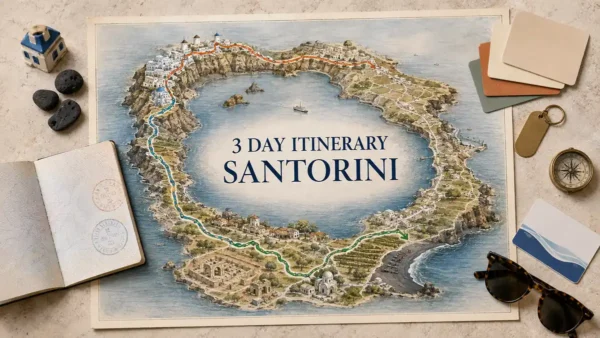
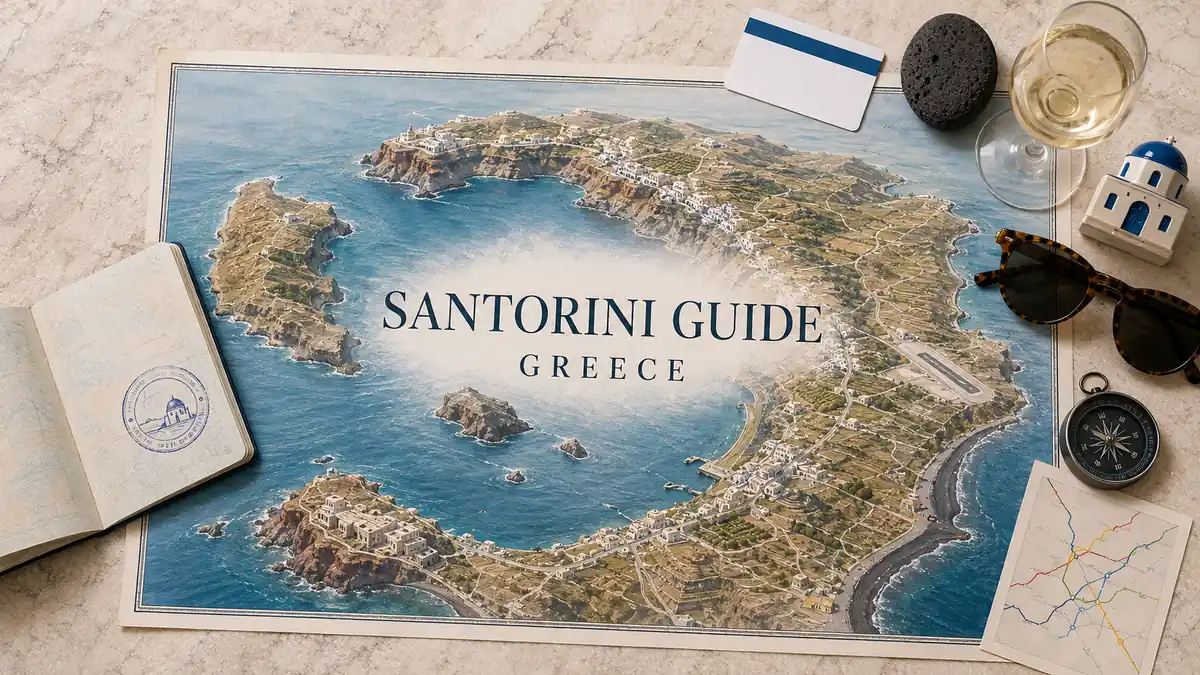
The caldera itself is a flooded volcanic crater, and its ring is bigger than the main island: Thirasia sits across the water, the uninhabited Aspronisi closes part of the circle, and Palea Kameni and Nea Kameni rise from the middle of it. Understanding that shape explains everything else about the island, including why one side has the views and the other has the beaches.
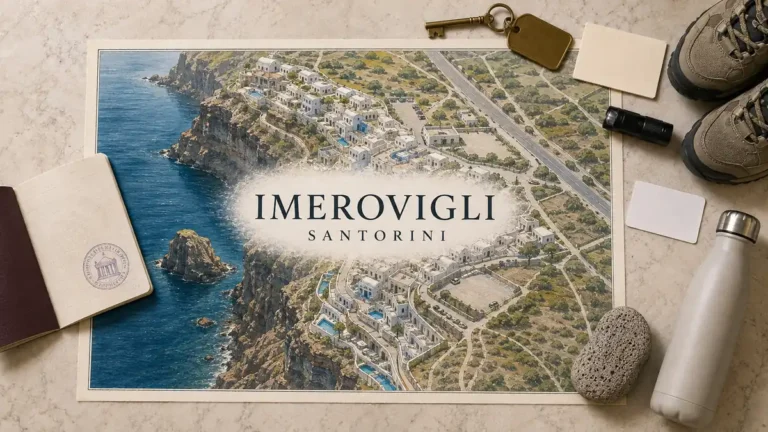
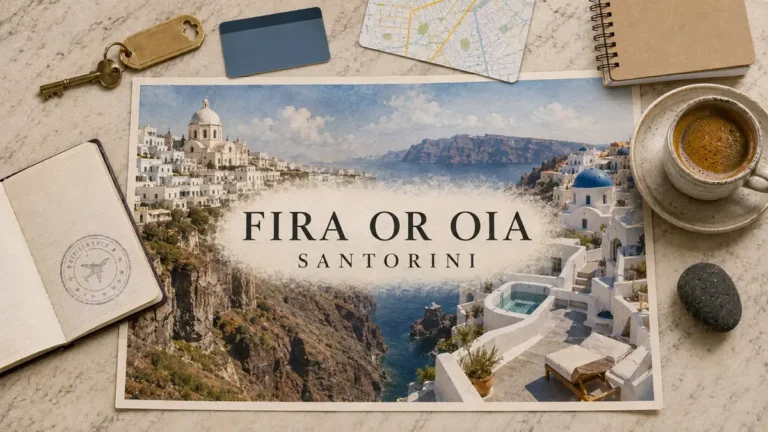
On the rim, Oia occupies the northern tip and owns the sunset. Fira is the busiest town and the island’s practical centre. Imerovigli and Firostefani sit along the quieter stretch of the same cliff, joined to both ends by the Fira–Oia caldera path that runs the length of the rim. Inland, Pyrgos climbs in rings to a ruined castle at the top and Megalochori keeps its wine-village character behind stone walls.
- Volcanic beaches — Kamari and Perissa for black sand and organised beachfronts, Perivolos for a longer and looser strip, Vlychada for pale wind-carved cliffs and quiet, and Red Beach for the colour it is named after.
- Archaeology and the volcano — Ancient Akrotiri, the Bronze Age town buried by the eruption; Ancient Thera on the ridge above Kamari; the Museum of Prehistoric Thera in Fira; and Nea Kameni, the young volcanic islet reached by boat from the caldera.
- Caldera set pieces — Skaros Rock, the headland below Imerovigli, and Ammoudi Bay, the fishing cove at the foot of Oia’s cliff.
The wine country is the part first-timers underestimate. Vines here are trained into low baskets against the wind, the soil is volcanic, and the whites made from assyrtiko taste like nothing else in the Mediterranean — a thread the Greek food guide picks up across the country. The beaches are equally unlike the postcard Cyclades: dark sand and pebbles, and ground that radiates the day’s heat back at you, which the guide to Greece’s best beaches puts in national context.
None of these get resolved here — this page names them so you know what the island holds. Which sites deserve a half-day, what to expect inside them, and how to sequence them belong to things to do in Santorini.
Tours and activities
Book skip-the-line tickets, day trips and local tours with free cancellation on most activities.
You can also browse everything on getyourguide.com.
Tripstou may earn a commission if you book through this link, at no extra cost to you.
How Many Days You Need in Santorini
Three to four days is the sweet spot in Santorini. Two days works only as a taster or an island-hopping stop, and a cruise call is less than that. The island pays out early in the morning and after the day crowds leave, and short visits never reach either hour.
Three days covers the shape of the place without hurrying: the rim towns and the caldera path, one day on the east or south coast beaches, and one day inland for the wine villages or the archaeology. A fourth day is what turns the trip from a tour into a stay — it buys the boat out to the caldera islets, or simply a morning with nothing scheduled.
The nights are what you are actually buying. A rim room only earns its price on the evenings and early mornings when the day crowds have gone, which is why adding a third night changes the trip more than adding the second one did.
As an island-hopping leg, Santorini works differently. Two nights is enough to see the rim and eat well before moving on, and the trade is that you accept the busy hours because you have no spare morning to dodge them; the Greek island hopping guide covers how it slots into a multi-island route. Once the length of the stay is settled, the day-by-day work is done on the 2-day Santorini itinerary and the 3-day Santorini itinerary.
Where Santorini fits in a wider Greek trip depends on total length. A one-week Greece itinerary can carry it alongside Athens and little else, a ten-day route gives it a proper stay plus a second island, and a two-week plan can pair it with a whole second island group without rushing — the Greece itinerary hub lays out those shapes side by side.
When to Visit Santorini (and When the Crowds Peak)
The shoulder seasons are the best time to visit Santorini. They balance warm weather against the crowd levels that make midsummer hard work. Midsummer is hot, bright and busy; the caldera towns hold a life outside the summer months, while the beach side is built around the swimming season and thins out beyond it.
The two sides of the island run on different clocks. The caldera side has the longest operating season on Santorini — it goes quiet in deep winter and comes back through late March, and the rim towns keep enough open to make an off-peak trip work. The beach side runs the other way: it is shaped around swimming weather, and it thins out much further beyond that window than the rim does. If your trip is beach-led, that difference decides your dates.
Cruise days reshape the island without touching the calendar. When ships are in, Oia and Fira concentrate hard around the middle of the day, and the same streets breathe in the early morning and again after dinner. The Oia sunset is the most concentrated moment on the island in any season, ship day or not.
The hours you protect matter more than the month you pick. An Oia sunset in a quiet shoulder week is still the busiest half-hour of your trip, while a July morning on the caldera path at seven o’clock is close to empty.
Month-by-month weather and crowd curves for the whole country sit in the best time to visit Greece guide. The practical crowd-dodging tactics — which hours to move, which direction to walk the path, where to watch sunset instead of Oia’s main viewpoint — are in Santorini travel tips, and once your dates are set the Greece packing list covers what the wind and the sun on this island actually demand.
Where to Stay in Santorini: Caldera, Beach Side, or Inland
Sleep on the caldera rim for the views, on the beach side for space and value. Inland villages suit travelers with their own wheels who want quiet. Couples and first-timers usually take the rim; families and longer stays are better served by the flat beach strips; anyone chasing calm goes inland.
| Island side | Named bases | What it feels like | Best suited to |
|---|---|---|---|
| Caldera side | Oia, Imerovigli, Firostefani, Fira | Cliff-stacked, scenic, stepped, busy by day | Couples, first-timers, view-led and short stays |
| Beach side | Kamari, Perissa, Perivolos | Flat, roomier, swimming-led, easier underfoot | Families, longer stays, value-conscious travelers |
| Inland villages | Pyrgos, Megalochori | Quiet, residential, wine country, few crowds | Repeat visitors and anyone with their own wheels |
On the rim, each town has one honest characteristic. Oia is the most polished and the most visited. Fira is the busiest and the most convenient. Imerovigli sits high and quiet on the cliff. Firostefani is the calmer neighbour of Fira, within walking distance of it. On the beach side, Kamari and Perissa are the two developed strips, and Perivolos runs on from Perissa with more space between people. Inland, Pyrgos and Megalochori trade the view for silence.
The steps are the hidden variable on the rim. Caldera-side properties are stacked down a cliff face, so the walk from the road to your own door can be longer and harder than the walk to dinner — which is exactly what catches out families with pushchairs and anyone carrying heavy luggage or managing limited mobility.
Choosing between actual areas and property types is a page of its own: where to stay in Santorini resolves it area by area. From there the intent-specific pages take over — first-time visitors get the safe default, couples get the view-led rim options, families get the flat and practical bases, budget travelers get the areas where prices break, luxury stays and the shortlist of Santorini’s luxury hotels cover the top end, and nightlife-led stays point at the parts of the island that stay awake.
Hotels and places to stay
Compare hotels, apartments and stays for your dates in one search.
Search hotels and stays on hotels.com →
Tripstou may earn a commission if you book through this link, at no extra cost to you.
How to Get Around Santorini
Santorini is small, but the roads are narrow, winding and slow. Almost everything routes through Fira, the hub the KTEL bus network radiates from, so journeys between two outlying points often mean changing there. Distances look trivial on a map and take longer than they look on the ground.
The island’s fixed points are easy to hold in your head. Santorini Airport (JTR) is on the east side, near Kamari and Monolithos. Athinios is the main ferry port, on the west coast. The Old Port sits directly below Fira. Fira itself is the bus hub, and the network runs out from it to the beach strips, the airport side and Oia.
Everything operational — how the buses actually work, whether to hire wheels, and what the road reality means for your plans — lives in the Santorini transport guide. Arrival is its own problem with its own answers, and it is handled in full in getting from Santorini Airport to your hotel.
Is Santorini Expensive?
Yes — Santorini is expensive by Greek-island standards. The caldera side carries the premium, and it is a view premium more than a quality one. The beach side and the inland villages are where value lives, and the gap between the two sides is wide enough to reshape a whole budget.
The money goes to a short list of things: a room with a caldera view, a table facing the sunset, and private transport that saves you from the bus timetable. Everything else on the island is priced closer to ordinary Greece. Bakeries, tavernas a street back from the view, the bus network and the beaches themselves cost roughly what they would anywhere in the Cyclades.
Sunset proximity is priced separately here. A table with a caldera view and a table two streets inland can serve much the same food at very different prices, and the walk between them takes minutes.
Spend style therefore changes this island more than it changes most destinations. A budget trip is entirely possible from a beach-side base, eating locally and using the buses, and it still gets you the same caldera at sunset. A mid-range trip splits the difference — a comfortable base off the rim, a couple of view meals, wheels for a day or two. A high-end trip buys the cliff itself: a rim room with a private terrace, and the mornings when that terrace is the best seat on the island.
Actual figures belong elsewhere. Daily budgets, what each spend level buys and where the numbers land are in the Santorini trip cost guide, and the national comparison — how much more Santorini asks than the rest of the country — sits in the Greece trip cost guide.
Who Santorini Is For — and Who Should Pick Another Island
Santorini suits couples, first-time visitors to Greece and anyone who travels for landscape. Families do well from a beach-side base, and solo travelers find it easy but distinctly couple-coded. Travelers hunting cheap, undiscovered or beach-first Greece will be happier somewhere else in the Cyclades.
Couples get the island at full strength. The rim towns are built around two people at a table facing west, and the accommodation stock leans hard into that. Honeymoons work here for exactly the reason the island is crowded: it is genuinely beautiful, and it knows it.
Families do fine, with one condition. Base on the flat — Kamari, Perissa or Perivolos — and the practical friction disappears: shallow beach entries, level walking, and rooms you can reach without carrying a child down a cliff staircase. Base on the rim with young children and the steps and cliff edges become the defining feature of the week.
Solo travelers find Santorini straightforward. It is easy to move around, easy to eat alone, and calm in terms of everyday hassle — the reassurance detail is in Santorini safety, and the country-level picture for women travelling alone is in solo female travel safety in Greece. The one thing worth carrying is ordinary tourist-zone awareness around pricing and pushy service in the busiest streets, which the Greece scams guide covers plainly.
Some people should choose differently, and it is not a failing of the island. If you want a beach-first holiday, empty villages, or Greece at a low price, Santorini will feel like a compromise on all three. And if what you actually want is a different Greece altogether — mountains, small towns, distance between stops — a Greece road trip on the mainland does that far better than any island can.
Frequently Asked Questions
How do cruise ship days affect crowds in Oia?
On ship days, Oia and Fira concentrate hard through the middle of the day, and the pressure eases early in the morning and again after dinner. The rest of the island barely notices — the beach strips and the inland villages stay much the same whether ships are in or not.
Is Santorini overrated?
No, but it is easy to mis-book. Santorini is a landscape destination, and travelers who arrive expecting an empty postcard, a beach holiday or cheap Greece find the gap between image and reality wide. Come for the caldera, treat the crowds as a timing problem, and it holds up.
Is Santorini good for families with young children?
Yes, though the age changes the answer. Babies and toddlers need the flat side — Kamari, Perissa or Perivolos — because the rim is stairs from the road to your door. Older children who walk well handle the rim fine and get more out of the caldera path and the volcano boat.
Is Santorini good for couples and honeymoons?
Yes — it is the island’s strongest fit, and honeymoon bookings turn on one variable: whether the terrace is private. A shared-terrace rim room in Oia or Imerovigli still hands you the caldera, but you share the best hour of the day with the whole property.
Do you need a car in Santorini?
Not for a standard trip. The KTEL buses radiate from Fira and reach the rim towns, the airport side and the beach strips, which covers most of what visitors want. Wheels earn their keep if you are staying inland at Pyrgos or Megalochori, or heading for Vlychada.
Can you swim in Santorini, and are the beaches good?
Yes, though they are volcanic, not postcard-Cyclades. Kamari and Perissa carry black sand and full beachfronts, Perivolos stretches on with more room between people, and Vlychada sits beneath pale wind-carved cliffs. Expect dark sand and pebbles that hold the heat, not white-and-turquoise water.
Related Guides
These are the next decisions to make once you have the shape of the trip.
- Where to stay in Santorini — the area-by-area base resolver.
- Things to do in Santorini — the depth behind every sight named above.
- 3-day Santorini itinerary — the sweet-spot trip, planned day by day.
- Santorini transport guide — buses, wheels, and how the roads really behave.
- Santorini trip cost — what the island actually costs by spend style.
- Cyclades guide — the island group Santorini belongs to, and its alternatives.
Did this guide save you time or money? Tripstou is independent and reader-funded — if you'd like to give something back, you can support the site with a crypto contribution of any size.