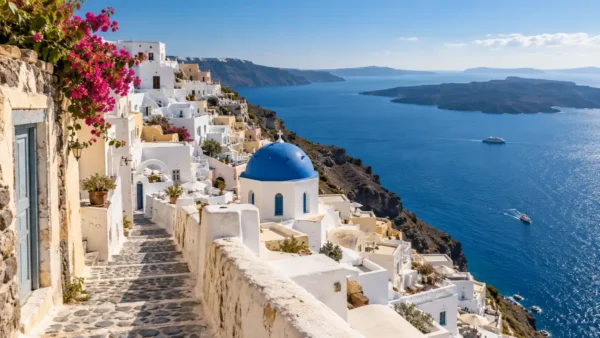
You have already picked Santorini and narrowed the base to two towns on the caldera rim. That is the whole decision left, and it changes the shape of the trip more than any other booking you make. Oia buys scenery and privacy, and charges for both in money and mobility. Fira buys access, choice and lower prices, and charges for them in calm.
This page resolves the head-to-head. It gives the verdict for most travelers, settles five decision dimensions one at a time — cost, getting around without a car, atmosphere and crowds, views and sunset, food and nightlife — and then says where the verdict flips by traveler type. It also answers the two questions people ask last: whether to split the stay between both towns, and whether to base in Fira and visit Oia for an evening. If you have not narrowed the island down to these two yet, start with the island-wide guide to where to stay in Santorini.
Quick Answer
Fira is the better base for most travelers in Santorini. Oia earns its price only when the hotel is the trip — a honeymoon or a caldera-view splurge. Fira suits first-timers, anyone without a car, tighter budgets and nightlife; it buys access and choice. Oia trades money and mobility for scenery.
Trust Layer
Tripstou comparison guide for travelers choosing between options. Covers tradeoffs, traveler fit, and decision logic.
Produced with AI assistance and reviewed by Alex Perrut, working in tourism since 2015, for the Tripstou editorial team. See our editorial process for details.
Last factual review: September 3, 2026.
Official sources consulted: Visit Greece, Greek Ministry of Tourism.
Key Takeaways
- Fira is the better base for most Santorini travelers: it is the bus hub, cheaper, and holds the widest food choice.
- Book Oia when the room itself is the trip — a honeymoon, a milestone stay, or a caldera-view splurge.
- The trade-off is fixed: Oia sells scenery and evening quiet, Fira sells access, choice and materially lower room prices.
- Booking Oia without a car turns most days into two bus rides that transfer through Fira anyway.
- Splitting the stay only pays off from about a week; below that, base in Fira and visit Oia for an evening.
- Families and first-time visitors should book Fira; luxury and honeymoon travelers get more from Oia’s cave and caldera stock.
Table of Contents
Fira is the better base for most Santorini travelers
Fira is the better base for most Santorini travelers. It sits at the centre of the island’s bus network, holds far more mid-range rooms, and puts food, shops and day trips within walking distance. Oia wins only when the hotel itself is the reason you came.
The verdict comes from weighting, not from a scoreline. Three of the five dimensions go to Fira and two go to Oia, and the two Oia takes — atmosphere and views — only outweigh the rest for a specific kind of trip. For a base you leave every morning, cost, mobility and choice decide the week. For a stay where you barely leave the terrace, views and quiet decide it, and everything else is noise.
Three tie-breakers settle the remaining doubt. Are you renting a car? With one, Fira’s transport advantage shrinks to almost nothing. How many nights do you have? Short trips punish any base that adds transfers. And is the hotel the trip, or the base for the trip? That last question does more work than the other two combined.
The tie-breaker people underestimate is what the room is actually for. A room you only sleep in makes Oia’s premium dead money; a room you spend afternoons on makes Fira’s savings irrelevant. If you have not yet ruled out the rest of the island, the full island-wide where-to-stay comparison covers the beach towns and the quieter rim villages too.
| Dimension | Fira | Oia | Winner |
|---|---|---|---|
| Cost and value | Deeper mid-range stock at lower prices | Premium at every tier, steepest on the rim | Fira, by a clear margin |
| Getting around without a car | Every island bus route starts here | Most journeys transfer back through Fira | Fira, decisively |
| Atmosphere and crowds | Working capital, busy at all hours | Day-trip crush, then polished quiet evenings | Oia, once the day-trippers leave |
| Views and sunset | Same caldera and sunset from its rim | The blue-dome skyline and the famous sunset | Oia, and the margin is wide |
| Food and nightlife | Widest price spread, real late-night scene | Fewer and pricier tables, early closing | Fira, on both counts |
Hotels and places to stay
Compare hotels, apartments and stays for your dates in one search.
Search hotels and stays on hotels.com →
Tripstou may earn a commission if you book through this link, at no extra cost to you.
Oia costs materially more than Fira
Fira is cheaper than Oia at every hotel tier, and the gap widens sharply for caldera-view rooms. Oia’s premium is concentrated exactly where people want to book: a terrace on the rim. In Fira, the same view costs less, and rooms a street back cost far less again.
Treat the difference as a relationship, not a number. For comparable categories, an Oia caldera-view room commonly runs from roughly a third more to about double the equivalent Fira rate, and that multiple grows in peak summer and narrows in the shoulder months. Treat it as a range and check current rates before booking; the direction is stable, the size of the gap is not. The premium buys address and view — not more room, better service, or a better location for doing things.
Fira’s value shows up in depth. It holds far more mid-range stock, and it has a whole tier Oia barely offers: rooms set back from the rim, cheap by island standards, still a few minutes’ walk from a caldera terrace you can stand on for free. Oia’s premium is genuinely earned when the room is the experience — a private plunge pool above the water is a different product, and it is not sold cheaply anywhere.
Between these two towns, a budget traveler books Fira. There is no close call and no condition that flips it. Oia’s cheapest rooms are also its worst value: you pay the Oia premium and still end up facing an inland wall. For the island-wide picture, including the cheaper areas away from the rim entirely, see where to stay in Santorini on a budget.
Fira is far easier without a car
Without a car, Fira is the clear pick. It is the island’s bus hub: KTEL routes radiate from the Fira station to Oia, Kamari, Perissa, Akrotiri, Vlychada and the airport. From Oia, most journeys route back through Fira anyway, which adds a transfer to almost every plan.
That structural fact drives the whole dimension. Buses between the two towns are frequent and inexpensive, and the ride is short. The problem is not the Fira–Oia leg itself. It is everything else: a beach day, the airport, the archaeological site, a boat from the port. Based in Oia, each of those becomes two rides with a wait in the middle, or a taxi, and taxis on Santorini are scarce at exactly the hours everyone wants one.
Two conditions narrow the margin. Renting a car or scooter removes the transfer penalty almost entirely, which is why so many Oia stays only work with wheels. A stay where you deliberately barely leave the hotel removes it too, because you are not travelling anywhere. Absent either, the mobility gap compounds daily.
Booking Oia without a car quietly converts most of your days into two bus rides through Fira — you end up commuting to the base you chose against. Luggage is the other practical variable, and it cuts both towns. Caldera-side hotels in Fira and Oia alike sit down flights of steps that no vehicle reaches, so someone carries the bags. Pack accordingly. For arrival logistics and how the island’s transport fits together, see the Santorini travel guide.
Oia is calmer and prettier, once the day-trippers leave
Oia wins on atmosphere and privacy, but only outside its daytime crowd window. Cruise passengers and day-trippers fill its lanes for a long stretch of the day, then leave it polished and quiet. Fira never empties in the same way; it stays busy well into the night.
The crowd pattern is the key to reading this dimension. Oia’s density is imported, arriving with cruise calls and organised day trips and departing after the sunset. That gives guests staying there something day visitors never see: early mornings and late evenings in a village with almost nobody in it. Those hours are the real product Oia sells. Fira’s busyness is native, generated by residents, workers, ferry traffic and its own bars, so it spreads across the whole day and does not switch off.
Who this margin matters to is narrow but intense. Couples who want the terrace to be the evening will feel the difference immediately. Anyone out on a boat, a hike or a beach from morning to dark will barely notice it — they arrive back after Oia has emptied and Fira has filled, and both work fine. Fira also reads as a real place, with locals, ordinary shops and a working centre, which some travelers prefer to Oia’s finished surface.
Neither town is quiet in the general sense; the difference is when. For what each place is actually like to walk around and spend time in, see the full profiles of Oia and Fira.
Oia takes the sunset and the postcard views
Oia wins the sunset and the postcard view, though both towns face the caldera. Fira sees the same sun go down from its own rim, and the daytime view is close to a tie. What Oia owns is the blue-dome skyline and the sunset everyone photographs.
Split this dimension in two and the margin becomes clear. On the daytime caldera view — volcano, water, cliff — the towns are near-level, because both sit on the same rim looking at the same thing. On the sunset and the photographed skyline, Oia is decisive: the sun drops behind the sea at its end of the island, and the stacked blue domes are there and nowhere else. Fira’s sunset is the same sun over a different foreground.
One condition decides whether this dimension settles your booking at all. If a caldera-view or cave room is the budget line — the thing you are actually paying for — then views outrank everything and Oia takes it. If you plan to watch the sunset from a boat, a bar or a rim walk, this dimension stops mattering and Oia loses its strongest argument for the extra money.
One practical note: a room facing the caldera is not the same as a room with the Oia skyline in it, and hotels use the phrase loosely. Check the actual photograph, from the actual room category. For named caldera-view and cave properties across the island, see the luxury caldera-view and cave hotels in Santorini.
Fira wins for restaurants and nightlife
Fira wins restaurants and nightlife on both choice and hours. As the island’s capital it carries the widest spread of tables, from cheap to expensive, and the only real late-night scene. Oia dines well and expensively, then goes quiet not long after the sunset crowd disperses.
The shape of the difference is choice and price range, not quality. Oia’s restaurants are good; there are simply fewer of them, they skew to the top of the market, and many trade on the view as much as the kitchen. Fira has everything from a gyros counter to a serious dining room within the same few streets, which matters more than it sounds on a week-long trip where you eat somewhere twice a day.
Nightlife is not a contest. Fira has bars that run late and a cluster of clubs; Oia has a handful of quiet places and a town that has gone to bed. Between these two, anyone who wants an evening that continues after dinner books Fira. If nightlife is a real priority, the island-wide answer includes areas beyond both towns — see where to stay in Santorini for nightlife. For specific places to eat in each town, the town profiles carry that.
When the Verdict Changes by Traveler Type
The verdict flips for exactly two groups: couples treating the room as the trip, and travelers booking a luxury stay. For both, Oia beats Fira. It holds for first-time visitors and for families, where Fira’s price, bus access and food choice matter more than a rim terrace.
Fira or Oia for first-time visitors?
First-time visitors should book Fira. A first trip is normally a survey of the island — the volcano boat, a black-sand beach, Akrotiri, a wine stop, Oia itself — and Fira is where all of that is reachable without planning around transfers. It also costs less, which leaves budget for the activities. The verdict flips only on a short trip with a car, built entirely around the hotel. The island-wide answer is in where first-time visitors should stay in Santorini.
Fira or Oia for couples and honeymoons?
Book Oia when the room is the trip, and Fira when the island is the trip and the room is a base. That is the entire distinction. A honeymoon built on private terraces, long mornings and a quiet evening village is what Oia is designed to sell, and it delivers. The trade-off is real money and reduced mobility, so if you plan full days out, you will pay the premium and not be there to use it. See the best areas in Santorini for couples for the wider comparison.
Fira or Oia for families?
Families should book Fira, and this one almost never flips. Stairs decide it: both towns have hotels down long flights of steps, but Fira has far more stock that a car or taxi can actually reach, which matters with a stroller, a car seat and suitcases. Add bus access, cheaper rooms and food children will eat. The strongest family answer often sits outside both towns entirely, in the flatter beach areas — see the best areas in Santorini for families.
Fira or Oia for a luxury stay?
Oia takes the luxury verdict. The concentration of cave suites, private pools and caldera-facing terraces is heaviest there, and at the top of the market the competition sharpens the product. The trade-off is the premium and the daytime crowd pressing against your gate. The exception worth knowing: rim hotels in Fira and Firostefani hit a similar standard with far better access, which suits a luxury stay that still leaves the property. Compare in the best luxury areas to stay in Santorini.
Should you split your stay between Fira and Oia?
Split only if you have enough nights that moving hotels costs you less than a day. Two check-ins, two luggage hauls and two sets of stairs eat a short trip whole. On anything under roughly a week, one base plus a day trip wins.
- Two or three nights: one base, and it is Fira. A hotel move burns an afternoon you do not have, and you would spend a third of the trip in transit or waiting for a room.
- Four or five nights: still one base, plus one deliberate Oia evening. This is the sweet spot for the compromise below — you get the village at its best without paying to sleep in it.
- A week or more: the split earns its keep. Enough nights on each side that the move costs a small fraction of the trip, and you get both products properly.
Do the split in one order: Fira first, Oia last. The caldera hotel reads as a reward at the end of the week and as an anticlimax at the start, and the practical arc runs the same way — active days out early from the hub, slow days on a terrace once you have seen the island.
Base in Fira and day-trip to Oia
Basing in Fira and visiting Oia for an evening is the most common compromise, and it works. Take the bus from the Fira station, go late in the afternoon, and stay through and past the sunset. What you keep is money and mobility. What you lose is the part day visitors never reach: Oia at dawn with empty lanes, and the town after the last bus has gone. Arriving at midday buys you the crush and none of the calm.
When neither Fira nor Oia is the right base
Sometimes the right answer is a third town. Firostefani and Imerovigli sit on the rim between the two, and they solve the trade-off directly: the caldera view and the quiet, without Oia’s prices or Fira’s noise, and close enough to walk into Fira for dinner and buses. Imerovigli in particular has become the considered traveler’s pick — see staying in Imerovigli.
Two other cases pull you off the rim entirely. Families and beach trips are usually better served on the flat east coast, where the hotels have pools, parking and no steps. Tight budgets stretch furthest inland, away from any caldera view at all. Both are properly resolved in the island-wide guide to choosing a base in Santorini.
How to Choose Between Fira and Oia
Choose Fira if the hotel is your base; choose Oia if the hotel is your trip. That one line resolves most of this comparison. Everything else — the bus network, the price gap, the crowd window, the sunset — is a consequence of which of those two trips you are taking.
Choose Fira if:
- You are not renting a car and will move around the island by bus.
- Accommodation cost is the constraint that shapes your booking.
- It is your first visit and you want to see the whole island.
- You want dinner choice and somewhere still open late.
- You are travelling with children, a stroller or heavy luggage.
Choose Oia if:
- The terrace and the view are the main thing you are paying for.
- It is a honeymoon or a milestone trip and the room is the gift.
- You have a car or scooter, so transfers cost you nothing.
- You are booking at the luxury end, where the cave and caldera stock concentrates.
- You want the village to yourself at dawn and after dark, and will accept the daytime crowd to get it.
Frequently Asked Questions
How far is Oia from Fira?
Oia sits roughly 10 to 11 kilometres from Fira by road, at the northern tip of the caldera rim while Fira holds the middle. It is a short hop by island standards, though the coast road is winding and peak-season traffic stretches the journey well beyond its distance.
Can you walk from Fira to Oia?
Yes. A marked rim path links the two towns, running along the caldera edge through Firostefani and Imerovigli. Treat it as a half-day hike with real climbing and exposure, not a way to commute between hotels, carry luggage or make a dinner reservation on time.
How do you get from Fira to Oia?
By KTEL bus, taxi or hire car. The bus is the standard option: services run from the Fira station to Oia frequently through the season and cost very little. Taxis are faster but scarce around sunset, when everyone on the island wants one at once.
Should you stay in Oia or just visit for the day?
Visit for the day if the island is your trip; stay if the terrace is your trip. A day visit costs a bus ride and keeps your budget and mobility intact. Staying costs the Oia premium and buys hours in the village that no ticket can.
Which is closer to Santorini airport and the ferry port, Fira or Oia?
Fira, for both. The airport and the main ferry port both sit closer to Fira, and the island’s airport bus route runs from the Fira station. From Oia you add distance in each direction, which matters most on an early flight or a late-arriving ferry.
Is Fira or Oia easier if you struggle with stairs?
Fira, though neither town is easy. Both are built into a cliff, and many caldera-side hotels in each sit down long flights of steps no vehicle reaches. Fira simply holds more rooms at road level, so a taxi can drop you at the door more often.
Related Guides
- Where to Stay in Santorini — the island-wide area comparison, beyond these two towns.
- Fira, Santorini — the full profile of the capital.
- Oia, Santorini — the full profile of the northern village.
- Imerovigli — the rim village between Fira and Oia.
- Where First-Time Visitors Should Stay in Santorini — the island-wide first-trip answer.
- Santorini Travel Guide — arrival, getting around and island planning.
Did this guide save you time or money? Tripstou is independent and reader-funded — if you'd like to give something back, you can support the site with a crypto contribution of any size.