You have chosen Santorini, and the remaining question is whether Oia is where you sleep or where you visit for an afternoon. Plenty of travelers book it on the strength of photographs and then meet the bill, the midday crowd and the staircase to reception, in that order.
This page settles three decisions. First, whether Oia earns the premium as a base, including the honest case against it. Second, which part of the village to book — the caldera-front cliffside, the main-street core, or the quieter eastern edge. Third, whether your room should face the caldera or the sunset, because most rooms face one and not the other.
It also discloses the friction before you book. Oia is the island’s most expensive base, its centre is closed to cars, and the crowd rhythm is real. Alternatives exist elsewhere on Santorini, and the sections below say plainly who should take them.
Quick Answer
Oia is worth basing in for couples and first-timers who want the caldera setting and can pay Santorini’s highest rates. The trade-off is price plus midday crowds and a stair-only village where luggage is carried by hand. Budget travelers, families with small children and anyone with limited mobility do better basing elsewhere on the island.
Trust Layer
Tripstou stay guide for travelers choosing where to base. Covers area atmosphere, budget, convenience, noise, and traveler fit.
Produced with AI assistance and reviewed by Alex Perrut, working in tourism since 2015, for the Tripstou editorial team. See our editorial process for details.
Last factual review: September 3, 2026.
Official sources consulted: Visit Greece, Greek Ministry of Tourism.
Key Takeaways
- Oia earns its premium only when the caldera setting is the trip itself, not a backdrop for days spent elsewhere.
- Book the caldera-front cliffside for the view, the main-street core for convenience, and the eastern edge for quiet arrivals.
- Most Oia rooms face either the caldera or the sunset, so confirm the orientation before assuming you get both.
- Oia is Santorini’s most expensive base, and moving one street back from the cliff cuts the price sharply.
- Staying overnight delivers the empty early morning and late evening that every Oia day-tripper misses entirely.
- Pedestrian lanes and stairs make porters, soft bags and a two-night minimum the practical baseline here.
Table of Contents
Is Oia worth staying in?
Oia is worth staying in if the caldera setting is the point of the trip and price is secondary. It is the wrong base if you want quiet, value or a step-free arrival. You are paying for a village address and a view, and everything else on the island costs less.
The case for is specific. Basing here gives you the village before the tour buses and after they leave, which is a different place from the one day-trippers photograph. The whitewashed core is compact and entirely walkable, dinner is a two-minute stroll from your room, and the caldera is in front of you all day instead of for one scheduled hour. For a certain trip — a honeymoon, an anniversary, a first visit built around the setting — that is the whole product, and no other base on Santorini delivers it as completely.
The case against is just as specific, and it has four parts. Oia charges the island’s highest nightly rates. The village fills through the middle of the day and again toward sunset, so your “quiet” village is loud for a large slice of the waking hours. The core is pedestrian-only and stepped, so arrival, departure and every trip to the bus stop involve stairs. And much of the cliffside terrace stock sits directly below the public walking path, so the private terrace in the listing photo is often overlooked in practice.
Oia is the one Santorini base where the room is the destination. If your days run from breakfast until dinner somewhere else on the island, you are paying a premium for a view you will not be sitting in.
Two neighbours change the maths. Fira is the island’s transport and services hub, busier and more commercial, with a deeper range of rooms at lower prices — the head-to-head is settled in our Fira vs Oia comparison. Imerovigli sits along the caldera rim between the two and trades Oia’s village life for quiet and a comparable view; that choice is resolved in our Oia vs Imerovigli comparison. Neither is ruled out here, because neither decision belongs on this page.
Hotels and places to stay
Compare hotels, apartments and stays for your dates in one search.
Search hotels and stays on hotels.com →
Tripstou may earn a commission if you book through this link, at no extra cost to you.
Who Oia Suits, by Traveler Type
Oia suits couples, honeymooners, view-first first-timers and high-end travelers who want the setting above all else. Families with young children, budget travelers, nightlife seekers and anyone with limited mobility should base elsewhere on Santorini. The village rewards one kind of trip and quietly punishes the rest.
Each segment has its own owning guide, and the one-clause verdict for Oia is this:
- First-time visitors: Oia works if the caldera is the reason you booked Santorini, and Fira works better if it is not — see where to stay in Santorini for a first visit.
- Couples and honeymooners: this is Oia’s core audience and the one segment that reliably gets its money’s worth — see where to stay in Santorini for couples.
- Families: skip it; the stairs, cliff edges and small rooms make Oia hard work with young children — see where to stay in Santorini with kids.
- Nightlife travelers: skip it; the bar scene here is thin and the evening ends early — see where to stay in Santorini for nightlife.
- Budget travelers: skip it; this is the island’s costliest address and the savings elsewhere are large — see staying in Santorini on a budget.
- Luxury travelers: Oia is where the island’s top cliffside stock concentrates and the obvious splurge base — see where to stay in Santorini for luxury.
Where to Stay Inside Oia
Oia splits into three stay zones: the caldera-front cliffside, the main-street core, and the quieter eastern edge. The cliffside buys the view at the highest price and the least privacy. The core trades that view for convenience and takes the foot traffic. The eastern edge, by the bus stop, gives you a calmer night and an easier arrival.
All three sit inside one small pedestrian village, so none of them is remote from the others. Inside Oia, moving away from the caldera path improves your sleep faster than extra money improves your view.
The caldera-front cliffside
The caldera-front cliffside is where the view rooms are, and it suits view-first couples who accept a semi-private terrace. Rooms here are built into the cliff face below the village, so you reach them by going down, and the caldera is directly in front of the terrace.
The atmosphere is the reason the village has its reputation, and also its main compromise. The public walking path runs above and through this stretch, so in many places your terrace is part of what passers-by are looking at. Convenience is fine for anyone on foot and awkward for anyone with luggage: the descent from the street to the room is stepped, and there is no vehicle access at any point. Price positioning is high-end, the highest of the three zones and the highest on Santorini. Named properties are not listed here — for a shortlist, see our roundup of luxury hotels in Santorini.
Best for: view-first couples who accept semi-private terraces.
The main-street core
The main-street core is the most convenient part of Oia, and it suits travelers who want everything on foot and can sleep through noise. Rooms sit on or just off the paved marble street that runs the length of the village.
The atmosphere flips twice a day. Through the crowd hours the street outside your door is the busiest ground in Oia; before and after, it is a quiet village lane. Convenience is unbeatable within the village — restaurants, shops and the walk to the caldera edge are all a few steps away, with no long stepped descent to your room. Price positioning is lower than the cliff front and still high-end by island standards, because you are inside Oia either way. Many core rooms have no caldera view at all, which is exactly what makes them cheaper.
Best for: travelers who want everything on foot and sleep through street noise.
The quieter eastern edge near the bus stop
The quieter eastern edge is the easiest part of Oia to arrive in, and it suits light sleepers and anyone carrying heavy bags. The bus stop sits on this side of the village, so this is where wheels stop and the walking begins.
The atmosphere is residential and calm. The crowd concentrates on the caldera side and the main street, and it thins noticeably before it reaches here, including in the evening. Convenience cuts both ways: arrival is the least painful of the three zones, but reaching the caldera front means walking through the village each time you want the view. Price positioning is the most moderate within Oia, though the village floor is still high — nothing in Oia reads as a budget zone. Rooms here typically look inland or over the rooftops.
Best for: light sleepers and travelers arriving with heavy luggage.
Caldera view or sunset view: which should you book?
Most Oia rooms face the caldera or the sunset, not both. Book caldera-facing if the daytime setting is what you came for, and sunset-facing if the evening is the point. Sunset-facing rooms carry the steepest premium in the village, because demand for them is global.
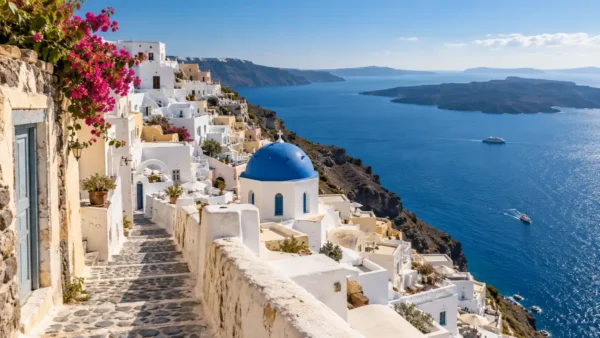
A caldera-facing room looks across the water at the volcanic islands and the far rim, and it is at its best in the morning and through the day, when the light is on the cliffs and the village below you is still calm. A sunset-facing room looks out along the water toward the horizon, and it is at its best for one part of the evening — spectacular then, ordinary the rest of the time, and dark early. The mistake worth avoiding is assuming these are the same purchase: a room sold on its sunset can lose the caldera panorama entirely.
Privacy tracks the public path more closely than the orientation does. Terraces below the walking route are overlooked wherever they sit, on either side of the village, which is why an Oia listing’s “private terrace” and a genuinely private terrace are not always the same thing.
| Factor | Caldera-facing | Sunset-facing |
|---|---|---|
| What you look at | The volcanic islands and the far caldera rim | Open water and the horizon line |
| When the room peaks | Morning and daytime, with light on the cliffs | The evening hour, then it goes dark |
| Privacy from the public path | Often overlooked where terraces sit below the path | Varies; the most exposed terraces sit near viewpoints |
| Where the price sits | High-end, the village standard for a view room | The highest premium anywhere in Oia |
| Who should book it | Travelers who will use the terrace all day | Travelers whose trip is built around the evening |
Oia is the island’s most expensive base
Oia costs more per night than any other base on Santorini. The premium buys the view and the address, not floor space or facilities. Move one street back from the caldera and the price drops faster than the quality does. Leave Oia altogether and it drops further again.
What each spend style actually gets in Oia:
- Budget: Oia is punishing. There is no genuinely cheap stay inside the village, and a budget-minded trip loses more here than anywhere else on Santorini — base elsewhere and visit Oia for an evening.
- Mid-range: possible, but only away from the caldera front. A comfortable room on the main street or the eastern edge, usually without a view, still sits above the island’s mid-range norm.
- High-end: this is Oia’s home ground. The cliffside stock — cave-style suites, private plunge pools, terraces on the caldera — is concentrated here, and the village is where the island’s ceiling sits.
The cheapest way to stay in Oia is to give up the terrace, not the village. A room in the core with no caldera view keeps the address, the early mornings and the walk to dinner, which is most of what basing here is actually for.
No cars, plenty of stairs: arriving at your Oia hotel
Oia’s core is pedestrian-only, so every hotel is reached on foot, with steps. Vehicles stop at the village edge and luggage travels by porter or by hand from there. Pack light and soft-sided, and treat limited mobility as a reason to base somewhere flatter on the island.
What that means in practice:
- No vehicles enter the village core. Taxis, buses and transfers set you down at the edge, and the last stretch is always walked.
- The main path through Oia is a paved marble street — smooth, but it turns slick in rain and it is never flat for long.
- The bus stop is on the eastern side. Caldera-side hotels are reached by walking through the village from there.
- Cliffside rooms are below the street, so expect flights of steps down on arrival and back up on departure, with the bags.
- Arrange a porter or a hotel meet-and-greet before you travel. Most properties organise this on request, and it is the difference between a five-minute arrival and a miserable one.
- Bring soft-sided bags. Wheeled hard cases are the wrong tool for a stepped village and have to be carried anyway.
Getting to Oia in the first place — from the airport, the port or Fira — is covered on our Santorini transport pages, and none of it changes the last hundred metres described above.
Sort the luggage before you arrive. It is the one part of an Oia stay that an expensive room cannot fix for you.
Staying overnight beats day-tripping to Oia
Staying overnight in Oia beats day-tripping because the village empties twice a day. Crowds build through the middle of the day and peak toward sunset, then drain away almost completely. Early morning and late evening belong to the people who slept here. A day trip never sees either.
The rhythm is consistent. Mornings are close to empty, with shops still shuttered and the caldera path yours. The village fills as tours and buses arrive, holds that density through the afternoon, and thickens again as the sunset crowd walks in. Afterwards it drains fast, and by late evening the marble street is quiet enough to hear your own footsteps. Oia has a permanent population of around 1,100 people, which is a fraction of what arrives on a busy day — that gap is the entire argument for having a key to a room here.
Three things follow directly from basing in the village. The sunset viewpoints are a short walk from your door instead of a bus ride with a deadline. Ammoudi Bay lies below Oia, reached by the cliff steps, which is a far more attractive proposition when you are not watching the clock for a return bus. And the caldera footpath toward Fira starts here, so an early-morning walk is available before the heat and the crowds. Each of those belongs to the island itinerary, not to the stay decision — plan them in our Santorini guide.
One night in Oia gives you two crowd-free windows, morning and late evening. A second night doubles them, and that is what makes the nightly rate defensible.
How many nights should you stay in Oia?
Two nights is the practical minimum in Oia, and three is the comfortable answer. You need to own the quiet hours at least twice: two mornings, two evenings. One night gets swallowed by arrival and departure logistics in a village where luggage moves slowly.
- One night: a single sunset and a single morning, with most of the day lost to checking in and out. It fits travelers passing through on an island-hopping route who want the experience once and are not optimising for value.
- Two nights: two empty mornings, two evenings and one full day in the village without luggage on your mind. This is the honest minimum for anyone paying Oia rates deliberately.
- Three nights: the same quiet hours, plus room for a day trip elsewhere on the island and a weather write-off. It fits couples and honeymooners who have made Oia the anchor of the trip.
- Four or more nights: only earns its cost if the room is where you want to be. Beyond three nights, most travelers get more from splitting the stay and moving to a cheaper or better-connected base.
Splitting the trip between Oia and a second base is the most common way to get the village without paying for it every night: a couple of nights on the caldera, the rest somewhere with easier transport. The island-wide options are laid out in our guide to where to stay in Santorini.
Frequently Asked Questions
How far is Oia from Santorini airport?
Oia sits at the northern end of the island, roughly 15 km from Santorini airport, about a 20-minute drive by road. That short distance is the easy part of arriving. Vehicles stop at the edge of the pedestrian village, so the final stretch to your hotel is always walked, with luggage.
Does Oia have nightlife?
Not in the club sense. Oia’s evenings run on dinner, wine bars and cocktail terraces, and the village goes quiet soon after the sunset crowd disperses. It is a polished, early-to-bed base. Travelers who want late bars and dancing should base elsewhere on Santorini and treat Oia as a dinner destination.
Is there a beach in Oia?
No. The village sits high on the caldera rim and has no beach of its own. Ammoudi Bay lies directly below, reached by the cliff steps down from the village, and that is where the waterfront tavernas sit. Santorini’s proper beaches are on the island’s far side.
Do Oia hotels have private terraces?
Semi-private is the honest expectation. Much of Oia’s cliffside stock sits below the public walking path, so terraces advertised as private are visible from above. Check a photo taken from the terrace looking upward, and ask the property directly where the path runs relative to your room.
How far in advance should you book Oia hotels?
Earlier than you would for anywhere else on Santorini. Caldera-front and sunset-facing rooms are the island’s scarcest stock and sell out first for high season, often many months ahead. Shoulder-season travel gives you more room to decide, but the best-positioned rooms still go early.
Is Oia suitable for travelers with limited mobility?
Generally no. The village core is pedestrian-only and built on stepped lanes, and cliffside rooms are reached by flights of stairs down from the street. A flatter base elsewhere on Santorini is the safer choice. If Oia is non-negotiable, ask the property about step-free access before booking.
Related Guides
- Where to stay in Santorini — every base on the island, compared.
- Fira vs Oia — the head-to-head between the two caldera towns.
- Luxury hotels in Santorini — the named cliffside shortlist.
- Where to stay in Santorini for couples — the couples verdict, island-wide.
- Santorini guide — sunset viewpoints, Ammoudi Bay and the rest of the island.
Did this guide save you time or money? Tripstou is independent and reader-funded — if you'd like to give something back, you can support the site with a crypto contribution of any size.