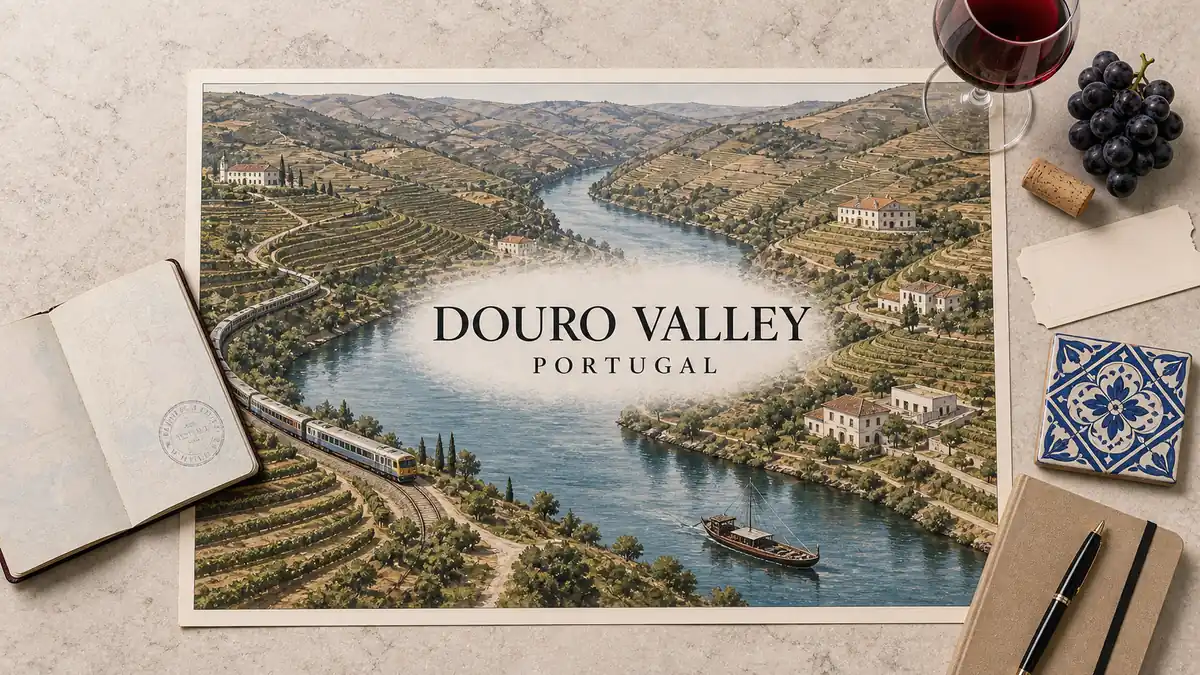
You have picked the Douro. This guide shapes the trip around it. The Douro Valley is the oldest demarcated wine region in the world, a UNESCO-listed landscape of terraced vineyards stacked above the river east of Porto, and almost every visitor arrives with the same four questions unresolved: how to get there from Porto, how long to stay, where to base, and whether a car is necessary.
Underneath all four sits the fork that decides the trip — day trip or overnight. Get that one right and the rest of the planning falls into place quickly, because access mode, base town and season all follow from it. This page answers the four moving parts in order, states the verdict on the fork early, and routes you to deeper pages when a decision needs more than a regional guide can carry.
Quick Answer
The Douro Valley is worth visiting, and it rewards an overnight far more than a rushed day trip. Trip length is the main variable: one full day works from Porto, but two nights unlock the valley’s pace. Base in Pinhão for scenery or Peso da Régua for connections; the train from Porto is the simplest way in.
Trust Layer
Tripstou region guide for travelers planning a regional trip. Covers sub-areas, trip shape, base strategy, timing, and mobility tradeoffs.
Produced with AI assistance and reviewed by Alex Perrut, working in tourism since 2015, for the Tripstou editorial team. See our editorial process for details.
Last factual review: August 29, 2026.
Official sources consulted: Visit Portugal, Turismo de Portugal.
Key Takeaways
- An overnight beats a day trip because the valley’s best hour arrives after the last day-trip train leaves Pinhão.
- Two nights is the sweet spot: it buys one uninterrupted valley day with no travel eating into it.
- Take the train from Porto — the Linha do Douro is scenic, and tastings make self-drive an awkward choice.
- Base in Pinhão for scenery, Peso da Régua for connections, and a rural quinta only if you have a car.
- The harvest window is the region at full intensity and the moment its small supply of rooms disappears first.
- Book the room before the tastings — accommodation, not quinta availability, is the valley’s binding constraint.
Table of Contents
Is the Douro Valley Worth Visiting?
Yes — the Douro is Portugal’s most rewarding regional detour, if you give it enough time. It is the oldest demarcated wine region in the world and a UNESCO-listed terraced landscape carved along the river. It suits slow travelers and wine lovers; tight schedules and nightlife seekers should skip it.
The valley earns its reputation on scale, not on individual sights. Terraces climb from the water to the ridgeline on both banks, worked by hand for centuries, and the effect is closer to a sculpted landscape than to farmland. Port wine can be legally produced only here, which is why the region reads as a working place rather than a scenic one — the vineyards are a business first and a view second.
It fits a specific traveler. Couples, wine drinkers, photographers and anyone happy to spend an afternoon doing very little get the most from it. Families with restless children and travelers who need bars, museums and late nights will find the valley thin, because the evening entertainment is the sunset and dinner. If your Portugal trip is already tight, the Douro is the region to cut — it punishes speed harder than any of the country’s other best places to visit in Portugal.
Within the wider national picture, the Douro sits alongside the coast and the cities as one of the three reasons people come. Our Portugal travel guide places it in that context, and the region’s cooking — river fish, roast kid, heavy stews built for wine — is covered in the Portuguese food guide.
The valley also rewards the traveler who plans least. With one quinta booked and an afternoon left open, the Douro tends to fill the gap better than a packed schedule would.
Where the Douro Valley Is and How It Fits Together
The Douro Valley lies east of Porto and unfolds along the river towards the Spanish border. Peso da Régua and Pinhão are its principal river towns, both on the Linha do Douro railway, and the upper valley runs on to Pocinho at the end of the line. Distances are short; the winding roads make them feel long.
Think of the region as a ribbon, not a circle. Everything of interest lines up along the water, so travel is linear: you move upriver or downriver, and there is no efficient loop. Régua comes first and acts as the region’s junction, Pinhão sits deeper in and holds the most dramatic scenery, and the upper valley beyond it grows drier, emptier and more remote as the road climbs towards Pocinho. The vineyards start well before Régua, so the shift from suburban Porto to terraced hillside happens gradually.
What you actually do here falls into four categories: quinta visits and tastings, river cruises, viewpoint stops, and walking or hiking between terraces. This guide deliberately stops at the category level — the full breakdown of options lives in things to do in the Douro Valley, and the quieter corners most visitors never reach are covered in hidden gems in the Douro Valley.
Porto is the gateway for almost every Douro trip, whether you sleep there or only change trains; the city itself is planned in the Porto travel guide. To the north, the greener and less visited Minho region makes the natural contrast if you want a second northern base with a different character.
Should You Day-Trip From Porto or Stay Overnight?
Stay overnight if you can — a day trip shows you the valley, a night lets you feel it. Travel time consumes most of a single day, leaving a couple of hurried hours among the vineyards. A day trip is a legitimate compromise only when Porto anchors a short trip.
The arithmetic is unforgiving. Getting in and back out again claims the bulk of your daylight, and what remains has to cover a quinta visit, lunch and at least one viewpoint. Day-trippers arrive mid-morning and leave mid-afternoon, which is precisely the window when the light is flattest and the terraces are busiest. Nothing about that is unpleasant. It is simply the least interesting version of the Douro.
The valley’s best hour is the one after the last day-trip train pulls out — the terraces go gold, the river flattens, and Pinhão belongs to the few dozen people sleeping there. That hour is the entire argument for the overnight.
A day trip is still the right call in three situations: your total Portugal time is under a week, you are travelling with someone who will not enjoy a rural evening, or the Douro is one of several excursions you are weighing from the city. In that last case, the fuller comparison against other options belongs in our guide to day trips from Porto, which sets the Douro against the alternatives properly.
How Many Days You Need in the Douro Valley
Two nights is the sweet spot for the Douro, and one full day is the workable minimum. Two nights give you a full valley day without travel eating it, plus an evening and a morning when the terraces empty. Three or more opens the upper valley beyond Pinhão.
Each tier buys something specific:
- One long day from Porto — one river town, one quinta visit, and the train ride itself. Right for travelers whose trip is really about Porto and who want proof they saw the valley.
- One night — the same ground, plus the evening and the early morning. This is the cheapest upgrade available in Douro planning, and it changes the trip more than the extra day suggests.
- Two nights — a complete valley day with no travel in it: two quintas at a human pace, a boat leg, a long lunch, a viewpoint at dusk. The default recommendation.
- Three nights or more — the upper valley towards Pocinho, hiking between terraces, and slow days with no schedule. Right for repeat visitors and anyone treating the Douro as the trip, not a stop in it.
The second night is the one that pays. It converts two half-days of travelling into a single uninterrupted valley day, which is the only version of the Douro that matches what people picture before they arrive.
Fitting those nights into a wider route is a separate exercise. Our Portugal itinerary guide shows where the valley sits in a national plan, and the length-specific versions handle the trade-offs directly: the 7-day Portugal itinerary usually treats the Douro as a day trip, the 10-day itinerary can absorb an overnight, and the 14-day itinerary has room for the full two nights without sacrificing the coast.
How to Get to the Douro Valley From Porto
The train from Porto is the simplest and most scenic way into the valley for most travelers. The Linha do Douro leaves from São Bento and Campanhã and runs beside the river into Régua and Pinhão. Driving, river boats from the Porto and Gaia quays, and guided day tours are the alternatives.
Porto to Pinhão by train takes roughly two and a half hours, and the upper valley towards Pocinho lies well beyond that. The last stretch is the reason to choose rail: the track runs at the water’s edge, so the journey is already part of the sightseeing instead of the price you pay for it.
| Access mode | Best for | Main trade-off |
|---|---|---|
| Train on the Linha do Douro | Most travelers, and anyone planning to taste wine | Ties you to the river towns; rural quintas need a transfer |
| Self-drive on the A4 and N222 | Rural quinta stays and viewpoint-hopping days | Winding roads, and one person cannot drink |
| River boat from Porto or Gaia | Travelers who want the valley seen from the water | Slow going upriver; usually paired with a train leg |
| Guided day tour | Short Porto trips with no appetite for planning | Fixed pace and group timing at every stop |
Most well-designed trips mix modes. Train in, boat for one leg, then train out is the classic combination, and it removes the driving problem entirely. Guided tours make sense when you have a single day and no wish to organise it. Boat-only trips are the weakest option, because the upriver journey is slow and eats the time you came to spend on land.
Rail beyond the valley is a bigger subject: if the Douro is one leg of a train-based tour of the country, the Portugal train itinerary guide handles the national network and the connections that matter.
Tours and activities
Book skip-the-line tickets, day trips and local tours with free cancellation on most activities.
You can also browse everything on getyourguide.com.
Tripstou may earn a commission if you book through this link, at no extra cost to you.
Do You Need a Car in the Douro Valley?
You only need a car if you sleep at a rural quinta or want to chase viewpoints. A base in Régua or Pinhão works on foot, by train, and by boat. Tastings also argue against driving, since the valley’s central experience is one you should not drive away from.
In-valley mobility is genuinely limited. The N222 that follows the river is beautiful and slow, full of blind curves and steep drops, and public transport between individual estates is sparse to non-existent. Estates scattered on the hillsides above the river are effectively unreachable without wheels or a booked transfer. Taxis work for short hops between a river town and a nearby quinta, and many estates will arrange collection for guests who ask when booking — that is the standard workaround, and it is worth arranging in advance instead of improvising on the day.
The drinking constraint is the part travelers underestimate. In a group with a car, someone spends the day pouring tastings into a spit bucket while everyone else enjoys the region as intended. A quinta with rooms solves this more elegantly than any designated-driver arrangement, because you sleep where you taste.
If the Douro is one section of a larger driving trip, the calculus changes — you already have the car, and the flexibility is worth having. The national picture, including road conditions and route logic, sits in the Portugal road trip guide.
Where to Base Yourself: Régua, Pinhão, or a Quinta
Base in Pinhão for the classic Douro scenery, or Peso da Régua if connections matter more than views. Pinhão sits at the valley’s most photographed bend; Régua is the region’s transport hub. A rural quinta delivers the deepest immersion but requires a car. First-timers should pick Pinhão.
- Pinhão — a small river town wrapped in terraces, with the azulejo-tiled station and boat departures from the quay. Everything is walkable, and the views start the moment you step outside. Best for: first-timers who want the postcard Douro without renting a car.
- Peso da Régua — larger, plainer, and the valley’s practical centre, with the best rail connections and the widest choice of places to eat. The scenery is a short trip away instead of outside the window. Best for: travelers arriving by train who are moving on within a day or two.
- A rural quinta — a working wine estate with rooms, usually up a hillside track, where the tasting, the dinner and the view all happen where you sleep. Best for: couples with a car and at least two free nights.
Lamego, just south of Régua and known for its monumental hillside staircase, works as a quieter alternative base if the river towns feel too small.
Booking behaviour matters more here than in most Portuguese regions. Quinta visits and tastings are reservation-led, walk-in acceptance varies from estate to estate, and the supply of rooms in the valley is genuinely small — during the harvest window, both fill well ahead of the rest of the year. Book the room first and the visits second; the room is the harder constraint.
The base you pick is also the biggest lever on what the trip costs. Estate stays and tastings are the region’s premium; a room in one of the river towns keeps spending closer to what the rest of the country asks. The Portugal trip cost guide sets the national baseline you can measure that against.
Hotels and places to stay
Compare hotels, apartments and stays for your dates in one search.
Search hotels and stays on hotels.com →
Tripstou may earn a commission if you book through this link, at no extra cost to you.
When to Visit the Douro Valley
Early autumn’s harvest window and spring are the Douro’s two best moments, for opposite reasons. Harvest brings the valley to life with picking, crushing and full quintas. Spring, when the almond blossom follows the winter quiet, gives you the same terraces with far fewer visitors and gentler heat.
When Is Harvest Season in the Douro Valley?
Harvest in the Douro runs from roughly mid-September into early October, though the exact window shifts each year with the weather. It is the region at full intensity: pickers on the terraces, grapes arriving at the estates, and many quintas opening up parts of the process to visitors. It is also the moment when demand outstrips the valley’s small supply of rooms, so accommodation and tasting slots need to be locked in well before you travel.
The rest of the year breaks down cleanly:
- Spring — green terraces, mild days, blossom in the early weeks and comfortable walking. The quietest good-weather season.
- Summer — the valley traps heat and runs routinely far hotter than the Porto coast. Mornings and evenings are fine; afternoons are for shade and water.
- Harvest window — the peak experience and the peak booking pressure, in the same few weeks.
- Late autumn and winter — russet and bare terraces, low mist over the river, many estates on reduced hours. The trade is solitude for limited access.
The Douro’s calendar does not match the country’s. Portugal’s coast peaks in summer while the valley is at its most punishing, which is why the national picture in our best time to visit Portugal guide should be read alongside this section, not instead of it. Summer visitors in particular should plan clothing for inland heat — the Portugal packing list covers that.
Frequently Asked Questions
Do You Need to Book Douro Valley Wineries in Advance?
Yes — reservations are the norm at most quintas, and the better-known estates expect them. Some accept walk-ins for a glass at the bar, but a full tasting or tour is rarely available on the day. Book further ahead for the harvest window, when slots go first.
Can You Visit the Douro Valley Without Drinking Wine?
Yes, and non-drinkers often rate the valley higher than they expected. The terraced landscape, the riverside train ride, short boat trips and the viewpoints carry the trip on their own. Some estates run tours without a tasting. What you lose is the cellar conversation, not the region.
How Far Is the Douro Valley From Porto?
Not far in distance, but longer in travel time than the map suggests. The train from Porto to Pinhão takes roughly two and a half hours, with Peso da Régua reached sooner. Roads follow the river in tight curves, so driving offers little time advantage over rail.
Is the Douro Valley Good for Families?
It works for families who like slow days outdoors, and less well for those needing constant activity. The train ride, short river cruises and the riverside towns hold children’s attention. Tasting-led days do not. Families with young children usually do better with one night than three.
Can You Get to the Douro Valley From Lisbon?
You can, but Porto is the practical gateway and Lisbon makes a poor starting point. Reaching the valley from Lisbon means travelling north first, usually by train through Porto, which turns a day trip into an overnight by default. Plan the Douro around Porto instead.
Is the Douro Valley Expensive?
It sits above Portugal’s national average, driven mainly by quinta stays and tastings. Eating and drinking in Régua or Pinhão costs about what it does elsewhere in the country. The train is the cheapest way in, and a river-town room instead of an estate keeps the trip close to normal.
Related Guides
The Douro is one region in a country with several strong ones. These guides cover the alternatives and the practical planning that sits around your trip.
- Algarve travel guide — the southern coast, and the sharpest contrast to the Douro’s inland pace.
- Alentejo travel guide — the wide plains between Lisbon and the Algarve, with a wine region of its own.
- Best beaches in Portugal — where to add coast time to a northern trip.
- Portugal’s islands — the Azores and Madeira, for travelers extending beyond the mainland.
- Common scams in Portugal — what to watch for in Porto and Lisbon before you head inland.
- Solo female travel safety in Portugal — practical guidance for travelling alone in the country.
Did this guide save you time or money? Tripstou is independent and reader-funded — if you'd like to give something back, you can support the site with a crypto contribution of any size.