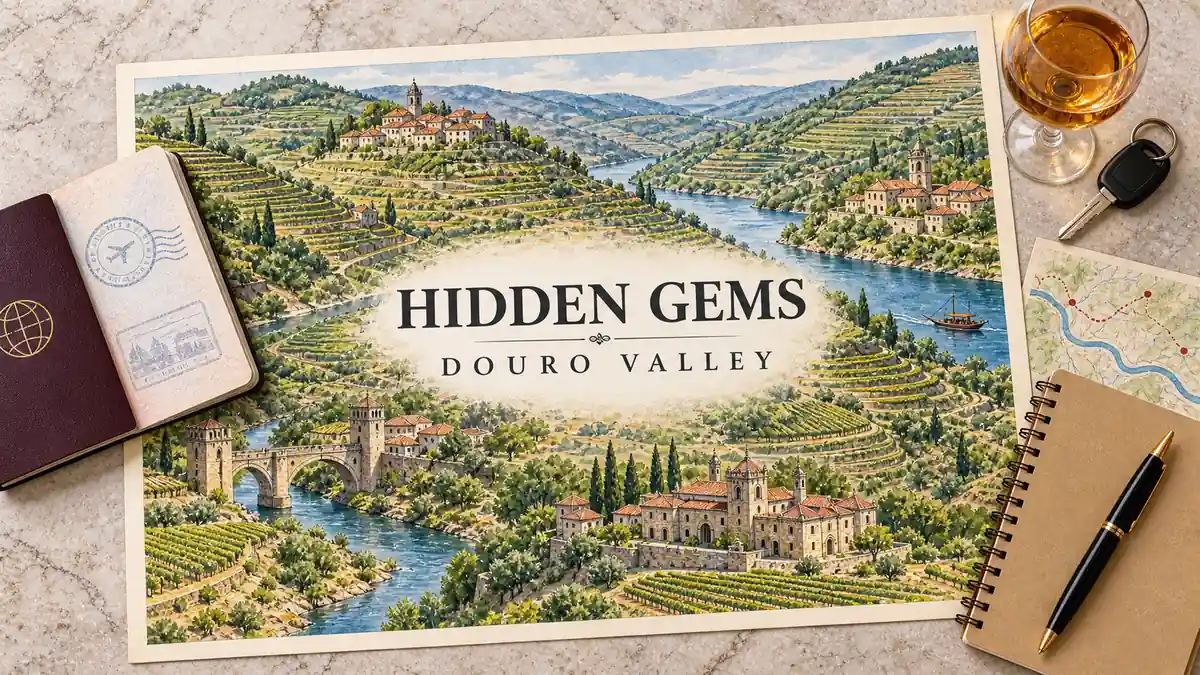
Search for hidden gems in the Douro Valley and you get a list of quintas, restaurants and viewpoints — the same tasting rooms the tour buses already stop at — and the one village that makes the cut is often placed in the wrong town. That is not a hidden gem list. It is a things-to-do list wearing a different title.
The quiet Douro is made of villages. Six of them carry an official name, and the small places east and south of the Régua–Pinhão corridor fill in the rest, in a geography that is easier than it looks: the monastic villages south of Lamego, the wine villages on the north bank above Pinhão, and the upper valley past the tourist zone. Nearly every one needs a car, none is a full day on its own, and the border park at Douro Internacional is honestly a separate trip.
This page runs three groups, eight picks, one “Pick this if” line each, then the border verdict and a selector by cluster and base.
Quick Answer
The Douro’s real hidden gems are its six wine villages, plus the Côa valley rock art. Geography decides which fits: they cluster south of Lamego, on the north bank above Pinhão, and in the upper valley east. Nearly all need a car; choose the cluster nearest your base and treat Douro Internacional as a separate trip.
Trust Layer
Tripstou selection guide for travelers choosing between multiple places. Covers selection criteria, traveler fit, and trip value.
Produced with AI assistance and reviewed by Alex Perrut, working in tourism since 2015, for the Tripstou editorial team. See our editorial process for details.
Last factual review: September 11, 2026.
Official sources consulted: Visit Portugal, Turismo de Portugal, Fundação Côa Parque, Fundação da Casa de Mateus.
Key Takeaways
- Ucanha’s toll bridge and Salzedas’s monastery sit minutes apart south of Lamego, making them the Douro’s easiest quiet half-day.
- Choose by what you want: Provesende for manor architecture, Favaios for Moscatel and bread, Trevões for medieval quiet.
- The Côa rock art needs a booked guided tour in park vehicles, which turns it into a full day.
- A car decides almost everything here; without one, only the north-bank villages near Pinhão stay realistically reachable.
- Casa de Mateus is worth a stop only if Vila Real already sits on your route.
- Douro Internacional deserves its own trip and its own night, not an afternoon carved out of the valley.
Table of Contents
What counts as a hidden gem in the Douro Valley?
A hidden gem in the Douro is a lived-in village or small town off the Régua–Pinhão corridor. Not a quinta, not a restaurant, not a viewpoint. The region’s own answer is the six Aldeias Vinhateiras, which cluster south of Lamego, on the north bank, and in the upper valley east.
The recycled lists fail because they answer a different question. A quinta tasting and a river cruise are experiences, and they live on the page for things to do in the Douro Valley; a restaurant is not a destination; and Pinhão and Régua are not hidden by any definition — they sit on the famous shortlist with Porto and the valley itself, covered under the best places to visit in Portugal.
Those six villages are the Aldeias Vinhateiras, a long-running regional programme: Favaios and Provesende on the north bank, and Barcos, Salzedas, Ucanha and Trevões on the south. Three of those six — Salzedas, Barcos and Trevões — are missing from almost every English-language page, which is the gap this list exists to fill.
Three criteria decide what made it here:
- Lesser-known in practice, not merely quieter than Porto.
- Lived-in: a working village or small town, not a single building and not a viewpoint.
- Sourced from official Portuguese tourism and Portuguese-language guides, which is why the six-village layer appears at all.
“Hidden” has a price, and it is worth stating before you plan around it. Nearly every pick needs a car. Several villages have little or nothing open at lunch or off-season. No pick on this page fills a day on its own, which is why they are grouped here: you visit a cluster, not a village. Bases, when to go and the full car-versus-train decision belong to the Douro Valley guide.
The six-village list is a map, not a ranking. Pick the bank you are already on — crossing the river eats more of your afternoon than any single village gives back.
This list is for second-day travelers: drivers, and anyone who has already done the tasting and the boat. If it is your first day in the Douro, the famous places are famous for a reason, and you should be on them.
The south bank’s monastic villages are the Douro’s easiest detour
Ucanha, Salzedas and Barcos sit a short drive south of Lamego, close enough to see in one half-day. They are the Douro’s monastic and manor-house layer, not its vineyard layer: a fortified toll bridge, a Cistercian monastery, and a village of stone manors above the terraces.
These three are the south-bank half of the Aldeias Vinhateiras, minus Trevões, which sits further east. Ucanha and Salzedas are minutes apart and belong together; Barcos is the extra leg that makes the cluster whole. With a car the trio is a half-day; without one, treat the south bank as out of reach from Régua, and settle whether to rent a car for the Douro before you plan around it. Lamego is the turning point, not a stop.
Ucanha
Ucanha is the village of the fortified toll bridge, a medieval crossing with a tower built into it that once collected the levy on everything passing over the river. That single structure made the village famous inside Portugal and left it unknown everywhere else. A river beach sits below it, in the shade of the same stonework.
Among the picks here, Ucanha is the one that is a single object and a swim: you see the bridge, you walk the tower, and the village behind it is small. That is the tradeoff, and it makes Ucanha the shortest stop on this page. A car is the only sensible way in.
Pick this if: you want one medieval bridge and a river beach in a short stop, not a village to wander.
Salzedas
Salzedas grew around the Cistercian monastery of Santa Maria de Salzedas, and the monastery still dwarfs everything around it. The church front rises straight out of a village of low stone houses, which is the whole effect. The Murganheira sparkling-wine cellars are cut into the hillside nearby, part of what this corner of the south bank is.
No other pick on this page has a major monastic interior, and that is what Salzedas is for. It pairs naturally with Ucanha, which sits minutes away. The tradeoff is that once you leave the monastery, the village is quickly done. Bring a car; nothing else reaches it.
Pick this if: a Cistercian monastery interior matters more to you than another quinta on the itinerary.
Barcos
Barcos is a village of stone houses and small manors on the south bank, with the Sanctuary of Nossa Senhora do Sabroso standing apart from it on the hill. It is one of the two Aldeias Vinhateiras that English-language lists almost never reach, which is exactly why it still feels like nobody’s discovery.
Barcos is the quietest of the south-bank three, and it earns its place by completing the cluster, not by a headline sight. The walk out to the sanctuary is the visit. Expect little or nothing open — check before you go. A car is required.
Pick this if: you want the emptiest village on this list and a sanctuary walk instead of a sight to tick.
Provesende and Favaios are the north bank’s showcase wine villages
Provesende is the most photogenic village in the Douro: stone façades and manors around a square above the vineyards. Its Baroque parish church crowns the village. Favaios is the opposite, a working Moscatel village where bread and wine are the point. Both sit above Pinhão; Casa de Mateus is a separate stop in Vila Real.
Provesende and Favaios are the north-bank half of the six, and the pair most likely to already be on a tour itinerary — so the useful question is fit, not discovery. Both work from a Pinhão base; Casa de Mateus does not, and belongs to a Vila Real leg. All three need a car. The Favaios cooperative appears below as what the village is; for tastings as an experience, see quinta tastings on the things-to-do page.
Provesende
Provesende sits on a hill high above the vineyards: a square ringed by stone houses and small manors, and a Baroque parish church. The Miguel Torga house-museum sits nearby. When an English page calls a Douro village beautiful and gets it right, this is the one.
Provesende is the architecture pick — the one to walk slowly and photograph in low light — and the one most exposed to the tour circuit, which is its tradeoff. Of the six wine villages it is the least likely to be yours alone. Drive; the village sits above the river road.
Pick this if: you want the valley’s manor-house village and the view from above Pinhão, and accept that you may not be alone.
Favaios
Favaios is the Moscatel village, and it is the one pick you taste instead of photograph. Its cooperative winery and its bread-and-wine museum are the village’s core, and its signature is a four-cornered loaf baked in a wood-fired oven. Moscatel de Favaios is what the surrounding vineyards exist for.
No other pick on this page is built on food and a single wine style, and none is plainer to look at — Favaios is a working village, not a postcard, which is the tradeoff. Opening times in a village this size are limited; check before you go. A car, again.
Pick this if: Moscatel and a loaf from a wood oven are a better reason to stop than a façade.
Casa de Mateus
Casa de Mateus is a Baroque manor house in Vila Real, on the region’s western edge. The estate opens its house, chapel, formal gardens and park, a wine museum and a library, and visits run guided or audio-guided, with booking indicated. It is the grandest single building on this page.
Every other pick here is a village; Casa de Mateus is one estate, and the only stop that falls on the way to or from Porto instead of inside the valley. That is the tradeoff: a detour off the wine corridor, and a visit you have to book. A car is assumed.
Pick this if: you want Baroque gardens and a house tour and are passing through Vila Real anyway.
The upper valley east of Pinhão is where the Douro empties out
East of Pinhão the tour circuit stops, and two picks are left. Trevões is a medieval village of chapels, hermitages and small museums. The Côa valley at Vila Nova de Foz Côa holds Palaeolithic rock art you can only see on a booked guided tour. São João da Pesqueira anchors the east.
The valley empties east because the tour circuit and the rail day both end at the Régua–Pinhão corridor. São João da Pesqueira is the town the eastern picks hang off — useful as a base if you commit to this end of the valley, not as a sight in itself. A car is not optional here, and the Côa is a full day because the tour rule makes it one. Trevões goes on the way east; the Côa is the destination.
Trevões
Trevões is the sixth Aldeia Vinhateira and the one almost no English list reaches. It is a medieval village scattered with chapels and hermitages, and its two small museums — ethnographic and sacred art — are what the village chose to show of itself. Nothing here has been arranged for visitors.
Trevões is the devotional pick, medieval and inward-facing where the other five villages face the vineyards. It also sits furthest east, which is both the reason to come and the tradeoff: the longest drive from any base, and off-season you may find nothing open. A car is non-negotiable.
Pick this if: you want the village nobody else on your trip will have heard of, and chapels and a small museum are enough.
Vila Nova de Foz Côa and the Côa rock art
The Côa valley holds open-air Palaeolithic engravings cut into schist along the riverbanks, and three sites are visitable: Canada do Inferno, Penascosa and Ribeira de Piscos. You cannot walk in. Every visit is guided and reaches the rock faces in the park’s or its partners’ all-terrain vehicles, from Vila Nova de Foz Côa.
No other pick has an access rule that shapes the whole day. Book ahead. Canada do Inferno and Ribeira de Piscos are morning visits and Penascosa is an afternoon one, and you cannot do more than two sites in a day, so the Côa is a day, not a stop. A car gets you to the park.
Pick this if: you can book ahead and give the Côa a full day, for prehistory seen from a park vehicle, not a viewpoint.
Tours and activities
Book skip-the-line tickets, day trips and local tours with free cancellation on most activities.
You can also browse everything on getyourguide.com.
Tripstou may earn a commission if you book through this link, at no extra cost to you.
Douro Internacional is a separate trip, not a Douro Valley afternoon
Douro Internacional is worth visiting, but as its own trip with its own night. The park follows roughly 122 kilometres of border river through Miranda do Douro, Mogadouro, Freixo de Espada à Cinta and Figueira de Castelo Rodrigo, far beyond the wine valley. Penedo Durão is its vulture viewpoint.
What you get there is a border canyon and birdlife, not vineyards — a different landscape, and not a deeper version of the Douro. Vultures ride the cliff thermals at Penedo Durão, the park’s named viewpoint, and that is the reason people make the drive. It suits a second visit to the north, a Trás-os-Montes leg, or walkers and birders with a car and a spare night. Skip it if you have two days in the valley; you will spend both getting there and back. For quiet corners elsewhere in the country, see hidden gems across Portugal.
Pick this if: you have a spare night and want vultures over a border canyon more than another vineyard.
Which Douro hidden gem fits your trip?
Choose by cluster and base first. The south-bank villages work from Régua via Lamego, Provesende and Favaios from Pinhão, the upper valley and the Côa as a full booked day, and Douro Internacional as a separate trip. Then choose by what you want: a bridge, a monastery, a manor village, Moscatel, or prehistory.
| Cluster | Picks | Car verdict | Commitment | Best for |
|---|---|---|---|---|
| South bank, south of Lamego | Ucanha, Salzedas and Barcos | Car needed, with no practical alternative | A half-day detour out of Régua | A toll bridge, a monastery, genuine quiet |
| North bank, above Pinhão | Provesende, Favaios, plus Casa de Mateus | Car, or a tour out of Pinhão | A half-day; Mateus is a separate Vila Real stop | A manor village and Moscatel with bread |
| Upper valley and the Côa | Trevões and Vila Nova de Foz Côa | Car, full stop, plus a booked tour | A full day built around the tour slot | Medieval quiet and Palaeolithic rock art |
| Douro Internacional, the border park | Penedo Durão and the border canyon | Car, and a night out there | A separate trip, not a valley day | Vultures over a canyon on the frontier |
A car decides more of this page than any preference does. Every pick is easier with one, and most are impractical without; if you are on the train, the north-bank villages above Pinhão are the realistic ambition, and even those mean a taxi or an organised tour. The full car-versus-train decision sits on the hub.
Give one of your two Douro days to a cluster, not to a list. The south-bank trio or the north-bank pair fits that day comfortably. The Côa needs a third day and a booking. Douro Internacional needs a different trip altogether.
The Côa tour slot, not the driving, decides the eastern day: morning sites and afternoon sites sit on opposite halves of the clock, so you book first and fit Trevões around what is left.
Train and bus tickets
Compare routes, schedules and prices across rail and bus operators in one search, with mobile tickets on your phone.
New to Omio? Code NEW10 takes 10% off your first booking — or APPNEW10 if you book inside the Omio app. Both apply to bookings up to €80.
Search routes and compare prices on Omio →
Tripstou may earn a commission if you book through this link, at no extra cost to you.
Frequently Asked Questions
Where should you go in the Douro Valley instead of Pinhão to avoid the crowds?
Head to the wine villages above and around it. Provesende and Favaios sit on the north bank within a half-day of Pinhão. The monastic trio south of Lamego — Ucanha, Salzedas and Barcos — is quieter still, and the upper valley past São João da Pesqueira empties out almost completely.
Do you need a car to visit the Douro wine villages?
In practice, yes. The villages sit off the river road and off the rail line, so the train leaves you short. Without a car, a tour or a taxi from Pinhão reaches the north-bank pair; the south bank and the Côa are effectively off the table. The full car-versus-train decision sits on the Douro Valley guide.
Is Casa de Mateus worth the detour from the Douro Valley?
Only if Vila Real is already on your route. The estate sits at the region’s western edge, closer to Porto than to the vineyards, so it is a detour off the wine corridor rather than a stop along it. Visits are guided or audio-guided, booking is indicated, and the gardens are the draw.
Can you stay overnight in the Douro wine villages?
In some of them, yes, and it is the best way to see them empty at dawn. Accommodation is limited, though, and not every village has somewhere to eat in the evening or off-season. Check what is open before you commit, and keep Régua, Pinhão or Lamego as the fallback.
Is the Côa Museum worth it without the rock art tour?
It is worth it as context, not as a substitute. The museum and the park visits are ticketed separately, and the engravings themselves are seen only on the booked guided tour in park vehicles. Treat the museum as a rainy-day or no-booking fallback, never as the reason you drove east.
Will anything be open in the villages at lunchtime?
Often not. Several of these villages have little or nothing open at lunch, and less again off-season, which is part of what makes them quiet. Plan the meal in Régua, Pinhão or Lamego unless you have confirmed something in the village itself, and treat any café you find as a bonus.
Related Guides
- Douro Valley guide — bases, when to go, how many days, and the full car-versus-train decision.
- Things to do in the Douro Valley — quinta tastings, the river cruise, the historic train and the miradouros.
- Best places to visit in Portugal — the famous shortlist, including Porto and the Douro itself.
- Hidden gems across Portugal — quiet corners in Trás-os-Montes and every other region.
Did this guide save you time or money? Tripstou is independent and reader-funded — if you'd like to give something back, you can support the site with a crypto contribution of any size.