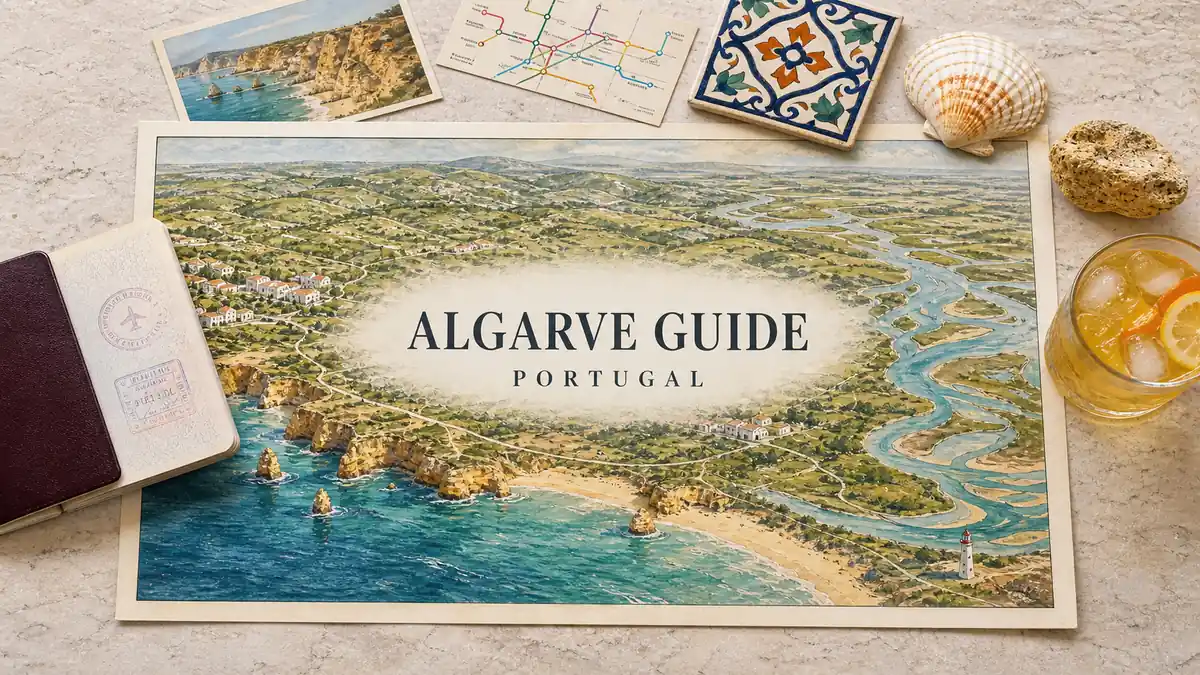
The Algarve is not one destination. It is roughly 150 kilometres of coastline that changes character three times over: wild cliffs and hidden coves in the west, a dense resort machine through the centre, and flat, island-laced lagoons in the east. Travelers who book the wrong stretch rarely have a bad holiday, but they usually have someone else’s holiday.
This guide resolves the decisions that actually shape an Algarve trip. Which stretch fits your travel style. Whether one base is enough or two are worth the hassle. How many days the region genuinely absorbs. Whether you need a car, and what the coast looks like without one. When to go, including the Atlantic detail that catches out visitors expecting Mediterranean water. It orients and routes; the deeper questions belong to the pages linked along the way.
Quick Answer
The Algarve splits into three stretches: cliff-backed west, resort-heavy centre, and quiet lagoon east; pick by trip style. Trip length is the main variable — one well-placed base covers most stays of a week or less, since the region is compact. Fly into Faro; first-timers lean west or central, peace-seekers east.
Trust Layer
Tripstou region guide for travelers planning a regional trip. Covers sub-areas, trip shape, base strategy, timing, and mobility tradeoffs.
Produced with AI assistance and reviewed by Alex Perrut, working in tourism since 2015, for the Tripstou editorial team. See our editorial process for details.
Last factual review: August 28, 2026.
Official sources consulted: Visit Portugal, Turismo de Portugal.
Key Takeaways
- The Algarve divides into three stretches — cliff-backed west, resort-dense centre, flat lagoon east — and picking the wrong one shapes the whole trip.
- One well-placed base covers most trips of a week or less; splitting into two only pays beyond ten days.
- Five to seven days suits a first visit; covering both the western cliffs and the eastern lagoons realistically needs ten.
- A car is optional for a town-centred stay but essential for the quiet coves, which buses barely reach.
- This is the Atlantic, not the Mediterranean: swimmable sea arrives months after the air turns warm, so September beats June.
- Faro Airport and a single coastal motorway make the region feel smaller than its 150 kilometres of coast suggest.
Table of Contents
Where the Algarve Is and How to Get There
The Algarve is Portugal’s southernmost region, a continuous south-facing coast running from the Spanish border to the Atlantic. Faro Airport is the main international gateway. Lisbon sits roughly 275–280 km north, about three hours away by road or rail, which makes the region easy to reach without a second flight.
Faro is the practical entry point for almost every trip. Nearly all international arrivals land there, and the region’s main motorway runs the length of the coast behind the resorts, putting Lagos in the far west about an hour from the airport. That single motorway is why the Algarve feels smaller than its map suggests.
Coming overland from Lisbon is a genuine option, not a fallback. Coaches and trains both make the run in roughly three hours, which suits travelers combining the capital with the coast or arriving into Lisbon on a long-haul route. If the Algarve is one leg of a wider Portuguese trip, the national picture in our Portugal travel guide sets the context, and the rail-based version of that trip is mapped in our Portugal train itinerary.
One geographic quirk shapes everything downstream: the Algarve is long and thin, so distance here is measured east-to-west along a single line, never in loops. Your base is essentially a point on that line, and every day trip is an out-and-back.
West, Central or East: Which Stretch of the Algarve Is Yours?
Choose the west for cliffs and coves, the centre for resort convenience, the east for quiet lagoon beaches. The three stretches share a coastline and little else. Deciding between them before you look at accommodation is the step that shapes the whole trip, because each one rewards a completely different pace.
The split is the standard way the region is divided locally, and it holds up as a planning tool because the landscape genuinely changes. Golden sandstone cliffs dominate from Lagos westward. Through the centre the cliffs soften and the development thickens. East of Faro the coast flattens into sandbars and tidal lagoons, and the beaches sit offshore.
| Stretch | Coastal character | Who it suits | Natural base | Car dependency |
|---|---|---|---|---|
| West (Lagos to Sagres) | Sandstone cliffs, small coves, exposed Atlantic surf | Scenery seekers, walkers, surfers, active couples | Lagos, walkable and well connected | High beyond the town beaches |
| Centre (Albufeira to Carvoeiro) | Broad resort beaches, heaviest tourism infrastructure | Families, first-timers, package and short-break travelers | Albufeira, the region’s busiest hub | Low for a single-base stay |
| East (Faro to Tavira) | Flat sandbars, tidal lagoons, island beaches by boat | Quiet seekers, slow travelers, birdwatchers, returners | Tavira, a riverside town with real local life | Moderate, with useful rail links |
Most disappointment on this coast comes from booking the centre while picturing the west’s scenery. All three stretches have excellent sand; only one of them looks like the photographs that sell the region.
Coastline character is the level this page works at. For which individual beaches earn a detour, see our guide to the best beaches in the Algarve or the wider national ranking in Portugal’s best beaches. Cave trips, boat tours and the region’s headline attractions — Benagil included — are covered in things to do in the Algarve. If your instinct is to avoid the crowds entirely, the quieter corners are mapped in hidden gems in the Algarve.
The West: Lagos to Sagres
The western Algarve is the region’s scenic headline. Ochre cliffs drop into small, sheltered coves reached by steps or by boat, and the coast grows steadily wilder toward Sagres, where the land ends at a windswept headland facing open Atlantic. The water is colder and rougher here, which is exactly why surfers cluster around the western capes.
Lagos is the natural base: a walled historic town with a proper centre, a marina, restaurants that stay open outside the season, and bus links west. The trade-off is that the best coves are strung out along the coast and thinly served by public transport, so a car turns a good stay into a great one.
Best for: travelers who want dramatic coastline and are willing to drive short distances for it.
The Central Algarve: Albufeira to Carvoeiro
The central Algarve is the resort core and the most efficient place to do very little. Beaches are broader and easier to reach than in the west, the infrastructure is unmatched anywhere else on the coast, and everything a family needs sits within a short walk or a short taxi ride. This is the stretch that built the Algarve’s reputation, for better and worse.
Albufeira anchors it, with the widest choice of accommodation, restaurants and organised activity in the region. The trade-off is atmosphere: parts of the centre are loud, heavily commercial and unmistakably built for visitors, and travelers looking for Portuguese daily life will not find much of it here in high season.
Best for: families and first-timers who want convenience and choice within walking distance.
The East: Faro to Tavira and the Ria Formosa
The eastern Algarve is the quiet one, and it looks nothing like the postcards. Cliffs give way to a flat coast fringed by the Ria Formosa lagoon, where sandbar islands sit offshore and are reached by short ferry hops. Towns here are working Portuguese towns first and resorts second, and the pace slows noticeably east of Faro.
Tavira makes the best base: a handsome riverside town with a real local rhythm, its island beach a ferry ride away. Prices across the eastern stretch run noticeably below the western resorts. The trade-off is effort — reaching a beach usually involves a boat and a timetable, so spontaneous swimming is harder than it is further west.
Best for: slow travelers and repeat visitors who value calm over convenience.
Where to Base Yourself: One Base or Two?
One well-placed base covers most Algarve trips. The coast is compact and threaded by a single motorway, so almost anywhere along it is reachable as a day trip from a central position. Split into two bases only when your trip runs beyond a week and genuinely spans the western cliffs and the eastern lagoons.
The logic is distance, and there is not much of it. Driving from one end of the developed coast to the other takes a couple of hours, and most travelers never attempt that in a day anyway. A base in the centre or just west of it puts the majority of the region within an hour’s drive, which is the range at which a day trip stays pleasant.
Two bases start to pay when the trip length makes them cheap in relative terms. On ten days or more, spending the first half in the west and the second in the east removes the longest drives entirely and lets each stretch be experienced at its own pace. Below that, the packing, checking out and re-settling eats an afternoon that a 90-minute drive would have cost you anyway.
This page stops at the level of stretch and town. Which part of a town to sleep in is a different decision, resolved in the town guides. For a sense of how the Algarve’s bases compare with the rest of the country, our guide to the best places to visit in Portugal puts them in national context.
Should You Stay in Lagos or Albufeira?
Stay in Lagos for scenery and a walkable historic centre; stay in Albufeira for convenience, choice and family infrastructure. The two towns are the region’s default bases and they suit clearly different trips.
Lagos combines an old town you can explore on foot with immediate access to the western cliffs and coves, and it keeps a year-round life outside peak season. Albufeira offers the region’s deepest concentration of accommodation, restaurants, transfers and organised activity, with easy beaches and short transfer times from Faro — at the cost of a busier, more commercial atmosphere. Our Lagos travel guide and Albufeira travel guide cover each town in full.
Hotels and places to stay
Compare hotels, apartments and stays for your dates in one search.
Search hotels and stays on hotels.com →
Tripstou may earn a commission if you book through this link, at no extra cost to you.
How Many Days You Need in the Algarve
Five to seven days is the sweet spot for a first Algarve trip. That covers one stretch properly with time to slow down, which is what the region is for. The variable that moves the number is whether you intend to cover one stretch of coast or two — spanning west and east realistically needs ten days.
- 2–3 days: one base, two or three beaches, a single boat trip. Works as an add-on to a Lisbon trip, but it is a taste rather than a holiday.
- 5–7 days: one stretch explored at a relaxed pace, with day trips inland or along the coast and genuine beach time. The right length for most first visits.
- 8–10 days: two stretches, or one stretch plus serious downtime. Enough to add the Ria Formosa islands to a western stay without rushing either.
- 12+ days: the Algarve as one leg of a wider Portuguese route, usually paired with Lisbon and the Alentejo instead of extended on its own.
Beyond ten days the region starts repeating itself, and the better use of the extra time is elsewhere in the country. Our 7-day Portugal itinerary shows how a short Algarve leg fits a first national trip, the 10-day Portugal itinerary gives the coast a fuller share, and the 14-day Portugal itinerary handles the routing when the Algarve is one region among several.
Do You Need a Car in the Algarve?
A car is not essential, but it is what unlocks the coast’s best parts. The Algarve’s finest coves, viewpoints and quieter beaches sit away from the towns and are poorly served by public transport. A single-base, town-centred trip works perfectly well without one, especially in the resort centre.
The car question is really a question about mornings. The best coves empty out before ten and fill by noon, and no bus timetable is built around that window. Drivers effectively get a different beach from the one everyone else photographs at two in the afternoon.
Against that, hiring adds cost, parking near popular beaches is genuinely difficult in summer, and the coastal motorway is tolled. If you are weighing the expense, our Portugal trip cost guide handles the budgeting side. For travelers who decide the driving is the point, our Portugal road trip guide covers the region behind the wheel.
Getting Around the Algarve Without a Car
The car-free Algarve works if you accept a town-centred trip. Three options cover the region, each with a clear tradeoff:
- Vamus Algarve regional buses: the network connecting coastal towns and the airport. Suits travelers moving between towns on a flexible schedule; services thin out toward the beaches and away from the main coastal routes.
- The coastal railway: a single line running roughly parallel to the coast and linking the main towns. Ideal for east–west hops, including Faro to Tavira; stations often sit away from the beaches, so a short onward hop is common.
- Uber and Bolt: both operate in the region and cover the gaps buses leave, particularly for early starts and evening returns. Convenient and flexible, but availability drops in the quieter eastern towns and out of season.
Taxis at the airport and in the busiest resort areas are where visitors most often get overcharged; agree the basis of the fare before setting off. Our guide to common scams in Portugal covers the patterns worth recognising.
Train and bus tickets
Compare routes, schedules and prices across rail and bus operators in one search, with mobile tickets on your phone.
New to Omio? Code NEW10 takes 10% off your first booking — or APPNEW10 if you book inside the Omio app. Both apply to bookings up to €80.
Search routes and compare prices on Omio →
Tripstou may earn a commission if you book through this link, at no extra cost to you.
When to Visit the Algarve
Late spring and September are the strongest windows, with warm weather and far fewer crowds than midsummer. The twist most visitors miss is the sea: this is the Atlantic, not the Mediterranean, and swimmable water arrives later in the year than the air temperature suggests it should.
Sea temperatures sit around the mid-teens Celsius through spring and warm gradually into and through summer, peaking well after the first hot days on land. Air temperature and water temperature run roughly two months out of step here, which is why September usually beats June for actual swimming even though June looks better on paper.
July and August bring the heaviest crowds, the highest prices and the busiest beaches, particularly in the central resorts. Winter is mild and quiet, good for walking the cliffs, but many beach-town businesses reduce hours or close. For the national seasonal picture see our guide to the best time to visit Portugal, and pack for wind and cooler evenings using our Portugal packing list.
Who the Algarve Suits — and Who Should Look Elsewhere
The Algarve is Portugal’s beach-holiday coast, and it is unapologetic about that. It suits travelers who want to settle in one place, swim, eat well and move slowly. Visitors chasing city energy, museum-dense culture or true solitude in high season will find the region thin, and should look north instead.
This is a coast that rewards staying put. Travelers who plan to change base every two days usually discover the region does not have enough variety to justify the movement — and they would have been happier on a route through the north. Food sets the same expectation: it is superb grilled fish and seafood done simply, not a culinary pilgrimage, and our Portugal food guide covers the national picture. Solo travelers do well here, with the resort centre easiest for meeting people and the east quietest; our guide to solo female travel safety in Portugal goes deeper.
If the Algarve sounds like the wrong fit, these regions answer different briefs:
- The Alentejo: empty plains, cork oaks and an undeveloped coast. Suits travelers wanting quiet and countryside; the tradeoff is that you will need a car and a tolerance for long distances between towns.
- The Douro Valley: terraced vineyards, river landscapes and wine estates. Suits food-and-wine travelers and couples; the tradeoff is that it is inland, with no beaches and a short list of towns.
- The Minho: the green north, with historic towns, national park scenery and low tourist density. Suits culture-first travelers; the tradeoff is a cooler, wetter climate than the south.
- Madeira and the Azores: volcanic landscapes, hiking and dramatic coastlines. Suits active travelers and walkers; the tradeoff is a separate flight and a climate that is mild but rarely a beach proposition.
Frequently Asked Questions
Can you swim in the sea in the Algarve?
Yes, but the water is Atlantic and cooler than most visitors expect. Sea temperatures sit around the mid-teens Celsius through spring and warm gradually across summer, peaking well after the hottest air temperatures. Early autumn is usually the most comfortable swimming window; spring swimming suits the hardy.
Is the Algarve good for families?
Yes, and the central stretch is the easiest place to bring children. Broad, sheltered beaches, short walks between accommodation and sand, and the region’s deepest concentration of restaurants and activity remove most of the daily friction. The eastern lagoon towns work well for calmer water and slower days.
Do they speak English in the Algarve?
English is widely spoken across the Algarve, more so than almost anywhere else in Portugal. Decades of international tourism mean hotels, restaurants and tour operators along the coast operate in English as standard. Learning a few Portuguese courtesies is appreciated, particularly in the eastern towns and inland villages.
How do you get from Faro Airport to your resort?
Four options cover almost every arrival: a pre-booked private transfer, a hire car collected at the terminal, the regional Vamus bus network, or Uber and Bolt, which both operate locally. Transfers and hire cars suit late arrivals and families; buses suit flexible solo travelers heading to main coastal towns.
Which Algarve towns are quieter and less touristy?
The eastern towns are consistently the calmest, keeping working Portuguese rhythms alongside tourism instead of being built around it. Inland villages behind the coast are quieter again, though they trade beach access for it. Anywhere in the central resort belt will feel busy from late spring onward.
Is Faro a good base for the Algarve?
Faro suits travelers who want the lagoon coast, city amenities and no transfer at all. It is a real Portuguese city with an old centre, rail links along the coast and ferries to the island beaches. It is a weaker choice if cliff scenery is your priority.
Related Guides
- Portugal itinerary guide — how to build a national route with the Algarve as one leg.
- Best beaches in the Algarve — which stretches of sand justify the drive.
- Things to do in the Algarve — boat trips, caves and the region’s headline experiences.
- Lagos travel guide — the western base in full.
- Albufeira travel guide — the central resort hub in full.
- Best time to visit Portugal — the national seasonal picture behind the Algarve’s timing.
Did this guide save you time or money? Tripstou is independent and reader-funded — if you'd like to give something back, you can support the site with a crypto contribution of any size.