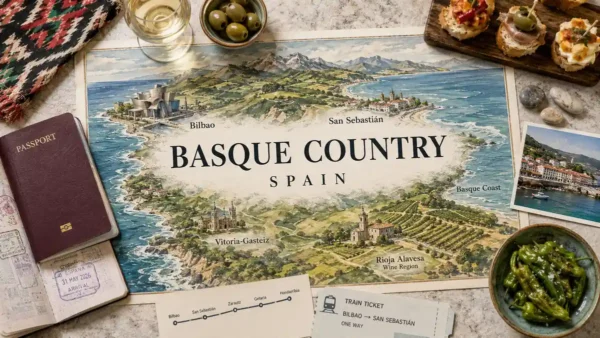
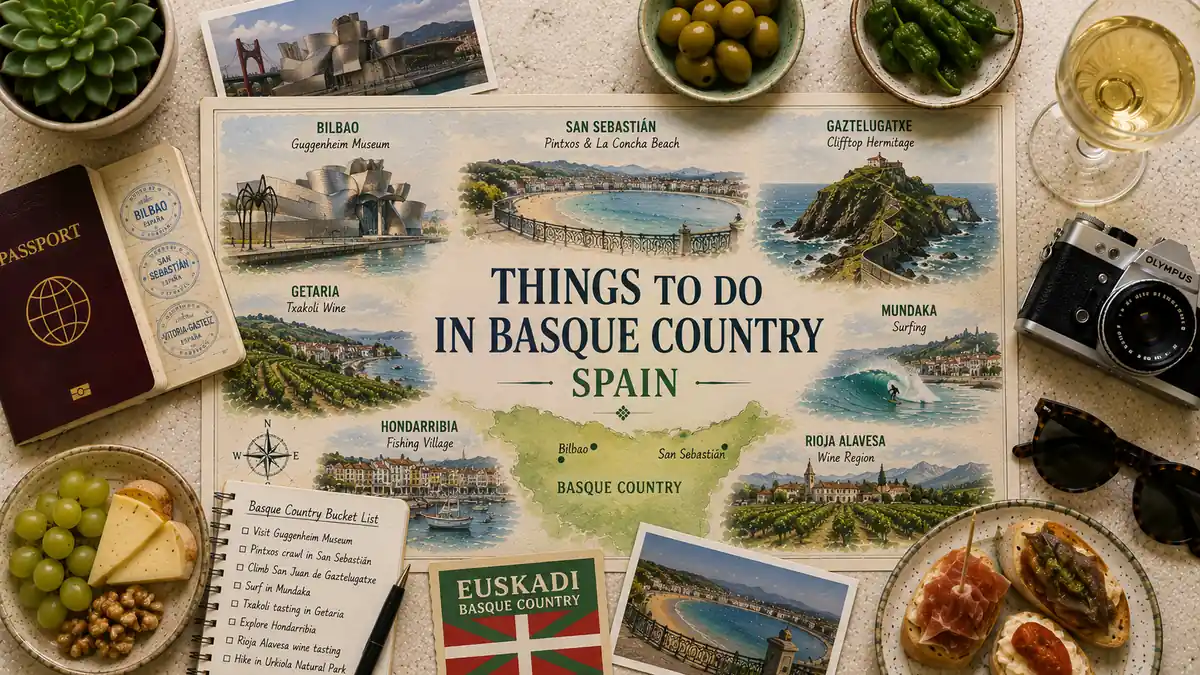
The Basque Country packs world-class art, some of Europe’s best food, and a dramatic Atlantic coastline into a region small enough to cross in a couple of hours. That density is the real planning challenge: there is more worth doing here than most trips have time for, so the useful question is not what to see but what to prioritise. This guide sorts the region’s best experiences into clear types — city art in Bilbao, food and wine around San Sebastián, and the coast and outdoors along the shoreline — so you can build a plan around what actually matters to you. Each experience below comes with a plain “Pick this if” line, so you can scan for your kind of trip and skip the rest. Whether you are a museum-first traveller, a dedicated eater, or a surfer chasing waves, the shortlist that follows tells you where your days are best spent.
Quick Answer
The Basque Country’s marquee experiences are Bilbao’s Guggenheim, San Sebastián’s pintxos and La Concha beach, and the dramatic coast. Experiences cluster into city art, food and wine, and coast or outdoors — pick by the trip you want. Most trips comfortably combine Bilbao’s art, San Sebastián’s food, and a coastal day.
Trust Layer
Tripstou selection guide for travelers choosing between multiple places. Covers selection criteria, traveler fit, and trip value.
Produced with AI assistance and reviewed by Alex Perrut, working in tourism since 2015, for the Tripstou editorial team. See our editorial process for details.
Last factual review: July 18, 2026.
Official sources consulted: spain.info, tourspain.es.
Key Takeaways
- Bilbao’s Guggenheim anchors the region’s best art experience — pair it with the walkable old town for a full first day.
- Food lovers should base in San Sebastián for its pintxos crawl, then add txakoli in Getaria and Rioja Alavesa’s reds.
- For coast and outdoors, prioritise Gaztelugatxe’s clifftop climb, surfing at Mundaka, and slow days in fishing villages like Hondarribia.
- Most trips comfortably combine Bilbao’s art, San Sebastián’s food, and one coastal day without feeling rushed across the compact region.
- The main planning variable is seasonal access — Gaztelugatxe entry, surf swell, and museum hours all shift, so check current details before you go.
- Trip length and day-by-day routing live elsewhere; this shortlist covers what to do, not how many days to spend.
Table of Contents
Bilbao: The Guggenheim and City Art Scene
Bilbao’s Guggenheim is the region’s signature experience — a Frank Gehry landmark that anchors an easy, walkable art-and-food city. The titanium-clad museum reshaped Bilbao from industrial port to design destination, and it sits within a compact centre you can explore on foot. Pair it with the old town and riverfront for a full day.
Bilbao works best as a one- to two-day city stop where the museum is the headline and the streets around it are the supporting act. The centre is flat and compact, so most visitors walk between the Guggenheim, the riverside promenade, and the old town without any transport. It is Spain’s most distinctive slice of the wider range of things to do in Spain, and a natural first base for a Basque trip.
The Guggenheim’s exterior and the plaza around it cost nothing to experience, and many travellers get the biggest hit of the building from outside — before deciding whether the collection inside justifies a ticket. The giant flower “Puppy” and the waterside sculptures are all free to see.
The Guggenheim Museum
The Guggenheim Bilbao is a work of architecture first and a modern-art museum second. Gehry’s curving titanium shell is the reason most people come, and its rotating exhibitions matter more than any fixed collection. Ticket types, opening hours, and timed entry change, so check current details before you go and consider booking ahead in peak season.
- Standard entry suits most visitors and covers the main exhibitions.
- Guided tours and audio guides suit anyone who wants the architecture story, not just the art.
- Combined culture tickets can suit travellers planning several Bilbao museums.
Pick this if: you want one unmissable piece of world-class architecture and modern art as your trip’s anchor.
Bilbao’s Old Town and Riverfront
Bilbao’s Casco Viejo delivers the city’s food-and-atmosphere experience away from the museum crowds. Its seven original streets are dense with pintxos bars, market halls, and small shops, while the riverfront promenade links the old town to the Guggenheim in a flat, scenic walk. It is where Bilbao feels like a lived-in Basque city rather than a design showcase.
Pick this if: you would rather graze pintxos and wander riverside streets than spend hours inside a museum.
Tours and activities
Book skip-the-line tickets, day trips and local tours with free cancellation on most activities.
You can also browse everything on getyourguide.com.
Tripstou may earn a commission if you book through this link, at no extra cost to you.
San Sebastián: Pintxos Bars and La Concha Beach
San Sebastián pairs the world’s densest pintxos scene with La Concha, one of Europe’s finest city beaches. The old town’s bars serve counter-top bites you eat standing, moving from place to place, while the shell-shaped bay curves right up to the centre. It is the region’s food-and-beach highlight, and reason enough for many to base here.
San Sebastián rewards travellers who treat eating as the main event. The Parte Vieja, or old town, is where you crawl from bar to bar, ordering one or two pintxos and a small drink at each before moving on. La Concha bookends the day: an arc of golden sand backed by an elegant promenade, calm enough for a swim and made for an evening walk. The city carries a Michelin reputation too, but the standing-and-grazing bar culture is the experience that defines it.
Between bites, the walk up Monte Urgull or a stroll to the aquarium gives the food day some shape. Keep expectations simple. You do not book a pintxos crawl — you join it.
Pick this if: eating is the point of your trip and you want the densest concentration of great bars in Europe.
Basque Food and Wine Experiences Worth Seeking Out
Beyond pintxos, the Basque food story runs through txakoli in Getaria and the red wines of Rioja Alavesa. The region treats eating and drinking as a core reason to visit, not a sideshow, and its two signature pours sit within easy reach of the coast. These experiences reward travellers who plan a day or two around the table.
The three experiences below layer onto a food trip without repeating the San Sebastián bar crawl. One is an evening ritual, one a coastal white-wine stop, and one an inland wine-country day. Tour access, tasting fees, and winery visits change with the season, so confirm current details and book ahead where visits require it.
Rioja Alavesa sits closer to Bilbao and San Sebastián than most people expect, which is what makes a Basque wine day realistic without giving up a coast day.
A Pintxos Crawl
A pintxos crawl is the region’s defining food ritual: several bars, one or two bites at each, over a single evening. It differs from a sit-down meal because the movement is the point — you follow the crowd, order the house speciality, and keep going. Bilbao’s Casco Viejo and San Sebastián’s Parte Vieja are the two strongest hunting grounds.
Pick this if: you want to turn dinner into a moving feast across several bars in one evening.
Txakoli on the Coast (Getaria)
Getaria is the home of txakoli, the crisp, slightly fizzy Basque white poured from a height to open it up. Tasting it where the vines grow, on slopes running down to the sea, is a short and distinctive coastal experience. Here Getaria is a wine stop; its harbour-town character sits further down this guide.
Pick this if: you like crisp, low-alcohol white wine poured from a height, straight from where it is made.
Rioja Alavesa Wine Country
Rioja Alavesa is the Basque slice of Rioja, known for serious reds and striking modern winery architecture set among vineyards and hilltop villages. It makes a full inland day away from the coast and pairs well with lunch in a walled village like Laguardia. Winery visits usually need booking, and access is easiest with a car or an organised tour.
Pick this if: you want serious red wine and dramatic modern wineries within an easy inland drive.
Surfing and Beach Days on the Basque Coast
The Basque coast offers world-class surf at Mundaka plus gentle beach breaks for beginners and families. Its shoreline mixes serious surf towns with calm, sheltered bays, so both experienced surfers and people who just want a swim are well served. Where you go depends entirely on whether you are chasing waves or a relaxed day on the sand.
The coast splits cleanly into two kinds of day, covered in the pick blocks below. Surf lessons, board rental, and the best swell windows shift through the year, so confirm current conditions and rates locally instead of assuming. A coastal day also slots neatly into a wider trip when you want to fit it into a day-by-day Spain itinerary.
Mundaka’s wave only breaks properly with the right swell and tide, so the town rewards surfers who stay flexible on dates far more than those locked to a single afternoon.
Surfing Mundaka and Beginner Breaks
Mundaka is the Basque coast’s famous surf spot, a long left-hand river-mouth wave that draws experienced surfers from across Europe. Beginners are better served by the mellow beach breaks around Zarautz and Sopelana, where surf schools cluster and the waves forgive mistakes. The two ends of the skill range sit close together, so a mixed group can split by ability and regroup for lunch.
Pick this if: you surf, or want a lesson, and want to watch or ride a genuinely famous wave.
Best Beaches for a Coastal Day
The coast’s calm bays are made for a slow beach day rather than a surf mission. La Concha in San Sebastián is the showpiece, but quieter sands at Zarautz, Lekeitio, and Bakio give you space and easy swimming. These beaches suit families and anyone who wants sun, a swim, and a seafood lunch without paddling out.
Pick this if: you want a relaxed beach day with calm water instead of a surf mission.
How Do You Visit San Juan de Gaztelugatxe?
You visit San Juan de Gaztelugatxe by crossing a stone footbridge and climbing a stairway to its hilltop hermitage. The reward is a dramatic clifftop setting that has become one of Spain’s most photographed coastal spots. It is a half-day outing built around a moderately demanding walk, not a quick roadside stop.
The islet sits on the coast between Bilbao and Bermeo, and reaching the hermitage means a downhill approach followed by a steep climb up the winding steps — comfortable shoes matter more than anything else. Access has at times required a free timed reservation, and the site can close in rough weather or for maintenance, so check the current rules before you set out. It also earned wider fame as a television filming location, which is why it now draws steady crowds. Getting there, when to go, and where to base yourself are all covered in our Basque Country guide.
Gaztelugatxe photographs best from the clifftop approach, not the island itself — the view you came for is on the walk down, which matters if entry to the hermitage is capped or closed.
Pick this if: you will trade a steep climb for one of Spain’s most photographed coastal views.
Basque Coastal Villages Worth a Detour
Getaria, Lekeitio, and Hondarribia give the Basque coast its harbour-town character, each with a distinct pull. Getaria is a working fishing port with a fashion-history twist, Lekeitio a laid-back beach town, and Hondarribia a colourful walled town near France. Any one makes an easy detour that shows a slower side of the region.
These are marquee coastal towns, not obscure hideaways, and each earns a stop for a different reason. They also sit among the wider set of best places to visit in Spain, which is where a national where-to-go plan belongs. Keep them to what they feel like — the logistics live on the region guide.
Getaria
Getaria is a compact fishing harbour best known for grilled fish cooked over open coals on the quayside and as the birthplace of couturier Cristóbal Balenciaga, honoured in a museum here. That mix of working port and fashion heritage sets it apart from the other villages. This is Getaria’s harbour angle; its txakoli story sits in the food-and-wine section above.
Pick this if: you want a working fishing harbour with a fashion-history twist.
Lekeitio
Lekeitio is the most relaxed of the three, a beach town built around a pretty harbour and a tidal island you can walk to across the sand at low tide. It trades big-name sights for an easy, local seaside rhythm. Time a visit around the tide and the island crossing becomes the highlight.
Pick this if: you want a laid-back beach town with a tidal island you can walk to at low tide.
Hondarribia
Hondarribia is a walled old town of brightly painted balconies stacked above a fishing quarter, sitting right on the border river across from France. Its colourful streets and marina give it the most photogenic townscape of the three, and a French day trip is within easy reach. It suits travellers who want architecture and colour alongside the harbour.
Pick this if: you want a colourful walled old town within reach of the French border.
Outdoor and Hiking Experiences in the Basque Country
Beyond cities and beaches, the Basque Country offers coastal cliff walks and green inland hills for easy hiking. The landscape shifts quickly from Atlantic shoreline to rolling farmland and low mountains, giving casual walkers plenty of scenery without technical routes. These outings round out a trip that is otherwise heavy on food, art, and towns.
The strongest light-outdoor experiences fall into two groups. On the coast, cliff-top paths and the Flysch shoreline near Zumaia deliver big sea views on gentle, well-marked trails. Inland, green valleys and the hills around the region give easy day walks and viewpoints without serious elevation. Both suit travellers who want fresh air and movement between city and food days, not a hardcore trekking holiday.
Pick this if: you want to stretch your legs on coastal cliffs or green inland hills between city days.
Frequently Asked Questions
Is the Basque Country worth visiting?
Yes, the Basque Country is well worth visiting for its rare mix of world-class art, exceptional food, and dramatic Atlantic coast in a compact area. Bilbao’s Guggenheim, San Sebastián’s pintxos, and clifftop Gaztelugatxe headline a region where you can pack culture, cuisine, and coast into a short trip.
What is the Basque Country most famous for?
The Basque Country is most famous for its food — pintxos bars in San Sebastián, txakoli wine, and Michelin-starred cooking — alongside Bilbao’s Guggenheim Museum. It is also known for the Basque language and culture, the surf wave at Mundaka, and the clifftop hermitage of San Juan de Gaztelugatxe.
Can you combine Bilbao, San Sebastián, and the coast in one trip?
Yes, the Basque Country is compact enough to combine all three easily. Bilbao and San Sebastián sit about an hour apart, with the coast, Gaztelugatxe, and fishing villages in between. A common approach is Bilbao’s art, San Sebastián’s food, and a coastal day — how you sequence those days is a separate planning question.
Is the Guggenheim Bilbao worth visiting?
Yes, the Guggenheim Bilbao is worth visiting even if modern art is not your priority, because the Frank Gehry building is the real attraction. Its curving titanium exterior and surrounding plaza are free to see, so many travellers enjoy the architecture outside before deciding whether the rotating exhibitions justify a ticket.
Do you need to book San Juan de Gaztelugatxe in advance?
Often, yes — access to San Juan de Gaztelugatxe has at times required a free timed reservation, especially in busy periods. Rules change and the site can close in rough weather or for maintenance, so check the current booking requirements before you travel. Comfortable shoes matter more than anything for the steep climb.
Is the Basque Country a good destination for families?
Yes, the Basque Country works well for families thanks to calm city beaches, easy coastal towns, and short distances between stops. La Concha and sheltered bays like Zarautz and Lekeitio suit swimming, while gentle cliff walks and surf lessons for beginners give older children plenty to do without long travel days.
Related Guides
- Basque Country guide — where to stay, getting around, when to go, and how many days the region needs.
- Spain itinerary — day-by-day routing to slot the Basque Country into a wider trip.
- Best places to visit in Spain — how the Basque towns rank among the country’s top destinations.
- Things to do in Spain — the national picture of experiences beyond the Basque region.
Did this guide save you time or money? Tripstou is independent and reader-funded — if you'd like to give something back, you can support the site with a crypto contribution of any size.