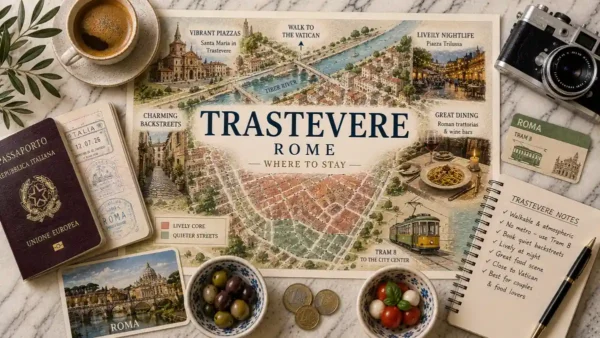

Choosing a Rome base often comes down to two neighborhoods: Centro Storico and Trastevere. Both sit within walking distance of the historic center, both book out fast, and both suit travelers who have already ruled out sleeping in the outer city. This guide compares them head to head on the axes that actually decide the booking — proximity to the major sights, price and value, atmosphere, nightlife, getting around, and first-trip fit. It does not describe either area in isolation. It arbitrates the choice. By the end you will have a clear verdict on which one fits your trip, plus the one exception where the other area wins. Read the scoreboard first, then jump to the dimension that matters most to you.
Quick Answer
Book Centro Storico for a first Rome trip built around walking to the Pantheon, Trevi, and Piazza Navona. Trastevere wins if you prioritize local atmosphere, lively evenings, and generally lower room prices. Use proximity versus atmosphere as your tie-breaker, since both neighborhoods stay walkable to the historic center.
Trust Layer
Tripstou comparison guide for travelers choosing between options. Covers tradeoffs, traveler fit, and decision logic.
Produced with AI assistance and reviewed by Alex Perrut, working in tourism since 2015, for the Tripstou editorial team. See our editorial process for details.
Last factual review: July 13, 2026.
Official sources consulted: Italia.it, ENIT — Italian National Tourist Board.
Key Takeaways
- Book Centro Storico for a first Rome trip: its historic-core location puts the Pantheon, Trevi, and Piazza Navona within an easy walk.
- Choose Trastevere if you want local atmosphere, lively evenings, and generally lower mid-range room prices over walk-out proximity to the monuments.
- The core tradeoff is proximity versus atmosphere: Centro Storico saves walking time, while Trastevere trades a river crossing for neighborhood character.
- Trastevere is the stronger base for nightlife and mid-range value, but book a set-back room to avoid noise past midnight.
- Do not assume Trastevere is far from the sights: it stays walkable to the historic center across a single bridge.
Table of Contents
How do Centro Storico and Trastevere compare?
Centro Storico and Trastevere differ on one core axis: central-and-walkable versus local-and-lively. Centro Storico is Rome’s historic core, so most first-timers who want to walk to the headline sights should start there. Trastevere trades a little distance for lower prices and a stronger neighborhood feel.
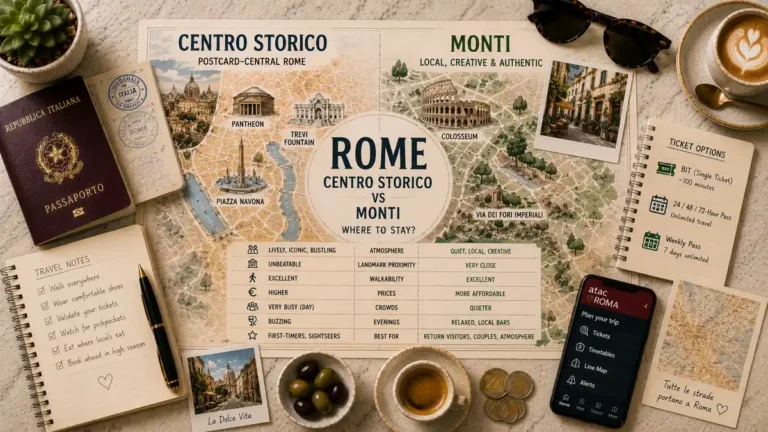
The scoreboard below maps the full comparison. Each row matches a dimension section further down, with the same winner and the same reasoning — it summarizes the page and never introduces a verdict the detail sections do not defend.
| Dimension | Winner | Why |
|---|---|---|
| Proximity to major sights | Centro Storico | Historic core; walk to the Pantheon, Trevi, and Navona cluster |
| Price and value | Trastevere | More mid-range rooms; Centro Storico carries a central premium |
| Local atmosphere | Trastevere | Residential, neighborhood feel over monumental streets |
| Nightlife and evening buzz | Trastevere | Denser bar scene and later evening energy |
| Getting around | Tie | Neither has an in-area metro; Centro Storico shortens walks |
| First Rome trip | Centro Storico | Lowest-friction base for walking to the top sights |
The scoreboard tilts to Trastevere on three of six axes, yet Centro Storico still wins most first bookings. Proximity outweighs three softer wins when your days are short and packed with monuments. For how these two fit alongside Rome’s other lodging neighborhoods, see the Rome where-to-stay overview.
Centro Storico wins for proximity to the major sights
Centro Storico is the closer, more walkable base for Rome’s headline sights. It is the historic core itself — the Pantheon, Piazza Navona, Trevi Fountain, and Campo de’ Fiori sit inside or beside it. Trastevere lies across the Tiber on the west bank, adding a river crossing to those same walks.
The practical effect is a shorter, more frequent commute to what you came to see. From a Centro Storico base you can string together the Pantheon, Trevi, and Navona on foot in a single loop, then return midday to drop bags or rest. From Trastevere the same circuit means crossing a bridge each way, which is pleasant but adds time to every outing.
- Centro Storico strength: the marquee monuments are on your doorstep, so short trips lose no time in transit.
- Trastevere tradeoff: a river crossing separates you from the core, which reads as scenic on day one and repetitive by day three.
Distances here are relative, not exact — walking times shift with your exact street and pace. For a full picture of the core’s layout and pockets, read the Centro Storico area guide.
Which area is cheaper to stay in?
Trastevere is generally the cheaper of the two for comparable mid-range rooms. Centro Storico carries a central-core premium: you pay extra to sleep steps from the Pantheon and Trevi. The gap is real but not enormous, and it narrows at the top luxury end, where both areas run expensive.
Treat any price figure as a moving range and verify before booking — rates swing with season, demand, and how far your room sits from the main squares. As a rule, the closer you book to a headline sight in Centro Storico, the steeper the nightly rate climbs.
- Book Trastevere to stretch a mid-range budget: the same nightly spend usually buys more room or a better location.
- Book Centro Storico when walk-out convenience is worth the premium: you are paying for steps saved, not square meters.
The value edge shrinks fastest at the luxury tier, where address prestige compresses the gap. For budget-first tactics see the budget Rome stay guide; for the top end, compare picks in the Rome luxury hotels guide.
Trastevere feels more local; Centro Storico feels more central
Trastevere feels more local; Centro Storico feels more central. Trastevere’s cobbled lanes, ivy-draped facades, and neighborhood trattorias read residential by day, especially away from the main squares. Centro Storico is grander and more monumental — and correspondingly more tourist-dense, since Rome’s most photographed sights all cluster inside it.
The distinction is about texture, not one being better. Centro Storico gives you postcard Rome at every turn, with the crowds that come attached. Trastevere gives you a lived-in quarter where laundry hangs over the alleys and locals still outnumber visitors on the back streets, though its central piazzas fill with tourists by evening too.
Pick Trastevere if a neighborhood feel is part of the trip you want; pick Centro Storico if being surrounded by the monuments is the point. Neither is wrong — they answer different briefs. For the full character of the west-bank quarter, read the Trastevere area guide.
Trastevere leads on nightlife — but expect noise at night
Trastevere leads on nightlife, and that same energy makes some streets noisy after dark. Its lanes hold a dense concentration of bars and late-evening buzz that draws crowds well past midnight. Centro Storico is livelier for sit-down dining than for late bars, and its residential streets stay quieter overnight.
That makes the nightlife win a double-edged one. If you want to walk out your door into the evening scene, Trastevere delivers. If you want to sleep through it, the exact street matters more here than in any other Rome-base decision: a room one lane back from Piazza Trilussa or Santa Maria in Trastevere can be the difference between charming and sleepless.
- Trastevere for going out: the highest bar density and the latest energy of the two.
- Centro Storico for early nights: strong for dinner, quieter once the restaurants close.
Ask for a courtyard-facing or upper-floor room away from the main piazzas if you book Trastevere for the buzz but still want to sleep. For a deeper look at going-out bases, see the Rome nightlife stay guide.
Getting around: is there a metro in either area?
Neither Centro Storico nor Trastevere has an in-area metro station. Both rely on walking, trams, buses, and taxis to move around Rome. Centro Storico’s central position shortens the walks to the headline sights, while Trastevere leans more on trams and a short bridge crossing to reach the core.
In practice this matters less than it sounds, because both areas are built for walking. Rome’s compact historic center means the sights you came for are on foot from either base; the metro is more relevant for reaching outer landmarks than for daily sightseeing between the two neighborhoods. Confirm current tram and bus routes locally before you rely on a specific line.
Taxis and rideshares fill the gap for late arrivals or tired evenings from both areas. For citywide transport, tickets, and getting-in logistics, use the Rome travel guide.
Centro Storico is the safer pick for a first Rome trip
Centro Storico is the safer pick for a first Rome trip. Walk-everywhere access to the top sights means less time working out transport and more time seeing the city. Trastevere is the reward-return base — better suited to repeat visitors and atmosphere-seekers who already know the layout and want a neighborhood feel.
The logic is about friction, not risk. A first-timer with a tight list of must-sees benefits from waking up inside the monument cluster, where a wrong turn still lands you at something famous. A returning visitor who has already ticked off the Pantheon and Trevi gains more from Trastevere’s evenings and local texture than from another night beside the crowds.
If it is your first Rome trip and you only book one area, Centro Storico is the lower-regret choice. For a fuller breakdown of the first-timer fit, see the first-time Rome stay guide.
How to choose between Centro Storico and Trastevere
The choice comes down to what your trip optimizes for: sights or atmosphere. Centro Storico wins when walking to Rome’s monuments is the priority and short days need to run efficiently. Trastevere wins when local character, evenings out, and room value matter more than shaving minutes off the walk.
Use the two condition lists below as the tie-breaker. They are mutually exclusive — if you find yourself nodding at both, weight the top item on each list, since that is the axis you will feel every day of the trip.
Choose Centro Storico if:
- It is your first Rome trip and the headline sights top your list.
- You want to walk out the door straight into the monuments.
- Your stay is short and every hour of sightseeing counts.
- Quiet residential streets at night matter more than an evening scene.
Choose Trastevere if:
- You have seen the core before and want a neighborhood feel this time.
- Lively bars and late evenings are part of the plan.
- You want more room or a better location for a mid-range budget.
- A river crossing to the sights is a fair trade for local atmosphere.
Hotels and places to stay
Compare hotels, apartments and stays for your dates in one search.
Search hotels and stays on hotels.com →
Tripstou may earn a commission if you book through this link, at no extra cost to you.
Frequently Asked Questions
How far is Trastevere from the Colosseum and the Vatican?
Both are reachable from Trastevere, though neither sits next door. The Vatican lies a moderate walk or short tram ride north along the same west bank, so it is the closer of the two. The Colosseum sits across the Tiber on the east side, making it a longer walk or a tram-and-bus hop.
Is Trastevere safe to stay in at night?
Trastevere is generally considered a safe, popular place to stay at night, busy with diners and bar-goers well into the evening. As in any lively tourist quarter, the usual big-city caution applies: watch for pickpockets in crowds and stick to well-trafficked lanes. The crowds that fuel its nightlife also keep the streets active.
How many nights should you stay in Centro Storico vs Trastevere?
For most first Rome trips, base all your nights in one area rather than splitting them, since both sit within easy reach of the center. Choose Centro Storico if your stay is short and sight-focused. If you have several nights or a repeat visit, Trastevere rewards the extra time with atmosphere.
Can you walk between Trastevere and Centro Storico?
Yes, the two areas are within walking distance, separated mainly by the Tiber and one of its bridges. A stroll from Trastevere into Centro Storico crosses the river and lands you near Campo de’ Fiori or Piazza Navona. The walk is short and scenic, which is why both count as central bases.
Which area is quieter for sleeping?
Centro Storico’s residential streets are generally the quieter overnight, since Trastevere’s bar lanes stay lively past midnight. But the exact street matters more than the area: a courtyard-facing or upper-floor room set back from the main piazzas can be quiet in either. Ask about the room’s position before booking.
Which area is better value for a short trip?
For a short, sight-packed trip, Centro Storico often delivers better overall value despite higher room rates, because its central position saves time on every outing. Trastevere is the stronger pick when nightly price is your main lever or your trip runs longer. Value here depends on whether you are buying time or savings.
Related Guides
Go deeper on the areas, the persona verdicts, and the wider Rome stay picture with these next-step guides:
- Rome where-to-stay overview — how every base neighborhood compares.
- Centro Storico area guide — the historic core in full detail.
- Trastevere area guide — the west-bank quarter in full detail.
- First-time Rome stay guide — the lowest-friction base for a debut trip.
- Rome stay guide for couples — the romantic-fit verdict by area.
- Rome stay guide for families — the practical-fit verdict for traveling with kids.
- Luxury Rome stay guide — the top-tier base and address picks.
Did this guide save you time or money? Tripstou is independent and reader-funded — if you'd like to give something back, you can support the site with a crypto contribution of any size.