Choosing where to stay in Venice with kids comes down to one tradeoff: centrality versus space, quiet, and stroller-sanity. Venice is bridge-heavy — every canal crossing is a flight of steps — and San Marco, the tourist core, is the most crowded and expensive part of the city. Families who book there for “central” access often spend the trip hauling strollers over bridges and dodging day-trippers.
This guide resolves the area decision and nothing else. It names the best overall family base, walks the four areas that genuinely suit families, maps common family types to the right area, and settles the apartment-versus-hotel question. For actual hotel picks and full neighborhood detail, it points you to the right deeper pages. No sightseeing itineraries here — just the base-selection call so you can book with confidence.
Quick Answer
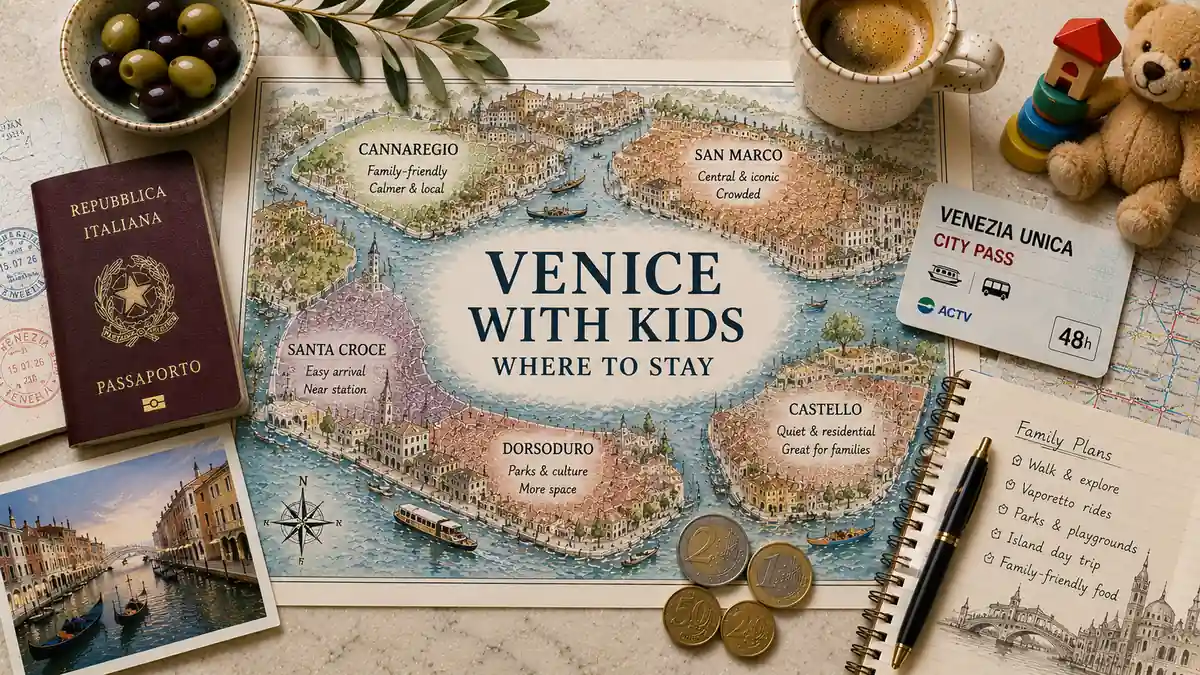
Cannaregio is the best overall Venice base for most families — calmer, roomier, and easy to walk with kids. The tradeoff is centrality: basing away from San Marco means slightly longer walks or a vaporetto hop to headline sights. Families wanting parks lean Dorsoduro or Castello, and a rented apartment usually beats a hotel.
Trust Layer
Tripstou stay guide for travelers choosing where to base. Covers area atmosphere, budget, convenience, noise, and traveler fit.
Produced with AI assistance and reviewed by Alex Perrut, working in tourism since 2015, for the Tripstou editorial team. See our editorial process for details.
Last factual review: July 16, 2026.
Official sources consulted: italia.it, enit.it.
Key Takeaways
- Cannaregio is the best all-round family base — quieter streets, more space, and the fewest bridges to lift a stroller over.
- The real family choice trades centrality for space and quiet, so basing away from San Marco usually beats booking inside it.
- Families wanting parks lean Dorsoduro or Castello, while those arriving with heavy luggage favor Santa Croce near Piazzale Roma.
- Areas away from San Marco — Cannaregio edges, Santa Croce, Castello — tend to run mid-range, while the central core commands top prices.
- A rented apartment usually beats a hotel for families, adding space, a kitchen for picky eaters, and better value per head.
- The common mistake is booking San Marco for “central” access, then fighting crowds and hauling a stroller over bridges all trip.
Table of Contents
Cannaregio is the best overall base for families in Venice
Cannaregio is the best all-round family base in Venice — quieter, roomier, and easy to walk with children. As one of the largest residential districts, it trades tourist density for wide canal-side promenades, everyday shops, and calmer streets where kids can walk without a constant crowd. It stays well connected to the rest of the city.
The atmosphere is the draw. Away from the main tourist funnels, Cannaregio feels like a neighborhood where Venetians actually live — bakeries, playgrounds, and long, flat fondamenta where a stroller rolls for minutes without hitting a bridge. Evenings are calm. Kids nap; parents breathe.
On convenience, it holds up well. The area connects to the train station and vaporetto lines, so reaching San Marco or the islands is a straightforward walk or water-bus hop rather than a fight through crowds. You lose a little immediacy to the headline sights and gain a base you can actually relax in.
The number that matters most for families here is not distance to San Marco — it is how many bridges sit between your door and the nearest vaporetto stop, since every bridge is a stroller lifted by hand. Cannaregio’s long straight quaysides keep that count low.
On price, Cannaregio generally sits mid-range — noticeably softer than the central core, with a spread of apartments and family-sized rooms. For a fuller sense of the neighborhood beyond the family angle, see the Cannaregio neighborhood guide, and to compare it against every other base for all traveler types, use the Venice where-to-stay overview.
Best for: most families — especially those with young kids who want space, calm, and easy walking without giving up connections to the sights.
Dorsoduro suits families who want open space and calm
Dorsoduro suits families who want open waterfront space and a calmer, local rhythm. The airy Zattere promenade, wide sunlit campos, and a relaxed neighborhood feel give kids room to roam away from the tightest crowds. The tradeoff is distance — it sits a walk or short vaporetto ride from the main sights.
The Zattere is the headline asset for families. It is a long, open, water-facing promenade where children can walk or scoot in a straight line, with gelato stops and boats to watch. Campo Santa Margherita adds a lively square with room to move. This is the airy, outdoors-leaning side of central Venice.
Convenience is solid without being central. Dorsoduro links to San Marco by a couple of bridges or one short vaporetto hop, and the Accademia sits on its edge. You are close enough for easy days out and far enough for quiet nights.
Price tends to run mid-range to upper, nudged by the neighborhood’s popularity and canal-view rooms. Families weighing this airier base directly against staying in the center should read the San Marco versus Dorsoduro comparison, and the full Dorsoduro neighborhood guide covers the area beyond the family lens.
Best for: families with older kids or a stroller who prioritize open promenade space and a calmer, local feel over being steps from the crowds.
Castello gives families the most breathing room
Castello gives families the most breathing room of any Venice base. The Giardini Pubblici park and the wide, quiet lanes of the eastern district give kids green space and room to run — rare in Venice. That openness comes at the cost of distance from the main sights.
Green space is the differentiator. The Giardini Pubblici is one of the few real parks in the historic city, with grass, trees, and paths where children can burn energy off-canal. The eastern reaches of Castello are residential and unhurried, far from the day-tripper flow.
The catch is walking time. From deep Castello, the main sights are a longer stroll or a vaporetto ride, so this base rewards families who plan slower, fuller days over dashing between attractions. Multi-generational groups with mixed walking speeds tend to appreciate the calmer pace.
On price, Castello often lands at the gentler end of central Venice — its distance from the tourist core keeps rates more moderate, though the marina-side pockets run higher. Value per room tends to be strong for families needing space.
Best for: families and multi-generational groups who want green space, quiet, and room to spread out, and don’t mind being furthest from the crowds.
Santa Croce works for families arriving by train or car
Santa Croce is the easiest base for families arriving by train or car. It sits closest to Piazzale Roma and the rail arrival edge, so you cross the fewest bridges hauling luggage and a stroller on day one. That convenience matters most at arrival and departure, less so once you are settled.
Arrival day is where this area earns its place. Piazzale Roma — where cars, buses, and the people-mover terminate — and the Santa Lucia rail edge are right here, so the walk to your door is short and low on bridge-climbing with bags and a pram in tow. For families dreading the first-day luggage haul, that alone can decide the base.
Beyond arrival, Santa Croce is quieter and less polished than the central sestieri, with a mix of local streets and some transit bustle near Piazzale Roma. Sights are a manageable walk or a vaporetto ride along the Grand Canal. Keep the arrival advantage in perspective — it is a day-one convenience, not an everyday one.
Price generally sits mid-range, softened by the area’s workaday feel and distance from the marquee squares. It is a practical, value-minded base rather than a scenic one.
Best for: families arriving by train, bus, or car — especially with heavy luggage or a stroller — who want the shortest, flattest haul into the city.
Should families avoid San Marco?
Mostly yes — San Marco is the most crowded, most expensive, and hardest base for young kids. As the tourist core, its narrow lanes fill with day-trippers, prices run high, and moving a stroller through the crush is a daily chore. It only works for short, sights-first trips with older children.
The crowding is structural, not seasonal. San Marco is where the day-trip flow concentrates, so the streets that look “central” on a map are also the tightest and busiest — awkward with a pram and stressful with small children who wander. Rooms here command the city’s top prices for the least family space.
San Marco’s real family cost isn’t the nightly rate — it is that the crowds peak at exactly the hours you’d want to walk kids to breakfast or back for a nap. That daily friction is what tips most families toward a calmer base.
There is a narrow case where it fits: a short two- or three-night trip, older kids who walk all day, and a sights-first plan where being steps from the Basilica outweighs space and quiet. If you are torn between the center and a calmer base, the San Marco versus Cannaregio comparison settles the head-to-head, and the San Marco neighborhood guide covers the area in full.
Best Venice areas for families by type
Match your family type to an area with one rule of thumb. The more open space and fewer bridge crossings you need, the further from San Marco you should base. The table below maps the most common family types to the area that fits them and the tradeoff each accepts.
| Family type | Recommended area | Why it fits | Main tradeoff |
|---|---|---|---|
| Toddlers or a stroller | Cannaregio | Fewest bridges and most step-free walking | Some canal crossings still remain |
| Older kids who walk all day | Dorsoduro | Walkable and close for easy self-guided days | A walk or hop from the core |
| Multi-generational group | Castello | Green space and a slower pace for mixed ages | Furthest from the main sights |
| Budget-conscious family | Santa Croce or Cannaregio edges | More room per euro away from the center | Fewer marquee sights on the doorstep |
Read the table as a starting point, not a rule. Families needing both fewest bridges and green space split the difference between Cannaregio and Castello, while those chasing value with older kids can stretch toward Santa Croce without much loss. The constant across every row is simple. Space and calm live away from San Marco.
Apartment or hotel in Venice with kids?
For most families a rented apartment beats a hotel in Venice. An apartment adds space, a kitchen for fussy eaters and early breakfasts, laundry for long trips, and better value per head. Hotels win when you want daily service, housekeeping, and no self-catering.
The two options suit different families:
- Apartment — best for most families, especially with young kids or longer stays. You get separate sleeping space, a kitchen for picky eaters and nap-time meals, and often a washing machine. The tradeoff is no daily housekeeping or front desk.
- Hotel — best for shorter trips or families who value service. You get housekeeping, breakfast, and staff to sort logistics, at the cost of tighter space and no kitchen. Family rooms are limited and fill early.
A kitchen changes the math more than the nightly rate. Skipping two restaurant meals a day with young children often saves more over a week than the gap between an apartment and a hotel — and it spares you the ordeal of restaurant meltdowns. For actual hotel and lodging picks, including family-suitable options, see the Venice hotels roundup.
Hotels and places to stay
Compare hotels, apartments and stays for your dates in one search.
Search hotels and stays on hotels.com →
Tripstou may earn a commission if you book through this link, at no extra cost to you.
Other Venice areas families should know
A few other Venice areas can work for families in specific cases. Giudecca, the Lido, San Polo, and mainland Mestre each solve a particular problem — a quiet retreat, a beach, central bustle, or lower cost — without matching the all-round family fit of the main four. Here is when each earns a look.
- Giudecca — a calm, residential island across the water, good for families wanting real quiet and views, at the cost of relying on the vaporetto for every trip into the center.
- Lido — the beach option, best for a summer trip where sand and open space matter more than being among the sights; it sits a boat ride from historic Venice.
- San Polo — central and lively around the Rialto market, workable for older kids who enjoy the bustle, but tighter and busier than the calmer family bases.
- Mestre (mainland) — the budget fallback, with more space and lower rates, suited to cost-focused families who accept a train or bus ride into Venice each day.
Frequently Asked Questions
How hard is Venice with a stroller — bridges and steps?
Venice is genuinely challenging with a stroller because nearly every canal crossing is a stepped bridge, not a ramp. You will lift the stroller by hand many times a day, especially near the center. Basing in a flatter area like Cannaregio, with long step-free quaysides, keeps the lifting to a minimum.
Is Venice walkable for families with young children?
Yes, Venice is very walkable for families — it is car-free, compact, and everything is reachable on foot or by vaporetto. The catch is the bridges, which make strollers hard work, and the crowds near San Marco. Choose a calmer base with wide, flat streets and young kids manage the walking well.
How far is Cannaregio or Dorsoduro from St Mark’s Square?
Both sit within an easy walk or a short vaporetto hop of St Mark’s Square — close enough for a daily visit without staying in the crush. Cannaregio reaches it along the northern lanes or by water-bus, while Dorsoduro is just a couple of bridges and the Accademia away. Neither feels remote.
Is it better to stay near the train station in Venice with kids?
Staying near the station helps mainly on arrival and departure day, when hauling luggage and a stroller over bridges is hardest. Santa Croce and western Cannaregio, close to Santa Lucia and Piazzale Roma, cut that first-day slog. For the rest of the trip, atmosphere and space matter more than station proximity.
Which Venice area is quietest for families with young kids?
Castello’s eastern reaches and outer Cannaregio are the quietest family bases, well away from the day-tripper flow around San Marco and Rialto. Evenings there are calm, streets are residential, and kids can nap or play without constant crowds. Giudecca is quieter still, though it depends on the vaporetto for every trip into the center.
Is staying on the mainland in Mestre a good idea with kids?
Mestre works as a budget fallback for families, offering more space and lower rates than the islands, plus easy parking. The tradeoff is a train or bus ride into Venice each day, which eats time and adds a transfer with tired kids. Choose it when cost outweighs staying inside the historic city.
Related Guides
- Where to Stay in Venice — the full all-audience area map for every traveler type.
- Venice Travel Guide — broad trip planning beyond the stay decision.
- Best Hotels in Venice — actual lodging picks, including family-suitable options.
- Cannaregio Neighborhood Guide — full depth on the best overall family base.
- Dorsoduro Neighborhood Guide — the airy, open-space alternative in detail.
- San Marco Neighborhood Guide — the central core, crowds and all.
- Venice: San Marco Guide
- Venice: San Marco Guide