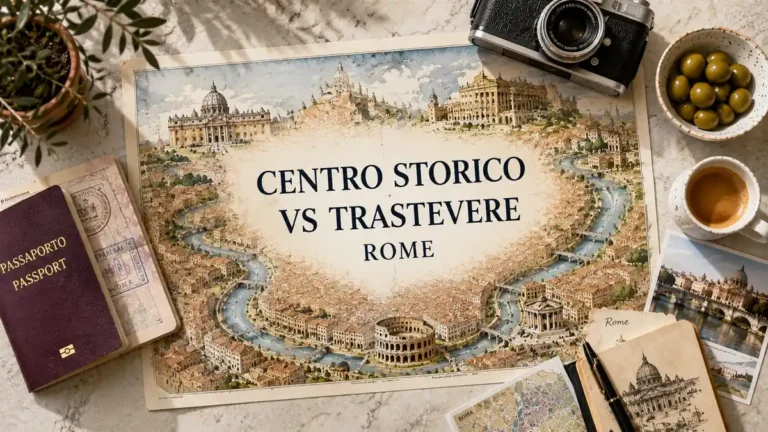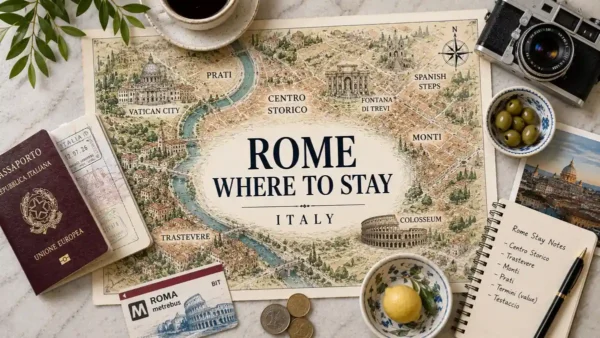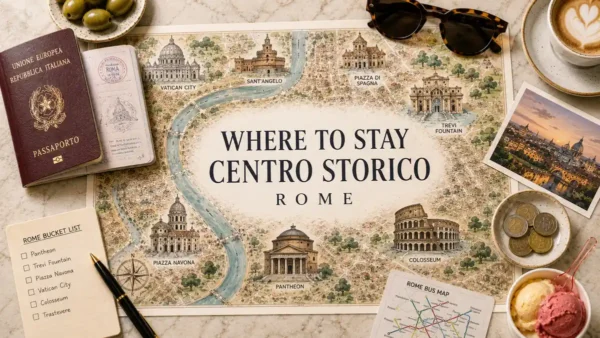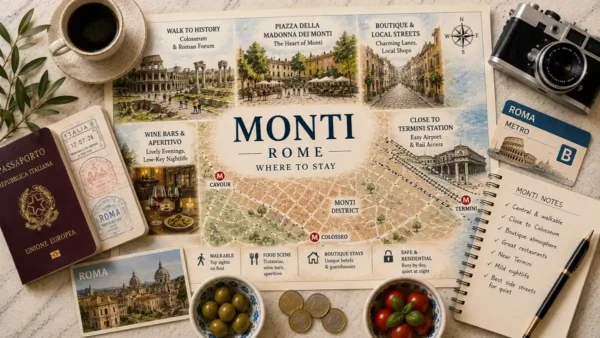
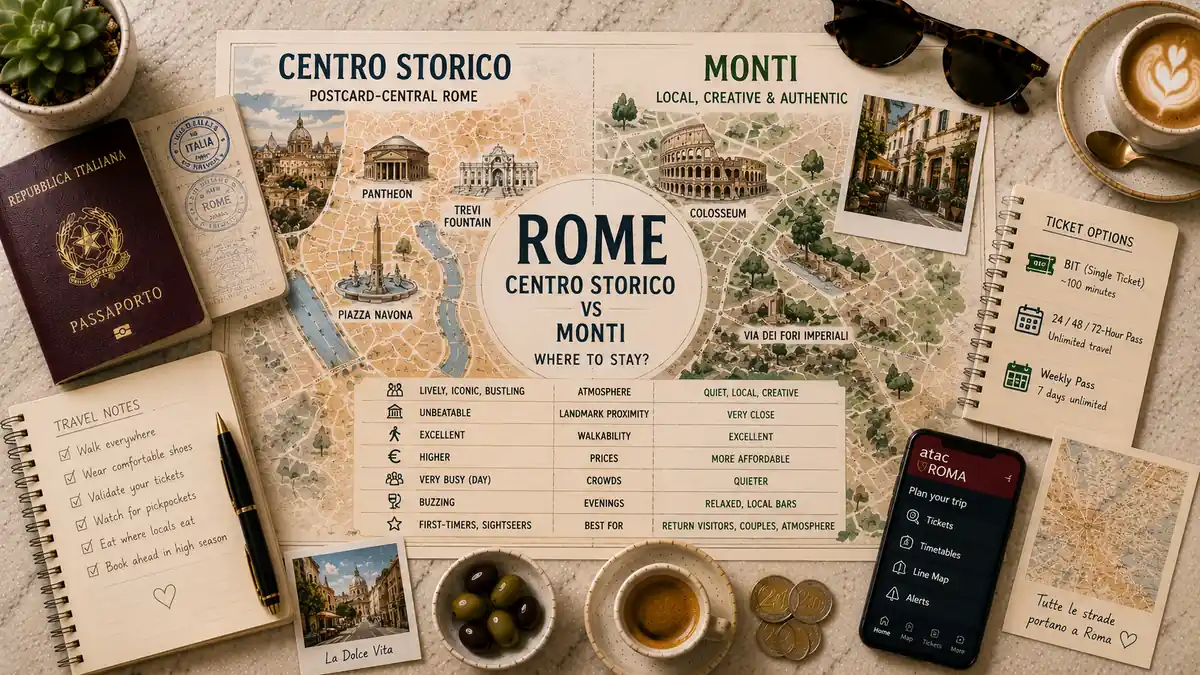
Rome gives you the same city from two very different front doors, and Centro Storico and Monti pull in opposite directions. Centro Storico is the postcard-central core — you sleep among the Pantheon, Piazza Navona and the Trevi Fountain. Monti is the quieter, creative pocket beside the Roman Forum, full of artisan workshops, wine bars and locals more than tour groups. Both work as a one-trip base; they simply suit different travellers. This guide resolves the choice variable by variable — atmosphere, landmark proximity, walkability, price, crowds and evenings — then hands you a clear pick by traveller type. Full single-area detail and specific hotel picks live on the dedicated area pages; here the job is the head-to-head decision.
Quick Answer
Centro Storico is the better base for most first Rome trips, thanks to unbeatable walking access to the marquee sights. Choose Monti instead if you want a quieter, more local and generally more affordable base. Decide by whether sight-proximity or neighbourhood atmosphere and value matters more to you.
Trust Layer
Tripstou comparison guide for travelers choosing between options. Covers tradeoffs, traveler fit, and decision logic.
Produced with AI assistance and reviewed by Alex Perrut, working in tourism since 2015, for the Tripstou editorial team. See our editorial process for details.
Last factual review: July 15, 2026.
Official sources consulted: Italia.it, ENIT.
Key Takeaways
- Centro Storico is the stronger default base for most first Rome trips, thanks to unmatched on-foot access to the marquee sights.
- Choose Monti for a quieter, more local and generally better-value base, with the ancient core and a metro line close by.
- The real trade-off is postcard proximity and buzz versus residential calm and value — one usually outweighs the rest for you.
- Centro Storico suits first-timers and dedicated sightseers; Monti suits repeat visitors, atmosphere-seekers and couples wanting local character.
- Picking on name recognition alone is the common mistake — decide on how you actually want your mornings and evenings to feel.
Table of Contents
Postcard-central or local-creative: how the two areas feel
Centro Storico feels monumental and tourist-facing; Monti feels bohemian, residential and quietly creative. That split is the heart of this choice. Centro Storico surrounds you with baroque squares, marble fountains and crowds; Monti trades that spectacle for cobbled lanes, artisan studios and a lived-in local rhythm just east of the Forum.
The difference shows up most at the start and end of the day. In Centro Storico you step straight out into the set-piece Rome of the postcards, but the squares stay busy and commercial well into the evening. In Monti, mornings are calm and the streets belong to locals grabbing coffee before the Forum crowds spill over the hill.
Your base sets the atmosphere you actually live in — not the one you sightsee in. Centro Storico stays a stage set around the clock; Monti hands the neighbourhood back to residents once the day-trippers leave. That contrast decides the vibe question for most people.
For a full street-by-street feel of each, see the dedicated Centro Storico area guide and the Monti area guide; this page stays on the head-to-head.
Which area is closer to Rome’s main landmarks?
Each area sits on top of a different landmark cluster. Centro Storico holds the Pantheon, Piazza Navona, the Trevi Fountain and Campo de’ Fiori. Monti sits just east of the Roman Forum and close to the Colosseum, with Cavour metro on Line B. Neither is central to everything — they anchor opposite halves of the sightseeing map.
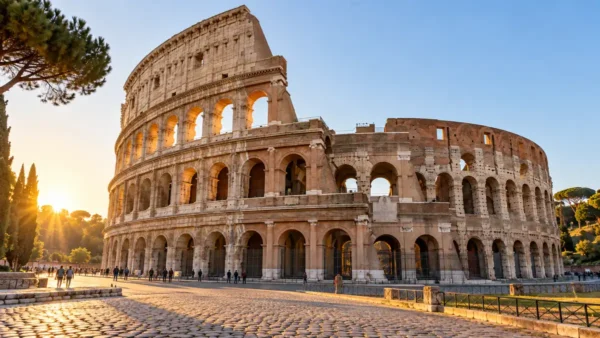
If your must-see list leans Renaissance and baroque — the Pantheon, the fountains, Navona — Centro Storico wins on proximity. If it leans ancient — Colosseum, Forum, Palatine — Monti is the shorter walk. The two halves sit close enough that a well-planned day can cover both, but your base decides which set you reach without effort.
Monti’s edge is underrated here. It puts you a short, flat walk from the Colosseum and directly on metro Line B, so the ancient sites and the wider city are both easy to reach. Centro Storico has no metro station in its heart, which matters more than most first-timers expect.
Which is better for walking to the sights?
Centro Storico is the better base for reaching the most sights on foot. It sits inside the densest cluster of headline landmarks, so many mornings start without any transport at all. Monti is very walkable too, but it leans on one flank of the centre, so the far western sights mean a longer stroll or a metro hop.
From Centro Storico you can chain the Pantheon, Navona, Trevi and Campo de’ Fiori into a single loop, then reach the Spanish Steps with a manageable walk. From Monti the Colosseum, the Forum and Monti’s own lanes are on your doorstep, while the western icons sit a longer walk across the centre or a short metro ride away.
Walkability is really about how many days you can leave transport untouched. Centro Storico buys you more of those days; Monti trades a few of them for calmer streets to come home to. If you plan to walk everywhere and dislike the metro, that tilts the base choice toward Centro Storico.
Is Centro Storico more expensive than Monti?
Centro Storico is generally the more expensive base, and Monti typically offers better value. Sleeping beside the Pantheon and Trevi commands a premium, so nightly rates in the historic core tend to run higher across most seasons. Monti, slightly off the marquee squares, usually gives you more room or comfort for the same spend.
The gap is about location premium, not build quality — both areas span budget rooms to high-end boutiques. What changes is what your money buys per night: in Centro Storico you pay partly for the address and the view; in Monti more of the rate goes into the room itself.
Book Centro Storico when proximity is worth the premium to you, and Monti when a budget that stretches further matters more. For the top end in either area, see our luxury hotels in Rome picks and the Rome luxury stay guide; on a tighter budget, the budget Rome stay guide points to the better-value pockets, which more often sit around Monti.
Rates shift with season and demand, so treat any price you see as a moving range and confirm before you book.
Which area is quieter and less touristy?
Monti is clearly the quieter and more local base, while Centro Storico is busier and far more tourist-dense. Monti’s residential lanes stay calm after dark and see mostly locals outside a few popular corners. Centro Storico’s squares draw crowds through the day and into the evening, especially around the Trevi Fountain and Piazza Navona.
Noise follows the crowds. In Centro Storico, popular streets can carry late-evening buzz from bars and passing groups, so a quiet room often depends on an interior-facing window. Monti quietens earlier and more completely, though its main piazza and busiest bars stay lively on weekend nights.
Being less touristy cuts both ways here. Monti gives you calmer mornings and a genuinely local feel, but it also means fewer of the round-the-clock services — late kitchens, tourist conveniences — that cluster in the historic core. Light sleepers and repeat visitors tend to prefer Monti; first-timers who want the buzz on their doorstep lean to Centro Storico.
Dining and evenings: nightlife and restaurants compared
Monti is the stronger evening base for local character, while Centro Storico offers central but more tourist-priced dining. Monti packs trattorias, enoteche and low-key wine bars into a walkable few blocks, drawing an easy after-dark crowd. Centro Storico puts you beside the famous squares, but restaurants nearest them lean pricier and more tourist-facing.
The two evenings feel different. Monti’s is neighbourhood nightlife — wine bars, aperitivo and dinner within a short walk, winding down at a civilised hour. Centro Storico’s is atmosphere-led: dining under floodlit monuments and a stroll past the Trevi at night, with the trade-off of higher menu prices near the icons.
Eat a few streets back from the main squares in either area and both the value and the cooking usually improve. In Centro Storico that small move away from the fountains matters most. For a base chosen specifically around going out, the Rome nightlife stay guide compares the liveliest areas in more depth.
Neither is a party district. Rome’s late-night club scene sits elsewhere, so pick here on dining and easygoing evenings, and leave clubbing districts out of the decision.
Who each area suits: first-timers, couples, families, budget
Centro Storico suits first-time visitors and dedicated sightseers; Monti suits repeat travellers, atmosphere-seekers and value-minded stays. It comes down to proximity versus personality: choose Centro Storico when ticking off the icons on foot is the priority, and Monti when a local, characterful base matters more than being in the middle of everything.
- First-timers: Centro Storico. Waking up inside the sight cluster makes a short trip feel effortless — see the first-time Rome stay guide.
- Couples: either works, but Monti’s quieter lanes and wine bars edge ahead for a romantic, local feel — detail on the couples stay guide.
- Families: Centro Storico for walk-everywhere convenience with young kids, or Monti for calmer streets and more room per night — compare on the families stay guide.
- Budget-minded: Monti, which more often stretches the same nightly spend further.
For the full range of Rome neighbourhoods beyond these two, the where to stay in Rome hub sets out every base option.
How to choose between Centro Storico and Monti
The choice comes down to a single question about your priorities. Does maximum walkable proximity to the sights matter more than a quieter, more local and better-value base? Answer proximity and Centro Storico wins; answer atmosphere or value and Monti does. Both are strong one-trip bases in the same compact heart of Rome.
| Decision dimension | Better base | Why it wins |
|---|---|---|
| Atmosphere and vibe | Depends on taste | Postcard spectacle in Centro Storico, local calm in Monti |
| Landmark proximity | Split by sight | Centro Storico for the historic centre, Monti for the ancient core |
| Walking to sights | Centro Storico | Sits inside the densest cluster of headline landmarks |
| Price and value | Monti, generally | Better value for the same nightly spend |
| Quiet and crowds | Monti clearly | Calmer, more residential and far less tourist-dense |
| Dining and evenings | Monti mostly | More local trattorias and wine bars within a short walk |
Read the scoreboard as a set of levers, not a total score — most travellers weight one row far above the rest, and that row decides the base.
Choose Centro Storico if:
- It is your first trip and you want the icons on foot from the door.
- Walking everywhere, with little or no metro, is how you want to sightsee.
- Waking up inside the postcard-Rome scene is worth paying a premium for.
- You are travelling with young children and want walk-everywhere convenience.
Choose Monti if:
- You want a quieter, more residential base that empties of crowds after dark.
- You have seen the headline sights before, or care more about atmosphere than being central.
- Value matters, and you want the same budget to buy more room or comfort.
- The ancient core and a metro line on the doorstep suit how you plan to get around.
Hotels and places to stay
Compare hotels, apartments and stays for your dates in one search.
Search hotels and stays on hotels.com →
Tripstou may earn a commission if you book through this link, at no extra cost to you.
Frequently Asked Questions
Is Monti a safe area to stay in Rome?
Yes, Monti is considered one of Rome’s safer central neighbourhoods to stay. Its residential, lived-in character means quiet streets after dark and a steady local presence. As anywhere central in Rome, stay alert for pickpockets around the Colosseum and Termini, but Monti itself carries no particular reputation for trouble.
How far is Monti from the Pantheon and Trevi Fountain?
Monti sits a short walk from the Trevi Fountain and only slightly further to the Pantheon, both reachable on foot in roughly fifteen to twenty minutes. The route runs through the centre rather than around it, so you pass other sights on the way. No transport is needed for either.
Is Monti walkable to Centro Storico?
Yes, Monti and Centro Storico are within an easy walk of each other. A stroll of around fifteen minutes links Monti’s lanes to the Pantheon area, crossing Via dei Fori Imperiali on the way. Whichever you choose as your base, the other area’s sights and streets stay comfortably on foot.
Do you need the metro to get around from either area?
Not for the central sights, which both areas reach on foot. Monti sits directly on metro Line B at Cavour, handy for the Colosseum and destinations further out. Centro Storico has no metro in its heart, so you rely on walking, buses or taxis for anything beyond the historic core.
Is Centro Storico too crowded to enjoy staying there?
No, Centro Storico stays enjoyable to base in despite the daytime crowds. The busiest crush concentrates around Trevi and Piazza Navona and thins in the smaller lanes nearby. Book a room on a quieter side street with an interior-facing window, and you get the location without the constant noise.
Are restaurants generally cheaper in Monti than Centro Storico?
Generally yes, especially for everyday meals. Monti’s trattorias and wine bars tend to price for locals as much as visitors, so value is easier to find. Centro Storico’s restaurants closest to the famous squares lean pricier and more tourist-facing, though walking a few streets back improves both cost and quality.
Related Guides
- Where to Stay in Rome — the full neighbourhood hub and every base option beyond these two.
- Centro Storico Area Guide — street-by-street detail on Rome’s historic core.
- Monti Area Guide — the local, creative pocket beside the Forum in depth.
- Rome Travel Guide — city-level orientation, sights and planning basics.
- Luxury Hotels in Rome — top-end picks across the city’s best areas.
- Where to Stay in Rome for First-Timers — the best bases for a first visit.
Did this guide save you time or money? Tripstou is independent and reader-funded — if you'd like to give something back, you can support the site with a crypto contribution of any size.