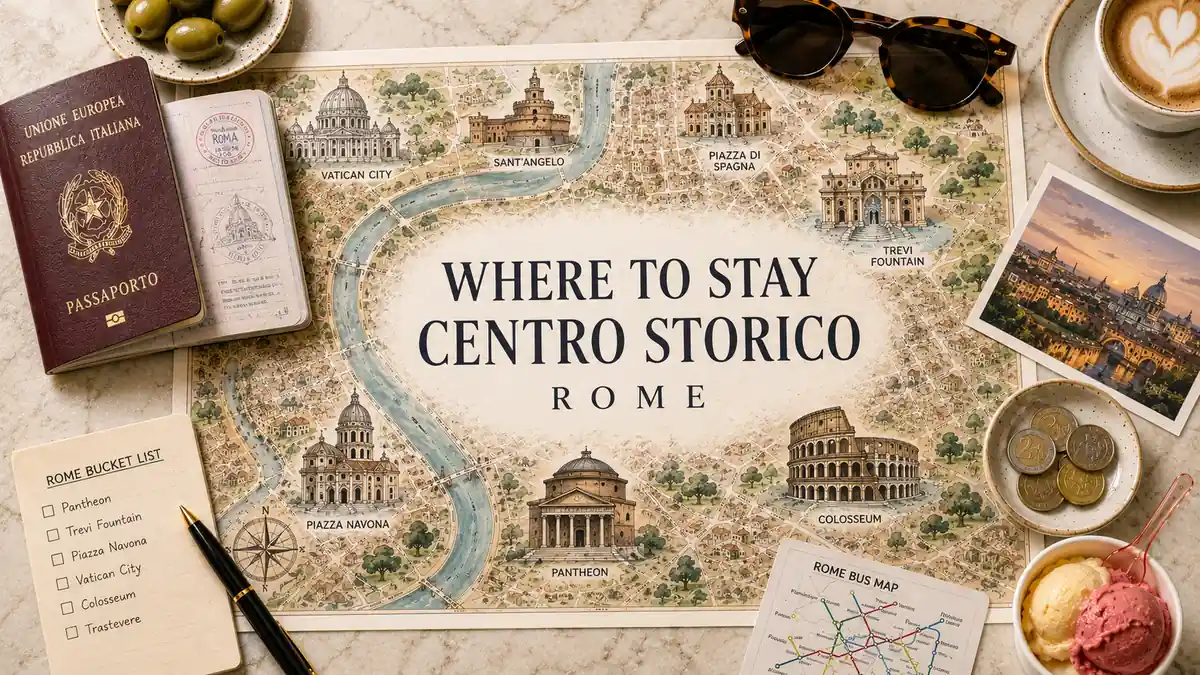
You’ve narrowed Rome down to the Centro Storico, and now you need to know whether it’s the right base and where inside it to book. This is the historic core — the tangle of piazzas and cobbled lanes wrapped around the Pantheon, Piazza Navona, and the Trevi Fountain. Staying here means Rome’s headline sights sit on your doorstep and most of your days start on foot. The trade-off is real. You pay a premium, share the streets with crowds, absorb late-night noise, and live without a metro station nearby. This guide gives you a straight verdict on whether Centro Storico fits your trip, walks you through which sub-zone to choose, and stays honest about the downsides you accept in return.
Quick Answer
Centro Storico is the best base for first-time visitors who want to walk to Rome’s landmarks. You pay more and accept crowds, noise, and no metro station in exchange for that central location. Book near the Pantheon or Piazza Navona for the classic core, or choose a quieter sub-zone if calm matters more.
Trust Layer
Tripstou stay guide for travelers choosing where to base. Covers area atmosphere, budget, convenience, noise, and traveler fit.
Produced with AI assistance and reviewed by Alex Perrut, working in tourism since 2015, for the Tripstou editorial team. See our editorial process for details.
Last factual review: July 12, 2026.
Official sources consulted: Italia.it, ENIT.
Key Takeaways
- Centro Storico is the strongest base for first-time visitors and landmark-focused couples who want to walk to Rome’s headline sights.
- You trade crowds, street noise, premium prices, and no nearby metro for an unbeatable walk-everywhere location.
- Book around the Pantheon or Piazza Navona for the classic core; a side lane one block back is quieter and often cheaper.
- Expect mid-range to high-end rates in mostly small, historic boutique hotels, not large modern-build rooms with resort facilities.
- The core has no metro station, so you get around on foot through its pedestrian and restricted-traffic lanes.
- Choose a quieter sub-zone or a neighbouring area like Trastevere or Monti if calm nights, space, or savings rank higher.
Table of Contents
Is Centro Storico the right place to stay in Rome?
Yes — Centro Storico is the right base for most first-time visitors and anyone who wants to walk to Rome’s landmarks. It suits travelers who rank location and atmosphere above quiet and budget. Look elsewhere if you need calm nights, more space, or the lowest nightly rate.
The pull of Centro Storico is simple to state: nowhere else in Rome puts this many marquee sights within a walk of your hotel door. First-timers with two or three days benefit most, since you lose almost no time to transport and can slip back to your room between sights. Couples chasing the postcard version of Rome — evening strolls past floodlit fountains — get exactly that here.
Who should hesitate? Budget travelers pay for the address, families often want more room than the small historic hotels offer, and light sleepers will notice the street noise. If your list of areas is still open, treat this as one option inside the wider Rome where-to-stay decision rather than a foregone conclusion.
The honest test is how you plan to spend your evenings. If you’ll be out among the piazzas until late, Centro Storico’s noise is a feature, not a cost — the people who regret booking here are the ones who wanted the location by day and silence by night.
Where Centro Storico sits and what’s inside it
Centro Storico is Rome’s historic core, the low-rise tangle of streets on the east bank of the Tiber. It packs in the Pantheon, Piazza Navona, the Spanish Steps, Campo de’ Fiori, and the Trevi Fountain, mostly within a short walk of each other. This is the Rome of postcards and film sets.
Orientation-wise, Centro Storico is the district most people picture when they imagine Rome, and it borders other stay areas without overlapping them. Trastevere sits across the river to the southwest; Monti lies east toward the Colosseum. For how the historic core fits into the rest of the city, the full Rome travel guide sets the scene. Inside the district, the landmarks cluster tightly enough that naming your nearest one — the Pantheon, say, or the Trevi Fountain — is usually enough to place a hotel on the map.
Centro Storico trades crowds and noise for an unbeatable location
Living in Centro Storico means accepting crowds and noise as the price of an unbeatable location. Days here have a buzzy, open-air rhythm — cafés spilling onto squares, footsteps on cobbles, tour groups by mid-morning. It’s exhilarating if you came for atmosphere, and wearing if you came for rest.
The balance sheet is easy to see once you name both sides:
- For it: Rome’s headline sights within walking distance of your door
- For it: postcard atmosphere — piazzas, fountains, and cobbled lanes at every turn
- For it: a dense choice of cafés, restaurants, and after-dark strolls
- Against it: crowds that build from mid-morning through the evening
- Against it: street and nightlife noise that carries into many rooms
- Against it: premium prices, mostly small and older hotels, and no metro in the core
Noise here is a location problem, not a hotel problem. Even a well-run property can’t mute a piazza, so the fix is a room on a side lane or a high floor, not paying up for a fancier address.
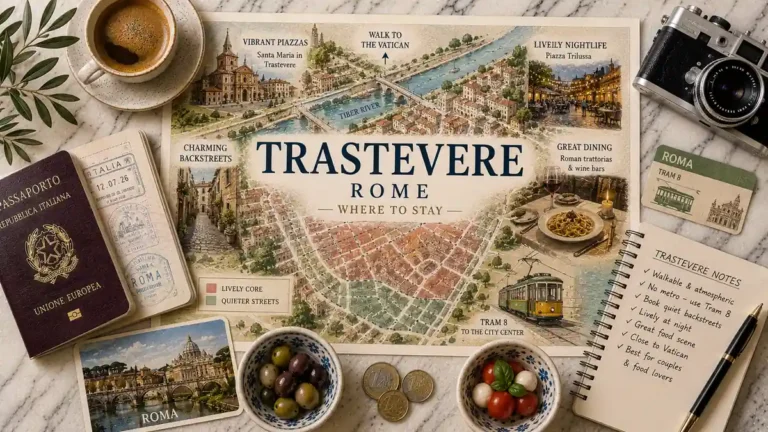
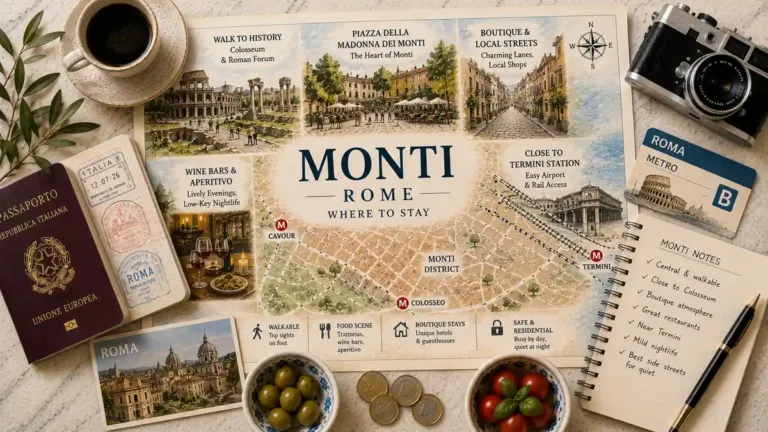
If the crowds give you pause, two nearby areas soften them. A stay in Trastevere swaps some central convenience for a more village-like evening, and Monti offers a quieter, more local feel a short walk from the Colosseum — see how the Centro Storico versus Trastevere and Centro Storico versus Monti calls play out before you commit.
Which part of Centro Storico should you book?
Book around the Pantheon or Piazza Navona for the classic Centro Storico stay — they anchor the walkable heart. Your sub-zone choice mostly tunes how much buzz, shopping, or quiet you want, not whether you’re central. Every pocket here is within an easy walk of the main sights.
Use this quick read to narrow the pick, then check the sub-zone notes below for the detail.
| Sub-zone | Vibe | Best for |
|---|---|---|
| Around the Pantheon | Central, classic, always in demand | First-timers wanting the core |
| Piazza Navona | Grand, romantic, open-square theatre | Couples paying for atmosphere |
| Spanish Steps | Polished, upscale shopping streets | Shoppers wanting metro access |
| Campo de’ Fiori | Lively, social, market and bars | Night owls and younger travelers |
| Trevi | Iconic, busy, tourist-heavy lanes | Landmark lovers who accept crowds |
The sub-zone matters less than the exact street. A room on a pedestrian lane one block off Piazza Navona is quieter, and often cheaper, than a window directly over a floodlit square — for the same walkability.
Around the Pantheon
The Pantheon area is the default choice for a first Centro Storico stay. You wake up beside an ancient monument and step straight into café-lined squares. It’s as central as Rome gets, walkable to Piazza Navona and Trevi in minutes. Demand is high and prices follow. Best for: first-timers who want the classic core within a two-day trip.
Piazza Navona
Piazza Navona delivers the grand-square version of Centro Storico. Baroque fountains, street artists, and open space give it a theatrical, romantic feel. You’re a short walk from the Pantheon and the river, with restaurants at hand. Prices run high, and the square stays busy into the evening. Best for: couples wanting atmosphere and willing to pay for a showpiece address.
Spanish Steps
The Spanish Steps area leans toward polished shopping streets over tangled lanes. This is Rome’s luxury-retail heart, elegant and comparatively orderly, and the Spagna metro stop puts it on a line — a genuine rarity for this part of the city. It’s walkable to the Trevi Fountain and the Villa Borghese gardens. Rates sit at the higher end. Best for: shoppers and travelers who want a metro stop on the doorstep.
Campo de’ Fiori
Campo de’ Fiori is the liveliest, most social pocket of the centre. A morning market gives way to packed bars around the square, so energy runs high from dawn to late. You’re walkable to the Pantheon, the Tiber, and the bridges over to Trastevere. Prices are broadly mid-range for the area. Best for: younger travelers and night owls who want the action downstairs.
Trevi
The Trevi area puts you beside Rome’s most famous fountain, which means beauty by day and crowds almost around the clock. Streets here are narrow and tourist-heavy, though the location is superb and walkable to the Pantheon and Spanish Steps. Prices sit high, driven by the landmark. Best for: travelers who want an iconic sight on their doorstep and don’t mind foot traffic.
Smaller pockets — around Sant’Eustachio, or the quieter lanes toward the Tiber — offer the same walkability with a lower profile. They’re fine picks without needing a verdict of their own.
Hotels and places to stay
Compare hotels, apartments and stays for your dates in one search.
Search hotels and stays on hotels.com →
Tripstou may earn a commission if you book through this link, at no extra cost to you.
Getting around Centro Storico without a metro
You get around Centro Storico on foot — the core is compact, walkable, and has no metro station of its own. The nearest metro stops sit at the edges, so most trips within the district are quicker on foot anyway. Much of the centre is pedestrianized or inside restricted-traffic zones.
In practice, walking is the plan and the pleasure. Distances between the main squares are short, and the lanes reward wandering more than any timetable would. Buses and taxis cover longer hops to the Vatican or Termini, and the edge metro stations pick up the slack for trips further out. Cobbles and the occasional flight of steps are worth flagging if you’re rolling luggage or have limited mobility.
If you’re arriving by car, the restricted-traffic zones matter more than the missing metro. Driving into the core is limited and fined, so most hotels expect you to arrive by taxi and park outside the centre.
Is Centro Storico expensive to stay in?
Yes — Centro Storico sits among Rome’s pricier places to stay, with rates skewing mid-range to high-end. You’re paying for the address and the walk-everywhere location more than for large rooms or resort facilities. The area is kindest to travelers who value time saved over square metres.
Roughly, the spend tiers break down like this:
- Budget-minded: expect small, simple rooms and guesthouses; true bargains are scarce inside the core
- Mid-range: the sweet spot here — comfortable boutique and townhouse stays at a location premium
- High-end: converted palazzi and design hotels, where the address does much of the pricing
Where the area punishes your budget is peak season and the marquee squares. Where it stays kind is the shoulder months and the plainer streets a block back, where the same location costs noticeably less. If a low nightly rate outranks the central address, compare it against budget-focused areas in Rome before booking.
What kind of hotels you’ll find in Centro Storico
Hotels in Centro Storico lean historic and boutique — think converted palazzi, intimate townhouse properties, and small independent stays. Big chains and large footprints are rare, because the buildings are old and protected. Rooms often run smaller than modern-build hotels elsewhere in Rome.
The character is the selling point. You trade the predictability of a chain for frescoed ceilings, tiny lifts, and reception desks that know the neighbourhood. That also means fewer pools, gyms, and family suites, so travelers who need those amenities should set expectations accordingly. For named properties at the top end, the best luxury hotels in Rome roundup does the picking, and the wider luxury stay areas guide covers where that tier concentrates.
Who Centro Storico suits — and who should look elsewhere
Centro Storico suits first-time visitors and landmark-focused couples better than any other traveler type. It rewards people who prize a walkable location and lively atmosphere, and frustrates those who need space, quiet, or a tight budget. Below is a quick fit read by traveler type, with a deeper route for each.
- First-time visitors: strong fit — you see the most with the least transport; more at where first-timers should stay
- Couples: strong fit for romance and evening strolls; compare stay options for couples
- Families: workable but tight on space and short on family suites; see family-friendly Rome areas
- Nightlife-led travelers: fine near Campo de’ Fiori, though better served elsewhere; check areas built for nightlife
The short version: come for location and atmosphere, and Centro Storico rarely disappoints. Come for calm, space, or savings, and one of the neighbouring areas will serve you better.
Frequently Asked Questions
Is Centro Storico Rome safe at night?
Yes, Centro Storico is generally safe to walk at night, and its busy piazzas stay lively well past dark. The main nuisance is pickpocketing in tourist-packed spots, not violent crime. Keep an eye on bags around the Trevi Fountain and crowded lanes, and stick to the well-lit main streets when returning late.
Is Centro Storico noisy at night?
Yes, Centro Storico can be noisy at night, especially near the busy squares where cafés and bars run late. Noise here is a location issue, not a hotel failing, since no property can quiet a piazza. Choose a room on a pedestrian side lane or a high floor if quiet sleep matters.
Can you walk to the Colosseum from Centro Storico?
Yes, you can easily walk to the Colosseum from Centro Storico’s eastern edge. From the Pantheon the stroll runs about twenty minutes at an easy pace, passing the Roman Forum along the way. If you’d rather not walk, a short bus or taxi covers it quickly.
Can you walk to the Vatican from Centro Storico?
Yes, you can walk to the Vatican from Centro Storico, crossing the Tiber to the west. From Piazza Navona it’s a comfortable walk of around half an hour, mostly flat and easy to follow. Many visitors combine it with a stroll through Trastevere, or take a quick bus or taxi instead.
Does Centro Storico have a metro station?
No, Centro Storico has no metro station inside it, which is why the historic core is a walk-everywhere district. The nearest stops sit around its edges — Spagna near the Spanish Steps and Barberini toward Trevi — so most central trips are quicker on foot. Buses and taxis handle longer hops across the city.
Where is the quietest place to stay in Centro Storico?
The quietest stays in Centro Storico sit on pedestrian side lanes a block or two back from the main squares. Pockets around Sant’Eustachio or the streets sloping toward the Tiber stay calmer than rooms overlooking Piazza Navona or the Trevi Fountain, while keeping the same short walk to the sights.
Related Guides
- Where to Stay in Rome — the full multi-area overview and how the neighbourhoods compare.
- Centro Storico vs Trastevere — the head-to-head verdict on the two most-compared bases.
- Centro Storico vs Monti — central buzz against a quieter, more local feel.
- Rome Travel Guide — wider city context, sights, and planning.
- Best Luxury Hotels in Rome — named picks at the top of the market.
- Where to Stay in Rome for First-Time Visitors — the segment guide for your first trip.
Did this guide save you time or money? Tripstou is independent and reader-funded — if you'd like to give something back, you can support the site with a crypto contribution of any size.