Yes: visitors who live outside the EU can get Croatian VAT back on goods they carry out of the EU, provided a single receipt comes to EUR 100.00 or more including VAT. The shop issues a PDV-P refund form, customs stamps it where the goods leave the EU, and the stamped form goes back to the shop or refund operator within six months of the invoice date. The money is the VAT share of the price: at Croatia’s 25% standard rate that is 20% of what you paid, before any operator fee or bank charge. Nobody gets “25% back”.
Sources and Review
This page settles one question: whether a visitor living outside the EU can reclaim Croatian VAT on goods, and how to collect it. It is not a shopping guide, an entry-rules page or a guide to business VAT recovery.
Alex Perrut, working in tourism since 2015, checked the receipt rule and the form procedure for the Tripstou editorial team; the text was produced with AI assistance under our editorial process.
Official sources consulted: Croatian Tax Administration (PDV-P form), Croatian Tax Administration (passenger VAT refund opinion), Croatian Tax Administration (electronic PDV-P), Zagreb Airport.
One Receipt of EUR 100 or More Is the Whole Game in Croatia
A Croatian VAT refund exists only when one invoice, VAT included, reaches EUR 100.00. Two receipts of EUR 60 do not add up to a claim. Each PDV-P form covers exactly one invoice, and invoices from different purchases cannot be combined on one form.
That gate decides everything else on this page. Below it there is no form and no refund, whatever you spend across the trip. Above it, each qualifying receipt carries its own form and its own customs stamp.
Two receipts of EUR 60 at two shops: EUR 120 spent, nothing to claim.
One receipt of EUR 120 at one shop: one PDV-P form, one claim.
The practical move is to concentrate. Buy the jacket, the shoes and the bag at the same shop on the same visit, and ask for a single invoice. A refund operator’s fee also weighs heavier on a small claim, so one large receipt returns more than several that barely clear the line.
A shopper who splits a EUR 150 purchase across two tills to “be quick” has just turned a claim into nothing. Ask for one invoice before you pay, because a printed receipt cannot be merged afterwards.
Who Can Claim in Croatia, and What Counts as a Refundable Purchase
You can claim if you live outside the EU, whatever passport you hold, and only on goods you take out of the EU. Residence decides eligibility, not nationality. Services are outside the scheme entirely.
- Residence: your permanent home is outside the EU.
- Proof: a passport or ID document, and the name and details on the form must match it.
- Goods, not services: the purchase is a physical item you carry or ship out of the EU.
- No fuel: fuel never qualifies, even on a receipt above EUR 100.
EU residents cannot claim, Croatians included. A Croatian citizen living in Germany pays Croatian VAT like any shopper from the EU. A Brazilian, American or Australian passport holder who lives in their home country can claim. An EU citizen whose permanent residence is outside the EU also falls on the claiming side, because the test is where you live.
Hotels, restaurants, tours and other services never qualify. The VAT on your room, your meals and your boat trip stays in Croatia, because a service is consumed there and nothing is exported.
This page covers travelers, not companies: business VAT recovery runs through a separate system with its own forms.
Duty-free allowances when you land back home are set by your home country, so check its customs rules before a large purchase.
How Much VAT Do You Really Get Back in Croatia?
At Croatia’s 25% standard rate, the VAT inside a price is 20% of what you paid: EUR 20 inside a EUR 100 receipt. That is the gross figure. The amount that reaches you is lower, because either a refund operator deducts a service fee or a bank transfer costs you money.
“25% back” is wrong arithmetic. The 25% is added to the net price, so a shelf price of EUR 100 is EUR 80 of goods plus EUR 20 of VAT. The VAT is one fifth of the receipt, never one quarter.
Which route the shop uses decides the deduction. A refund operator handles the paperwork and pays you through its own channel, minus its service fee. A shop that refunds directly pays the full VAT share, but if you ask for a bank transfer, the transfer costs fall on you. Neither route pays the full 20% in every case.
Reduced VAT rates of 13% and 5% also apply to some goods, so not every receipt carries the full one-fifth share. The VAT line on the invoice shows which rate the shop charged.
The claim earns its effort on a large single receipt. On a receipt that only just clears EUR 100, a fee-reduced payout rarely justifies a detour to the customs desk on a tight connection, so plan the claim around your biggest purchase.
How to Claim Your Croatian VAT Refund, Step by Step
Claiming takes five moves, in the order your trip runs: ask for the PDV-P form at checkout, keep the goods unused, get the customs stamp where the goods leave the EU, return the stamped form, and collect the money.
- At checkout, show your passport and ask for the PDV-P VAT refund form.
- Keep the goods unused, with tags on, and reachable until customs has seen them.
- Get the customs stamp on the form where the goods leave the EU, before you check any bags.
- Send or hand the stamped original back to the shop or its refund operator.
- Receive the refund in cash, by post or by bank transfer.
The PDV-P is the official Croatian form, titled “Zahtjev za povrat PDV-a / VAT refund form”. The seller issues it on request, one form per invoice, and the original goes to you. The electronic version carries a barcode that customs scans when you leave the EU.
Ask at the till whether the shop refunds you directly or works through a refund operator such as Global Blue. The answer decides where the stamped form goes later and what deduction applies. Not every shop takes part, so ask before you pay if the refund matters to the purchase.
Check the form before you leave the shop. Your name and passport number must match your document exactly, and the goods listed must match the invoice. A typo found at the airport is much harder to fix than one found at the counter.
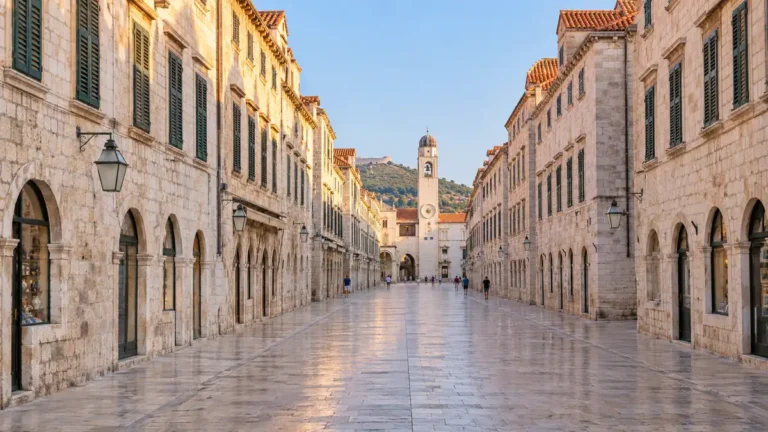
Pack refund purchases in your carry-on where you can, because customs may ask to see them. For where to do the shopping itself, the shopping streets and markets sit in our guide to things to do in Croatia.
Where Does Customs Stamp the Form When You Leave Croatia?
Customs stamps the form at the point where your goods leave the EU. That is a Croatian airport only when you fly from Croatia straight out of the EU; the last EU airport when you connect through one; the land border when you drive into Bosnia and Herzegovina, Montenegro or Serbia. A ferry to Italy never triggers the stamp, because Italy is in the EU.
| Exit route | Where the stamp happens | What to do with the goods |
|---|---|---|
| Direct flight out of the EU from Croatia | Customs at the Croatian departure airport | Show them before checking bags |
| Connecting via another EU airport | Customs at the last EU airport | Keep them in hand luggage |
| Land border to Bosnia and Herzegovina, Montenegro or Serbia | Customs at the EU external border | Keep them reachable in the car |
| Ferry to Italy | Not on the ferry; at your final EU exit | Keep goods and form until then |
At Zagreb Airport, customs validation is in Departures, before security. Validate the form before you check your bags, since customs may want to see the goods. A refund point for operator forms is inside the terminal, and an operator app or the airport mailboxes serve as the route when nothing is staffed.
Leaving from Split or Dubrovnik on a flight out of the EU, the stamp comes from the customs office at the airport you leave the EU from. Arrive early enough to find it before bag drop.
A connection through another EU hub moves the stamp there. Budget time at that airport, and keep the goods in your hand luggage; if they travel in checked baggage, be ready for that airport’s checked-bag procedure before you drop the case.
A ferry to Italy, or a drive through Slovenia or Hungary, keeps you inside the EU. The stamp waits for your eventual EU exit, whether that is a final airport or an external land border, so keep the goods and the form together until then.
Goods sent home by post or through a shipping agency can also qualify, when the shipment itself crosses the EU border.
The stamp follows your goods out of the EU, not your departure from Croatia. On a Split–Rome–New York itinerary the form is validated in Rome, so the connection there needs enough time for customs as well as the gate.
Leaving by Land to Bosnia and Herzegovina, Montenegro or Serbia
The land border with Bosnia and Herzegovina, Montenegro or Serbia is the EU external border, so that is where your goods leave the EU and where customs stamps the form. Keep the goods and the form within reach in the car, not buried in the boot.
Drivers heading to Dubrovnik along the coast cross the short Neum corridor through Bosnia and Herzegovina and re-enter Croatia minutes later. That crossing is transit, not your final export: goods bought for a claim stay with you and get stamped at your real exit from the EU. Border formalities for the crossing itself are covered in our Croatia visa requirements guide.
Cash, Bank Transfer or Operator Payout: How the Money Comes Back
The stamped original form, returned to the seller, is itself your refund request. A shop that refunds directly pays in cash, by post, or by bank transfer to an account you name, and the bank-transfer costs are yours. A refund operator pays through its own channel after deducting its fee.
- Cash at the shop or a refund point: immediate and whole when the shop pays directly, but only possible if you pass the shop again after the stamp or use a refund point that handles your form.
- Bank transfer from the seller: suits shoppers who leave Croatia right after the stamp; the full VAT share is paid, less whatever your bank and the transfer cost.
- Operator payout: suits anyone who wants the paperwork handled, with a refund point at Zagreb Airport for operator forms; the service fee comes off the amount.
Store-direct refunds pay more, while operator refunds ask less of you. If the shop offers both, the direct route is worth it on a large receipt and when you can live with your bank’s charges.
Keep a photo or copy of the stamped form and the invoice before you send the original. The original is the claim, so once it is in the post or the mailbox, the copy is your only proof of what you sent.
Spending money abroad
A Wise account converts your money at the mid-market exchange rate and shows every fee upfront, with a card you can spend in the local currency.
Check Wise’s rates and fees for your currency →
Tripstou may earn a commission if you sign up through this link, at no extra cost to you.
The Two Deadlines, and Why Croatian VAT Refund Claims Get Refused
Two deadlines govern every claim. The goods must leave the EU before the end of the third month following the month of purchase, and the stamped form must reach the seller within six months of the invoice date. Miss either one and the claim dies.
Buy something in the first month of a long trip, and the goods must be out of the EU by the end of the third month after that month. The six-month clock for returning the form runs from the invoice date, not from the stamp, so a form stamped late in the export window leaves less time to post it back.
The PDV-P form itself lists the reasons a claim is refused:
- Name or passport data on the form do not match your document.
- The goods shown to customs do not match the invoice.
- The invoice is under EUR 100.
- The form is not signed.
Each one is avoidable at the till or at customs. Check the passport details and sign the form before you leave the shop, keep the goods unopened and matching the receipt, and never present a receipt below EUR 100.00 for validation.
Your Tax-Free Checklist
- Put your purchases on one invoice of EUR 100.00 or more, VAT included, because each PDV-P form covers a single receipt and smaller receipts never add up to a claim.
- Where you live decides eligibility, not your passport: residents outside the EU can claim, while EU residents, Croatians included, cannot.
- Expect no more than 20% of the price back at the 25% standard rate, and less once an operator fee or a bank-transfer cost comes off.
- Get the customs stamp where your goods leave the EU and before you check bags, which on a connecting flight means the last EU airport, not Croatia.
- Send the stamped original to the shop or its refund operator within six months of the invoice date, and keep a copy of both form and invoice.
- Hotels, restaurants, tours and fuel never qualify, whatever the receipt total.
Next Steps for Your Croatia Trip
- Croatia travel guide: the planning overview this page sits under.
- Croatia visa requirements: the entry rules for the land crossings mentioned above.
- Things to do in Croatia: where the shopping streets and markets are covered.
Did this guide save you time or money? Tripstou is independent and reader-funded — if you'd like to give something back, you can support the site with a crypto contribution of any size.