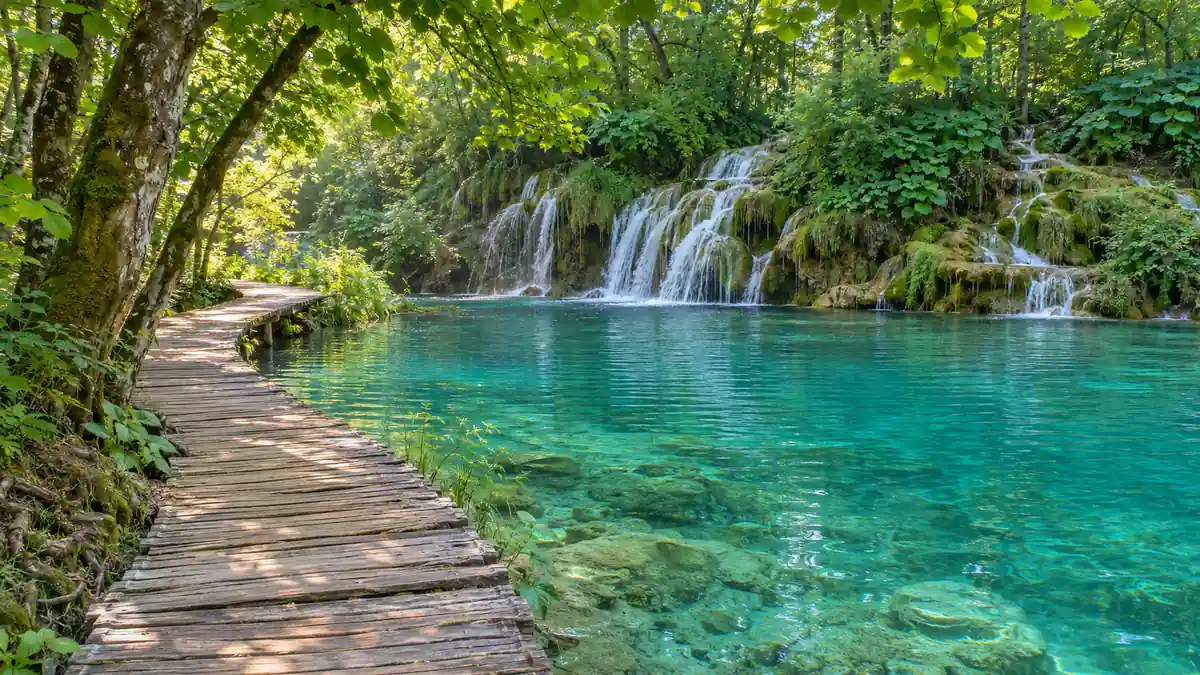
For a first trip, the best things to do in Croatia are on the Dalmatian coast: Dubrovnik’s walled Old Town, Split and the islands off its harbour, and one of the two waterfall parks, Plitvice or Krka. Istria is the strongest alternative for travelers who want food, wine and hill towns over crowds. Zagreb is the add-on, not the reason to come. One fork decides the trip: old towns and islands point to Dalmatia, while truffles, wine and quieter towns point to Istria.
Croatia’s sights cluster by region, so the regions come before the sights. Dubrovnik and the Elaphiti share the far south; Split, Hvar and Brač share one stretch of sea; Zadar, Šibenik and Krka lie close together further north; Istria sits apart in the north-west, next to Slovenia and Italy. The regional picks come first, then the beaches, food and outdoor choices that cut across them. Choosing places and putting them in order are separate decisions, and the order belongs to the itinerary.
How This Shortlist Was Made
This is a curated first-trip selection of places and experiences across Croatia, grouped by region and chosen for how distinct each one is and who it suits; it is not a planning hub, an itinerary, a Dubrovnik or Split page, or an island-hopping planner.
Written with AI assistance, this shortlist was then read through by Alex Perrut, working in tourism since 2015, for the Tripstou editorial team. Each step is set out in our editorial process.
Official sources consulted: Croatian National Tourist Board, Plitvice Lakes National Park, Krka National Park.
Where to Go in Croatia: The Six Regions and What Each Is For
South Dalmatia is for Dubrovnik and its walls, Central Dalmatia for Split and the islands, and North Dalmatia for Zadar, Šibenik and the Kornati. The Plitvice and Krka parks are for waterfalls, Istria and Kvarner for hill towns, Roman Pula and food, and Zagreb with the continent for a capital and quiet countryside. A first trip takes South and Central Dalmatia plus one park. The other regions can wait for a second visit unless one of them is exactly what you came for.
The first-trip core earns its place on distinctness. Dubrovnik’s walled Old Town and the lived-in Roman palace at Split have no substitute anywhere else in the country, and they sit on one coastline with the islands between them. The return-trip regions are slower, not lesser. Istria rewards unhurried days between hill towns and konobas. North Dalmatia is where the coast goes quiet. The continent suits travelers who already know the sea.
| Region | What it is for | Natural base | Where this page covers it |
|---|---|---|---|
| South Dalmatia | The walled Old Town, Lokrum, the Elaphiti, Korčula and Mljet | Dubrovnik | Dubrovnik section; islands section |
| Central Dalmatia | Diocletian’s Palace, Trogir, Hvar and Brač | Split | Split section; islands section |
| North Dalmatia | Zadar’s waterfront, Šibenik’s cathedral, the Kornati and Pag | Zadar or Šibenik | North Dalmatia section |
| Plitvice and Krka | Lakes, waterfalls and boardwalks | Šibenik or Split for Krka; inland for Plitvice | Parks section |
| Istria and Kvarner | Hill towns, Roman Pula, truffles and wine | Rovinj or Pula | Istria section |
| Zagreb and the continent | The capital, Baroque towns and wetlands | Zagreb | Zagreb section |
Dubrovnik and Istria sit at opposite ends of the coast, so a short first trip that tries to include both spends its best days in transit. How these regions fit together over a set number of days is the job of our Croatia itinerary. When to go, what the trip costs and how to get around are in our Croatia travel guide.
Dubrovnik Is Worth It, Early or Late
Dubrovnik belongs on almost every first trip to Croatia, and the way to enjoy it is to walk the city walls and the Old Town early in the morning or in the evening. Midday crowds and summer heat trapped inside the stone are the real cost of the visit, not the sights themselves.
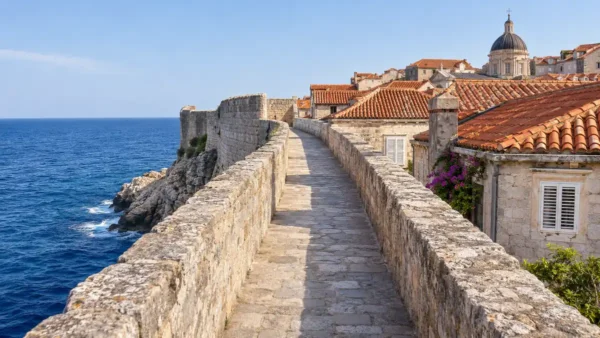
The walls circle the entire Old Town, so the walk along them is the best way to read the city: terracotta roofs on one side, open sea on the other. Enter through Pile Gate, and climb Lovrijenac Fortress on its rock outside the walls for the view back at them. A guide adds the history behind the gates and towers if you book a walls walk.
Lokrum is the half-day escape, a short boat ride from the Old Town harbour. It holds an old Benedictine monastery, Fort Royal on its high point and a replica of the Iron Throne, which brings Game of Thrones fans over from the King’s Landing streets of the Old Town. Its shaded paths are the cool counterpoint to a morning on the walls.
For a full day out, the Elaphiti — Koločep, Lopud and Šipan — make the classic boat trip, and sea kayaking below the walls is the active alternative. At sundown, the Buža cliff bars sit on the rocks beyond the seaward walls.
Dubrovnik’s crowd problem is really a timing problem. Cruise passengers and day-trippers fill the Old Town in the middle of the day, so a traveler who sleeps nearby gets the quiet hours they never see. Every sight, beach and evening is on the full list of things to do in Dubrovnik, and the Dubrovnik guide covers where to stay and how to get around.
Tours and activities
Book skip-the-line tickets, day trips and local tours with free cancellation on most activities.
You can also browse everything on getyourguide.com.
Tripstou may earn a commission if you book through this link, at no extra cost to you.
Split and Central Dalmatia: Diocletian’s Palace, Trogir and the Blue Lagoon
Split is a Roman palace you walk through rather than visit: Diocletian’s Palace is the Old Town, with homes, cafés and shops inside its walls. It is also the gateway to the central islands. Trogir and the Blue Lagoon are the two day trips that make a Split stay more than a ferry connection.
The Peristyle, the palace’s colonnaded central square, is where the Roman layout is easiest to see. The Cathedral of St Domnius stands beside it, inside the emperor’s own mausoleum. Beyond the palace, these are the trips that earn the time:
- Trogir: a compact island old town on the UNESCO list, close enough to Split to pair with a palace day.
- Blue Lagoon: the clear, shallow bay off Drvenik, reached by boat from Split or Trogir, made for snorkelling.
- Omiš: the town where the Cetina river cuts through a gorge to the sea, a dramatic setting south of Split.
For many travelers, Split works better as a base than as a destination: the palace takes less time than expected, and the payoff is everything the harbour connects to. The museums, markets and beaches of the city itself are on our list of things to do in Split.
Which Croatian Islands Belong on a First Trip?
Hvar and Brač are the first-trip islands from Split, Korčula or Mljet the ones from Dubrovnik, and Vis is the return-trip pick for travelers who want a further, quieter island. Choose one or two that sit near your base. Trying to see all of them turns the holiday into a ferry schedule.
Hvar
Hvar Town is the island’s glamour stop, with a yacht-filled harbour and the liveliest nightlife on the islands, while the Pakleni islets just offshore are its swimming coves. Stari Grad, on the north side, is the older and calmer town, next to Stari Grad Plain, an ancient Greek field layout on the UNESCO list. Vrboska is the small canal village nearby. Hvar suits a couple or group who want a scene and a quiet side on one island.
Brač
Brač is the beach island. Its draw is Zlatni Rat at Bol, the country’s best-known beach, covered in the beaches section below. It fits a family or a beach-led trip from Split.
Korčula
Korčula Town is a compact walled town on a peninsula, a smaller echo of Dubrovnik with far fewer people. Lumbarda, at the island’s eastern end, grows grk, a white wine rarely found beyond it. Korčula is the pick for wine and a slower old town at the Dubrovnik end of the coast.
Vis
Vis is the further, quieter island. Stiniva is a pebble cove almost closed off by cliffs, and the Blue Cave on nearby Biševo glows blue when sunlight enters it. It is a return-trip pick because reaching it takes longer than the central islands.
Mljet National Park
Mljet National Park covers the green western part of the island, around two saltwater lakes, Malo jezero and Veliko jezero, with quiet lakeside roads made for cycling. It is the nature-first island day from Dubrovnik.
Which islands to combine, in what order, and how the ferries connect them is the job of our Croatia island hopping guide.
Plitvice or Krka: Choosing Between Croatia’s Waterfall Parks
Plitvice is the bigger spectacle, with boardwalks over a chain of lakes and Veliki slap at the end, and it needs a timed entry booked ahead online. Krka is the easier park to fit into a Dalmatian coast trip, from Šibenik or Split. Neither is a swimming trip.
The airport you use usually picks the park for you. Plitvice lies inland between Zagreb and the coast, while Krka sits beside Šibenik, so a trip based on the south coast leans Krka and a Zagreb arrival leans Plitvice.
Plitvice Lakes
Plitvice Lakes National Park is a staircase of lakes stepping down through forest, linked by waterfalls and crossed on wooden boardwalks; Veliki slap, the Big Waterfall, is its climax. It is on the UNESCO list. Tickets are best bought on the park’s official webshop, and each one is validated at the chosen entrance within its time window, so book ahead and aim for an early or late slot when the boardwalks are quieter.
Krka
Krka’s centrepiece is Skradinski buk, a broad cascade of travertine steps: you view Skradinski buk from the paths, you don’t swim under it. Upstream, the monastery islet of Visovac and the Roški slap falls show a quieter side of the river. Skradin is the gateway town at the park’s lower end.
Can you swim at Plitvice or Krka?
No at Plitvice: swimming in the lakes is strictly prohibited. At Krka you cannot swim under the main falls at Skradinski buk, and jumping from the falls or the bridges is banned. Treat both parks as walking days and save the swimming for the coast.
North Dalmatia: Zadar’s Sea Organ, Šibenik and the Kornati
North Dalmatia is the stretch first-timers most often skip and the easiest one to add, especially on a Krka day: Zadar for the Sea Organ and the Greeting to the Sun at sunset, Šibenik for the Cathedral of St James, and Murter for a boat day in the Kornati. It suits travelers who want the Dalmatian coast with fewer cruise crowds than Dubrovnik and Split.
Zadar’s waterfront is an evening ritual. The Sea Organ plays as waves push air through pipes beneath the marble steps, and the Greeting to the Sun, a circle of solar panels set into the promenade, lights up after dark. Offshore, Dugi Otok holds Sakarun, one of the coast’s rare sandy beaches.
Šibenik’s Cathedral of St James, a Renaissance church in pale stone, is on the UNESCO list. Krka is right next door, which makes Šibenik the natural pairing for the park. Murter is the jumping-off point for Kornati National Park, a bare, scattered archipelago best seen from the deck of a boat.
Pag is the odd one out. The rocky island produces Paški sir, its sheep’s cheese, and at Novalja the beach of Zrće runs the summer club scene.
Istria Is the Best Alternative to Dalmatia
Istria is the better choice for travelers who want food, wine and hill towns, or who would sooner avoid Dubrovnik’s summer crowds. The core is Rovinj, Pula’s Roman arena, Poreč’s Euphrasian Basilica and the truffle hill towns of Motovun, Grožnjan and Hum.
Rovinj is the postcard harbour town, its old streets climbing to St Euphemia’s Church on the hilltop. Pula’s arena is a Roman amphitheatre still standing in the middle of a working city. Poreč’s Euphrasian Basilica, known for its Byzantine mosaics, is on the UNESCO list.
Inland, Motovun sits on a hilltop above the truffle forests and fills up for its film festival in summer. Grožnjan is a village of artists’ studios, and Hum is a walled hamlet famed for its tiny size. Truffles, olive oil and Malvazija white wine are the reason many travelers come (more in the food section).
Kvarner is the coast between Istria and Dalmatia: the port city of Rijeka, the old resort of Opatija, and the islands of Krk, Rab and Lošinj.
The trade-off is real: Istria has none of the big-name Dalmatian sights. Pick Istria if your ideal day is a long lunch and a hill-town wander; stay with Dalmatia if a first trip without Dubrovnik and the islands would feel incomplete.
Is Zagreb Worth Adding to a Croatia Trip?
Yes, Zagreb is worth a day or two at the start or end of a trip, especially if you fly in there or come for Advent, but it is not a reason to visit Croatia on its own. The Upper Town, Dolac Market and the Museum of Broken Relationships are the core.
The Upper Town joins two old hilltop quarters, Gradec and Kaptol. In Gradec, St Mark’s Church shows off its tiled roof, and Lotrščak Tower looks out over the Lower Town. Dolac Market sells produce from the countryside just below. The Museum of Broken Relationships, filled with objects donated by former couples, is the city’s most original museum, and Mirogoj cemetery, with its long arcades, is its quietest walk. In the weeks before Christmas, Advent markets take over the centre.
Continental Croatia for a return trip
Continental Croatia is what to save for a second visit, once the coast is ticked off. Varaždin is a Baroque town that hosts Špancirfest, its street festival, in late summer. Vukovar holds the country’s war memorials. Kopački rit and Lonjsko polje are wetland nature parks, and the village of Čigoč is famous for the storks that nest on its rooftops. The Zagorje hills north of Zagreb are castle country.
Croatia’s Best Beaches Are Pebble, Not Sand
Croatian beaches are mostly pebble or rock, and the clear water is the reward for it; sandy beaches are the exception, and the main ones are named below. Pack water shoes, because they make rocky entries easy.
- Zlatni Rat, Bol (Brač): the pebble spit that changes shape with wind and current; the family pick in Central Dalmatia.
- Punta Rata, Brela (Makarska Riviera): pebbles under pine trees, for a mainland beach stay between Split and Dubrovnik.
- Banje, Dubrovnik: the city beach facing the Old Town, for a swim between sessions on the walls.
- Stiniva, Vis: a cove almost sealed by cliffs, for the traveler who makes the trip out to Vis.
- Sakarun, Dugi Otok: sandy and shallow, the North Dalmatia choice for young children.
- Šunj, Lopud: a sandy bay on the Elaphiti, reached from Dubrovnik.
In Croatia, sand means a day trip. Both Sakarun and Šunj sit on islands, so a family that needs a sandy beach should plan it as an outing from Zadar or Dubrovnik and not as the place to stay.
Croatian Food and Wine Worth Planning Around
Croatian food is regional, so the dishes tell you where you are: peka and brudet on the Dalmatian coast, Ston oysters and Plavac mali on Pelješac, truffles, olive oil and Malvazija in Istria, štrukli in Zagreb and kulen in the east. A food-led traveler leans Istria and Pelješac.
On the Dalmatian coast, peka is meat or octopus slow-cooked under an iron bell buried in embers, often ordered ahead. Crni rižot, the black risotto coloured with cuttlefish ink, and brudet, the fish stew, are the coast’s other signatures. Pršut, the dry-cured ham, starts most meals. On Pag the sheep’s cheese, Paški sir, is the island’s export.
Pelješac, the long peninsula north-west of Dubrovnik, pairs two things worth the detour. Ston and Mali Ston raise oysters in their bay, and the steep slopes of Dingač and Postup grow Plavac mali, the coast’s big red. Korčula, across the channel, adds grk.
Istria eats differently: truffles shaved over pasta, peppery olive oil, and Malvazija, the region’s white. Inland, Zagreb’s štrukli is a baked cheese pastry, and the east is the home of kulen, a paprika-spiced sausage.
Hiking, Kayaking and Sailing Beyond the Old Towns
The outdoor Croatia first-timers miss is the Velebit range behind the North Dalmatian coast, with Paklenica, Northern Velebit and the Premužić Trail, and Biokovo above Makarska. On the water, the picks are sea kayaking at Dubrovnik and sailing between the central islands.
Paklenica National Park cuts two gorges into the Velebit near the coast, with trails for hikers and walls for climbers. Higher up, Northern Velebit National Park carries the Premužić Trail, an old stone-built path along the ridge with the islands spread out below. Further south, Biokovo rises straight behind the Makarska Riviera, so its viewpoints look down on the beaches.
Sea kayaking at Dubrovnik circles the walls from the water and slips into coves beyond them. It is the easiest active morning on the coast, and you can reserve a kayak spot ahead. Sailing works best out of Split, with Hvar and Brač close to the harbour and Vis as the longer leg.
Summer heat on the bare karst is the catch. Start hikes at first light, carry more water than seems sensible, and leave the midday hours to the sea.
The Shortlist in Five Lines
- Dalmatia is the first-trip region, because Dubrovnik’s walled Old Town and Split’s lived-in Roman palace have no substitute elsewhere in Croatia and the islands sit between them.
- Plitvice is the bigger waterfall spectacle and suits a Zagreb arrival, while Krka, beside Šibenik, is the park that fits a trip based on the Dalmatian coast.
- Istria is the better pick for travelers who want truffles, wine and hill towns over summer crowds, at the cost of every big-name Dalmatian sight.
- The honest trade-offs are midday crowds in Dubrovnik’s Old Town and on Plitvice’s boardwalks, beaches that are mostly pebble, and no swimming in Plitvice’s lakes or under Krka’s main falls.
- Vis, the Velebit trails and continental Croatia, from Baroque Varaždin to the stork village of Čigoč, are the places to save for a second visit.
Two Questions First-Timers Still Ask
Where are the Game of Thrones locations in Croatia?
The ones worth planning around are in Dubrovnik: the Old Town and its walls stood in for King’s Landing, Lovrijenac Fortress rises just outside them, and Lokrum, a short boat ride away, keeps a replica of the Iron Throne. The filming streets sit among the rest of the city’s sights on the full list of things to do in Dubrovnik.
Can you visit Mostar or Kotor from Croatia?
Yes, both are long day trips from Dubrovnik: Mostar, often paired with the Kravica waterfalls, is in Bosnia and Herzegovina, and Kotor, usually combined with Perast, is in Montenegro. Both countries are outside the EU, so the day includes a border crossing and you need your passport. Check the entry rules that apply to your passport before booking.
Plan the Rest of the Trip
- Croatia travel guide: when to go, what it costs and how to get around.
- Croatia itinerary: how to combine these regions into days.
- Croatia island hopping: which islands in which order, and the ferries between them.
Did this guide save you time or money? Tripstou is independent and reader-funded — if you'd like to give something back, you can support the site with a crypto contribution of any size.