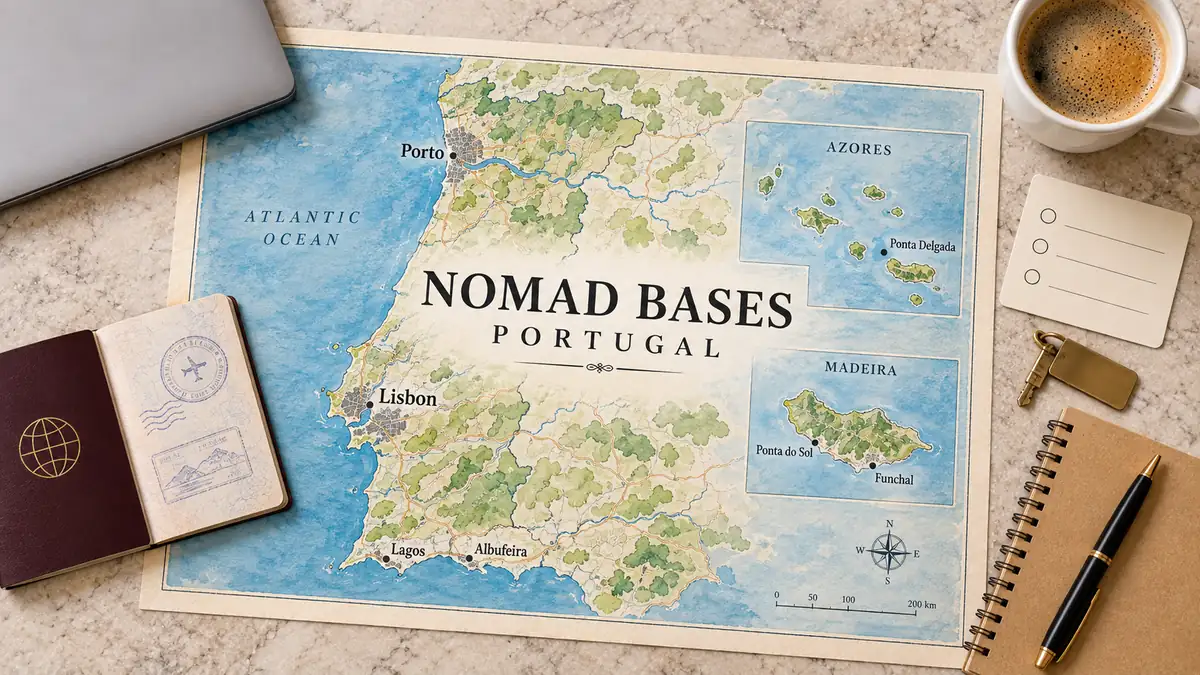
Portugal’s credible nomad bases differ in kind, not just in price. One is a capital with the country’s biggest remote-work scene. Another is a cheaper second city in the rainier north. Then come an Atlantic island with a purpose-built nomad village, a surf town that quietens sharply in winter, and a nature-first archipelago where coworking thins fast. Choosing on cost alone is how remote workers end up in the wrong life — a quiet village when they wanted a network, or a busy capital when they wanted a slower pace.
This guide profiles six bases on the same five criteria: cost direction, internet and coworking, community size, lifestyle and climate, and connectivity. It makes an explicit call on Lisbon versus Porto and another on Madeira versus the Azores. Each base ends with a one-line “Pick this if” verdict, so you can shortlist one or two and move on to the detail.
Quick Answer
Lisbon is the best overall base for most digital nomads in Portugal, with the largest community and densest coworking scene. Porto gives similar infrastructure at a clearly lower cost but a smaller networking circle. For island or beach life, pick Madeira, anchored by the Ponta do Sol nomad village, or surf-town Lagos.
Trust Layer
Tripstou selection guide for travelers choosing between multiple places. Covers selection criteria, traveler fit, and trip value.
Produced with AI assistance and reviewed by Alex Perrut, working in tourism since 2015, for the Tripstou editorial team. See our editorial process for details.
Last factual review: September 11, 2026.
Official sources consulted: Visit Portugal, Turismo de Portugal, Digital Nomads Madeira.
Key Takeaways
- Lisbon has Portugal’s largest nomad community and widest coworking choice, but the highest rents, so it rewards people who use the network.
- Porto delivers nearly the same big-city infrastructure at a clearly lower cost, in exchange for a smaller networking circle and rainier winters.
- For island life, Madeira beats the Azores, because Ponta do Sol’s nomad village adds a free workspace and an organised community.
- Lagos is the Algarve’s nomad base for surf and an outdoor crowd, but judge it by the months you will actually live there.
- Pick the lifestyle type first (city, island or beach town), because it reshapes your week more than switching cities within a group.
- Trial one or two shortlisted bases for a week or two before signing a longer rental, especially seasonal or island bases.
Table of Contents
Which Portuguese City Is Best for Digital Nomads?
Lisbon is the best Portuguese city for most digital nomads because it has the biggest community and coworking density. Porto is the better choice when cost matters more than scene size. Madeira or the Algarve wins when island life or surf outranks networking, since both trade a big-city scene for a slower, outdoor routine.
Six bases made the list, and each earned its place the same way. A base qualified only with working nomad infrastructure — dependable internet, places to work outside your flat, and other remote workers to find — plus a full Tripstou guide behind it. Every pick was then judged on five criteria: cost direction, internet and coworking, community size, lifestyle and climate, and connectivity.
The six fall into three groups, because the real choice comes before the city. Big cities (Lisbon, Porto) sell community and year-round services. Island bases (Madeira, the Azores) sell nature and a slower pace, and they live by their flights. Algarve beach towns (Lagos, Albufeira) sell surf and sun, and they change with the season.
The group you pick matters more than the city inside it. Moving from Lisbon to Porto changes your budget; moving from Lisbon to Lagos changes your whole week.
Labels compare the six bases with each other, not with prices or scenes elsewhere.
| Base | Cost direction | Community size | Coworking scene | Best for |
|---|---|---|---|---|
| Lisbon | Highest on this list, with rents under pressure | The largest nomad community in Portugal | The densest coworking choice in the country | Networkers who want events and scale |
| Porto | Clearly below Lisbon for rent and daily costs | Large, but smaller and quieter than Lisbon | Real coworking choice across the city | Big-city infrastructure on a lower budget |
| Funchal and Ponta do Sol | Below Lisbon; the village desk is free | Small, organised community around the nomad village | Free village workspace plus a city base | Island living with a built-in community |
| Lagos | Seasonal: pricier in summer, calmer off-season | Visible surf-led and outdoor nomad crowd | Small-town choice, fewer options than cities | Surfers and outdoor-first remote workers |
| Ponta Delgada | Below Lisbon; flights add to the bill | Thin and scattered remote-work community | Thin; the archipelago’s only workable hub | Nature-first nomads who want real quiet |
| Albufeira | Seasonal, with crowded and pricier summers | A quieter nomad scene than Lagos | Resort-town services, little nomad-focused space | Sun seekers who want resort-town convenience |
Two questions come before this page: whether Portugal suits you as a nomad at all, and how the visa and tax side works. Both are covered in the Portugal digital nomad guide.
Lisbon Wins on Community, Porto Wins on Cost
Choose Lisbon for Portugal’s largest nomad scene, the most coworking and the busiest events calendar. Choose Porto for nearly the same infrastructure at a clearly lower cost, with a smaller and quieter networking circle. The split is about what you value more: a ready-made crowd, or a lighter monthly bill with room to breathe.
Both cities clear the infrastructure bar, so the choice rests on two variables. Community scale favours Lisbon. Cost favours Porto. The monthly numbers for each — rent, desks and daily spending — sit in the cost of living in Portugal for digital nomads guide.
Porto’s saving starts with the first rent payment, while Lisbon’s network only pays back after weeks of turning up to events. On a stay of a month or less, the Lisbon premium rarely earns itself back.
Lisbon
Lisbon is Portugal’s capital, a coastal city and home to the country’s largest nomad scene. That scene is why it leads this list. Meetups, coworking spaces and people doing similar work are easy to find from the first week, which shortens the lonely stretch every new base begins with.
No other pick matches Lisbon on community density or coworking choice. Porto has a scene; Lisbon has several, so when one crowd doesn’t suit you, another usually will.
The trade-off is cost. Lisbon sits at the top of this page for rent, and its housing market is under real pressure, so good mid-term flats go quickly and cost more than newcomers expect. The busiest central areas also carry the heaviest tourist traffic. None of that breaks the base. It does mean Lisbon pays off for people who actually use the network they are paying for.
Pick this if: you want the biggest community and the widest coworking choice, and you accept Portugal’s highest rents to get them.
The Lisbon guide covers the city in full, from neighbourhoods to getting around.
Porto
Porto is Portugal’s second city, in the north, with real coworking and an established nomad community at a cost that runs clearly below Lisbon. It earns its place by keeping what makes a big-city base work while easing the budget.
It is the only big-city pick where cost and infrastructure both land in your favour. You still get year-round services, an international airport and enough remote workers to build a routine around. The difference is scale, not substance.
Porto asks for two concessions, on crowd and on weather. The networking circle is smaller and quieter, so events are fewer and meeting people takes more effort on your part. Northern winters are also rainier than Lisbon’s, and the damp months are what newcomers underestimate most. For many remote workers, both costs are worth paying.
Pick this if: you want big-city infrastructure and lower living costs more than the largest possible crowd.
The Porto guide covers the city, its districts and getting around.
Madeira Beats the Azores for Island-Based Nomads
Madeira is Portugal’s island pick for digital nomads. Funchal gives you a real city base, and the Ponta do Sol village adds a free workspace and an organised community. The Azores suit nature-first nomads who accept thinner infrastructure outside Ponta Delgada, and they reward quiet more than networking.
Both archipelagos depend on flights, so the island decision turns on what waits for you when you land. Madeira is the only base on this list where the nomad community is organised for you. The Azores leave you to build it. That difference outweighs anything the scenery adds.
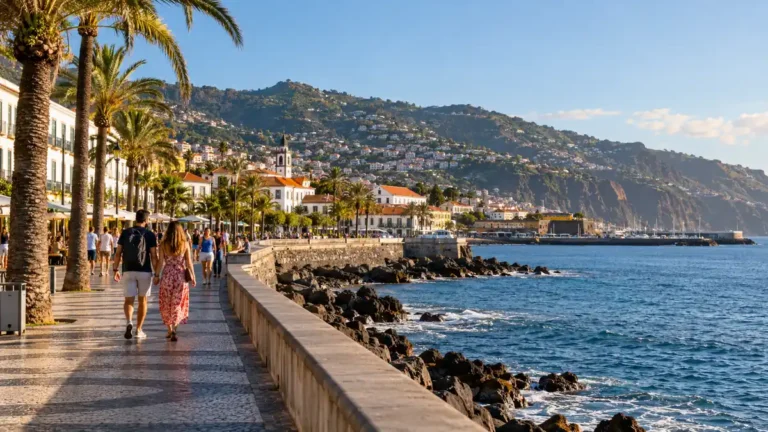
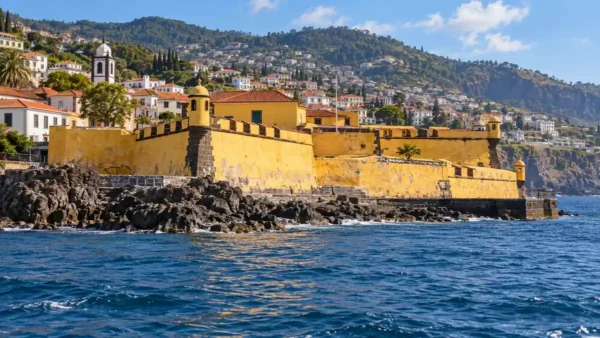
Funchal and Ponta do Sol (Madeira)
Funchal is Madeira’s capital and the practical everyday base, with the island’s widest choice of services and housing. Ponta do Sol is a small village on Madeira’s southwest coast, and it is the reason Madeira made the list: it hosts the government-run Digital Nomad Village.
That programme is something no other pick offers. The village runs a free workspace for nomads, remote workers and locals at the John dos Passos Cultural Centre, open 9 AM–6 PM. Registering gives access to community events and the programme’s Slack group, so the community exists before you arrive.
Island life sets the limits. Everything runs through flights, so trips to the mainland or home take planning and money. The village scene is small by design and can feel repetitive over a long stay. The real choice inside Madeira is simple: Funchal for city services, Ponta do Sol for the village community.
Pick this if: you want island life with a built-in community and don’t need a big-city scene around you.
Full detail on Madeira’s capital sits in the Funchal guide.
Ponta Delgada (Azores)
Ponta Delgada, on São Miguel, is the Azores’ main city and home to the archipelago’s largest airport. It made the list as the one place in the Azores with workable everyday infrastructure for remote work, from services to the islands’ best flight access.
It is the nature-first pick. No base on this page is more remote, and none is less shaped around nomads. The draw is landscape and quiet, with the ocean and a green interior close to town, and a pace that leaves room for both.
Coworking and community are thin, so expect to work mostly from your accommodation and meet people slowly. Every trip to the mainland means a flight, and changeable Atlantic weather can rearrange a week of plans. Beyond Ponta Delgada the infrastructure thins further. For some remote workers, that isolation is the point.
Pick this if: landscape and quiet matter more to you than coworking, community or quick flights to the mainland.
The Azores guide covers São Miguel and the rest of the archipelago.
Lagos Is the Algarve Base, Albufeira the Resort-Town Alternative
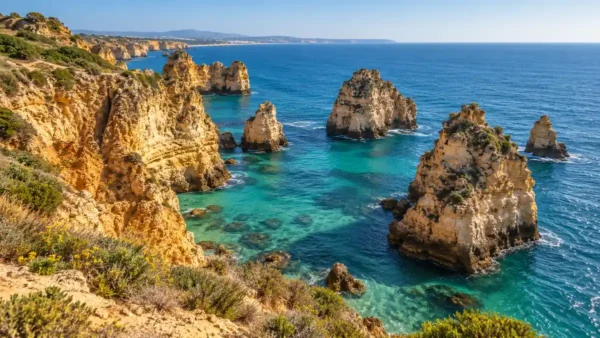
Lagos is the Algarve’s nomad pick, built around surf, beaches and an outdoor community. Albufeira is the bigger resort town, with more tourist services and a quieter nomad scene. Both are seasonal bases: busy and pricier in summer, noticeably calmer off-season, so the month you arrive shapes the base you get.
The Algarve decision turns on the calendar as much as the town. A Lagos summer and a Lagos winter are different bases. For most remote workers, the region works best in the shoulder seasons, between the summer crush and the winter lull, when the beaches clear but the working crowd is still around.
Lagos
Lagos is a western Algarve town known for surf and beaches, with the region’s most visible nomad and outdoor community. That mix put it on the list: it is the Algarve base where you are least likely to work alone.
It is the only pick where the community forms around sport and the outdoors. People meet in the water and on the coastal paths, and work conversations follow from there. For remote workers who find networking events forced, that is the appeal.
Season and size are the catches. Summer brings crowds and higher prices, while the off-season is noticeably quieter and part of the scene moves on. As a small town, Lagos also has less coworking choice than either big city on this page, so confirm your workspace before booking a long stay. Plan around the season first.
Pick this if: surf, sun and an outdoor crowd matter more to you than a year-round city scene.
The Lagos guide covers the town, its beaches and getting around.
Albufeira
Albufeira is a central Algarve resort town with the region’s largest tourist infrastructure. Its case rests on services: shops, restaurants and accommodation choice run at resort scale, which makes daily life quick to set up.
It is the resort-scale alternative to Lagos. Lagos offers a community; Albufeira offers convenience and beaches, for nomads who want those more than a crowd of peers. Its central position also puts the rest of the Algarve coast within reach in both directions.
The trade-offs need saying plainly. Summers are crowded, loud in the busiest areas and built around holidaymakers on a week off. The nomad scene is quieter than in Lagos, and nobody should expect one to find them. Off-season, the town calms down noticeably. Good for focus. Less good for company.
Pick this if: you want Algarve sun with resort-town services and don’t need a nomad crowd around you.
The Albufeira guide covers the town and its stretch of coast in full.
Braga, Coimbra and Ericeira: Cheaper Mainland Bases Worth a Look
The cheapest credible mainland bases for digital nomads sit outside Lisbon and Porto. Braga and Coimbra are university cities with lower living costs than either big city, and Ericeira is a small surf town near Lisbon. All three trade a much smaller nomad scene for lower costs or a quieter pace, which suits self-sufficient workers best.
- Braga — suits remote workers who want a lively northern city at a lower cost than Porto. The trade-off is a small nomad community, so your social life comes from the city itself.
- Coimbra — suits focused workers who like a student-town rhythm. The trade-off is that the university calendar sets the pace, and the town quietens in the academic breaks.
- Ericeira — suits surfers who want Lisbon within reach. The trade-off is a small-town scene with the same busy-summer, quiet-winter swing as the Algarve.
Expect to build your own routine in all three. They work best as a second base, once you know you can work well without a big scene around you.
How Do You Choose Between a City, an Island and a Beach Town?
Choose your lifestyle type first — city scene, island life or surf town — and the base second. Then check the two things that break bases: seasonality, because the Algarve and the Azores change character off-season, and flight dependence, because islands live by their air links. Trial your shortlist with a short stay before signing anything long.
The three lifestyle types break down like this:
- City (Lisbon, Porto) — suits remote workers who want community, services and events in every month. Its defining trade-off is cost, highest in Lisbon, where housing is tightest.
- Island (Madeira, the Azores) — suits those who want nature and a slower pace. Its defining trade-off is access: every trip out is a flight, and the scene is small.
- Beach town (Lagos, Albufeira) — suits surf, sun and outdoor routines. Its defining trade-off is seasonality, with crowded summers and quiet winters.
Seasonality sorts the six into two camps. Lisbon, Porto and Funchal work as year-round bases. Lagos, Albufeira and the Azores need judging by the months you plan to live there, and a summer holiday is the worst guide to a winter lease.
Connectivity is the second check. Mainland bases link to the rest of Portugal by road and rail, and Lisbon and Porto add the widest flight choice. Island bases connect by air alone. If you fly home often or travel for work, that gap compounds every month.
Test before you commit. Book a short stay of a week or two in one or two shortlisted bases, work real days from each, and only then sign a longer rental. A fortnight on the ground shows you what no list can: your actual desk, your actual connection, and whether the local scene is one you will join.
Frequently Asked Questions
Which island in Portugal is best for digital nomads?
Madeira is the best Portuguese island for most digital nomads, because it pairs Funchal’s city services with the Ponta do Sol nomad village. In the Azores, base yourself on São Miguel, near Ponta Delgada. Infrastructure thins further on the smaller Azorean islands, so they suit remote workers who can go without coworking entirely.
Where do most digital nomads live in Portugal?
Most digital nomads in Portugal live in Lisbon, which has the country’s largest remote-work community by a clear margin. Porto comes next, with a large but quieter scene. Outside the two big cities, Madeira stands out, largely because the Ponta do Sol village gives newcomers an organised community from the start.
Where should you base your first month as a digital nomad in Portugal?
A big city makes the easiest first month, and Lisbon is the surest start because its large community cuts the lonely early weeks. Porto works if budget matters more. Save the Azores, the Algarve off-season and the smaller mainland towns for later, once you have a working routine that does not depend on a crowd.
Is the Algarve good for digital nomads in winter?
The Algarve suits winter remote work if you want calm more than company. Off-season the towns are noticeably quieter, prices ease from their summer peak, and part of the nomad scene moves on. Lagos remains the likeliest place to meet other remote workers, while Albufeira is quieter still.
Is the Ponta do Sol coworking space free?
Yes. The Ponta do Sol Digital Nomad Village workspace is free, and it covers the basics: internet and a desk. It sits in the John dos Passos Cultural Centre, open 9 AM–6 PM, and it is shared with remote workers and locals. Registration is encouraged, since it unlocks the programme’s events and Slack group.
Can you split the year between a Portuguese city and an island or beach base?
Yes, and a split plays to each base’s strengths. Use Lisbon or Porto as the year-round anchor for community and flights, then add a stretch in Madeira or the Algarve for island or surf life. Time the Algarve stint for the shoulder seasons, and trial the second base briefly before committing to a lease.
Related Guides
Once a base is on your shortlist, these guides pick up where this page stops — the country-level decision, the monthly budget, and each base in full.
- Portugal digital nomad guide — whether Portugal suits you as a nomad, plus the visa and tax overview.
- Cost of living in Portugal for digital nomads — the monthly budgets and rent detail this page leaves out.
- Lisbon guide — the full city guide behind the best overall pick.
- Porto guide — the northern city behind the best-value big-city pick.
- Funchal guide — Madeira’s capital, the everyday base for the island pick.
- Lagos guide — the western Algarve surf town in full.
- Azores guide — São Miguel and the wider archipelago for nature-first nomads.
- Albufeira guide — the central Algarve resort town and its coast.
Did this guide save you time or money? Tripstou is independent and reader-funded — if you'd like to give something back, you can support the site with a crypto contribution of any size.