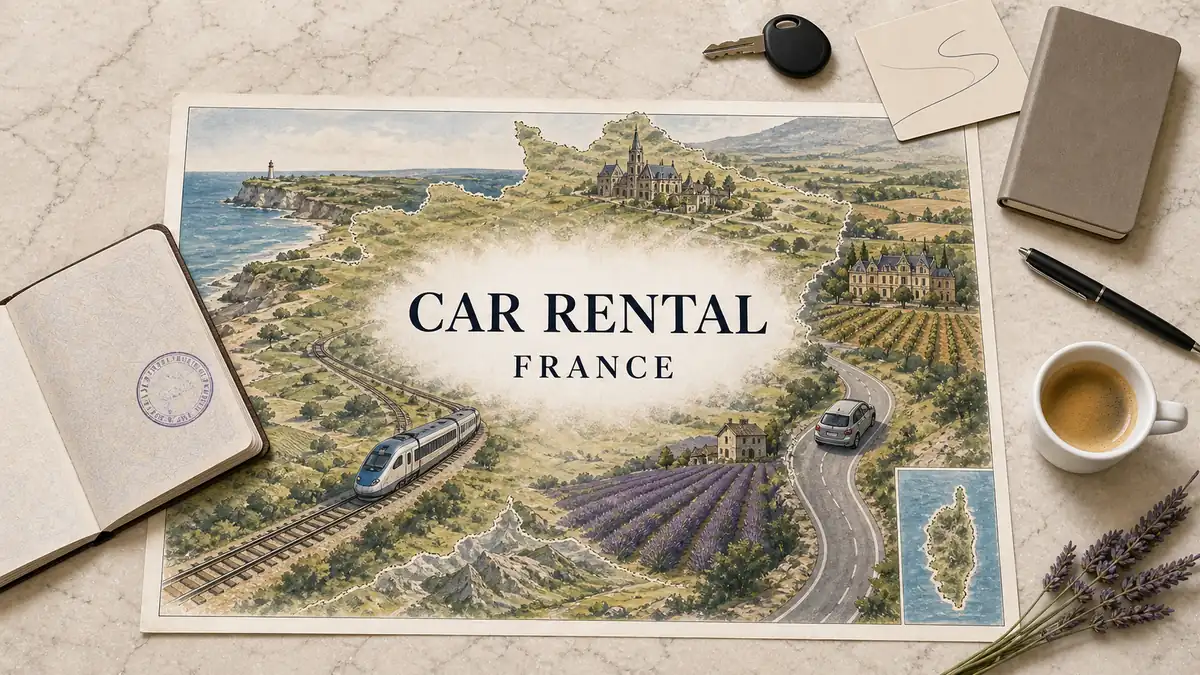
Every guide to renting a car in France asks whether you should rent one, then quietly assumes the answer is yes. This page treats “no” as a legitimate outcome, because for a large share of French trips it is the right one. France runs one of the best rail networks in Europe and holds some of the most rewarding backroads on the continent, and those two facts pull in opposite directions depending on how your trip is shaped.
What follows resolves three things: whether your trip needs a car at all, what renting one actually requires at the counter and on the road, and how the money works once tolls, insurance and one-way fees are added to the day rate. It also covers the rules that catch foreign drivers out — the permit question, the low-emission zones, the péage system.
You should finish with either a booking plan or a better alternative.
Quick Answer
You don’t need a rental car for city-to-city France — you need one when the trip turns rural. Trip shape decides it: TGV corridors make a car a liability; backroad regions make it essential. The strongest pattern is train between cities, then rent locally, with a credit card in the driver’s name.
Trust Layer
Tripstou planning guide for travelers resolving one travel decision. Covers the main variable, traveler context, and practical tradeoffs.
Produced with AI assistance and reviewed by Alex Perrut, working in tourism since 2015, for the Tripstou editorial team. See our editorial process for details.
Last factual review: August 24, 2026.
Official sources consulted: France.fr, Atout France.
Key Takeaways
- France’s high-speed rail beats a rental between cities, so count the idle city days before you count the driving days.
- Trip shape decides the rental, not preference: corridor itineraries punish drivers, while dispersed regions like Corsica make a car unavoidable.
- The hybrid pattern wins most trips: take the train between cities, then rent locally for the days that leave the network.
- Book with a credit card in the main driver’s name; a debit card in the same name will not release the car.
- Carrying an international driving permit is cheap insurance against a rental desk that demands one as its own company policy.
- Confirm your rental carries a Crit’Air sticker before driving into Paris, Lyon or Grenoble, and check the current zone rules.
Table of Contents
Do You Need a Car in France at All?
For a trip built around Paris and other major cities, no — the train is faster, cheaper and less stressful. A car earns its cost only when your days move away from railway lines. Trip shape decides this. Corridor travel punishes drivers; rural travel punishes everyone else.
The case against renting is stronger than most travelers realise, because the costs arrive in pieces. The day rate is the part you see when you book. Parking in a French city is the part you discover afterwards: secure garages charge by the night in every centre worth staying in, and street parking in the places you actually want to sleep is either metered, permit-only or already occupied. A car parked in Lyon for three nights is a hotel room for a vehicle.
Then there is what the car does to the days themselves. Inside a city it is worse than useless — one-way systems, restricted centres, pedestrianised cores, and a constant background calculation about where the thing is and what it is costing. Nobody drives to a museum in Bordeaux. The rental sits still while you walk, and it charges you for sitting still.
Count the days the car will sit idle before you count the days you will drive it. A fortnight’s rental with four city nights in the middle is paying full rate for a vehicle that never leaves a car park. That one calculation flips more trips to the train than any argument about fuel or tolls.
The input that decides the whole question is the shape of the trip, which is why it is worth settling your route length and structure first — our France itinerary planning guide works through how many regions a given number of days can absorb. If you are still choosing between regions and travel styles altogether, start from the complete France travel guide and come back once the shape is clear. Group size shifts the maths too: four adults sharing one car change the comparison against four rail fares, though parking and tolls claw some of that back.
Car or Train in France: Which Should You Choose?
The train wins between cities; the car wins once your days are rural. Most good French trips use both. France’s high-speed network connects the major cities faster than any motorway drive, while the countryside beyond the stations only opens up on four wheels.
On the main corridors the comparison is not close. Rail links Paris to Lyon, Bordeaux, Marseille and Lille at speeds a motorway cannot approach, and it delivers you into the city centre instead of a ring road. Driving the same corridor costs you tolls, fuel, a parking problem at both ends and several hours you could have spent reading. A car on a city-to-city itinerary is an expensive way to arrive late.
The hybrid pattern is the answer for most itineraries, and it is no compromise. Take the train between cities, then rent a car for the specific stretch of the trip that leaves the network — a week in Provence, four days in the Dordogne, a Normandy loop. The rental clock only runs on the days the car is working.
That is the real mechanism behind the hybrid: rentals charge by the day whether or not you move, while the train charges by the journey. Every idle city day you cut out of the rental period is a day you stop paying for a parked car.
| Trip shape | Better choice | Why it wins | The tradeoff |
|---|---|---|---|
| City-hopping between the major cities | Train, with no real contest | High-speed lines beat motorway driving door to door | You give up spontaneous stops between cities |
| One rural region from a single base | Rental car for the whole stay | Villages and sights sit well off any bus route | Parking and narrow lanes take daily patience |
| Wine country tasting days | Rental car, with a sober plan | Domaines are scattered down unmarked country lanes | Someone in the group stays sober all day |
| Corsica from start to finish | Rental car, effectively mandatory | Public transport reaches very little of the island | Mountain roads are slow and demanding to drive |
| Mixed cities and countryside | Both, train then rental car | Train between cities, rent only for the rural leg | A one-way fee if you drop in another region |
If the table pushes you towards rail, that decision is fully resolved elsewhere: our guide to travelling France by train covers the network, the booking logic, passes and how to build a rail-based route. Everything about riding the trains lives there. This page stops at the point where the driving starts.
Train and bus tickets
Compare routes, schedules and prices across rail and bus operators in one search, with mobile tickets on your phone.
New to Omio? Code NEW10 takes 10% off your first booking — or APPNEW10 if you book inside the Omio app. Both apply to bookings up to €80.
Search routes and compare prices on Omio →
Tripstou may earn a commission if you book through this link, at no extra cost to you.
Which Parts of France Are Worth Renting a Car For?
A car pays off where France disperses — Provence’s backroads, Normandy’s scattered sites, and above all Corsica. These are places where the sights sit between the villages instead of inside them. Cities never reward a rental. If your list is museums and neighbourhoods, the car is dead weight.
Three regional characters make the strongest case. Provence is a landscape of small hill villages, markets and lavender country connected by minor roads, and the gaps between them are the point of going. Normandy spreads its landing beaches, cemeteries, abbeys and cliff towns across a wide coastal band with no single transport spine, so a driver sees in one day what a non-driver sees in three. Corsica is the clearest case in the country: the island’s mountain interior, coves and coastal roads are effectively unreachable without a vehicle.
Corsica is the one place in France where skipping the car changes what you can see, not merely how comfortably you see it. Elsewhere the car buys convenience and range. There it buys access.
Wine country belongs on this list too, with a complication serious enough to need its own section below. Beyond the three regions above, the same test holds wherever the appeal is dispersed — river valleys, mountain foothills, coastlines with no rail line behind them. For a wider view of which parts of the country are worth building a trip around, the guide to the best places to visit in France shows where a car unlocks access and where it adds nothing.
Once you have decided to rent, the routes, pacing and region sequencing are a separate problem — that is what our France road trip guide is for. This page settles whether to drive and what driving demands of you; that one settles where to point the car.
Wine Country by Car: Rural Access and the Tasting Tradeoff
Wine regions are the strongest case for a car and the worst place to drink and drive. Domaines sit down unmarked lanes with no bus route, so access is a driving problem. France’s drink-driving limit is materially lower than the UK’s and the US’s, so the driver tastes differently from everyone else.
Travelers resolve this in four ways, and all of them work. A designated driver rotates through the group by day. Spitting at tastings is normal, expected and mildly encouraged by the producers themselves — nobody at a serious domaine is offended by a spittoon in use. Basing overnight in a wine village puts several producers within walking or short-taxi distance of your bed. And guided tasting transport, booked locally for a single day, removes the problem entirely for the one day you most want it gone.
Design the wine days around where you sleep. A producer you can reach on foot or by a five-minute taxi at the end of the afternoon is worth more to the day than a better-known estate an hour’s drive back down a dark country road.
Choosing which wine region to visit is a different decision, resolved in our guide to France’s wine regions — that page picks the region, this one tells you what driving it involves. How much driving each region demands does vary: Champagne‘s houses sit relatively close together, Burgundy‘s estates line up along a narrow strip, and the Rhône Valley spreads its producers along a much longer corridor. That difference decides how many tastings a single day can realistically hold.
What Do You Need to Rent a Car in France?
A valid driving licence, your passport, and a credit card in the main driver’s name. The card rule is the one that strands people: the deposit must go on a credit card belonging to the person named on the contract, and a debit card in the same name does not substitute.
What the rental desk will ask for:
- A valid driving licence held by the person collecting the car
- A passport or national ID card for identification
- A credit card in the main driver’s name, for the security deposit
- The booking reference, and the names of any additional drivers
Age is set by the rental company, not by a national rule. Most agencies open at 21, a good number hold the line at 25, and several also require the licence to have been held for at least a year. Drivers under the company’s standard threshold are usually accepted with a young-driver surcharge applied per day, and some vehicle categories stay closed to them entirely. Check the specific supplier’s terms before booking rather than assuming a country-wide minimum, because there isn’t one.
What must be in the car while you drive:
- Your driving licence, on your person
- Your passport or ID card
- The vehicle’s insurance certificate, supplied by the rental company
- The carte grise, the vehicle registration document
The rental company provides the last two — check they are in the glovebox before you leave the depot, because a roadside check that finds them missing becomes your problem. Everything else about preparing for France, from entry practicalities to phone and data setup, sits in our France travel tips; this page stays strictly with the vehicle.
Do You Need an International Driving Permit for France?
An IDP is worth carrying even where guidance says you can drive without one. It translates your licence into a standard format; it does not replace it, and it costs little. Rental desks can demand one as their own company policy, and a booking refused at the counter costs far more than the permit.
Two firm points are worth stating plainly. UK photocard licences are accepted in France, and holders are not expected to produce an IDP alongside them; older UK paper licences sit differently and may need upgrading or a permit. France’s official tourism information states that visitors from the United States can drive on a valid US licence for stays of under 90 days.
Neither of those positions binds a rental company. The counter clerk applies whatever the supplier’s terms say, and some suppliers list an IDP as a requirement for licences issued outside the EU regardless of what the tourism guidance states. That is where the permit earns its keep — it settles an argument you cannot win at eight in the morning with a queue behind you.
It does the same job at a roadside stop, where an officer reading an unfamiliar alphabet gets a document laid out in a format they recognise. The permit is cheap, issued quickly by motoring organisations and post offices in most countries, and valid for a limited period. Weigh that against being turned away from a booked car in a town you have no other way of leaving.
How Much Does It Cost to Rent a Car in France?
The day rate is only the entry fee. Season, transmission, pickup point and one-way fees decide what you actually pay, and summer in the south is the most expensive combination of all. Tolls and fuel then land on top as separate lines, and long motorway days make both significant.
The drivers that move the number:
- Season. July and August peak everywhere, and coastal and Provençal depots peak hardest. Shoulder months are materially cheaper for the same car.
- Transmission. Manuals dominate the French fleet. Automatics are scarcer, carry a premium and sell out early in peak months.
- Pickup location. Airport desks add surcharges that city and station depots often don’t. Small-town depots are cheapest and have the least choice.
- One-way fees. Collecting in one region and dropping in another triggers a repositioning charge, sometimes a large one.
- Driver age. A young-driver surcharge applies below the supplier’s threshold, billed per day across the whole rental.
- Extras. Additional drivers, child seats, GPS units and cross-border permissions are all billed separately.
One-way fees are the cost travelers price last. Before accepting a one-way quote, price the same car with a matching pickup and dropoff — the gap between the two is the fee, and it is far easier to design around than to negotiate down.
Fuel and tolls belong in the budget from the start, because on a long motorway day they can rival the rental itself. Neither is optional on a serious drive. To see where the rental sits against the rest of your spending — accommodation, food, transport, activities — our France travel budget guide puts the whole trip in one frame. Book automatics as early as you can, because in peak months the ones at sensible rates disappear long before the manuals do.
Do You Need Extra Insurance for a Rental Car in France?
Basic cover is included in every French rental, so the real decision is the excess. The excess is what you owe out of your own pocket before the insurance pays anything, and on a standard contract it is high enough to hurt. You have three ways to handle it.
The first is to accept it. The deposit is blocked on your credit card, you drive carefully, and nothing happens — which is what usually happens. The second is to buy the desk’s excess reduction, which is convenient, immediate and the most expensive route by some distance, because it is sold at the counter to people who are already anxious. The third is to buy standalone excess insurance from an independent insurer before you travel, typically as an annual policy; you still pay the rental company if something goes wrong, then reclaim it.
Check what your credit card already covers before you decide any of this. Several travel and premium cards include rental excess cover as a benefit, with conditions attached — the rental must usually be paid in full on that card, and certain vehicle classes are excluded. Read the benefit terms while you are still at home. The desk is a bad place to discover you were already covered, and a worse place to discover you weren’t.
Contract Checks Before You Drive Away
Five minutes in the depot car park prevents most rental disputes. Before you leave:
- Photograph and film the whole car — all four sides, the roof, wheels, windscreen and the interior
- Get every existing scratch, dent and chip marked on the checkout sheet in writing, signed by staff
- Confirm the fuel policy, and photograph the fuel gauge and the odometer
- Check that additional drivers are listed on the contract, and what each one costs
- Confirm the mileage allowance and whether it is capped
- Repeat the photographs at dropoff, especially if you return the car outside opening hours
Keep the rental company’s assistance number with you, and know that breakdowns and accidents follow a specific procedure in France — our France safety guide covers roadside and emergency handling.
How Do French Motorway Tolls Work?
Take a ticket when you enter the motorway, pay when you exit — French tolls charge by the distance you drive. Payment is made at the péage barrier by cash, card or contactless. On long motorway days the toll total becomes a real budget line, not a rounding error.
The mechanism is simple once you have done it once. You pull into a lane at the entry barrier, take the ticket the machine issues, and keep it somewhere you can reach without unbuckling. At the exit you hand it over or feed it into the machine, which calculates the charge for the distance travelled and takes payment. Lanes are signed by payment type, and the ones marked with an orange “t” are reserved for electronic badge holders — those will not serve you.
Payment options at a staffed or automated péage:
- Cash, at lanes marked with coins and notes
- Chip-and-PIN bank cards, at most automated lanes
- Contactless cards and phones, at lanes showing the contactless symbol
- An electronic toll badge, if the rental includes one — check at pickup
Free-flow tolling is where foreign drivers get caught. On a growing number of motorway sections there are no barriers at all: cameras read the plate, nothing stops you, nothing prompts you, and the obligation to pay only surfaces afterwards. Payment is made online or at a licensed retailer within a set window after the journey, and missing that window turns a small toll into a penalty. If you drive a free-flow section in a rental, settle it the same evening and confirm with the rental company that nothing is outstanding.
Toll-free national roads run parallel to most motorways and trade money for time — they are slower, pass through towns and add hours across a long day. For the exact cost of a specific route, use the motorway operator’s official route planner, which prices tolls and fuel for the journey you are actually driving.
Do You Need a Crit’Air Sticker to Drive in France?
Yes, inside a low-emission zone — and the requirement applies even to vehicles just passing through. A Crit’Air sticker classifies a vehicle by its emissions and must be displayed on the windscreen to enter one of these zones. Foreign-registered cars are covered by the same rule.
Low-emission zones — zones à faibles émissions, or ZFE — restrict which vehicle classes may enter a defined urban area, with the sticker’s colour and number determining access. Paris, Lyon and Grenoble operate the established ones. A fine applies for entering a zone without a valid sticker, and driving through on the way to somewhere else is not an exemption.
For a rental this is mostly a pickup-desk question. French rental fleets are modern and generally carry a sticker already, but the sticker belongs to the individual vehicle, so confirm it is on the windscreen before you drive off and ask which class it is if you plan to enter a city centre. A car with no sticker cannot be made compliant in an afternoon — the application goes through an official service and the sticker arrives by post.
Which cities operate a zone, and which vehicle classes they admit, has changed more than once. Check the official Crit’Air service for the specific city before you drive into its centre, and treat the answer as current for that trip only.
Can You Drive into Central Paris?
Central Paris is a low-emission zone, so a rental needs a valid sticker of an admitted class to enter it. The better answer is that you should not want to. Driving in central Paris is the worst possible use of a rental car — the traffic is punishing, the restricted and pedestrianised streets multiply, and parking is expensive where it exists at all. Leave the car outside the city, or better, don’t have one while you’re there.
Where Should You Pick Up a Rental Car in France?
Not in Paris. Take the train to the city where your rural driving actually starts and collect the car there. A Paris pickup means paying to store a vehicle you cannot use, then driving out through the country’s hardest traffic and its low-emission zone on day one.
The execution is straightforward. Spend your Paris days without a car, take the high-speed train to Avignon, Bordeaux, Rennes, Nice or wherever the countryside portion begins, and collect the rental at the station depot on arrival. Station depots are usually a short walk from the platform, and you start driving on regional roads instead of a périphérique. The rental period then covers only the days the car is doing work.
The same logic applies to dropoff. Return the car at a station in the last region you drive, then take the train back to your departure city rather than driving a rental into an airport you are not flying from that morning. If your pickup and dropoff points sit in different regions, expect a one-way fee — it is often worth paying, because it can save two days of backtracking, but price it before you commit to the shape.
Airport pickups are the exception worth making when you land directly into the region you intend to drive. Flying into Nice or Toulouse and starting the drive from the terminal makes sense; flying into Paris and driving south does not. Check depot opening hours before booking a late arrival, because smaller station depots close in the evening and on Sundays, and an out-of-hours pickup is not always offered.
Frequently Asked Questions
Is it hard to drive in France?
No — French roads are well surfaced, clearly signposted and straightforward once you adjust to driving on the right. The hard parts are city centres and narrow rural lanes, not the open road. Speed limits drop through towns and in wet weather, and they are posted, so read the signs instead of assuming a national number.
Should you rent an automatic or a manual car in France?
Take the manual if you drive one confidently — it is cheaper, and the French fleet is built around it. Choose an automatic if you are rusty, because hill starts on narrow village lanes are a poor place to relearn. Automatics are scarce, so book yours well ahead.
How does parking work in French towns?
Most town parking is either paid or disc-controlled. In a paid zone you buy time at a machine and display the ticket. In a blue zone you set a cardboard disc to your arrival time for free limited-stay parking. Underground car parks handle longer stays in city centres.
Can you take a French rental car to another country?
Sometimes, but only if the contract allows it. Cross-border travel is governed by the rental company’s terms, and some restrict which countries you may enter or charge a fee for the permission. Declare your plans when booking and get the authorisation in writing before you collect the car.
Do you need winter tyres to drive in France?
In mountain regions, yes — winter tyres or snow chains are required there through the winter period. Elsewhere in the country they are not. The list of areas covered has been revised since the rule came in, so confirm which départements apply when you book a winter mountain rental.
What is the drink-driving limit in France?
Lower than the limits in the UK and the United States — meaningfully so, which is why a glass that would be legal at home may not be here. Renting a car changes nothing about how the limit applies to you, and visitors who calibrate by their own country’s rule are the ones caught out.
Related Guides
- The best time to visit France — how season moves rental pricing, mountain driving conditions and road traffic.
- Planning a France road trip — routes, pacing and region sequencing once the car is booked.
- France by train — the network, booking and rail-based routes for travelers skipping the car.
- France itinerary planning — how many days and regions your trip can realistically hold.
- France’s wine regions — choosing which wine country to visit before you plan the driving.
- French food and regional specialities — what to eat in each region you drive through.
Did this guide save you time or money? Tripstou is independent and reader-funded — if you'd like to give something back, you can support the site with a crypto contribution of any size.