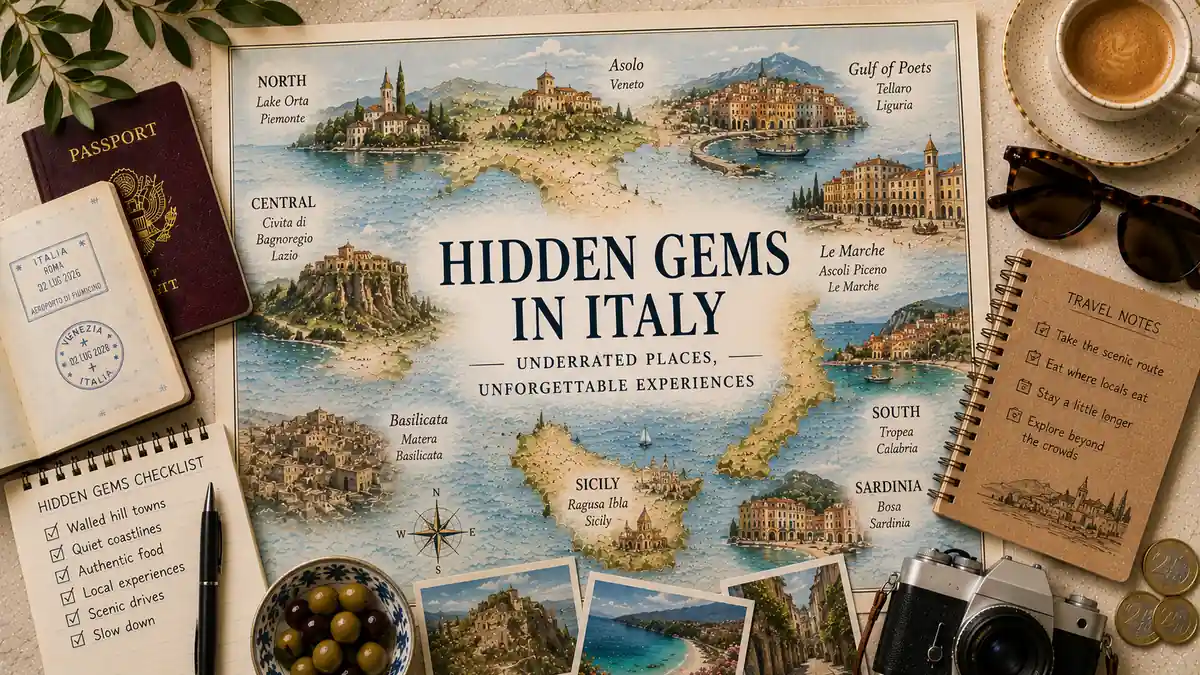
The famous Italian circuit runs on repeat: Rome, Florence, Venice, the Amalfi Coast, Cinque Terre. It is crowded, expensive, and increasingly hard to enjoy in peak months. Yet Italy hides a second country of walled medieval towns, cliff-top villages, and whole regions that most visitors never reach. These are the places where a piazza still belongs to locals, where a coastline has no cruise terminal, and where a detour of an hour or two changes an entire trip.
This is a curated shortlist of genuinely under-visited Italian destinations, grouped by area so you can pick by the region you are near. Each pick comes with why it is underrated, who it suits, and a route into deeper region coverage. No headline sights, no recycled lists — just the quieter Italy worth going out of your way for.
Quick Answer
Italy’s best hidden gems are walled hill towns, quiet coastal villages, and under-visited regions far from the famous circuit. They group by area — north, central, south, and islands — so pick by the region you are nearest. They suit travelers escaping the Rome–Florence–Venice crowds who value atmosphere over headline sights; go deeper through the region guides.
Trust Layer
Tripstou selection guide for travelers choosing between multiple places. Covers selection criteria, traveler fit, and trip value.
Produced with AI assistance and reviewed by Alex Perrut, working in tourism since 2015, for the Tripstou editorial team. See our editorial process for details.
Last factual review: September 4, 2026.
Official sources consulted: Italia.it, ENIT, Casa Civita Bagnoregio, Ferrovie Appulo Lucane.
Key Takeaways
- Group your picks by area — north, central, south, and islands — so a hidden gem fits wherever you already plan to be.
- For a standout each way, choose Lake Orta in the north, Tropea in the south, and Ragusa Ibla among the islands.
- Use substitution to beat crowds: swap Cinque Terre for the Gulf of Poets, or Venice for the working canals of Chioggia.
- Reachability is the main tradeoff: trains reach the main towns, but a car unlocks the coast, countryside, and quiet islands.
- For a whole slow trip instead of single towns, Le Marche suits first-timers while Basilicata rewards bolder, landscape-driven travelers.
- Treat this page as a launchpad — each regional pick opens into a deeper child guide for Tuscany, Puglia, Sicily, and more.
Table of Contents
The Most Underrated Towns and Villages in Italy
A genuine Italian hidden gem is an under-visited town or village, not a famous city or an in-city corner. It stays off the standard listicle, keeps its everyday rhythm, and rewards a detour with atmosphere instead of queues. The shortlist below spreads across every region, from Alpine walled towns to sun-baked southern hamlets.
Qualifying is stricter than “pretty and slightly quieter than Rome.” A real gem still sees mostly Italian visitors, holds a defining feature you cannot photograph anywhere else, and has not yet been packaged into a day-trip machine. That filter cuts most of the internet’s recycled hidden-gems lists in half.
These names recur through the sections below as representative picks, each opening into a fuller region guide:
- Civita di Bagnoregio (Lazio) — a tufa hilltop town reached only by a pedestrian footbridge, slowly eroding on its ridge; the footbridge charges a €5 entry ticket, and the Cotral bus from Orvieto, itself a direct Trenitalia regionale from Rome, is the way in without a car.
- Matera (Basilicata) — ancient sassi cave dwellings carved into a ravine, a UNESCO World Heritage Site.
- Ascoli Piceno (Marche) — a travertine-stone city built around grand, café-lined Renaissance piazzas.
- Bosa (Sardinia) — pastel houses climbing a hill above the Temo, one of the island’s few navigable rivers.
- Locorotondo (Puglia) — a circular whitewashed town crowning the Valle d’Itria.
Use the geographic sections to shortlist by where you already plan to be. The famous-versus-hidden logic then does the rest.
Hidden Gems in Northern Italy
Northern Italy’s quietest gems include Lake Orta in Piedmont and the walled town of Glorenza in the Alps. They deliver Alpine and lakeside beauty that rivals the headliners without the summer crush. Each one keeps a slow, local pace, and most sit within easy reach of a major northern city.
Lake Orta (Piedmont) is the north’s antidote to Lake Como. A small, cypress-lined lake with the tiny island of San Giulio at its heart, it has the same mirror-still water and none of the celebrity-villa traffic. Lake Orta stays quiet not because it is less beautiful, but because it lacks a famous name to draw the crowds.
Glorenza (Glurns) in South Tyrol is one of the smallest walled towns in the Alps, its medieval ramparts and arcaded streets intact near the Swiss and Austrian borders. It pairs naturally with the wider mountains: for the valleys most day-trippers miss, follow the lesser-known Dolomites valleys.
Liguria hides its own quiet coast. The Gulf of Poets villages of Tellaro and Portovenere offer the same pastel-cliff drama as their world-famous neighbor with a fraction of the foot traffic — see the quieter alternatives to Cinque Terre. And around Como itself, the side branches and hill villages stay calm even in August; the hidden corners of Lake Como cover where to look. Most of these sit on regional rail or a short drive from a hub — Portovenere is an ATC bus ride from La Spezia Centrale, the same station the Cinque Terre trains run through — so a car helps but is not essential.
Hidden Gems in Central Italy
Central Italy’s standout hidden gem is Pitigliano, a Tuscan town carved from volcanic tufa cliffs. The center rewards travelers who want Tuscan and Umbrian hill country without San Gimignano’s tour-bus queues. Its villages sit close together, so a single base opens several in a day.
Pitigliano rises straight out of a tufa outcrop in southern Tuscany, its houses seeming to grow from the rock. Long home to a Jewish community, it earned the nickname “Little Jerusalem” and still keeps a synagogue cut into the cliff. It anchors a whole cluster of off-radar towns; the off-radar corners of Tuscany go deeper on this quieter southern half of the region.
Umbria carries the theme inland. Spello wraps Roman gateways in flower-draped medieval lanes and stays calm while nearby Assisi fills with pilgrims. Higher up, the Castelluccio plateau above Norcia turns to a broad wildflower bloom in early summer — a landscape few foreign visitors ever plan around. This is slow-travel country. One agriturismo base and a car unlock the lot.
Hidden Gems in Southern Italy
Southern Italy’s best hidden gem is Tropea, a cliff-top town above a turquoise Calabrian bay. The south is the strongest value on the hidden axis: dramatic coastlines and whitewashed towns still see few foreign visitors. It suits travelers happy to trade convenience for atmosphere.
Tropea perches on a sandstone bluff over some of Italy’s clearest water, with a clifftop old town and a sanctuary on its own rock offshore. It headlines a coast that stays local well into the season. Matera, inland in Basilicata, remains the south’s most cinematic town — its cave-dwelling sassi districts feel carved from another millennium.
The south’s hidden coast delivers the best value on this whole list: a cliff-top sea view in Calabria or the Cilento costs a fraction of the same view on the famous stretch further north. In Campania, the wild Cilento coast trades resorts for Greek temples and empty coves — see the hidden side of the Amalfi Coast. And Puglia’s Valle d’Itria towns, from Locorotondo to Ostuni, deliver whitewashed skylines and trulli by the thousand; the hidden gems across Puglia map the region in full. Reachability is the tradeoff: trains reach the main towns — Matera on the Ferrovie Appulo Lucane line from Bari, a separate operator from the national network — but a car opens the coast and countryside.
Italy’s Islands Beyond the Crowds
Italy’s best island gem beyond the crowds is Ragusa Ibla, a Baroque town in interior Sicily. The islands hide far more than their postcard hotspots, from inland Sicilian towns to Sardinia’s quiet west coast. These spots suit travelers who want island character without resort density.
Ragusa Ibla anchors the Val di Noto, a cluster of golden-stone Baroque towns rebuilt after a historic earthquake and collectively UNESCO-listed. Inland Sicily — Ragusa, Modica, Scicli — stays refreshingly local while the coast fills up. For the full inland-and-coast picture, follow under-visited Sicily.
Sardinia hides its best on the west: Bosa’s river-town color and the wild Sinis peninsula sit far from the Costa Smeralda’s yacht set. The quiet corners of Sardinia cover where the island stays real. For a smaller quiet island, Salina in the Aeolians is the green, vineyard-covered antidote to its flashier neighbors — the same volcanic drama, a slower pulse. Ferries reach all of these — Salina by Liberty Lines hydrofoil from Milazzo — though inland Sicily and western Sardinia are easiest with a car.
Which Italian Regions Are Most Underrated for a Whole Trip
Le Marche and Basilicata are Italy’s most underrated regions for a full trip. Both reward a slow week or more, with hill towns, coastline, and food scenes that rival better-known regions. Le Marche suits first-time explorers; Basilicata suits travelers chasing raw, uncrowded landscapes.
Le Marche, on the Adriatic side, folds Renaissance towns like Urbino and Ascoli Piceno into rolling hills that drop to quiet beaches. It works as a whole-trip base precisely because it has no single blockbuster sight — that absence is what keeps its towns and shoreline uncrowded. It suits travelers who want variety without a rigid must-see checklist.
Basilicata is for a bolder trip. Beyond Matera, it runs from mountain wilderness to two separate coastlines, including the cliff-backed town of Maratea on the Tyrrhenian. Distances are longer and a car is close to essential, but the payoff is a region still largely off the international map. Either region rewards depth over speed — treat these as slow bases, and let the region guides handle the sequencing.
Crowd-Free Alternatives to Italy’s Famous Destinations
Skip the Cinque Terre crush and head to the Gulf of Poets villages of Tellaro and Portovenere instead. The smartest hidden-gem strategy is substitution: match each crowded headliner to a quieter place that shares its defining feature. You keep the scenery and lose the queues.
A swap only works when the alternative carries the headliner’s defining feature. Chioggia stands in for Venice because it has genuine working canals, the one thing crowds actually cross the lagoon to see. The famous destinations below appear as anchors only — for their full coverage, see Italy’s famous headline destinations.
| Famous headliner | Hidden alternative | Region | Why the swap works |
|---|---|---|---|
| Cinque Terre | Tellaro & the Gulf of Poets | Liguria | Same pastel-cliff coastline, a fraction of the day-trippers |
| Amalfi Coast | Cilento coast | Campania | Wild shoreline and Greek ruins without the coast-road traffic |
| Venice | Chioggia | Veneto | Real canals and fishing lanes with an everyday local feel |
| Tuscan hill towns | Pitigliano & Le Marche | Tuscany / Marche | Medieval skylines minus the tour-bus queues |
| Lake Como | Lake Orta | Piedmont | A serene island lake without the celebrity crowds |
Use the table as a planning shortcut: anchor your trip on the feature you actually want — canals, cliffs, hill towns, a quiet lake — and the quieter address follows.
Frequently Asked Questions
What is the most underrated city in Italy?
Ascoli Piceno is Italy’s most underrated city, a travertine-stone gem in Le Marche built around grand, café-lined Renaissance piazzas. It delivers the architecture and everyday café culture travelers cross the country for, yet still sees mostly Italian visitors. Matera in Basilicata runs a close second for sheer drama.
Where do Italians go on vacation to avoid tourists?
Italians escape to their own under-the-radar corners, far from the international circuit. Favorites include Calabria’s Tropea coast, Sardinia’s wild west around Bosa, the Cilento shore below the Amalfi crowds, and inland Puglia’s Valle d’Itria. These stay local largely because none holds a single blockbuster sight.
Can you reach Italy’s hidden gems without a car?
Yes, for many of them, though a car widens your options considerably. Regional trains and ferries reach most of the main towns and island hubs, but the quiet coastlines, countryside villages, and inland clusters are far easier with your own wheels. Base yourself on the rail network, then rent for detours.
Which Italian town is like Venice or Cinque Terre without the crowds?
Swap Venice for Chioggia in the Veneto, a working lagoon town of real canals and fishing lanes. For a Cinque Terre substitute, the Gulf of Poets villages of Tellaro and Portovenere in Liguria share the same pastel-cliff coastline with a fraction of the day-trippers.
Are Italy’s hidden gems worth it compared to Rome, Florence, and Venice?
For most repeat or crowd-weary travelers, yes — the hidden gems trade blockbuster monuments for atmosphere, space, and lower costs. First-time visitors may still want the famous trio for the landmark sights, then divert for balance. The two aren’t rivals; pair a headline city with a quieter detour nearby.
When should you visit Italy’s hidden gems to avoid the crowds?
Late spring and early autumn are the sweet spots, with warm weather, thinner crowds, and everything open. Even in July and August, these under-visited towns stay calmer than the famous circuit, though the south and islands run hot. For detailed timing by region, see the Italy guide.
Related Guides
Use these guides to turn a shortlist into a trip — go deeper on a region, plan the practical side, or find what to do once you arrive.
- Complete Italy travel guide — planning, timing, and how the regions fit together.
- Things to do across Italy — experiences and activities to build around your picks.
- Off-radar corners of Tuscany — the quieter southern and inland half of the region.
- Hidden gems across Puglia — the Valle d’Itria, the coast, and beyond.
- Under-visited Sicily — inland Baroque towns and quiet shores.
- Quiet corners of Sardinia — the west coast and the real island interior.
- Lesser-known Dolomites valleys — Alpine towns beyond the busy passes.
- Hidden side of the Amalfi Coast — the wilder, quieter Campanian shoreline.
Did this guide save you time or money? Tripstou is independent and reader-funded — if you'd like to give something back, you can support the site with a crypto contribution of any size.